When Should a Timing Belt Be Replaced? What Happens If It Breaks?
Does your truck even have a timing belt? Compare belt, chain and gear-train timing, replacement intervals, failure signs and what breaking one really costs.
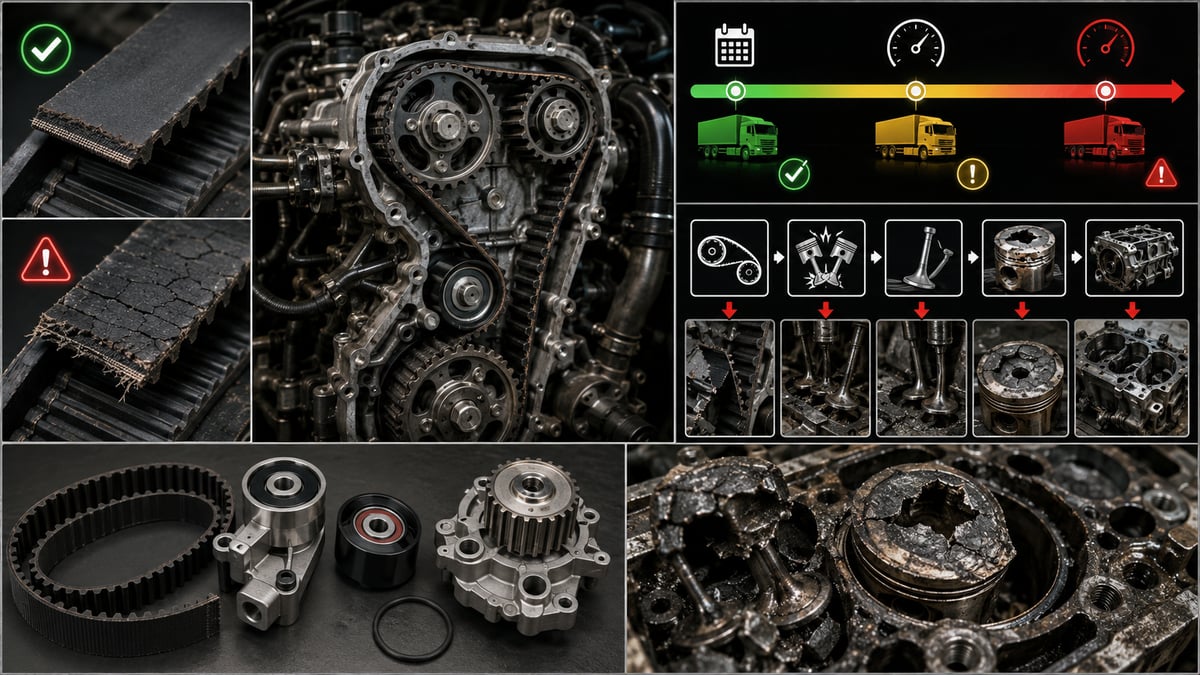
One of the most common maintenance questions raised in the workshop is: "When does the timing belt on this vehicle need replacing?" In the passenger car world that question has a straightforward answer. On a heavy commercial vehicle, though, the right answer usually has to start with another question first: does this vehicle actually have a timing belt at all? Most diesel engines used in trucks, tractor units, buses and construction machinery time the camshaft not with a belt but with a timing chain or a direct gear train. This is not an academic distinction — it changes the maintenance schedule, the failure symptoms, and everything that happens to the engine the moment timing is lost. This guide first helps you identify which system your own vehicle actually has, then walks through the maintenance logic that applies to that specific system.
Why does engine timing matter so much?
In a four-stroke engine, two shafts have to work in flawless coordination. The crankshaft drives the pistons; the camshaft opens and closes the valves. The intake valve must open while the piston is moving down, the exhaust valve must stay open while the piston is moving up, and during the compression and power strokes both valves must be fully closed. When this relationship is off by even a few degrees, the engine loses power and fuel efficiency; when it is off badly, the valve and the piston try to occupy the same space at the same time, and mechanical damage becomes unavoidable.
The only job of the timing system is to keep these two shafts locked to a fixed speed ratio and a fixed phase offset — in the four-stroke cycle, the crankshaft turns twice for every single turn of the camshaft. For the crankshaft's construction and failure symptoms, see the crankshaft guide; for cam lobe wear, see the camshaft guide. The timing system is simply the link that locks together the parts described in those two guides.
On a heavy-duty diesel, this link carries a far heavier load than it does in a passenger car. The same drive very often also turns the high-pressure fuel pump, the oil pump, the air brake compressor and the hydraulic steering pump. In other words, the timing system does not just run the inside of the engine — it even turns the unit that produces the vehicle's brake air. The number of units it drives, and the peak torque it has to carry, is exactly why heavy vehicles favour a chain or a gear train over a flexible belt.
What is the first sign that timing has slipped?
Timing rarely fails all at once; in most cases it slips first. When a belt or chain jumps a tooth, the engine will usually keep running, but its character changes: cranking takes longer, idle becomes rough, low-end torque drops, dark smoke appears at the exhaust, and fuel consumption rises enough for the driver to notice. On electronically controlled engines, the control unit compares the crankshaft and camshaft sensor signals, so this condition is typically logged as a correlation fault code. That code is the earliest warning that the chain or belt has slipped; clearing it without investigating costs you both the diagnostic opportunity and, eventually, the engine itself.
Three timing systems: belt, chain and gear train
Engine manufacturers choose one of three ways to build the timing drive, and the choice is never random. A belt is cheap, light and quiet, but it has a limited service life. A chain lasts a long time, but depends on oil condition and tensioner health. A gear train is the most durable of the three, but it is heavy and noisy. Because a heavy commercial vehicle engine's service life is measured in hundreds of thousands of kilometres, manufacturers tend to favour the second or third option.
| System | Where it is used | Life expectancy | Failure symptom | Result of breakage or a jumped tooth | Maintenance |
|---|---|---|---|---|---|
| Timing belt | Most passenger car and light commercial engines; rare in heavy-duty applications | Limited; read together with both mileage and years | Cracking, tooth loss, edge fraying, oil contamination, bearing whine | Sudden, total loss of synchronisation; valve and piston damage on interference engines | Scheduled kit replacement, leak inspection |
| Timing chain | Common on modern heavy commercial vehicle and bus diesels | Designed for the life of the engine, but not infinite because of stretch | Cold-start rattle, tensioner fault code, phase drift | Phase shifts as stretch increases; the same severe outcome as a belt if it breaks | Oil and oil filter discipline, tensioner inspection |
| Gear train | Heavy commercial vehicles, construction machinery and high-load diesels | Generally not expected to need replacement over the life of the engine | Whine that rises with rpm, increasing backlash, metal swarf in the oil | Tooth breakage is rare, but causes severe internal engine damage when it happens | No separate scheduled service; lubrication and backlash checks |
The timing belt is a reinforced rubber band with teeth on its inner face. It grips by meshing tooth-to-tooth rather than by friction, so it cannot slip — but because it is a flexible body, it fatigues, ages, and has a limited service life.
The timing chain is made up of links that mesh with toothed sprockets. It is lubricated by engine oil, tensioned by a hydraulic tensioner, and runs over plastic guide shoes. With the right oil it delivers a very long service life, but that life is not unlimited: as the pins and bushings in each link wear, the chain's overall length grows — in the field this is known simply as chain stretch.
The gear train transmits motion through steel gears that mesh directly, with no flexible element in between. Positioned at the front of the engine or, depending on the design, at the flywheel end, the group typically consists of the crankshaft gear, one or more idler gears, the camshaft gear, and often the gears for the fuel pump and the air compressor. Its advantage of needing no scheduled maintenance comes at the cost of its weight and its characteristic whine.
Does your vehicle have a timing belt, a chain, or a gear train?
The answer to this question determines which maintenance item actually applies to that vehicle. On a belt-driven engine, scheduled replacement is a critical line item; on a chain-driven engine there is usually no such line item at all, and the system is protected by good oil discipline; on a gear-train engine, replacement never comes up as a procedure in the first place.
- Check the vehicle's maintenance booklet. If the maintenance table includes an item such as "timing belt replacement" or "timing kit," the vehicle has a belt. If no such item exists, the system is very likely a chain or a gear train. This single check resolves the majority of cases.
- Look at what the timing cover is made of. If the cover is plastic or thin sheet metal and easy to remove, a belt is likely. A thick cast cover indicates a wet cavity full of engine oil behind it; a belt cannot tolerate contact with oil, while a chain or a gear train runs inside the oil.
- Listen to the cold-start sound. A belt-driven system stays quiet even when cold. A chain-driven system typically produces a brief rattle in the first few seconds that disappears once oil pressure builds up. A gear train produces a continuous whine, independent of temperature, that rises with rpm — this is not a fault, it is the system's natural signature. Depending on the design, the whine comes from the front of the engine or from the flywheel area; when it comes from the flywheel side, it is often mistaken for gearbox noise.
- Check the spare parts catalogue against the engine code. This gives the definitive answer. What matters is not the vehicle model but the engine code; the same truck model can carry different timing solutions across its different engine options.
What kind of component is a timing belt? Construction and tooth engagement
From the outside, a timing belt looks like a simple rubber band; in fact it is a layered composite structure. Its body is made of synthetic rubber engineered to withstand high temperature and oil vapour. Embedded inside it are high-strength tension cords that keep the belt's length constant and carry the tensile load; these fibreglass- or aramid-based cords are what actually stop the belt from stretching — in other words, what keeps timing from slipping. The tooth surface itself is covered with a wear-resistant fabric.
The key concept here is positive drive. An accessory belt transmits power by friction; if its tension drops, it slips and warns you with noise. A timing belt cannot slip, because it engages tooth-to-tooth. This looks like an advantage, but it is also the real risk: an accessory belt announces fatigue with noise, while a timing belt loses a tooth or breaks without giving any warning at all. This is why the maintenance strategy for a timing belt cannot be "replace it when it fails" — it has to be "replace it on schedule, before it fails."
The belt does not work alone. The system is a complete assembly: the crankshaft and camshaft sprockets, depending on design the fuel pump sprocket, one or more tensioner bearings, idler bearings where fitted, and, on many engines, a coolant pump driven by the belt itself. All of these parts share the same operating hours, which is exactly why replacement is handled with kit logic.
When a driver says "the belt broke," the first thing to clarify is which belt they mean. An accessory belt sits outside the engine; if it breaks, the vehicle is stranded but there is no internal engine damage. A timing belt sits under a cover, and when it breaks the outcome is far more serious. The diagnosis and cost picture for the two situations are nothing alike.
When does a timing belt need replacing? Mileage and years are read together
A timing belt's replacement interval is given by the manufacturer as two separate measures: a mileage figure and a time figure. Whichever comes first applies. This dual rule exists because the belt does not age only through use — it also ages purely with the passage of time. The rubber body hardens under thermal cycling and exposure to oxygen, ozone and oil vapour; a belt that has lost its flexibility starts cracking at the tooth root even at low mileage. The two most common field mistakes come from exactly this: on a lightly used vehicle, saying "the mileage hasn't been reached" and ignoring the time limit, and replacing only the belt while leaving the tensioner and bearings as they were.
As a general framework, belt replacement intervals on today's engines fall somewhere in a wide band running roughly from the order of a hundred thousand kilometres up to several hundred thousand kilometres, with the time side typically defined on the order of a few years. The width of that band shows exactly why the interval cannot be used without knowing the engine code: two engines of the same displacement from the same manufacturer can call for very different figures because of a different emissions level or a different accessory layout. The precise number is written only in the current OE service document for that vehicle's specific engine and chassis code.
There are also conditions that call for shortening the interval: constant short trips with frequent cold starts, dusty construction-site environments, extreme heat or cold, extended idling, continuous full-load operation, and any engine with a documented history of leaks. Manufacturers define a shortened interval for vehicles that meet the "severe duty" definition, and that interval, too, has to be read from the OE document.
What makes a timing belt fail early
Behind almost every belt that breaks before its intended service life, there is a fault somewhere other than the belt itself. Replacing the belt without finding the cause of the early failure means buying the same failure a second time.
- Oil or coolant leaks: The belt's biggest enemy. Oil seeping from the front crankshaft seal, the camshaft seal or the fuel pump seal swells and softens the rubber body, and the belt separates rapidly at the tooth root. When the coolant pump seal leaks, coolant lands directly on the belt. If fluid traces are visible when the cover is opened, a new belt should not be fitted until the source of the leak is found.
- Incorrect tension: A loose belt jumps teeth and starts wearing from the edge; an over-tensioned belt fatigues its cords and puts unnecessary bearing load on the tensioner and idlers. Tension is set by the method the manufacturer specifies, never by eye.
- Misalignment: If one of the sprockets is out of plane, the belt wears from one edge, its fibres fray, and it can climb off the sprocket. The usual cause is a bent tensioner arm or a damaged sprocket.
- Worn-out bearings: A tensioner with play or one that has seized loads the belt unevenly; a seized bearing can cut a belt instantly. This is why the bearings are renewed together with the belt.
- Contamination and foreign objects: If the cover gasket has failed or the cover is missing, dust, mud and stone chips can get between the teeth; a hard object can strip several teeth in a single revolution.
- Faulty installation: Forcing the belt onto a sprocket with a screwdriver or a lever breaks the cords invisibly. A belt should never be forced on — it should be fitted freely with the tensioner released. A belt fitted backwards or twisted also cracks within a short time.
- A failing accessory unit: A coolant pump or fuel pump that is starting to seize puts a torque load on the belt that it cannot carry. On any belt that fails early, this possibility should be investigated.
Timing belt failure symptoms and visual inspection
A timing belt usually fatigues silently, which is why opening the cover and looking is the primary method rather than waiting for symptoms. Even so, there are signs that do reach the driver, and none of them should be ignored.
| Symptom | Likely cause | Required action |
|---|---|---|
| Fine transverse cracks at the tooth root | Rubber hardened by heat and age | The belt has reached the end of its life and must be replaced as a kit |
| Fraying at the edge, fibres coming loose | Sprocket misalignment or the belt climbing | Check alignment and sprockets, renew the damaged part |
| Missing or broken tooth | Foreign object, seized bearing, excessive load | Inspect the entire system before starting the engine |
| Oil or coolant traces on the belt | Seal leak or coolant pump leak | Do not fit a new belt until the leak is fixed |
During the visual check, it is not only the visible face of the belt that needs inspecting but also the toothed side; bending the belt slightly at one point exposes the tooth root, where transverse cracks start. Bearings should also be turned by hand; any bearing that does not turn smoothly or has play in its axis should be renewed along with the belt.
Further reading
For a plain-language technical overview of this subject, see the reference article on Wikipedia. Always confirm specific figures and procedures against the vehicle manufacturer service data.
What happens if a timing belt breaks? The interference engine concept
When the belt breaks, the camshaft stops suddenly while the crankshaft keeps turning under the engine's own inertia. What happens in that fraction of a second — a few hundred milliseconds — of mismatch depends entirely on the engine's design, and one single concept decides the outcome: the interference engine.
In an interference engine, the volume the valves reach at full lift overlaps with the volume the piston occupies at top dead centre. When timing is correct, this overlap never actually happens, because the valve and the piston are never in the same place at the same time. Once timing is lost, that synchronisation disappears and the piston strikes a valve that has been left open. The usual outcome is bent valves, damaged valve seats, broken rocker arms or lifters, a scored piston crown, and in severe cases a cracked cylinder head and a bent connecting rod. For the structure of the valve train, the damage patterns and the rebuild logic, the engine valve train guide is a detailed reference.
In a non-interference (free) engine, the valve and piston volumes are designed so they never overlap; when the belt breaks the engine stops but internal damage generally does not occur. This design has become steadily less common in modern engines, and the overwhelming majority of diesels running high compression ratios must be assumed to be interference engines. On a diesel vehicle, the assumption that "the belt broke but nothing happened" is not a safe one.
The correct sequence after a breakage is as follows: do not attempt to restart the engine, transport the vehicle to the workshop, open the timing cover and identify the cause of the breakage, inspect the piston crowns and valves with a borescope where possible before removing the cylinder head, then measure the extent of the damage with a compression test or a cylinder leakage test. A repair carried out without finding the cause of the breakage leaves the door open for the same scenario to repeat.
Parts replaced together with the timing belt
A timing belt is never replaced on its own — it is replaced as a kit. This is not about cost saving, it is engineering: every element in the system has shared the same operating hours, the same heat and the same load. An old tensioner bearing can finish off a new belt in a short time, or even break it outright. Since most of the labour is already spent gaining access, not renewing the parts in the same area is not a real saving.
| Part | Why it is addressed together | Decision criterion |
|---|---|---|
| Timing belt | Main replacement item | Manufacturer's mileage or time interval |
| Tensioner bearing and tensioner arm | Shares the belt's service life; if it fails it causes breakage | Renewed at every kit replacement |
| Idler bearings | Fatigues silently, cuts the belt if it seizes | Renewed at every kit replacement |
| Coolant pump | If belt-driven, access is the same labour | Recommended for replacement together if belt-driven |
| Crankshaft and camshaft seals | Leaks directly damage the belt | Renewed at the smallest trace of oil |
| Sprockets and cover gasket | A worn tooth profile or a failed gasket finishes off the new belt | Renewed if damaged or hardened |
The coolant pump deserves particular attention. If the pump is driven by the timing belt, leaving it in place is a common but risky choice; when the pump fails a few years later, the same labour is repeated from scratch, and a belt that still had life left in it is thrown away as well.
Timing belt replacement: the procedure sequence
The sequence below is a general framework showing the logic of the job and its critical points. In practice, every engine has its own fixing tools, its own timing marks and its own torque values; the job must always be carried out following that engine's own OE service procedure.
- Secure the vehicle. The engine must be fully cooled, the battery terminal disconnected, and the vehicle parked on level ground and chocked.
- Open up access. The accessory belt, pulley guards, the engine mount if required, and the timing cover are removed; every fastener is set aside and marked according to its length.
- Bring the engine to the timing position. The crankshaft is always turned in its normal direction of rotation to reach the reference position specified by the manufacturer; the engine must never be turned backwards.
- Verify and lock the timing marks. The crankshaft and camshaft marks must align. Where engine-specific locking pins or fixtures exist, they must always be used; the marks are never left to eyeball alignment.
- Record the condition of the old belt. Before removal, note its direction, its wear pattern and any trace of oil; if there was an early failure, this is the only clue to finding the cause.
- Release the tensioner and remove the belt. The belt is removed by releasing the tensioner, never by forcing it off with a lever or cutting it.
- Clean and inspect the area. Sprocket teeth, seal areas and the cover face are cleaned; every bearing is checked by turning it by hand; oil and coolant leaks are checked for.
- Fix any leak first. Seal replacement is completed before fitting the new belt; skip this step and the new kit will meet the same end in a short time.
- Fit the new parts and set the tension. Bearings and the tensioner are seated in place, and the belt is routed in the direction and sequence the manufacturer specifies, without bending it at any point. Tension is set using the method and tool the manufacturer specifies; pressing it by hand and calling it "tight enough" is not an acceptable measurement.
- Turn the engine over by hand for two full revolutions. Once the locking fixtures are removed, the crankshaft is turned by hand, in its normal direction, for two full revolutions, and the marks are checked to confirm they realign. Any resistance felt must be investigated before the engine is started.
- Apply the torque values and sequence. Sprocket and tensioner fasteners are torqued to the value and sequence given in the OE manual; fasteners specified as single-use are never reused.
- Close up, start the engine and log the job. The cover is fitted with its gasket; if the cooling system was drained, it is bled. The engine is run at idle and checked for noise, vibration and leaks, and fault codes are read. The replacement date, mileage and parts changed are recorded in the vehicle file.
Timing chain: stretch, tensioning and failure symptoms
For most heavy commercial vehicle owners, this is really the topic that matters. A timing chain is engineered to last the life of the engine, and there is normally no scheduled replacement item for it in the maintenance table. That does not mean the chain needs no maintenance at all — only that its maintenance goes by a different name. Maintaining the chain means maintaining the engine oil.
The mechanism that determines chain life is stretch. Every link has a pin and a bushing, and this pair operates constantly under an oil film. When the oil becomes contaminated, thins out, or is left unchanged for too long, the film gets thinner and the pin and bushing wear. The wear in a single link is measured in microns, but once hundreds of links are added together, the chain's total length grows by a measurable amount. As the chain stretches, it pushes the tensioner's compensation range to its limit, seats differently on the sprocket, and the phase angle between crankshaft and camshaft drifts. The engine picks this drift up from its sensor signals and, in most cases, reports it as a correlation fault code.
The symptoms to watch for on a chain-driven system are: a metallic rattle heard in the first few seconds of a cold start that stops once oil pressure rises, an irregular ticking coming from the timing area at idle, rising fuel consumption and torque loss, tensioner- or phase-related fault codes, and fine metal particles found in the oil pan or the filter. None of these on their own is a definitive diagnosis; they need to be assessed together and confirmed with the OE procedure.
The main causes that shorten chain life are delayed oil changes, using oil that does not meet specification, running the oil level low, fuel or coolant getting into the oil, excessive idling, and prolonged short-trip use at low oil temperature. Because the chain tensioner is hydraulic, it is directly dependent on oil pressure and cleanliness; a clogged tensioner strainer cannot pressurise the tensioner in time and lets the chain slap.
Failures and maintenance on gear-train timing
The gear train is the most durable timing solution, and that is exactly why so many heavy commercial vehicle diesels use it. Drive leaving the crankshaft gear passes through one or more idler gears to the camshaft gear, and within the same gear set to the gears of units such as the fuel pump, the air compressor and the oil pump. Because there is no element in between that flexes, stretches or fatigues, the phase angle stays essentially constant for the life of the engine.
This system has no scheduled replacement item; maintenance is indirect, consisting essentially of keeping up lubrication. The gears are lubricated by engine oil, and oil quality and pressure determine the life of the gear bearings and bushings. Even so, it has its own characteristic failure modes: a noticeable change in the tone or intensity of the characteristic gear whine, metallic knocking that increases with load, gear backlash measuring outside the limit, metal swarf found in the oil, and play felt at an idler gear bushing. These usually stem from lubrication problems, excessive load, faulty assembly, or a foreign object that has entered the engine.
Any work on the gear train requires removing a large part of the engine; on trains positioned at the flywheel end in particular, the gearbox and clutch assembly have to come down as well. This is why a gear-train failure, once identified, is normally planned as a major engine job. Correct matching of the gear timing marks during assembly is critical; a camshaft gear that is out by a single tooth can produce the same outcome as a broken belt.
The question of "which system is best" has no single answer, because the difference between the three systems is one of purpose, not superiority. A belt is chosen for low weight and low cost, and asks for a planned replacement in return. A chain is chosen for long service life, and asks for oil discipline in return. A gear train is chosen for the heaviest loads, and brings weight, cost and whine in return. For a heavy commercial vehicle operator, the right question is "which one does my engine have, and am I performing the maintenance that system requires?"
Technical reference ranges and a maintenance checklist
The table below gathers the figures most often needed in the field, given as an order of magnitude. These values are not meant for making decisions but for judging whether a measured result is plausible; exact values are found only in the OE service document for the vehicle's specific engine code.
| Figure | General reference or criterion | Interpretation |
|---|---|---|
| Belt replacement interval | Whichever comes first, mileage or time | Depends on engine code; a general figure cannot be used |
| Belt tension | Measured and set according to the OE method | Pressing by hand is not an acceptable measurement |
| Verification of timing marks | Checked by turning the engine by hand for two full revolutions after assembly | One revolution is insufficient, as it does not cover the full cycle |
| Chain stretch measurement | Via tensioner position or mark offset, per OE procedure | Cannot be assessed by eye; it is measured following the procedure |
| Gear backlash | Limit values as defined in the OE manual | Measured with a dial indicator; the gear is renewed if outside the limit |
On the maintenance side, there is a checklist that applies regardless of which system is fitted. This list treats the timing system not as a separate maintenance item but as an indicator of the engine's overall health.
- Confirm the system: Document whether the vehicle has a belt, a chain, or a gear train based on its engine code, and build the maintenance plan around that.
- Keep the schedule on belt-driven systems: Plan around whichever comes first, mileage or time, and keep records with a label.
- Maintain oil discipline: On chain-driven and gear-train engines, the life of the timing system depends directly on oil quality and change interval.
- Understand fault codes before clearing them: A crankshaft-to-camshaft correlation fault code should never be cleared without mechanical verification.
The timing system is one of the quietest, least visible parts of an engine — and at the same time one of the most expensive to get wrong. The right approach on a heavy commercial vehicle is to understand the engine's own architecture rather than carry over passenger-car habits: on a belt-driven engine, the replacement schedule is what matters; on a chain-driven engine, it is the oil log; on a gear-train engine, it is lubrication and assembly discipline. In all three cases, the final authority is the current OE service documentation for that vehicle's specific engine and chassis code.
The belt that drives the engine's external accessories is a separate group; for its noise and the tensioner pulley check, see the V-belt and tensioner pulley guide.
Shop this part: Engine
Main guide: What Is a Crankshaft? Function, Failure Symptoms and Maintenance
Tags
Frequently Asked Questions
- Do trucks, tractor units and buses have a timing belt?
- Most don't. The majority of heavy commercial vehicle diesels time the engine not with a timing belt but with a timing chain or a direct gear train. The reason is that the same drive also turns units such as the fuel pump, the oil pump and the air brake compressor. Which system is fitted depends on the engine code, not the vehicle model.
- How can I tell if my vehicle has a timing belt, a chain, or a gear train?
- The fastest way is to check the maintenance booklet: if the table includes a timing belt replacement item, the vehicle has a belt; if not, it is very likely a chain or a gear train. The second clue is the cover — a belt sits under a plastic or thin sheet-metal cover, while a chain or gear train runs inside oil behind a thick cast cover. For a definitive answer, check the spare parts catalogue against the engine code.
- When does a timing belt need to be replaced?
- The manufacturer gives two figures, a mileage value and a time value; whichever is reached first applies. Even on a vehicle that is barely used, the rubber body hardens with age, so the time limit ends up being the deciding factor. The exact interval varies by engine code and is written only in the vehicle's current OE service manual.
- What happens if a timing belt breaks?
- The camshaft stops suddenly while the crankshaft keeps turning, and synchronisation is lost. On an interference engine, the piston strikes a valve that has been left open; the result can be bent valves, damaged bearings, a broken rocker arm or lifter, and in severe cases a cracked cylinder head. The overwhelming majority of diesels running high compression ratios must be assumed to be interference engines.
- Is it harmful to try to start the engine after the timing has broken?
- Yes, very. Every revolution turned on the starter drives a bent valve further in and makes damage that could have stayed limited much worse. The vehicle should be transported on a flatbed and the engine assessed in the workshop by turning it by hand. The same rule applies to any engine suspected of having slipped timing but that is still running.
- What other parts get replaced along with a timing belt?
- The job is done as a kit: alongside the belt, the tensioner bearing and tensioner arm, the idler bearings, and, where needed, the crankshaft and camshaft seals and the cover gasket are all renewed. If the coolant pump is driven by the timing belt, replacing it at the same time is recommended, since a failure a few years later would mean repeating the same labour from scratch. An old tensioner bearing can finish off a new belt in a short time.
- What are the failure symptoms of a timing belt?
- A belt usually fatigues silently, which is why opening the cover and inspecting it is the main method. Visible signs include transverse cracks at the tooth root, a glazed surface, fraying at the edge, a missing tooth, and oil or coolant traces on the belt. Signs that reach the driver include whining from the timing area, longer cranking time, a rough idle and torque loss.
- Why does oil contamination on the belt matter so much?
- Leaking oil swells and softens the rubber body, and the belt separates rapidly at the tooth root; coolant leaking from the coolant pump seal has the same effect. This is why, if fluid traces are visible when the cover is opened, a new belt should not be fitted until the source of the leak has been found and fixed. Otherwise the new kit meets the same end in a short time.
- Does a timing chain need replacing too, and what is chain stretch?
- A chain is engineered to last the life of the engine, and there is no scheduled replacement item for it in the maintenance table — but its life is not unlimited. As the pins and bushings in each link wear, the chain's overall length grows; this is known as chain stretch. A stretched chain pushes the tensioner's compensation range to its limit, the phase angle drifts, and the engine usually reports this with a correlation fault code. Symptoms include a cold-start rattle, torque loss and tensioner fault codes.
- Does gear-train timing need maintenance?
- There is no separate scheduled maintenance item; the gears are lubricated by engine oil, and maintenance is essentially a matter of oil discipline. Even so, a noticeable change in the tone of the gear whine, metallic knocking that increases with load, backlash measuring outside the limit, and metal swarf in the oil are all warning signs. Because it requires removing a large part of the engine, any repair is planned as a major engine job.
Related Articles
Oil Filter Cap and Housing: Leaks, Cracks and Seal Replacement
Truck engine oil filter cap and housing: why plastic caps crack, O-ring leak causes, bypass valve faults, and correct torque and seal replacement steps.
Piston Rings: Oil Consumption, Compression Loss and Replacement
Ring-related oil consumption and compression loss in truck diesel engines: how rings seal, blow-by and leak-down tests, ring gap and replacement.
Intake Manifold and Intake Pipe: Faults, Diagnosis, Repair
How the intake manifold and charge air pipe work on truck diesel engines, how to spot boost leaks, run a pressure test and fit them leak free.