What Is an EGR Valve? Failure Symptoms and Cleaning (Heavy Commercial Vehicles)
What is an EGR valve? How it works, why it clogs, failure symptoms, diagnosis steps, and cleaning limits for heavy commercial vehicles.
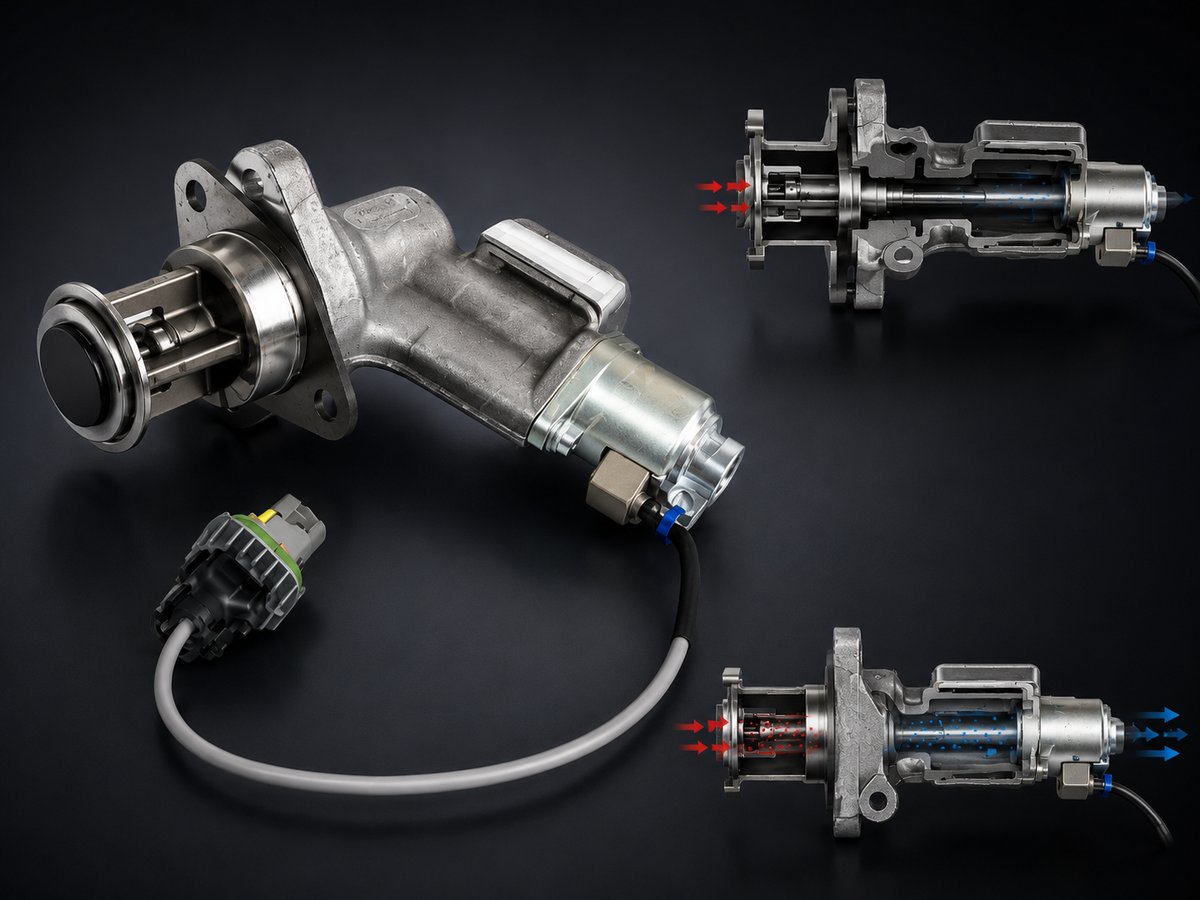
A city-distribution truck rolls into the shop for the second time in three months with the same fault code: EGR valve position error. The valve comes out, the carbon gets scraped off, the code gets cleared, the truck runs clean for a while — and then it's back. More often than not, the problem isn't the valve itself; it's the conditions the valve has been forced to operate in. This guide treats EGR not as a single part but as a control loop built into the engine to limit nitrogen oxide formation before it ever happens.
What does EGR mean? What problem does exhaust gas recirculation solve?
EGR stands for Exhaust Gas Recirculation. The name describes exactly what it does: a metered portion of the gas leaving the exhaust is routed back to the intake side instead of leaving the vehicle, and drawn into the cylinder again on the next cycle.
The reason comes down to a single pollutant: nitrogen oxides (NOx). A diesel engine runs on excess air — plenty of oxygen. More than three-quarters of that air is nitrogen, which stays inert under normal conditions; but once flame temperature crosses a certain threshold, nitrogen and oxygen combine into nitrogen oxides. That reaction is exponentially temperature-dependent: a relatively small rise in peak temperature multiplies NOx output several times over. Since removing oxygen isn't an option in a diesel engine, temperature is the only lever left.
What is the EGR valve and what does it do in the system?
The EGR valve is a variable flow-restriction device, driven by the engine control unit, that determines how much exhaust gas returns to the intake side. It isn't an on/off valve — it positions itself continuously based on engine speed, load, coolant temperature, ambient pressure, and the emissions strategy in effect. The control unit sends the valve a position request, the valve's own position sensor reports back the actual opening, and once the gap between requested and actual position exceeds tolerance, a fault code is set. Most of what gets called an "EGR fault" in the field isn't the valve failing mechanically — it's this feedback loop failing to close.
The returned gas has two effects. The first is dilution: because burnt gas displaces part of the intake charge, oxygen concentration in the cylinder drops and combustion proceeds more slowly. The second is heat capacity: the carbon dioxide and water vapour in exhaust gas absorb more heat than fresh air does, so the same fuel produces a lower peak temperature. Together, the two effects suppress NOx formation at the source.
Why it isn't free: the trade-off between NOx and soot
EGR has a cost, and that cost defines the system's entire character. Reducing oxygen in the cylinder lowers NOx but increases soot and particulate formation. Engine developers call this inverse relationship the NOx-PM trade-off, and it's the reason EGR rate can't simply be turned up. An engine running a high EGR rate produces more soot, that soot works its way into the oil, it accelerates liner and ring wear, and it fills the particulate filter faster. That's why modern heavy-duty engines never run EGR alone — it's paired with after-treatment hardware and kept to a measured rate.
How does the EGR valve work? The gas's path back to the intake
There's exactly one condition for exhaust gas to flow into the intake: pressure at the point it's drawn from has to be higher than pressure at the point it's delivered to. On a turbocharged engine, that doesn't happen on its own, because boost pressure in the intake manifold can run high. That's why the system is never just a valve — it also includes the hardware needed to create that pressure difference.
The typical flow path: gas is drawn from the exhaust manifold, cooled by passing through the EGR cooler, metered by the EGR valve's opening, mixed into the fresh air stream at a mixer or venturi section, and enters the intake manifold. The pressure difference needed to drive that flow comes from a flap restricting flow, from suction created at a venturi, or from varying turbo geometry — which method is used depends on the engine family, and knowing which one applies is a precondition for judging whether a measured value is normal.
EGR rate and its operating window
EGR rate is the share of recirculated exhaust gas in the total charge entering the cylinder. It isn't a fixed number — depending on the engine, the calibration, and the operating point, it typically runs somewhere around 5 to 30 percent at partial load. The correct figure for a given vehicle comes only from the manufacturer's calibration data; a rate seen in live data shouldn't be judged without a reference from the same engine family.
When is EGR kept closed?
The valve isn't open all the time. The control unit typically closes it, or cuts it back sharply, during cold start, at idle, at full load, and on rapid throttle demands: combustion in a cold engine is already unstable, and at full load oxygen demand peaks, so recirculating gas there costs power and adds soot. This behaviour is useful for diagnosis: a valve that won't close at full load shows up as power loss and black smoke, while one that stays open when it should be closed shows up as rough idle.
What components make up the EGR system?
On a heavy commercial vehicle, EGR is less a single-body valve than a short circuit built between exhaust and intake. Every link in that circuit works under soot, heat, and vibration; before chasing a fault, it's worth confirming which of these links the vehicle actually has.
| Component | Function | Typical failure symptom |
|---|---|---|
| EGR valve | Meters the recirculated gas flow continuously | Position error, sticking, rough idle |
| Valve actuator (electric or pneumatic) | Moves the valve shaft to the requested position | Slow response, no movement at all, air leak |
| Position sensor | Reports actual valve opening to the control unit | Persistent gap between requested and reported position |
| EGR cooler | Lowers the temperature of the recirculated gas | Coolant loss, white smoke, pressurised expansion tank |
| EGR flap (exhaust throttle valve) | Creates the pressure difference needed for flow | Sticking, low EGR flow, rising back-pressure |
| Differential pressure sensor | Measures the pressure gap used to calculate flow | Implausible flow reading, blocked signal hose |
| Temperature sensors | Monitor cooler inlet and outlet temperature | Low cooler efficiency code |
| Mass air flow sensor | Measures fresh air flow; EGR flow is derived from it | Incorrect EGR calculation, skewed dosing |
The last row in that table gets overlooked most often. On many engines, EGR flow isn't measured directly — it's back-calculated from fresh air flow. In that case, a mass air flow sensor that has drifted can throw an EGR fault code with nothing wrong on the EGR side at all. Starting diagnosis at the valve in that scenario leads straight to replacing the wrong part.
Cooled vs. uncooled EGR, high-pressure vs. low-pressure architectures
EGR systems split along two axes: whether the gas is cooled, and where the circuit is tapped relative to the turbocharger. These two choices between them determine both efficiency and how the system fouls.
Uncooled EGR sends the gas to the intake at whatever temperature it left the exhaust. It's simple and cheap, but because hot gas heats the charge and lowers its density, the NOx benefit is limited and charge efficiency suffers — it's the exception on heavy-duty engines today. Cooled EGR routes the gas through a heat exchanger cooled by engine coolant. The cooled gas is denser, and its temperature-lowering effect is markedly stronger. Virtually every Euro V and later application uses cooled EGR, which also adds a new failure surface tied into the engine's cooling circuit.
| Criterion | High-pressure EGR | Low-pressure EGR |
|---|---|---|
| Gas taken from | Upstream of the turbine, exhaust manifold | Downstream of the particulate filter, cleaned gas |
| Gas delivered to | Downstream of the compressor, intake manifold | Upstream of the compressor, intake tract |
| Response speed | Fast, short path | Slow, gas travels a long path |
| Soot content of the gas | High, raw exhaust | Low, already filtered |
| Fouling tendency | Significant, at the valve and intake ports | Lower, but with condensation and corrosion risk |
| Prevalence in heavy commercial vehicles | The dominant solution | More common on passenger cars and light commercial applications |
What does the EGR flap do?
The EGR flap is a throttle plate fitted into the intake or exhaust tract, and its only job is to create the pressure difference the gas needs to flow. Fitted on the intake side, it lowers intake pressure and leaves the exhaust side relatively higher; fitted on the exhaust side, it raises back-pressure and forces gas into the EGR circuit. Soot settles between the plate's shaft and its housing and makes movement stiffer over time; once the flap sticks partway open, EGR flow drops and the system misses its target even though the valve itself is fine.
Actuation types: pneumatic and electric
Two actuation types show up on heavy commercial vehicles. In pneumatic actuation, the valve is moved by a diaphragm actuator fed through an electrically driven proportional valve; dry, oil-free air is what keeps this arrangement healthy — moist air degrades the diaphragm and the proportional valve over time and leaves the valve responding sluggishly. In electric actuation, a DC motor and gear set do the work, usually with the position sensor built into the same housing. It positions faster and more precisely, but when it has to force a shaft that's stiffened with soot, current draw rises, and the control unit can log that as an overload.
Why does the EGR valve foul with carbon? How the deposit forms
The black, sticky layer on an EGR valve isn't pure soot. It forms from three components coming together: the dry soot particles carried in exhaust gas, oil vapour reaching the intake tract from crankcase ventilation, and the water and acidic compounds that condense out of the gas on cold surfaces. Dry soot on its own doesn't stick — it blows off. Once it meets oil vapour, though, it turns into a sticky sludge, bakes on with heat, and locks onto the surface as a hard shell.
Once the deposit starts, the process feeds itself. As the shell narrows the passage, the valve has to open further for the same flow, gas velocity changes, and that creates more surface for the next layer to grab onto. Once the valve can no longer seat properly, some gas leaks through even when it should be fully closed — this is the stage where idle vibration and full-load power loss start showing up.
Crankcase ventilation: the most overlooked cause
The real variable behind how fast fouling progresses is how much oil vapour is reaching the intake. A clogged or saturated crankcase ventilation filter can't separate the oil carried by blow-by gas from the cylinders; worn piston rings, a blocked oil separator, and a stuck pressure-regulating valve all lead to the same outcome. That's why a fouling problem that comes back soon after a cleaning should send you to the crankcase ventilation side first — until the source is cut off, cleaning only resets the clock.
The effect of duty cycle
Short trips, frequent stops, extended idling, and low load all keep exhaust temperature in the band where deposits form but never get hot enough to burn off. Urban distribution trucks, refuse collection vehicles, city buses, and construction-site machinery therefore foul noticeably faster than the same engine spec running long-haul. That isn't a manufacturing defect — it's a direct consequence of the duty cycle, and the service interval should be shortened to match it.
What are the symptoms of EGR valve failure?
The symptom set for EGR problems is wide, because the valve affects charge air, combustion character, and the after-treatment system all at once. Reading a symptom in isolation is misleading — more than one mechanism can sit behind the same complaint, and the only reliable path is confirming the mechanism with measurement.
| Symptom | Likely mechanism | Confirmation / check |
|---|---|---|
| Power loss, can't pull a grade | Valve stuck open, charge over-diluted | Watch position and air flow in live data |
| Black smoke from the exhaust | Excess EGR, or valve not closing at full load | Read valve position at full load |
| Rough idle, vibration | Valve not seating, leaking | Remove the valve and inspect seat sealing |
| Increased fuel consumption | Disrupted combustion, charge error | Compare consumption trend against air flow |
| Position error code, warning lamp | Shaft seizure, actuator or sensor fault | Watch request vs. feedback during an actuator test |
| Coolant loss, white smoke | Internal leak in the EGR cooler | Pressure-test the cooling system |
| DPF filling up frequently | Increased soot from excess EGR | Check regeneration frequency and EGR rate |
| Hard cold starting | Valve staying open when it should close on cold start | Watch position feedback on a cold engine |
The critical point in that table is that the same symptom can come from two opposite faults: power loss can result from the valve staying too far open, or just as easily from a stuck flap choking the circuit off entirely. The fastest way to tell them apart is comparison — watching requested and actual position at the same time shows whether the problem sits in the control side or the mechanical side.
Standards and further reading
For the regulatory background on this subject, see Regulation (EC) No 595/2009 (Euro VI heavy-duty emissions). Always confirm specific figures and procedures against the current regulation and the vehicle manufacturer service data.
How is an EGR fault diagnosed?
The most expensive mistake in diagnosis is replacing whatever part the fault code names, without further checking. EGR is a closed-loop system, and the code usually points to the result of a fault, not its source.
- Read the fault codes and freeze-frame data; note the engine speed, load, and temperature at which the code was set.
- Confirm the engine's general health: if the air filter, turbo, boost pressure, and exhaust back-pressure are all normal, the EGR data can be trusted; if not, fix those first.
- Watch requested and reported valve position together on the same live-data screen, then run an actuator test to sweep the valve from fully closed to fully open; note whether the movement is smooth or stepped and catching.
- Compare fresh air flow with EGR open and closed; opening the valve should produce a clear drop in fresh air flow — if it doesn't, gas isn't actually getting through.
- On pneumatically actuated systems, check the air supply to the actuator, the hoses, and the proportional valve; look for moisture and oil traces.
- Visually check EGR flap movement and the deposit level inside the intake manifold; if the flap shaft is sticking, valve readings become misleading.
- Compare cooler inlet and outlet temperatures in live data; if the expected drop isn't there, the cooler is fouled or its bypass circuit has stuck open.
- Pressure-test the cooling system and check the expansion tank for exhaust gas; an internal leak shows up at this step.
- After the repair, clear the codes, run any required adaptation procedure, and re-verify position tracking on a test drive under load.
Cleaning the EGR valve: methods, limits, and when replacement is needed
Cleaning is a legitimate, often correct, first step in EGR maintenance — provided its limits are respected. For a carbon-caused stick, cleaning restores the vehicle to normal. For a worn shaft bearing, a burnt-out actuator, or a cooler with an internal leak, it fixes nothing; it only postpones the date the fault comes back.
- Let the engine cool and disconnect the battery negative terminal; a hot exhaust housing and a live electric actuator are both a hazard at the same time.
- Disconnect the electrical connector, pneumatic hoses, and sensor wiring, marking each one; hoses pulled off without marking are the most common cause of a reassembly mistake.
- Remove the valve, and the flap if fitted, and discard the old gaskets; a gasket is never reused if the seal has to hold.
- Remove the bulk of the deposit with a plastic or brass scraper; never use a metal brush, wire brush, or abrasive paper on sealing surfaces or the shaft bearing.
- Soak the body in a suitable cleaning solution; never submerge the electric actuator, the position sensor, or the connector. Ultrasonic cleaning is only appropriate for the metal housing itself.
- After washing, dry thoroughly with compressed air and confirm with a light that every passage is clear.
- Move the shaft by hand; if there's play, rattling, or a tight spot anywhere in its travel, the part can't be saved by cleaning and needs replacing.
- Reassemble with a new gasket, torquing to OE values in stages and in the correct sequence; even clamping load across the exhaust-side flanges is essential.
- Turn the ignition on, run the adaptation/learning procedure, clear the codes, and confirm position tracking on a test drive under load.
The line between cleaning and replacement is clear-cut. If the body and passages are fouled but the shaft moves freely, the actuator is sound, and the sensor reads correctly, cleaning is enough. If there's radial play in the shaft, wear at the seat, a leak at the seating surface, a slow-responding actuator, or a position sensor giving an erratic signal, the part needs replacing. For the component-level teardown and replacement steps, the EGR valve and EGR flap fault, replacement, and maintenance guide covers a more complete sequence; this article stays focused on definition and operating principles and leaves the hands-on procedure there.
EGR cooler failure: why it deserves its own section
The EGR cooler carries the highest thermal load of anything in the system. Exhaust gas at several hundred degrees runs down one side, engine coolant runs down the other, and the two are separated by nothing more than a thin tube wall. Constant heating and cooling cycles fatigue that material over time; a crack in a weld seam or in the tube bundle lets the two media mix.
An internal leak here has a symptom set distinct from the valve's, and it's easy to recognise: coolant level dropping with no visible external leak, white smoke from the exhaust with a faintly sweet smell, and steady pressure or bubbling in the expansion tank. The leak can run the other way, too — exhaust gas getting into the cooling circuit builds pressure that swells the hoses, and the air pockets that form in the system cause localised overheating. For that reason, a cooler leak shouldn't be left for later; the cooling circuit also needs flushing and refilling once it's repaired.
Technical check points and general reference ranges
Exact numerical thresholds on the EGR side vary by engine family, calibration, and emission level. The table below isn't a catalogue of numbers — it's a map of what to read each value against; actual figures come from the vehicle's OE service data.
| Check point | Expected general behaviour | How to verify |
|---|---|---|
| EGR rate, partial load | Roughly a 5-30 percent band, depending on the engine | Compare the live-data rate against the OE reference |
| Gap between requested and actual position | Narrow and stable, tracking without lag | Watch both values simultaneously during an actuator test |
| Fresh air flow response | Clear drop as the valve opens | Compare readings with EGR open and closed |
| Cooler inlet and outlet temperature | Clear, stable drop at the outlet | Compare the two sensors in live data |
| Cooling circuit pressure | Stable, no bubbling | Pressure test and expansion-tank observation |
| Pneumatic supply air | Dry, oil-free, stable pressure | Inspect hoses and the proportional valve for moisture |
| Flap and shaft movement | Free, no sticking, full travel | Check by hand and with an actuator test |
Is EGR delete legal? Legal and technical consequences
Disabling the EGR circuit — blanking the valve or defeating it in software — is an intervention that renders emissions control hardware inoperative. This guide does not explain how such a modification is done and will not describe one; what follows is a summary of the consequences only.
On the technical side, tampering doesn't remove the underlying problem — it just hides it. Disabling EGR pushes combustion temperatures up, which shifts a heavier NOx load onto the after-treatment system. And with the on-board diagnostics for that circuit switched off, a genuine fault no longer raises a warning: a clogging cooler, a sticking flap, or a drifting sensor can progress unnoticed. Restoring the system to its original configuration later is, in most cases, more expensive than the maintenance that would have prevented the failure in the first place, because of the secondary damage that accumulated in the meantime.
EGR maintenance and service life: a checklist for fleets
What determines how long EGR components last has less to do with part quality than with the environment they operate in. Cut the oil vapour reaching the intake and keep exhaust temperature in the band that burns deposits off, and the same valve lasts many times longer.
- Crankcase ventilation upkeep: Replace the oil separator and filter on schedule; check the intake tract for an oil film.
- Air filter and oil discipline: A dirty filter throws off the charge calculation; use a low-ash oil matched to the engine's emission level, and shorten the change interval to fit the duty cycle.
- Periodic live-data logging: Track requested vs. actual position and the air flow response as a trend, before the warning lamp ever comes on.
- Cooler leak screening: Check coolant level, the expansion tank, and cold-start smoke on a regular basis.
- Flap and shaft movement: Physically test flap movement at every service so sticking is caught early.
- Service interval matched to duty cycle: Schedule EGR maintenance more often for urban distribution, refuse collection, and construction-site vehicles than for long-haul trucks.
- Regeneration logs: A rising trend in DPF regeneration frequency is an early sign of an imbalance on the EGR side.
Where does EGR sit in the NOx control chain?
EGR isn't a stand-alone emissions solution — it's the first link in a three-link chain. The logic of that chain is simple: reduce formation first, capture the solids next, and chemically neutralise whatever gas is left last. EGR is step one, and it works inside the engine; it doesn't clean up NOx, it keeps less of it from forming in the first place. In step two, after passing through an oxidation catalyst, the gas reaches the diesel particulate filter (DPF) stage, where soot and particulate matter are trapped in a porous ceramic structure. Step three brings in the SCR circuit, where urea solution injected into the exhaust stream converts to ammonia and reduces the remaining nitrogen oxides to nitrogen; once the fluid for that circuit, AdBlue (marketed in North America as Diesel Exhaust Fluid, DEF), runs low or falls out of spec, the last link in the chain breaks.
How the workload is split between the links varies from engine to engine. In the Euro V era, manufacturers split into two camps: some met the standard with heavy EGR and skipped AdBlue entirely, while others kept EGR modest and handed the load to SCR instead. Euro VI has both approaches running side by side — most engine families now pair a measured EGR rate with a strong SCR system, though a few manufacturers have chosen an EGR-free architecture built almost entirely around SCR. So it isn't accurate to say every heavy commercial vehicle runs EGR; the engine code is what decides it.
The practical consequence of that split is that a fault in one link shows up as a symptom in another. Excessive or uncontrolled EGR increases soot production, so the particulate filter fills faster; regenerations that keep getting interrupted disturb the exhaust temperature profile, and that disturbed profile raises the tendency for crystallisation on the SCR side. In the other direction, the back-pressure created by a clogged particulate filter shifts EGR flow and, with it, the dosing calculation. That's why an emissions-side complaint should be read across the whole chain rather than pinned on a single link.
In short, EGR is the set point, inside the engine, for the balance between fuel economy and emissions. Nearly all of its problems trace back to three things: oil vapour reaching the intake tract, a duty cycle that keeps exhaust temperature low, and sensor and cooler checks that don't happen on schedule. A fleet that keeps an eye on crankcase ventilation, reads live data before the warning lamp comes on, and shortens the service interval to match the duty cycle largely takes EGR-related breakdowns off the table. Where there's any uncertainty, the current OE service documentation for the vehicle's specific engine and chassis code is the authority.
Shop this part: Egr Valve
In-depth technical guide: For fault diagnosis, step-by-step replacement and service intervals: EGR Valve & EGR Flap: Faults, Replacement and Maintenance
All our technical guides on this topic
- DPF (Diesel Particulate Filter) Guide: Symptoms & Cleaning
- What Is an Exhaust Manifold? Leak Symptoms and Causes
- Exhaust Manifold: Cracks, Leaks, Replacement & Torque Guide
- Exhaust Flex Pipe: Faults, Replacement and Maintenance Guide
- Exhaust Clamp & Connecting Pipe: Faults, Replacement, Care
- Exhaust / Engine Brake: Faults, Replacement & Maintenance Guide
- Intake Manifold and Intake Pipe: Faults, Diagnosis, Repair
- Turbo Intake & Exhaust Inlet Pipe: Faults and Replacement
- EGR Valve & EGR Flap: Faults, Replacement and Maintenance
- Turbocharger: Symptoms, Diagnosis, Replacement & Maintenance
- What Is a Turbocharger? Turbo Failure Symptoms in Diesel and Heavy-Duty Vehicles
VADEN ORIGINAL products
- Exhaust System — 505 products
- Exhaust Flexible Pipe — 332 products
- Exhaust Manifolds — 166 products
- Turbo — 29 products
Tags
Frequently Asked Questions
- What is an EGR valve and what does it do?
- The EGR valve meters a controlled portion of exhaust gas back to the intake side, adjusting the flow continuously based on what the engine control unit requests. The returned gas lowers oxygen concentration in the cylinder and absorbs extra heat, which caps the peak temperature of combustion. That doesn't clean up nitrogen oxides (NOx) after the fact — it keeps less of them from forming in the first place.
- What are the symptoms of a failing EGR valve?
- The most common ones are power loss and difficulty pulling a grade, black smoke from the exhaust, rough idle, higher fuel consumption, and a warning lamp with a position-error code on the dash. On cooled systems, coolant dropping with no visible leak and white smoke also point to EGR. Because the same symptom can come from two opposite faults, diagnosis relies on comparing requested and actual valve position in live data.
- Can an EGR valve be cleaned, and is cleaning a permanent fix?
- For a carbon-caused stick, cleaning is the right and sufficient fix — the valve comes out and the body and passages get cleared of deposits. But if the shaft has play, the seat is worn, the actuator responds slowly, or the position sensor gives an erratic signal, cleaning won't change the outcome and the part needs replacing. If the source of the fouling — crankcase ventilation and duty cycle — isn't addressed, the deposit comes back quickly regardless.
- Can a vehicle keep running with a faulty EGR valve?
- It can be driven short distances at low load, but that shouldn't continue. A valve stuck open causes power loss and excess soot production, and that extra soot fills the particulate filter faster and contaminates engine oil sooner. If a cooler leak is involved, the vehicle shouldn't be driven at all until the cooling system has been checked.
- Is deleting the EGR system legal?
- No. Tampering with a vehicle's emissions control hardware is illegal wherever EU-aligned type-approval rules apply, and the EGR system is an integral part of the configuration defined at type-approval. Periodic roadworthiness testing includes an exhaust-emissions check, and inconsistent on-board diagnostics (OBD) data gives tampering away; a vehicle found to have been modified can fail its inspection. It also voids manufacturer warranty claims tied to the emissions system and noticeably reduces resale value.
- How often should an EGR valve be cleaned or replaced?
- There's no fixed mileage figure — the right interval depends on the duty cycle. Urban distribution, refuse collection, and construction-site vehicles keep exhaust temperature low enough that fouling builds up fast, so their check interval should be noticeably shorter than a long-haul tractor's. For the actual figure, the current OE service manual for the vehicle's engine and chassis code is the authority.
- What happens if the EGR cooler fails internally?
- An internal leak lets exhaust gas and engine coolant mix. The signs are coolant dropping with no visible external leak, white smoke from the exhaust with a faintly sweet smell, and steady pressure or bubbling in the expansion tank. Because gas getting into the cooling circuit creates air pockets that cause localised overheating, this repair shouldn't be put off.
- What's the difference between EGR and AdBlue (SCR)?
- Both target nitrogen oxides, but at different points in the chain. EGR acts preventively inside the engine, keeping less NOx from forming in the first place; SCR treats NOx that has already formed, converting AdBlue into ammonia in the exhaust stream to reduce it to nitrogen. Most modern Euro VI engines run a measured EGR rate together with a strong SCR system.
- Does every heavy commercial vehicle have EGR?
- No — it depends on the engine code. In the Euro V era, some manufacturers met the standard with heavy EGR and no AdBlue, while others kept EGR modest and relied on SCR instead. Under Euro VI, most engine families combine both, but a handful of manufacturers use an EGR-free architecture built almost entirely around SCR.
- Does a faulty EGR valve increase fuel consumption?
- In most cases, yes. A valve that stays open when it shouldn't dilutes the charge and disrupts combustion, and the driver ends up using more throttle to get the same performance. The extra soot that results also makes the particulate filter regenerate more often, which adds further fuel consumption on top.
Related Articles
Burnt Cylinder Head Gasket: Symptoms and Causes
Symptoms, leak paths and root causes of a burnt heavy-duty head gasket, plus pressure testing, block testing, torque procedure and replacement steps.
What Is a Turbocharger? Turbo Failure Symptoms in Diesel and Heavy-Duty Vehicles
What is a turbocharger and how does it work? Turbo failure symptoms, VGT vane sticking, and the oil habits that determine service life in heavy-duty diesels.
Low Engine Oil Pressure: Causes, Symptoms and the Lubrication System Explained
Low engine oil pressure in heavy-duty trucks: causes, warning signs, a step-by-step diagnostic order, gauge testing and how the lubrication system works.