What Is Valve (Rocker Arm) Clearance Adjustment? Why and When Is It Needed?
What is valve clearance (rocker arm) adjustment and when is it needed? Feeler-gauge measurement, adjustment steps and failure symptoms in heavy-duty diesels.
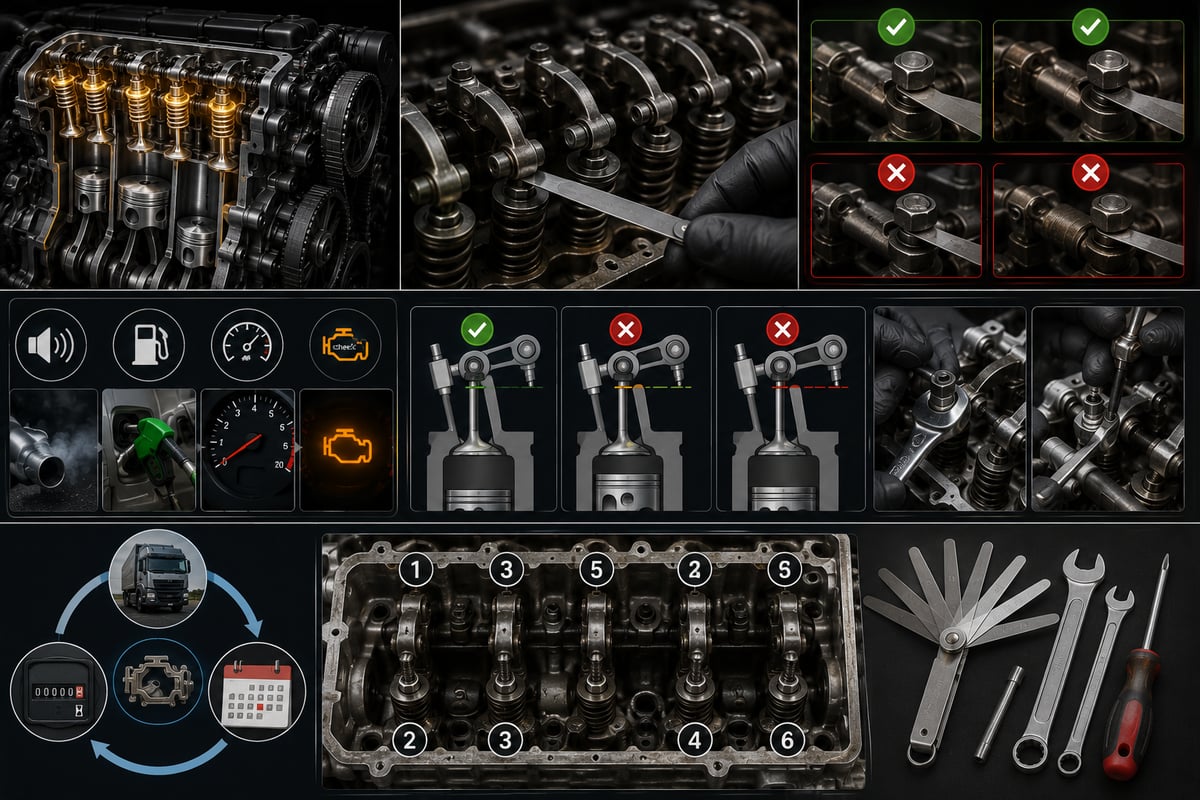
A steady tap under the valve cover on a cold start-up is usually written off as normal cold-engine noise. A few months later the same tractor unit won't pull torque on a grade, and one cylinder's compression comes back noticeably low; pull the cover and the exhaust valve seat shows clear burn marks. The only thing that changed in between is a gap measured in tenths of a millimetre. This guide treats valve clearance adjustment not as a routine service item, but as a measurement discipline governing how the chain from camshaft to valve head behaves as it heats up.
What is valve clearance, and why is it left in place?
Valve clearance is the free gap deliberately left in the closing chain while a valve is shut; valve adjustment brings that gap to the value the engine manufacturer specifies. The gap is not a flaw or a manufacturing tolerance — it is part of the design. Its purpose: to stop the parts that expand as the engine reaches operating temperature from lifting the valve off its seat, so it can never fully close.
The reason is thermal expansion. As the engine goes from cold to operating temperature, the valve stem, rocker, pushrod and cylinder head heat up at different rates and grow by different amounts. The exhaust valve has it worst: the full flow of hot combustion gas passes over it, so it's the hottest link in the chain and stretches the most. If no clearance were left when cold, the stem — now longer once hot — would bear against the rocker and hold the valve open by a few hundredths of a millimetre, and even a gap that small takes an engine down within a short time.
The clearance has a second, less obvious job. A valve sheds the heat it absorbs two ways: through the stem into the guide, and through the head into the seat and from there into the cooled cylinder head. That second path only works while the valve is fully seated. As clearance closes up, contact time and pressure both drop, the valve stops shedding its own heat, the material softens as temperature climbs, and the process feeds on itself.
Valve clearance or valve lash? Which term is used where?
Both terms describe the same measurement, and there is no difference in meaning between them. Valve clearance is the term used in OE service literature for the European heavy-duty market and by most engine makers worldwide, and it's the term used throughout this guide. In North America the same measurement is commonly called valve lash, and the job itself is often called a "lash adjustment" or simply "setting the valves." You'll also see it as rocker clearance or tappet clearance, depending on the manual.
How does the valve train work, and where does the clearance sit in the chain?
Most heavy-duty diesel engines run a valve train where force travels through a long mechanical chain: the camshaft lobe rotates and lifts the tappet; the tappet passes that motion to the pushrod; the pushrod pushes one end of the rocker arm; the rocker pivots on its shaft and, with its other end, pushes down on the valve — or on the bridge that presses two valves at once; the valve spring then returns the valve to its seat once the cam lobe has passed.
Clearance is measured at the last link of that chain: between the end of the rocker facing the valve and the top of the valve stem, or, on bridge-equipped valve trains, between the rocker and the bridge. One condition makes the reading valid, and most field errors trace back to skipping it: at the moment of measurement, that valve's tappet must be sitting on the base circle of the camshaft. The base circle is the round section of the cam lobe with no lift; while the tappet sits there, the chain is free of load and the true clearance can be read. If the cam has already moved a few degrees onto the opening ramp, the reading comes out smaller than it really is, and the adjustment leaves too much clearance in the engine.
The clearance you measure is not the clearance the valve actually gets
The rocker arm is a lever, and on most engines the arm lengths on either side of the shaft are unequal, so movement on the pushrod side and on the valve side are related by a ratio, not identical. A clearance figure only means anything when measured at the exact point the manufacturer specifies. Depending on the engine, that point can be the rocker tip or the adjusting screw on the pushrod side; change the point and the figure changes with it, and applying the manual's number at the wrong point throws the setting off from the start.
The valve bridge and engine brake mechanism
On modern engines with two intake and two exhaust valves per cylinder, the rocker acts on the valves through a bridge that presses both at once. That bridge has to sit level; on some engines the bridge carries its own adjusting screw, and bridge balance is set before valve clearance is touched. On vehicles with a compression-release engine brake, the brake mechanism's own operating clearance is a separate figure; on unit-injector engines, injector preload is a third item set under the same cover. Because these three adjustments influence each other, the OE sequence should never be reordered.
The two faces of incorrect clearance: tight and wide
A valve clearance problem is not a single failure mode; depending on which way the gap has drifted, two entirely different damage mechanisms take hold. The most dangerous assumption is that a quiet engine has good clearance: wide clearance makes noise and gets noticed, while tight clearance creeps along silently — and it's the one that actually takes the engine down.
| Criterion | Tight or zeroed clearance | Excessively wide clearance |
|---|---|---|
| Sound behaviour | Usually silent; the engine can sound smoother than it is | A steady, speed-related tapping under the cover |
| Underlying mechanism | The valve can't fully close when hot; combustion gas blows by | The chain makes impact contact; the cam ramp gets skipped |
| Heat path | The valve can't shed heat through the seating face | Heat rejection is not affected |
| Valve timing | The valve opens early and closes late | The valve opens late and closes early; lift is reduced |
| Effect on performance | Compression drops, the cylinder goes weak, hard starting | Fill and scavenging efficiency drop; power and fuel are lost |
| Wear location | Valve head and seat; the exhaust side goes first | Rocker tip, adjusting screw, bridge, stem tip, pushrod |
| Rate of progression | Fast and irreversible; a burnt valve in short order | Slow; steadily grows both wear and noise |
| When it gets noticed | Late — only once power loss shows up | Early — the noise itself is the warning |
Why does tight clearance burn the valve?
Once the valve can no longer close fully when hot, high-temperature combustion gas starts escaping through the gap between the valve head and its seat. That leak passes through a narrow section, so it speeds up and cuts into the seating face like a torch. At the same time, because the valve can't shed its own heat, head temperature rises, the material softens, and the leak path widens further. Left running, this can crack the valve head and, later, separate a piece of it entirely — debris that does severe damage to the piston, liner, and cylinder head. Repairing a burnt valve and damaged seat is covered under engine valve train and adjustment shim failure symptoms and replacement; keeping clearance on schedule is what makes that repair unnecessary in the first place.
How does wide clearance wear the engine down?
A cam profile is not an arbitrary bump: ramps at the start and end of the lobe bring the motion in and out smoothly. Once clearance grows, the chain wastes those ramps and contact is re-established with an impact, right where the motion is accelerating hardest. That repeated impact, once per revolution, peens the rocker tip, the ball end of the adjusting screw, the bridge face, and the valve stem tip; as wear progresses the clearance opens further and the process feeds itself. Because the valve now opens later, closes earlier, and lifts less than designed, less air reaches the cylinder and exhaust can't fully scavenge. The result is power loss most visible at higher engine speed, rising fuel consumption, and darker exhaust smoke under load.
What symptoms show up when valve clearance is out of adjustment?
Valve clearance is one of the maintenance items most often confused with other faults. Not every noise from under the cover is clearance-related, and not every clearance problem makes noise. Reading the symptom together with the running condition — whether the noise is cold or hot, how it changes with speed, and whether it holds up under load — narrows the cause considerably.
| Symptom | Likely mechanism | Confirmation / check |
|---|---|---|
| Steady tapping under the cover that grows with engine speed | Clearance has widened; the rocker is striking the valve on impact | Pull the cover and measure every cylinder with a feeler gauge |
| Tapping when cold that disappears once warm | Clearance is at the upper limit and closes with expansion | Measure on a cold engine; check the oil circuit on hydraulic setups |
| Rough or uneven idle, shaking | One cylinder's valve isn't fully closing; low compression | Cylinder cut-out test, compression and leak-down test |
| Hard starting, long cranking when cold | Tight clearance is holding compression pressure below spec | Compare compression cylinder by cylinder |
| Power loss under load, can't hold a grade | Lift has dropped, or one cylinder isn't contributing | Compression spread compared against the clearance log |
| Unexplained rise in fuel consumption | Fill efficiency has dropped; the engine does the same work on more fuel | Compare the consumption trend against the clearance record |
| Weaker engine brake performance | The brake mechanism's own operating clearance has drifted | Check the brake mechanism separately, per the OE procedure |
A leak-down test (cylinder sealing test) is the most useful way to tell these symptoms apart. Compressed air is fed in with the cylinder at top dead centre on the compression stroke, and the source of any leak is listened for: from the intake manifold points to the intake valve, from the exhaust pipe points to the exhaust valve, and from the oil filler neck points to the rings or liner. Even when the measurement shows the clearance has gone tight, this is the only practical data that tells you whether the damage has reached the seating face.
When is valve clearance adjustment needed?
Valve adjustment comes up for three distinct reasons, and it pays not to mix them up: scheduled maintenance, a check triggered by a symptom, and a mandatory adjustment following work on the mechanism itself.
- Scheduled maintenance interval: the interval varies by engine family, duty cycle, and manufacturer; some engines specify it by distance, others by time. The vehicle's own maintenance schedule is the only valid source.
- Check after break-in or an overhaul: on a new or rebuilt engine, the seating faces bed in during the first hours of running and clearance tightens; the first-service check sets the tone for every interval that follows.
- Triggered by a symptom: if any symptom in the table above shows up — particularly a steady tap or unexplained low compression on one cylinder — the schedule is not worth waiting for.
- After any job that requires removing the valve cover: head removal, head gasket replacement, work on the rocker shaft or pushrods, injector removal, and valve grinding all make a follow-up adjustment mandatory, since re-torquing the cover bolts changes the chain's geometry.
- More frequently under severe duty: urban distribution, refuse collection, transit buses, concrete mixers, and mining — profiles combining high exhaust temperatures with frequent start-stop cycles — accelerate seat recession. On CNG bus engines, exhaust-side thermal load runs even higher.
How is it measured? Feeler gauges, and the hot-versus-cold difference
The measuring tool is a feeler gauge set: thin steel blades with the thickness stamped on each one. The correct-thickness blade is slid between the rocker tip and the valve stem. The right reading isn't "goes in or it doesn't" — it's a light, even drag: the blade should slide in without being forced, but not slip through loosely either. Forcing a blade in lifts the rocker and makes the clearance read wider than it is; a loosely sliding blade gives the impression the clearance is tighter than it actually is.
A more reliable method is two-blade verification: the blade one size below target should slide in easily, and one size above should not go in at all. This removes person-to-person variation in "feel" and keeps readings consistent where more than one technician works on the same engines. Feeler blades must be flat, clean, and unkinked; on a peened rocker tip a flat blade will never give an accurate reading, and the part needs assessing first.
Hot engine or cold engine — which is it set on?
The only correct answer is whichever condition the manufacturer specifies. Because clearance changes with temperature, the manual's figure is only valid at one specific engine temperature. Common practice on heavy-duty diesels is to set clearance cold, where "cold" means the engine has rested for several hours and dropped close to ambient — not merely cool enough to touch. Some engine families call for a hot measurement instead, and the manual's figure is written for that condition.
Mixing the two conditions up produces a systematic error: applying the cold figure to a hot engine tightens the clearance, and the hot figure on a cold engine leaves it too wide — in both cases the engine ends up out of adjustment even though the job was done. In fleet practice, the simplest fix is to pull vehicles needing a setting into the shop at the end of the previous shift.
Further reading
For a plain-language technical overview of this subject, see the reference article on Wikipedia. Always confirm specific figures and procedures against the vehicle manufacturer service data.
Positioning by firing order: which valve gets set when?
Because a valve's clearance can only be measured while its tappet sits on the camshaft's base circle, the measurement order depends on crankshaft position. Two methods are used in practice, and both arrive at the same result.
Cylinder-by-cylinder method: the crankshaft is turned until the cylinder being set reaches top dead centre on the compression stroke. In that position both of that cylinder's valves are closed, the rockers are free, and the clearance can be read. The position is confirmed against the TDC mark on the flywheel and its locating pin; the next cylinder in firing order is then set the same way.
Overlap method: while one cylinder's valves are at overlap — exhaust closing as intake opens — the cylinder paired to it in the firing order has its tappets on the base circle and is ready to be set. This is faster since it only needs watching the motion rather than hunting for a mark; the pairing table, though, is specific to the engine family and must come from the service manual.
Two discipline rules apply regardless of method. The crankshaft is always turned in its normal direction of rotation; turning it backward stacks the clearances up in reverse and throws the position off. Every valve set is marked as it's finished: on a twenty-four-valve engine, the only way to catch one missed valve afterward is to measure the whole engine again from the start.
How is valve clearance adjustment done, step by step?
The sequence below is a general framework; the order, measurement point, and tightening torque all vary by engine and should be taken from the OE documentation.
- Bring the engine to the temperature condition the manufacturer specifies; if a cold setting is called for, let the vehicle rest long enough.
- Secure the vehicle on level ground, apply the parking brake and chock the wheels; disconnect the battery master switch so the engine can't be cranked by accident.
- Clean around the valve cover; dirt dislodged during removal falls onto the rocker shaft and oil galleries. Follow the OE's renewal rule for gaskets and fuel line connections when removing the cover and any spacer parts.
- Before measuring, inspect the mechanism visually: rocker shaft bolt tightness, pushrod straightness, free seating of the bridges, condition of the adjusting screws and lock nuts, and any signs of lubrication.
- Turn the crankshaft in its normal direction to bring the first cylinder to top dead centre on the compression stroke; confirm the position against the timing marks and check by hand that the rockers are free.
- On engines with a bridge adjustment, set bridge balance per the OE procedure first, then move on to valve clearance.
- Slide the correct feeler blade between the rocker tip and the valve stem or bridge, and check for the light drag feel; confirm with a blade one size smaller and one size larger than target.
- If the value is off, loosen the lock nut and turn the adjusting screw until the feeler gives the correct feel.
- Hold the adjusting screw steady so it can't turn and tighten the lock nut to OE torque; if the screw rotates with the nut, the setting shifts, so always re-measure after locking.
- Since intake and exhaust values differ, confirm each time which valve belongs to which side, and mark every valve once set.
- Move to the next cylinder in firing order; on engines with an engine brake or unit-injector adjustment, carry out those items in the order the OE specifies.
- Once every cylinder is done, turn the crank over again and re-check a few of the first valves set; any deviation means an error occurred during locking.
- Clean the cover mating surfaces, fit a new gasket, and torque the cover down in the OE sequence and value; reconnect every line and connector disturbed.
- Start the engine and listen at idle and mid-range, check around the cover for oil leaks, and repeat the check after a short test drive.
- Log the measured and adjusted values, date, and odometer reading against the vehicle record; this is the only data that lets the next adjustment be compared against this one.
How rocker arm, rocker shaft, and tappet wear affect the setting
Valve adjustment is not a repair, it's compensation for wear. Clearance drifting over time is the sum of two opposing processes that can mask each other. On one side is valve seat recession: as the valve head and seat wear into one another, the valve migrates upward and clearance tightens. On the other is wear in the chain: the rocker tip, the ball end of the adjusting screw, the pushrod sockets, the bridge faces, and the valve stem tip all wear and open the clearance. A reading that comes back "normal" can hide the truth on an engine where these two effects cancel out — which is why visual inspection of the mechanism matters as much as the measurement itself.
A worn contact surface also distorts the measurement itself. A pit in the rocker tip stops a flat feeler blade from sitting fully against the surface, so the reading mixes the true clearance with the depth of the pit. Oval wear developing in the ball joint between the adjusting screw and pushrod, meanwhile, lets the setting drift again within a short time: the engine starts tapping a few thousand kilometres later, the most common cause behind "the adjustment doesn't hold" complaints. Inspection criteria and the replacement decision for these components are covered under rocker arm and shaft set failure symptoms and replacement.
The link between lubrication and adjustment
The rocker shaft and its bushings are fed by pressurised oil; if the feed gallery is blocked, or the oil change interval has repeatedly been overrun, the bushings wear quickly and give a reading that isn't repeatable. On an engine like that, adjustment only delays the problem, it doesn't fix it. If dry patches or a dark varnish layer show up on the shaft once the cover is off, the lubrication side needs assessing before the clearance does.
Do engines with hydraulic lifters need valve clearance adjustment?
On hydraulic-lifter valve trains, clearance isn't zeroed with a mechanical screw — it's taken up by a compensating element running on oil pressure. The piston inside the lifter uses engine oil pressure to keep the chain permanently at zero clearance and automatically compensates for temperature changes. Periodic valve adjustment isn't performed on this setup, because no clearance was ever left to adjust.
A significant share of heavy-duty diesel engines still keep a mechanical setup, and the reason is necessity, not design preference. Unit-injector fuel systems, compression-release engine brakes, and high-tension valve springs generate forces higher than a hydraulic compensating element can carry. Hydraulic compensation is far more common on light-duty and passenger-car diesel engines.
On a hydraulic setup, hearing a tap means an oil circuit problem, not a clearance problem. Common causes: low oil level, wrong oil viscosity, sludging inside the lifter from an overrun change interval, a blocked feed gallery, and air drawn in through the intake line. A tap lasting a few seconds after cold start is just the lifters filling with oil and isn't a fault on its own; if the noise runs longer, persists once warm, or comes from only one cylinder, the lifters and oil circuit need checking. On these engines the most effective maintenance isn't chasing an adjustment — it's keeping oil type and change-interval discipline in place.
Technical values and check points
The table below shows the check points and general order of magnitude involved. None of these figures may be used as the adjustment value for any engine; their purpose is to show the precision the measurement is made to and what needs to go into the record.
| Check point | General reference | Why it matters |
|---|---|---|
| Intake valve clearance | On the order of tenths of a millimetre; given smaller than the exhaust side | The intake valve runs cooler and needs less allowance for expansion |
| Exhaust valve clearance | Given noticeably larger than the intake side | The exhaust valve is the hottest link in the chain and stretches more |
| Engine brake mechanism | Has its own value and procedure, separate from valve clearance | A wrong value cuts braking power or creates a contact risk |
| Valve bridge adjustment | Present or absent depending on the engine; done before valve clearance if fitted | An unbalanced bridge under-closes one of the two valves |
| Measurement condition | Hot or cold, whichever the manual specifies | The same number means a different real clearance if the condition changes |
| Crank position | The relevant valve's tappet must be on the camshaft base circle | Measuring on the ramp is systematically wrong |
| Lock nut tightening torque | Applied to the OE value with a torque wrench | Too loose and the setting slips; too tight and the thread is stressed |
| Cover bolts | OE sequence and torque, new gasket where required | The wrong sequence stresses the cover face and causes oil leaks |
| Record | Measured and adjusted values, date, odometer reading | Only the record shows which way the clearance is drifting |
Maintenance, service life, and fleet practice
Valve clearance adjustment is one of the lowest-cost maintenance items with one of the highest costs for skipping it: repairing a burnt valve calls for removing the head and reworking the seat, while a clearance check is a job of a few hours in the shop. On the fleet side, the payoff comes from running the job on a programme rather than per-vehicle basis.
- Programme by engine family: vehicles sharing the same engine are grouped into the same maintenance window; the measurement order and values are prepared once.
- Recording the measured value: not just an "adjustment done" note — the value read before adjustment is logged for every valve, since that's the only data showing the trend.
- Reading the trend: an engine where clearances keep tightening has seat recession; one where they keep opening has chain wear — the two call for different action.
- Opportunistic check when the cover is already off: if the cover was removed for another job, the adjustment is done at the same time; removing it a second time is an unnecessary cost.
- Oil and tooling discipline: the right viscosity and interval determine bushing life; feeler blades get inspected regularly and torque wrenches stay on a calibration schedule.
- Driver feedback: a new noise, longer cranking when cold, or power loss on a grade gets logged and triggers a check without waiting for the interval.
Tracking compression values over time is also a low-cost early-warning method: a growing spread between cylinders shows one cylinder's valve side weakening well before the damage grows further.
Where does valve adjustment sit in the engine's mechanical chain?
Valve clearance is not a standalone component — it's the output of a chain. That chain starts at the camshaft: the lobe profile decides when the valve opens, by how much, and how fast. If the lobe surface is worn, the measured clearance grows; closing that gap with the adjusting screw quiets the noise but doesn't restore the lost lift, and the engine keeps under-breathing regardless. That's why a cylinder showing an unexpectedly large clearance reading also calls for reviewing the inspection criteria under camshaft failure symptoms, diagnosis, and replacement.
The middle of the chain holds the tappet, pushrod, rocker shaft, and bridge; wear there opens the clearance. The end of the chain holds the valve, spring, guide, seal, and seating face; recession there closes the clearance. The cover gasket, cover bolts, and lubrication circuit set the operating condition the whole chain works under. So what gets called "valve adjustment" is really a periodic health check reducing the combined condition of all these components to a single measured value.
Nearly every field problem falls under one of three headings: not following the manual's temperature condition and measurement point, the setting slipping during lock-down, or trusting a measurement taken on a worn mechanism. A shop that sets up the measurement condition correctly, verifies after every lock-down, and logs the values read removes most valve-related engine damage from its list before it starts. Whenever in doubt, the current OE service documentation specific to the vehicle's engine and chassis code is the authority.
The mechanism that carries this adjustment also wears in service; for the symptoms of play and the replacement procedure, see the rocker arm and shaft set guide.
Shop this part: Valve
In-depth technical guide: For fault diagnosis, step-by-step replacement and service intervals: Engine Valve Train & Adjustment Shim: Faults, Replacement, Care
Main guide: What Is a Crankshaft? Function, Failure Symptoms and Maintenance
Tags
Frequently Asked Questions
- What is valve clearance adjustment?
- Valve clearance adjustment is bringing the free gap left between the rocker arm and the valve stem while the valve is closed to the value the manufacturer specifies. This gap stops parts that expand as the engine heats up from holding the valve open. In the shop it's also called valve lash adjustment, rocker arm adjustment, or simply setting the valves.
- Why does valve clearance need to be adjusted?
- As the engine goes from cold to operating temperature, the valve stem, rocker, pushrod, and cylinder head heat up and grow at different rates, and the exhaust valve — the hottest part in the chain — stretches the most. Without clearance, the stem grown longer when hot would hold the valve off its seat. The gap also lets the valve shed heat through its seat while fully closed, so clearance is a cooling requirement as much as a mechanical one.
- When should valve clearance be adjusted?
- It's set in three situations: at the interval given in the vehicle's own maintenance schedule, whenever a symptom such as tapping or unexplained low compression appears, and after any job that requires removing the valve cover. Cylinder head gasket replacement, rocker shaft work, injector removal, and an engine overhaul all make a follow-up adjustment mandatory. The interval varies by engine family and duty cycle, so the vehicle's own service schedule is the only valid source.
- What happens if valve clearance is out of adjustment?
- If the gap is too tight, the valve can't fully close when hot; combustion gas leaks past the seat, the valve can't shed its own heat, and a burnt valve with lost compression follows quickly. If the gap is too wide, the chain runs on impact, the rocker tip and bridge wear, valve lift drops, and power and fuel economy suffer. Tight clearance is the more dangerous fault because it runs silently, while wide clearance at least announces itself with noise.
- Does a ticking noise always mean the valve clearance is off?
- A steady tap under the valve cover that grows with engine speed usually points to wide valve clearance. But the same sound can also come from a worn rocker shaft bushing, a loose fastener, or — on engines with hydraulic lifters — an oil circuit problem. The only reliable way to confirm the cause is to pull the cover and measure every cylinder with a feeler gauge.
- Is valve clearance set on a hot or a cold engine?
- Whichever condition the manufacturer's manual specifies; common practice on heavy-duty diesel engines is to set it cold, meaning the engine has rested for several hours and cooled close to ambient temperature, not just cool enough to touch. Applying the wrong condition produces a systematic error even with the correct figure: a cold value set on a hot engine leaves it too tight, and a hot value set on a cold engine leaves it too wide.
- What should valve clearance be set to?
- There's no single figure — clearance differs between intake and exhaust, and between engine families and power ratings from the same manufacturer, even within the same family. Values run in the tenths-of-a-millimetre range, with the exhaust side always set wider than the intake. The correct number must come from the current OE service manual for the vehicle's specific engine and chassis code, checked against the engine's data plate where fitted.
- Does valve clearance affect fuel consumption?
- Yes. When clearance widens, the valve opens later, closes earlier, and lifts less than designed, so less air reaches the cylinder and exhaust gas isn't fully scavenged. The engine ends up doing the same work on more fuel, and exhaust smoke darkens under load. Unexplained increases in fuel consumption are a reason to check the valve clearance log.
- Do engines with hydraulic lifters need valve clearance adjustment?
- No. Hydraulic lifters use engine oil pressure to keep the valve train permanently at zero clearance, so there's no gap left to adjust. A tap on this type of engine points to an oil circuit issue instead — low oil level, wrong viscosity, an overrun oil change interval, or a blocked feed gallery. Most heavy-duty diesel engines, though, still use a mechanical setup that does need periodic adjustment.
- Can valve clearance be adjusted without a workshop?
- The job needs a feeler gauge set, a torque wrench, and the engine's own service data; the measurement point, temperature condition, firing order, and lock nut torque are all specific to the engine. A single mistake, such as the adjusting screw turning while the lock nut is tightened, is enough to leave the engine out of adjustment. For that reason it should be done in a workshop with the correct documentation and equipment, with the measured values logged against the vehicle record.
Related Articles

Oil Filter Cap and Housing: Leaks, Cracks and Seal Replacement
Truck engine oil filter cap and housing: why plastic caps crack, O-ring leak causes, bypass valve faults, and correct torque and seal replacement steps.
Piston Rings: Oil Consumption, Compression Loss and Replacement
Ring-related oil consumption and compression loss in truck diesel engines: how rings seal, blow-by and leak-down tests, ring gap and replacement.
Intake Manifold and Intake Pipe: Faults, Diagnosis, Repair
How the intake manifold and charge air pipe work on truck diesel engines, how to spot boost leaks, run a pressure test and fit them leak free.