What Is Antifreeze/Coolant? Red vs Green Coolant Difference, and When to Change It
What is antifreeze? A heavy-duty guide to coolant chemistry, red vs green differences, mix ratios, and when to change it.
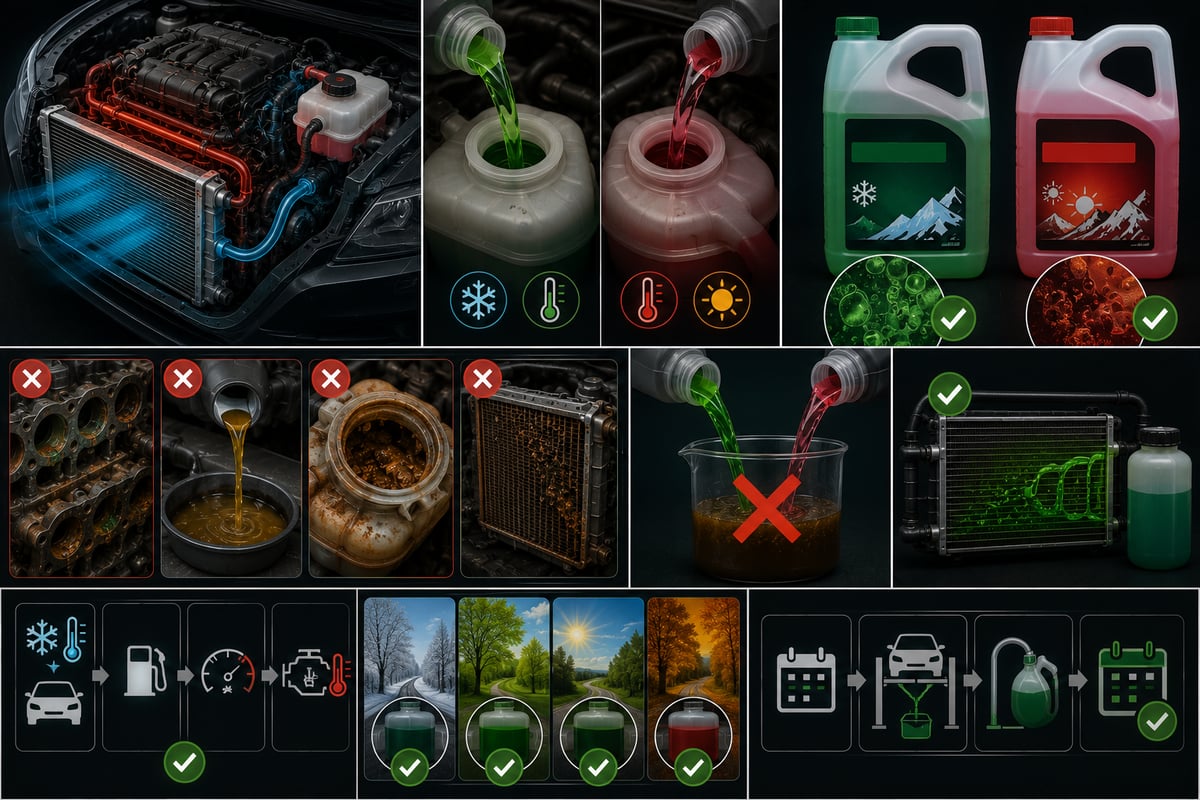
Two tractor units sit side by side in a fleet yard. The coolant in one expansion tank is clear and bright. In the other, after a few hurried roadside top-ups, it has turned a muddy brown. The second truck's driver hasn't logged a complaint, and the temperature gauge reads normal. But that tank no longer holds a protective fluid — it holds a sludge of spent additive. That is the quiet danger of antifreeze: when it degrades, it rarely fails loudly. It eats away at the cylinder liner, wears down the water pump seal, and hands the engine the bill months later. This guide treats antifreeze not as a winter item, but as the year-round chemical protection layer of a heavy-duty cooling system.
What Is Antifreeze? Composition and Its Role in Heavy-Duty Vehicles
Antifreeze is a glycol-based technical fluid mixed with water at a defined ratio in the engine cooling circuit; it lowers the freezing point, raises the boiling point, and — through its additive package — protects the metals in the circuit from corrosion and the cylinder liner from cavitation. The name points to a winter-only function, but in a heavy-duty vehicle most of the wear it prevents has nothing to do with cold weather; the real damage happens on the hot side of the system.
The fluid has three building blocks. The first is the base fluid: most commonly monoethylene glycol, less commonly monopropylene glycol. Glycol is what changes water's freezing behaviour and raises its boiling point. The second is water itself, which does the real job of carrying heat, since water's specific heat is higher than glycol's. The third — and technically the most critical — is the additive package: corrosion inhibitors, anti-cavitation agents, anti-foam agents, and pH buffers. What separates one antifreeze from another isn't the glycol; it's the chemistry of this package.
In a heavy-duty vehicle the circuit volume is many times larger than in a passenger car. On a tractor unit, the radiator, block and head water jackets, oil cooler, EGR cooler, cab heater, and the water-cooled cylinder head of the air brake compressor all sit on the same loop. That means tens of litres of fluid and a wide mix of metals — cast iron, aluminium, copper, brass, solder, and steel. The additive package is balanced to protect all of them at once; any change that upsets that balance produces damage starting at the weakest metal in the chain. Antifreeze is not a fuel or oil additive; ethylene-glycol based fluid is toxic, and used fluid must be disposed of as hazardous waste.
What Does Antifreeze Do? Four Jobs in One Fluid
Antifreeze carries out four jobs at once in a heavy-duty vehicle, and losing any one of them produces its own failure pattern.
1. Preventing freezing. Water expands as it freezes, and when the expanding ice has nowhere to go in a sealed circuit, it breaks the weakest point: the radiator core, the heater core, the water pump housing, or the engine block itself. A cracked block turns a cold morning into the cost of an engine replacement.
2. Delaying boiling. A loaded tractor climbing a long grade at low speed in summer heat puts the cooling system under its heaviest load. The mixture boils at a higher temperature than plain water, and a pressurised circuit pushes that limit further still. Boiling fluid produces vapour pockets, and vapour doesn't carry heat — the moment boiling starts, cooling collapses.
3. Stopping corrosion. Plain water in a hot, oxygen-rich circuit holding several different metals produces rust, pitting, and galvanic corrosion; the resulting deposits narrow the radiator core passages, settle in the thermostat housing, and wear down the water pump impeller. The additive package breaks this chain by forming a thin protective film on metal surfaces.
4. Preventing cavitation. This job is specific to heavy-duty diesel engines. In wet-liner engines, combustion pressure makes the liner vibrate at high frequency; that vibration creates momentary low-pressure zones on the liner's outer surface, the fluid flashes to vapour locally, and the collapsing bubbles chip away micron-sized particles of metal, eroding the surface. Nitrite- or molybdate-based additives build a protective layer on that surface that stops the erosion.
Because all four jobs live inside the same fluid, the "top up with antifreeze in winter, add water in summer" habit causes direct damage: the added plain water dilutes the additive concentration and pulls the boiling limit down.
How Antifreeze Works: Mix Ratio, Freezing and Boiling Point
Glycol makes it harder for water molecules to form an ordered ice lattice; the mixture solidifies at a much lower temperature than plain water and, because vapour pressure drops, boils at a higher one. The relationship isn't linear, though: past a certain point, adding more glycol stops improving freeze protection — and it degrades the fluid's heat-carrying capacity.
Here is the critical point: the best freeze protection does not come from pure antifreeze. Pure concentrate freezes at a much higher temperature than when it is mixed with water. The idea that "more antifreeze is always better" is wrong for this reason, and it leaves the circuit vulnerable to both freezing and overheating.
| Antifreeze ratio by volume | Approximate freeze protection | Assessment |
|---|---|---|
| Plain water (0%) | Roughly 0°C | No corrosion or cavitation protection; unsuitable for permanent use |
| Roughly 40% | Roughly -24°C | Lower limit accepted by most manufacturers in mild climates |
| Roughly 50% | Roughly -35°C | Common factory fill; best balance of protection and heat transfer |
| Roughly 60% | Roughly -50°C | For very cold climates; heat transfer capacity drops somewhat |
| 70% and above | Protection starts to worsen again | Heat transfer drops noticeably, raising summer overheating risk |
| Pure concentrate (100%) | Roughly -13°C | Never used alone; gives the worst freeze protection |
Pressure shifts the table upward again. The pressure valve in the radiator or expansion tank cap holds the circuit above atmospheric pressure, and each extra pressure stage raises the boiling point noticeably. A tired cap with a hardened seal, or one rated to the wrong pressure, can cause an overheating complaint on its own; cap and tank behaviour is covered in detail in our Truck Radiator & Expansion Tank guide.
How the mixture circulates through the loop is set by the thermostat: if it opens late the fluid overheats unnecessarily; if it stays stuck open, the engine never reaches operating temperature and both fuel consumption and internal wear increase. Symptoms and how to confirm them are covered in our Engine Coolant Thermostat guide.
What Water Should Be Used? The Damage Tap Water Does to the Circuit
Half the mixture is water, and the quality of that water is often more decisive than the antifreeze brand. In a heavy-duty vehicle, only demineralised or deionised water should be used; tap water, well water, and spring water are not suitable for this job.
The reason is chemical. Tap water carries calcium and magnesium salts, chloride, and sulphate. The hardness salts form a scale layer on the hottest surfaces in the circuit — exactly where heat needs to be rejected — and that layer acts like insulation, causing local overheating of the liner surface. Chloride, meanwhile, punches through the protective oxide film and starts pitting corrosion. On top of that, these ions consume the additive package and shorten the fluid's service life.
The most practical shop-floor solution is to use pre-mixed, ready-to-use antifreeze; water quality is controlled at the factory and the risk of a wrong mix ratio at fill-up disappears. If concentrate is used instead, the mix should be prepared to the correct ratio in a clean container, not blended in the vehicle. Pouring concentrate into the engine first and topping up with water afterward creates pockets of very high glycol concentration that impair cooling.
Red vs Green Antifreeze: What the Colour Tells You — and What It Doesn't
This is the most common and most expensive misunderstanding in the field. Antifreeze colour is not standardised. Colour is simply a dye added afterward; it has no chemical function whatsoever, and there is no binding international colour code. The same green can hide two completely different additive chemistries, and two manufacturers' reds don't necessarily belong to the same class either.
Colour's only real purpose is practical convenience: it makes a leak easier to trace visually. Beyond that, deciding "this vehicle takes red" based on colour is technically no different from deciding "this vehicle takes the one with the blue cap."
That said, there is a field tendency, and it is the source of the confusion: traditional inorganic-additive fluids have historically been mostly green or blue, while long-life organic-acid fluids have mostly been dyed red, orange, pink, or purple. This is a tendency, not a rule. The rule is: the fluid is chosen by the specification it meets, not by its colour.
The correct choice comes from the approval list the engine manufacturer requires: manufacturers such as Mercedes-Benz, MAN, Volvo, Scania, DAF, Iveco, Renault Trucks, and Cummins each have their own coolant approvals. What to look for on the jug isn't a colour name, it's these approval codes; the required specification is listed in the vehicle's service manual and should be recorded on the vehicle's fleet card.
Antifreeze Types and the Consequences of Mixing Them: IAT, OAT, HOAT, NOAT
Antifreezes are classified by the chemistry of their additive package; knowing these four families makes the colour debate irrelevant.
IAT (Inorganic Additive Technology) is the traditional family; it uses inorganic inhibitors such as silicate, phosphate, borate, and nitrite. It builds a protective film quickly, but because the film is thick it depletes over time and somewhat hinders heat transfer. OAT (Organic Acid Technology) is carboxylate-based; the film is extremely thin, so it barely affects heat transfer, and because the additive is only consumed where corrosion actually starts, service life is noticeably longer. On the other hand, the film takes longer to build, and its chemistry breaks down if mixed with silicated fluids. HOAT (Hybrid OAT) combines the two approaches by adding silicate or phosphate to an organic-acid package. NOAT (Nitrited OAT) is developed specifically for heavy-duty diesel engines: nitrite, and in most formulations molybdate as well, is added to the OAT package — and the reason isn't corrosion alone, it's wet-liner cavitation.
| Family | Additive chemistry | Common colour (not binding) | Service life | Assessment for heavy-duty vehicles |
|---|---|---|---|---|
| IAT (traditional) | Silicate, phosphate, borate, nitrite; thick film | Green or blue | Short; needs interim top-up | Used in older-generation engines; liner protection drops quickly without follow-up |
| OAT (organic acid) | Carboxylate-based; no silicate or phosphate | Red, orange, pink, purple | Long | Nitrite-free pure OAT can fall short on cavitation protection in wet-liner engines |
| HOAT (hybrid) | Organic acid plus silicate or phosphate | Yellow, turquoise, purple, pink | Medium to long | Silicate-supported variants are common in European-origin heavy-duty vehicles |
| NOAT (nitrited organic acid) | Organic acid plus nitrite, mostly molybdate | Red, pink, yellow | Long; can be extended with a top-up additive | Developed for wet-liner heavy-duty engines; strongest cavitation protection of the group |
The right way to read this table is to stop asking "which one is better" and start asking "which one does my engine call for." A wet-liner tractor engine and a dry-liner light commercial engine don't have the same requirement; the decision always comes from the OEM approval list.
Topping up with whatever jug is at hand on the roadside is the most common self-inflicted failure in these circuits, and it has four consequences. First is a shortened service life: when a short-life fluid gets mixed into a long-life one, the blend's service life drops to that of the shorter-lived fluid — with no warning light to show it. Second is additive precipitation and gelling: when a silicated package mixes with an organic-acid package, components meant to stay dissolved fall out of solution; the precipitate builds up in the narrow channels of the radiator and heater core and coats sensor tips. Third is loss of cavitation protection: adding a nitrite-free fluid to a nitrited one dilutes the concentration so the protective film can't form, and the first sign is often liner pitting found only when the engine is stripped down. Fourth is foaming: incompatible packages upset the anti-foam balance; foaming fluid doesn't carry heat and carries air into the water pump impeller.
If a mix is suspected, the course of action is clear: drain the entire circuit, flush it if needed, and refill with a single specification. "Drain half and top up with the new one" is not a fix, because it keeps the incompatible additive in the loop.
Further reading
For a plain-language technical overview of this subject, see the reference article on Wikipedia. Always confirm specific figures and procedures against the vehicle manufacturer service data.
Cylinder Liner Cavitation and Nitrite Monitoring
This is the technical issue that separates a heavy-duty vehicle from a passenger car, and it's the real reason for careful antifreeze selection. In wet-liner diesel engines, the liner is in direct contact with the coolant on its outer surface. On every combustion cycle, piston side-thrust puts the liner through a very brief but high-frequency vibration. As the liner moves outward it pushes the fluid; as it snaps back inward it leaves a momentary pressure drop behind it. Where that pressure locally drops below the fluid's vapour pressure at that temperature, microscopic vapour bubbles form; when the pressure returns, those bubbles collapse against the liner surface, and each collapse chips away a micron-sized fragment of metal.
The process is slow but cumulative: first small black spots appear, then pinhole pits, then deepening craters, and eventually a hole clean through the liner wall. A perforated liner puts coolant into the sump oil or the combustion chamber; at that point it is no longer a cooling-system failure, it is an engine overhaul.
The chemical defence works through nitrite and molybdate. These components form a thin, hard, self-renewing passive film on the liner surface; when a bubble collapses, that film absorbs the energy instead of the bare metal. Because the film is continuously consumed, nitrite concentration drops over time and is a maintenance figure that needs monitoring. In traditional systems, a supplemental additive is added at service intervals; some heavy-duty engines instead use an additive-releasing coolant filter that feeds additive into the fluid gradually.
There are also mechanical factors that raise cavitation risk and that chemistry alone cannot fix: incorrect liner seating, the wrong O-ring selection, trapped air in the circuit, and low system pressure from a tired cap. If there is air in the circuit, even the best antifreeze cannot fully stop cavitation.
How Is Antifreeze Tested? Refractometer, Test Strips, and pH
Coolant is a fluid that, like engine oil, needs to be measured regularly. Looking at it isn't enough: a fluid that looks clear can already have a depleted additive package. In a fleet, measurement replaces guesswork.
| Method | What it measures | How to read it, and its limits |
|---|---|---|
| Refractometer | Glycol concentration and freeze point | The measured freeze point must sit below the value required for the vehicle's climate; ethylene and propylene glycol use separate scales |
| Multi-parameter test strip | Freeze point, nitrite and molybdate concentration, pH | The colour scale is compared against the manufacturer's range; an expired or damp strip gives an unreliable result |
| pH measurement | Whether the fluid has turned acidic | Fresh fluid sits clearly on the alkaline side; drifting toward neutral signals additive depletion, but it alone doesn't decide service life |
| Electrolysis (stray current) test | Circuit voltage and fluid conductivity | Depleted fluid becomes conductive; rising voltage points to electrolytic corrosion, with the limit taken from the OEM document |
| Combustion gas test | Whether combustion gas is present in the fluid | A colour-change reagent reveals a leak; used when a head gasket leak or perforated liner is suspected |
| Laboratory analysis | Additive concentrations, metal wear traces, contamination | The most reliable method for an extended-service decision; the sample must come from a clean container and the right sampling point |
Two mistakes are common when sampling. The first is taking it from the top of a settled tank; the fluid there may not represent the whole circuit. The second is using a dirty container; a single drop of oil or detergent throws the analysis off.
When Should Antifreeze Be Changed? Service Life and Reasons for Early Replacement
Antifreeze's glycol doesn't deplete over time — what depletes is the additive package. That's why the change decision is answered not by "is the fluid old" but by "is protection still there." The schedule is built from two inputs: the manufacturer's recommended interval and the measurement results.
Traditional inorganic-additive fluids have a short service life, and interim additive top-up is part of routine maintenance. Long-life organic-acid fluids have a notably longer life; many manufacturers call for a single top-up at the midpoint. The exact interval comes from the OEM service manual; whichever comes first, distance or time, applies.
Regardless of the schedule, the fluid is changed before its interval is up if any of the following apply:
- Suspected mixing: if a fluid of a different specification is known or suspected to have been added.
- Oil or fuel contamination: an oil film, a brown emulsion, or a fuel smell in the tank; refilling with fresh fluid before finding the source contaminates the new fluid too.
- Combustion gas leak: a positive block test, or bubbles rising in the tank at idle.
- Fill with unsuitable water: if a significant part of the circuit was topped up with tap or well water.
- Out-of-range measurement: if freeze point, nitrite concentration, or pH falls outside the manufacturer's range.
- After a major repair: following work that opens the circuit, such as cylinder head, liner, oil cooler, or water pump replacement.
One more warning: fluid isn't consumed in a sealed circuit, so a dropping level is not normal consumption. A vehicle that keeps needing top-ups needs a leak search; the leak can be external, or it can run from the oil cooler into the oil, from the EGR cooler into the exhaust, or from the head gasket into the combustion chamber.
Draining, Flushing, and Refilling the Cooling Circuit
This job is different on a heavy-duty vehicle, both in volume and in how hard it is to bleed the air out. In a circuit holding tens of litres, a single trapped air pocket comes back as a non-working heater or temperature swings — and worse, a circuit carrying air raises cavitation risk.
- Secure the vehicle on level ground, let the engine cool, and confirm pressure has dropped; opening a cap on a hot circuit risks a burn injury.
- Prepare a container of sufficient volume, with a lid and a label, to collect the old fluid. Ethylene glycol is hazardous waste — never drain it onto the ground or into a drain.
- Set the cab heater valve to the open position; a closed heater circuit traps some of the old fluid inside and contaminates the fresh charge.
- Open the radiator drain plug and the block drain plugs specified by the manufacturer to fully drain the circuit. Draining from the radiator alone leaves a significant portion of the circuit full.
- Inspect the drained fluid visually: if it shows an oil film, metallic glitter, gel-like sediment, or a heavy rust colour, don't refill with fresh fluid until the cause is found.
- If the circuit is dirty, flush it with a cleaner approved by the manufacturer; circulate the flush fluid for the specified time, then drain it completely.
- After flushing, rinse the circuit with clean demineralised water and drain the rinse water completely too. Leftover cleaner residue consumes the new fluid's additive package.
- Refit the drain plugs with new seals and to OEM torque; use the opportunity to check hoses, clamps, and the tank cap.
- If an additive-releasing coolant filter is fitted, replace it with the type matched to the fluid being switched to.
- Fill the circuit with pre-mixed fluid, or with a pre-measured mixture, at the rate the manufacturer specifies. Fast filling traps air; feed the fluid slowly and with pauses.
- Use the bleed screws in the manufacturer's specified sequence, keep the vehicle in the recommended position, and watch the tank level throughout the fill.
- Run the engine until the thermostat opens, run the heater at full heat, and raise engine speed to help air escape; top up the level as it drops.
- Once the engine has cooled, check the level one final time, measure the freeze point with a refractometer, and confirm nitrite concentration with a test strip if applicable.
- Record the specification, quantity, measurement result, and date of the fluid used in the vehicle file. This record is the only reliable safeguard against using the wrong fluid at the next fill.
A slight level drop in the first few days after the job is normal, caused by remaining air working its way out. A persistent drop calls for a leak investigation.
Symptoms and Diagnosis of the Wrong or Depleted Antifreeze
Most coolant-related failures look, at first glance, like they're pointing at some other part of the circuit rather than the fluid itself. The table below ties each symptom back to its chemical cause.
| Symptom | Likely mechanism | First check |
|---|---|---|
| Gel-like or powdery sediment in the tank | Incompatible additive packages mixed, silicate or phosphate drop-out | Check fluid history, sample from the bottom of the tank |
| Fluid turned brown or rust-coloured | Additive depleted, corrosion under way; usually tap water or an overdue change | Read pH and nitrite test strip, inspect internal circuit surfaces |
| Oil film or brown emulsion on the surface | Oil cooler, cylinder head gasket, or EGR cooler leak | Check for coolant on the oil side too, run a pressure test |
| Weeping from the water pump weep hole | Seal surface worn by abrasive sediment or degraded fluid | Remove the belt, check play and noise, assess fluid condition together |
| Overheating on grades, normal temperature on flat roads | Reduced heat transfer: excess glycol ratio, core deposits, or low system pressure | Measure ratio with a refractometer, pressure-test the cap |
| Level dropping with no visible leak | Internal leak: perforated liner, head gasket, cooler internal leak | Run a system pressure test and a combustion gas test together |
| Hoses gone soft, or hardened and cracked | Elastomer degradation from an unsuitable fluid or oil contamination | Inspect hose interior, confirm fluid specification |
| Freezing in the circuit in winter, cracked hose or core | Diluted mix ratio, plain-water top-up | Measure freeze point, check fill history |
| Whitish deposit on aluminium, green colouring on solder | Electrolysis or additive imbalance | Measure stray current in the circuit, check chassis grounds |
One row deserves special attention: the water pump's mechanical seal is lubricated and cooled by the coolant itself; a depleted fluid carrying sediment grinds against that surface like sandpaper. In other words, the complaint "the water pump we just fitted is leaking again" is often not the pump's fault but the old fluid left in the circuit. Symptoms and replacement procedure on the pump side are covered in our Water Pump guide.
Technical Values and General Reference Ranges
| Parameter | General reference | Interpretation |
|---|---|---|
| Factory fill mix ratio | Typically around 50% by volume | Can be raised within manufacturer limits for colder climates |
| Lower and upper mix limit | 40% to 60% for most manufacturers | Protection falls short below it; heat transfer drops above it |
| Water to use | Demineralised or deionised water | Tap, well, and spring water bring in deposits and chloride |
| System pressure | The value printed on the cap is authoritative | Pressure raises the boiling point; a tired cap causes overheating |
| Nitrite and molybdate concentration | Between the lower and upper limit set by the manufacturer | Too little leaves the liner unprotected; too much causes precipitation and wear |
| Change interval | Short for traditional fluid, long for long-life fluid | Whichever comes first, distance or time, applies |
Fleet Discipline: Turning Antifreeze into a Maintenance Line Item
Using the correct fluid in a single vehicle is easy; keeping that same discipline across a thirty-vehicle fleet is a systems problem. Almost every antifreeze-related failure traces back not to a lack of chemical knowledge, but to a lack of record-keeping and fill discipline.
- Specification consolidation: reduce the number of fluid types used across the fleet; if two types are unavoidable, mark the jugs and fill equipment separately.
- Vehicle card: record the specification in use, the date and mileage of the last change, and the last measurement result on the card; drivers and roadside assistance should be able to access it.
- Dedicated equipment: keep a funnel, container, and pump used only for coolant. A container that has held oil or fuel contaminates the circuit even on a single use.
- Roadside top-up rule: carry a ready-mixed fluid matching the specification used on the vehicle; log any fluid and quantity added out of necessity.
- Periodic measurement and trend tracking: read freeze point, and nitrite and pH where applicable, at every service. Base the decision on the trend over time, not a single reading.
- Storage: keep jugs sealed, in a cool spot out of direct sunlight; don't let an opened jug sit for a long time.
Where Does Antifreeze Sit in the Cooling Chain?
Antifreeze isn't one part of the cooling circuit — it's the shared medium every other part operates inside. The water pump circulates it and is itself lubricated by the fluid it moves; the thermostat decides which loop it takes; the radiator and expansion tank reject heat and absorb volume change; the cap sets system pressure; and the oil cooler, EGR cooler, cab heater, and water-cooled air brake compressor head are all consumers drawing on that same fluid.
The chain's logic is this: when the fluid degrades, the damage doesn't show up in the fluid — it shows up at the chain's weakest link. Depleted fluid first narrows the radiator passages and produces an overheating complaint; then it wears the water pump seal and arrives at the shop as a pump failure; and at the end it erodes the wet liner and turns into an engine overhaul. All three failures share the same root cause.
The correct order is fixed: document which specification is required first, then prepare the fluid with the right water at the right ratio, then drain and refill the circuit fully and bleed the air out, and finally sustain it with measurement and record discipline. It isn't a decision made by looking at the temperature gauge — protection can already be gone while the gauge still reads normal. In every case, the current OEM service documentation for the vehicle's engine and chassis code is authoritative.
Shop this part: Cooling System
Main guide: Water Pump: Faults, Replacement & Maintenance Guide
Tags
Frequently Asked Questions
- What is antifreeze and what does it do?
- Antifreeze is a glycol-based technical fluid mixed with water at a set ratio in the engine cooling circuit. It lowers the freezing point and raises the boiling point, and its additive package protects the metals in the circuit from corrosion and the wet cylinder liner from cavitation. In other words, it isn't just a winter item — it's a protection layer that works year-round.
- What is the difference between red and green antifreeze?
- Colour isn't standardised; it's simply a dye added afterward, and there's no binding international colour code. The field tendency is that traditional inorganic-additive fluids are usually green or blue, while long-life organic-acid fluids are usually red, orange, or pink. But that's a tendency, not a rule: the choice is made by the specification the engine manufacturer requires, not by colour.
- Can different brands or colours of antifreeze be mixed?
- They shouldn't be. Incompatible additive packages cause gelling and precipitation, the mixture's service life drops to that of the shorter-lived fluid, and diluted nitrite concentration means liner cavitation protection is lost. If a mix is suspected, drain the entire circuit, flush it if needed, and refill with a single specification.
- What is the correct antifreeze-to-water ratio?
- A common factory fill is around 50% by volume, and that's where the balance between protection and heat transfer is best. Most manufacturers accept a range of 40% to 60%; below that, corrosion and cavitation protection fall short, and above it, heat transfer drops. The exact ratio comes from the current OEM service manual for the vehicle's engine and chassis code.
- Can pure, undiluted antifreeze be used on its own?
- No. Pure concentrate freezes at a much higher temperature than when it's mixed with water, meaning it gives the worst freeze protection. Its heat-carrying capacity is also low, which leaves the circuit vulnerable to overheating as well.
- Can tap water be added to antifreeze?
- It shouldn't be. Calcium and magnesium salts in tap, well, and spring water form a scale layer on the hottest surfaces of the circuit, while chloride punches through the protective oxide film and starts pitting corrosion. If it had to be used as a roadside emergency measure, that's temporary; the circuit should be drained and refilled with the correct mixture once the vehicle reaches the workshop.
- When should antifreeze be changed?
- The glycol itself doesn't deplete — it's the additive package that does — so the decision is based on both the schedule and the measurement together. Traditional fluids have a short service life and need an interim additive top-up; long-life organic-acid fluids last considerably longer. It should be changed early if there's suspected mixing, oil contamination, a combustion gas leak, or an out-of-range measurement.
- Why is nitrite additive important in heavy-duty vehicles?
- In wet-liner diesel engines, the liner vibrates at high frequency, and the vapour bubbles that form on its outer surface chip away micron-sized particles of metal as they collapse. Nitrite and molybdate build a protective passive film on that surface that stops the erosion. Because the film is continuously consumed, concentration drops over time — which is why nitrite is a figure that needs ongoing monitoring.
- How is antifreeze tested?
- Freeze point and glycol concentration are measured with a refractometer, using separate scales for ethylene and propylene glycol. A multi-parameter test strip also gives nitrite, molybdate, and pH readings. For a fleet-level decision on extending service life, laboratory analysis is the most reliable method.
- Why does the antifreeze level keep dropping?
- Fluid isn't consumed in a sealed circuit, so a vehicle that keeps needing top-ups has a leak somewhere. The leak can be external, or it can run from the oil cooler into the oil, from the EGR cooler into the exhaust, or from the cylinder head gasket into the combustion chamber. With no visible leak, a system pressure test and a combustion gas test are run together.
Related Articles

Engine Overheating in Heavy-Duty Trucks: Causes & Fixes
Learn why heavy-duty truck engines overheat, how to read the gauge, step-by-step diagnosis, and how coolant, water pump, thermostat, and fan clutch fail.
Fan Belt Tensioner: Failure, Replacement & Maintenance
What a truck fan belt tensioner does, why it squeals or vibrates, how to measure belt tension and how to replace a worn tensioner pulley bearing.
Water Pump: Faults, Replacement & Maintenance Guide
How the heavy-duty water pump keeps engine temperature in check, what fluid colour at the weep hole reveals about a failing seal, and safe replacement.