Choosing an Air Brake Compressor Manufacturer
A failed compressor does not stay isolated to one component line on a purchase order. In a commercial vehicle, it affects brake system readiness, air supply.
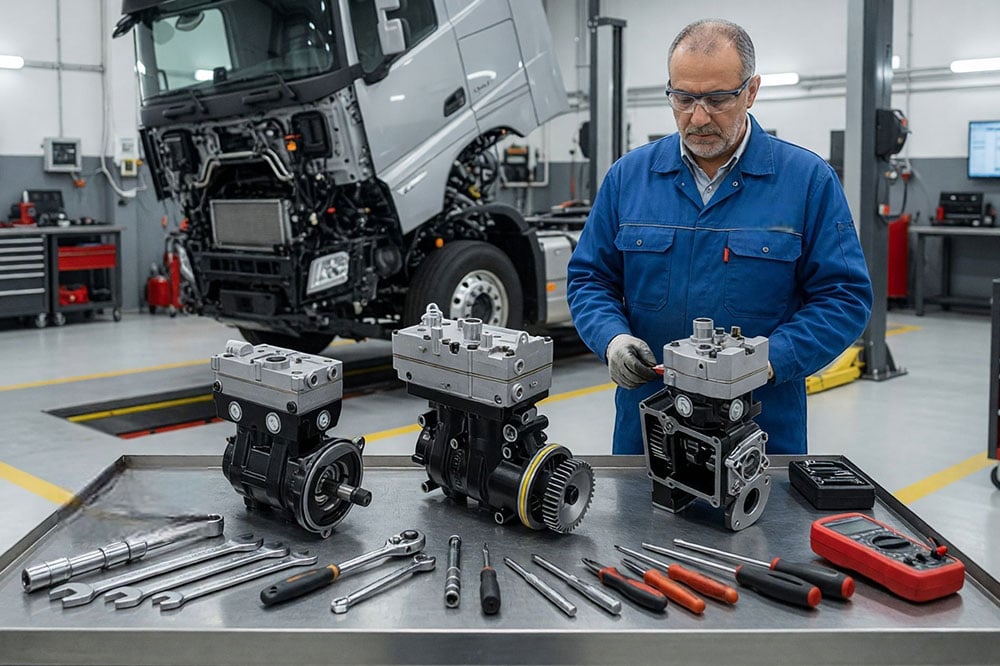
A failed compressor does not stay isolated to one component line on a purchase order. In a commercial vehicle, it affects brake system readiness, air supply stability, workshop scheduling, and vehicle uptime. That is why selecting an air brake compressor manufacturer is not a routine sourcing decision. For fleets, distributors, and service networks, it is a technical and operational decision with direct consequences in the field.
In the commercial vehicle aftermarket, compressors are expected to do more than meet a basic dimensional specification. They need to support dependable air generation under demanding duty cycles, maintain consistency across repeated orders, and match the installation realities of truck and bus service environments. The difference between an acceptable supplier and a capable manufacturer often becomes visible only after units are installed, warranty patterns start to emerge, or supply interruptions begin to affect service levels.
What sets an air brake compressor manufacturer apart
Not every supplier in the market has the same level of control over the product. Some businesses trade in compressors. Others assemble from externally sourced subcomponents. A true air brake compressor manufacturer has direct influence over engineering, machining, quality control, and final assembly. That distinction matters because compressor performance depends on the interaction of multiple tolerances, materials, sealing surfaces, and production disciplines.
For professional buyers, manufacturing depth is not a marketing detail. It is a practical indicator of whether the company can maintain repeatable quality, respond to technical issues, and support a broad range without losing control of product integrity. In air brake systems, even small deviations in critical areas such as internal wear surfaces, valve function, or mounting compatibility can create larger system-level problems over time.
A manufacturer with in-house capability is usually in a better position to validate design changes, monitor process stability, and trace issues to their source. That does not guarantee perfect performance in every case, but it does create a more reliable framework for quality management than a model built entirely around outsourced production.
Why manufacturing control matters in compressor performance
An air brake compressor works under mechanical load, thermal stress, and continuous operational pressure. In heavy-duty applications, reliability depends on stable production standards as much as on initial design. A compressor may look correct on paper yet still create premature wear, insufficient pressure build-up, oil carryover concerns, or installation challenges if manufacturing quality is inconsistent.
This is where production control becomes a decisive factor. When design, machining, inspection, and assembly are managed within one manufacturing structure, the producer can align the full process around application requirements. Critical dimensions can be monitored more closely. Material selection can be standardized. Testing can be linked to actual production batches rather than treated as a separate compliance exercise.
For buyers responsible for fleet continuity or distributor reputation, this level of control reduces uncertainty. It supports confidence that the compressor ordered today will perform like the compressor ordered six months from now. In aftermarket supply, consistency is often more valuable than claims of peak performance because repeated installation success is what protects workshop efficiency and customer trust.
Evaluating an air brake compressor manufacturer beyond the catalog
A broad catalog is useful, but range alone is not proof of capability. Buyers should look deeper into how the product portfolio is built and supported. A serious manufacturer should be able to demonstrate not only coverage, but also production discipline behind that coverage.
One of the first points to assess is technical specialization. Companies focused on commercial vehicle air brake systems generally understand the operating environment better than generalist parts suppliers. That specialization tends to improve fit accuracy, functional reliability, and application knowledge. It also matters when technical questions arise around compatibility, service expectations, or replacement planning.
The second point is production structure. If a manufacturer controls its own engineering and manufacturing processes, it is usually better equipped to maintain quality across high-volume and long-tail references. This becomes especially important for distributors and wholesalers serving mixed fleets, where one supply partner may need to cover multiple vehicle makes and operating profiles.
The third point is quality consistency over time. A professional buyer is rarely purchasing for a single installation. The real test is whether the same reference remains stable across repeat orders. If dimensions, materials, or service life vary from batch to batch, the cost is absorbed by the distributor, the workshop, or the fleet. That cost appears as returns, labor waste, vehicle downtime, and reputational damage.
The role of application coverage in aftermarket sourcing
In commercial transport, compressor sourcing is rarely limited to one platform. Fleets operate mixed vehicle populations. Independent service centers support different brands and model years. Distributors need stock that reflects real market complexity, not a narrow product window.
An effective manufacturer should therefore offer application breadth without sacrificing technical confidence. That means coverage across truck, bus, and other heavy-duty vehicle requirements, supported by disciplined reference management. Catalog depth is valuable when it reduces sourcing fragmentation and helps buyers consolidate purchasing under a technically credible supplier.
There is a trade-off here. Very wide product coverage can sometimes signal diluted manufacturing focus if it is not backed by genuine production capability. Buyers should distinguish between companies that simply list many references and those that can produce and support them with the same level of control. A large portfolio is an advantage only when quality systems and manufacturing resources scale with it.
Supply reliability is part of product quality
In the aftermarket, a compressor that cannot be delivered when needed is functionally the same as a compressor that does not exist. This is why evaluating an air brake compressor manufacturer should include supply performance, not only product specifications.
Professional buyers need stable replenishment, clear reference management, and confidence that a supplier can support ongoing demand. This is particularly important in brake-related categories, where delays can immobilize vehicles and disrupt maintenance planning. A manufacturer-led business with established production infrastructure is often better positioned to support continuity than a sourcing model dependent on multiple external producers.
Supply strength also supports long-term account development. Distributors and wholesalers do not just need products that perform well once. They need a partner that can help them serve their own customer base consistently. For fleet maintenance teams and service networks, dependable availability reduces the need for emergency substitutions that may complicate fitment or service outcomes.
What experienced buyers should ask
The right questions are usually straightforward. Does the manufacturer specialize in commercial vehicle air brake components, or is compressors only one small part of a broader, less focused range? Is production handled in-house, or is the business mainly coordinating external supply? Can the company support a wide set of references while maintaining consistency? Does its operational scale match the expectations of professional aftermarket supply?
It is also useful to look at how the manufacturer presents itself. Serious industrial producers tend to communicate through technical clarity, category depth, and production facts rather than broad claims. That approach reflects a stronger alignment with B2B purchasing logic, where buyers evaluate risk through evidence of capability.
A company such as VADEN ORIGINAL, with long-standing manufacturing experience and in-house control across commercial vehicle component production, fits the profile many professional buyers look for in this category. The reason is simple: compressor sourcing becomes more reliable when the producer has both air brake specialization and real manufacturing depth behind the product line.
The long-term value of choosing the right manufacturer
Price always matters, but compressor purchasing in the heavy-duty aftermarket should not be reduced to unit cost alone. The true cost sits across service life, installation success, warranty exposure, stock continuity, and vehicle uptime. A lower purchase price can quickly lose its advantage if quality inconsistency creates failures, returns, or repeat labor.
This is why experienced procurement teams often evaluate compressor suppliers through total operating value. A capable manufacturer helps reduce uncertainty across the full ownership cycle of the part. That benefit is not always visible in the quote sheet, but it becomes measurable in workshop productivity, distributor confidence, and fewer service disruptions in the field.
When brake system components are involved, predictable performance carries extra weight. These are not cosmetic items or low-risk accessories. They are part of the vehicle's operating reliability and safety support structure. Choosing a manufacturer with proven production discipline is a practical way to reduce avoidable risk.
For buyers in the commercial vehicle aftermarket, the strongest sourcing decisions usually come from looking past the label and evaluating the manufacturing reality behind it. If the compressor is expected to perform under real load, across real fleets, and through repeat ordering cycles, the manufacturer matters just as much as the part number. Choose the source with the engineering control, category focus, and supply strength to support the work your customers expect to complete every day.
Shop this part: Air Compressor
Frequently Asked Questions
- What should you look for most when choosing an air brake compressor manufacturer?
- The most important criteria are whether the manufacturer has direct control over engineering, machining, quality control, and final assembly, along with proven technical expertise and consistent quality from batch to batch over time. A manufacturer that manages its own production process in-house, such as VADEN ORIGINAL, can standardize critical dimensions and material selection to ensure this consistency.
- What's the difference between a supplier that trades compressors and a true manufacturer?
- Some businesses simply trade compressors or assemble outsourced sub-components, while a genuine air brake compressor manufacturer has direct influence over engineering, machining, quality control, and final assembly. This difference determines whether small deviations in critical areas, such as internal wear surfaces, valve function, and installation fit, turn into major system-level problems.
- Why does production control affect compressor performance so significantly?
- An air brake compressor operates under mechanical load, thermal stress, and continuous working pressure, so its reliability depends as much on consistent manufacturing standards as on the original design. When design, machining, inspection, and assembly are managed within a single production structure, critical dimensions can be monitored more closely; otherwise, even a compressor that looks correct on paper can end up with premature wear, inadequate pressure buildup, or oil carryover issues.
- Is a broad product catalog alone enough for distributors and service networks?
- No, a broad catalog is helpful, but product range alone isn't proof of competence. Buyers also need to evaluate the technical expertise behind that range, the manufacturing structure, and quality consistency over time, since distributors serving mixed fleets need dependable stock that reflects the real complexity of the market.
- What costs arise when compressor quality is inconsistent from batch to batch?
- If dimensions, materials, or service life vary from batch to batch, that cost is absorbed by the distributor, service center, or fleet. The result shows up as returns, wasted labor, vehicle downtime, and reputational damage, which is why consistency in aftermarket supply matters even more than the highest performance claims.
Related Articles
Clutched Air Brake Compressor: Faults, Replacement, Care
Learn how the clutch works, tell a slipping clutch from a worn compressor, follow the replacement steps and read the reference torque and pressure values.
Single vs Twin-Cylinder Air Compressor: Choice & Fitment
Learn how to match single or twin-cylinder air brake compressors to your truck: flow demand, drive and cooling interfaces, fault diagnosis, replacement steps.
Truck Air Compressor by Engine & Make: DD15, Cummins, PACCAR, Mack & More
DD15, Cummins ISX, PACCAR MX, Mack & Freightliner air compressors explained: how they feed the brake system, failure symptoms & VADEN OE-quality replacements.