Air Brake Compressor Duty Cycle & Efficiency Guide
Heavy-duty compressor efficiency and duty cycle: how much time it runs loaded, how to measure build-up time, what drives high duty cycle, and fleet logging.
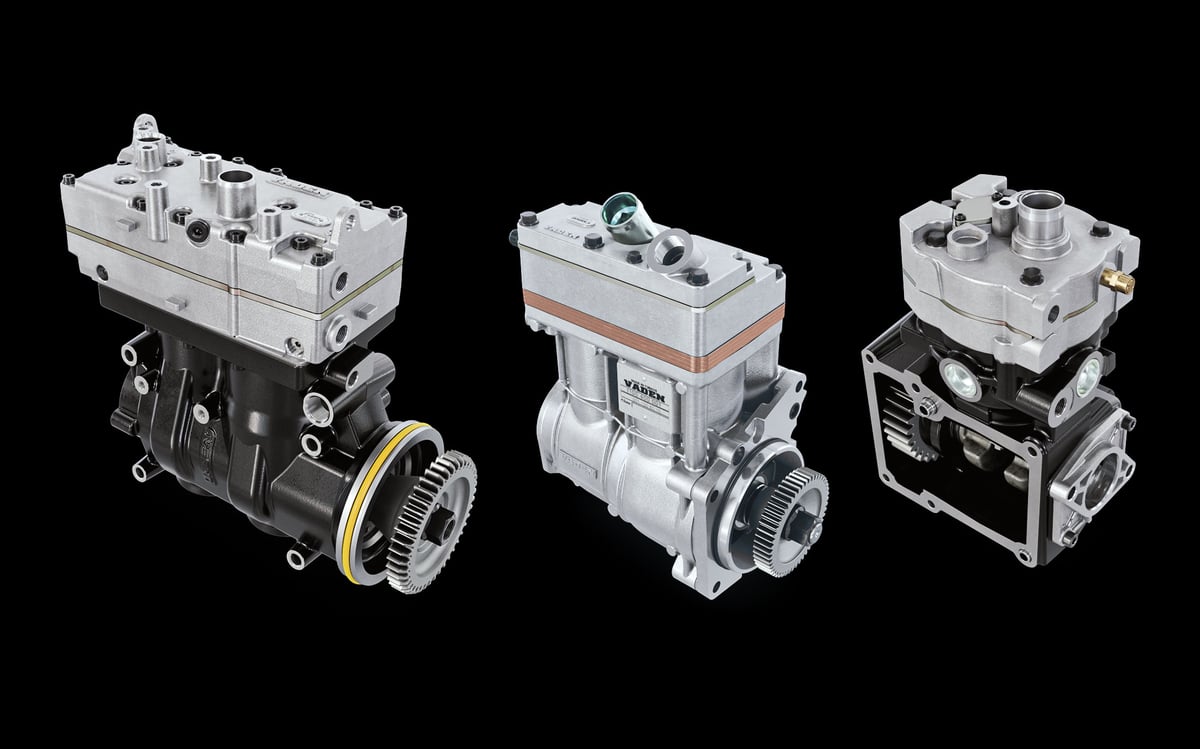
The tractor rolls into the shop with a one-line complaint: the compressor isn't building air. The gauge tells a different story: reservoir pressure sits inside the normal band, cut-in and cut-out points fall where they should, and the dash has logged no fault. So the tech measures instead of guessing: the reservoirs are drained and the recharge time is timed, and it comes out at almost double what the identical sister vehicle — same engine, same compressor — needs. The compressor is building air; it just isn't building it fast enough, which means it barely gets to rest. A large share of the cases that arrive under the label "compressor failure" are not a broken part at all — they are the workload the system has quietly piled onto the compressor over time.
This guide treats the compressor not as a part to be pulled apart and inspected, but as the component that sets the energy balance of the whole air system. Two quantities sit at the centre of it: efficiency, and duty cycle — the share of total running time the compressor is forced to spend under load. Part-level anatomy, fault diagnosis and replacement procedure are covered in the companion guides; what follows here is the operating variables that determine compressor life, how to measure them, and the fleet discipline that keeps them in check.
The compressor's real job in the system: not making air, but holding pressure in the band
The compressor on a heavy-duty vehicle does not exist to produce air continuously; it exists to hold reservoir pressure inside a pre-set band. The distinction looks small, but it explains the whole system. The system never asks the compressor for "so many litres of air" — it says "don't let pressure fall below this value, don't let it climb above that one." The compressor is a regulator tasked with holding that band, not a production plant.
The bottom of the band is cut-in pressure, the top is cut-out pressure. When pressure drops to the bottom, the compressor loads and fills the reservoirs; once it reaches the top, it comes off load and starts spinning unloaded. As consumption grows, loaded cycles become more frequent and longer. Reservoir pressure looks identical in both cases — the gauge shows that the band is being held, not what it costs to hold it.
The defining trait of the compressor is that it turns continuously for as long as the engine runs. It is driven by gear or belt and cannot stop on its own. So "is it running" has no practical answer; the question that matters is "is it running loaded, and for how long." What measures a compressor's health is not whether it builds air, but how much of the total time it has to spend loaded just to hold the band.
If loaded time is stretching out, there are only two possibilities: either the compressor is doing the same job more slowly (efficiency has dropped), or the job itself has grown (consumption or leakage has increased). This is the split that has to be made before anything comes off the vehicle — because in the second case, a brand-new compressor lands under exactly the same load and wears out on exactly the same schedule.
Loaded and unloaded running: how cut-out (unloader) logic works
Because the compressor turns together with the engine, it has to do something even when no air is wanted. The system solves that not by stopping the compressor but by unloading it. Unloaded, the pistons keep moving but stop pushing air into the system; the intake charge is either bled back to the inlet side or simply shuttled freely between cylinders.
The part that makes the call is the pressure regulator, or governor. It watches reservoir pressure continuously; once cut-out is reached it sends control air that pushes the unloader pistons holding the intake valves open, and compression effectively stops. When pressure falls back to cut-in, the control air is dumped and compression resumes. Some designs unload on the discharge side rather than the intake side, or through a separate energy-saving valve — the logic is the same either way.
Is unloaded running free?
No. Even unloaded, the compressor keeps turning, keeps generating friction, and keeps carrying an oil film; it still draws some power from the engine. But that cost is small next to loaded running: under load, drawn power jumps by a multiple, discharge-side temperature rises because of compression, and the rings and cylinder wall take on a far heavier thermal load. The time that wears a compressor out is not the time it spends turning — it is the time it spends loaded.
On some applications even the unloaded loss is judged too much, and the compressor is disconnected from the engine altogether by a clutch; the working principle, fault symptoms and maintenance of that setup are covered in our clutched compressor guide. With a clutched unit the gain shows up as fuel savings, but the duty-cycle logic doesn't change: how long the clutch stays engaged is still set by the system's air demand.
What is duty cycle, and why does it matter so much?
Duty cycle is the ratio of the time the compressor spends running loaded to the engine's total running time, expressed as a percentage. If the engine ran for eight hours across a shift and the compressor spent a combined total of one hour of that loaded, duty cycle is roughly twelve and a half percent. The measurement window is not picked at random — it has to be long enough to represent the vehicle's typical working day.
This figure is not a part specification, it is a system indicator. It does not appear in the compressor's catalogue data — it is set jointly by the vehicle's consumption, its leakage, the condition of its dryer, its route, and driver habits. A single number summarises how hard the entire air system is being worked.
| Duty-cycle range | What it means | What shows up in the system |
|---|---|---|
| Roughly below 10% | Air demand is low, the system is not leaking | Compressor spins unloaded most of the time, cut-out is heard rarely, dryer cartridge reaches its expected life |
| Roughly 10-25% | The band generally regarded as healthy | Short, regular loaded cycles, predictable cartridge life, limited carbon build-up in the discharge line |
| Roughly 25-40% | Borderline zone; consumption or leakage has grown | Loaded cycles lengthen, the dryer no longer gets enough unloaded time to regenerate, moisture increases at the reservoir drain |
| Roughly 40-60% | High; the compressor is staying loaded almost constantly | Discharge line runs noticeably hot, oil-carryover traces appear, recharge time climbs above the vehicle's own baseline |
| Roughly above 60% | Critical; the compressor cannot find any rest interval | Valve-plate and gasket fatigue accelerates, cartridge life shortens by several multiples, oil consumption and recurring faults appear |
| Almost continuously loaded | System demand exceeds compressor capacity | Pressure never reaches the top of the band, cut-out is never heard, park brake and suspension respond sluggishly |
The bands in the table are there to give an order-of-magnitude feel; what counts as acceptable depends on the compressor's design, its cooling method and how the manufacturer defines the measurement. Some manufacturers define the ratio across the whole shift, others only across time the vehicle is actually moving. When deciding, the current OE service manual matching the vehicle's engine and chassis code is authoritative; the table is only there to judge whether a measured value looks reasonable. The reason the ratio matters so much is that its effect is not linear: as temperature rises, the tendency of oil to carry over, carbon build-up and how fast the cartridge saturates all climb together, and past a certain threshold the system enters a loop that keeps making itself worse.
How is duty cycle measured in the field?
Duty cycle is not a guess, it is a measurable ratio. Three methods work on a fleet, and each offers a different level of precision.
- From vehicle data: if governor command or cut-out state is visible on the vehicle network, loaded time can be pulled directly from the telemetry log. This is the most accurate method; the only condition is that the data covers the same window as engine running time.
- Observational count: without data, a fixed observation window is chosen under the vehicle's typical operating conditions, and cut-out and cut-in sounds are timed with a stopwatch. It gives an approximate result, but one accurate enough to move the vehicle into a different band.
- Indirect indicator: read together, recharge time, cartridge life and oil traces at the drain show that duty cycle is climbing without measuring it directly. This is the most practical way to track a trend.
Whichever method is used, the conditions must be logged. Ambient temperature, altitude, whether the engine has reached operating temperature, and whether the vehicle is loaded all directly affect the result; comparisons are only valid between similar conditions. A common mistake is measuring the ratio at idle only: at idle, compressor speed is low and air consumption differs from real operation. An idle measurement is valuable for hunting leaks, but it does not represent duty cycle.
Recharge time: the most practical way to track efficiency
Recharge time is how long it takes the reservoirs to climb from a defined lower pressure to a defined upper pressure. It sums up how much air the compressor can actually deliver in a single number, and it needs no special equipment in the field — a gauge and a stopwatch are enough. Its real value is not in comparing it to some absolute figure, but in comparing it against the vehicle's own history.
If the time is stretching out, the same job is simply taking longer now. The cause can sit inside the compressor (worn valve plate, leaking valves, fatigued rings) or outside it (restricted intake filter, clogged dryer, narrowed discharge line, a leak). The measurement doesn't tell you the cause; it gives you the objective flag that starts the search.
- Bring the vehicle up to operating temperature; a reading taken from a cold engine and cold compressor is not comparable.
- Park the vehicle on level ground, chock the wheels and secure it mechanically; the measurement requires draining the reservoirs.
- Drain the reservoirs down to the starting pressure specified by the manufacturer, and drain any accumulated water from the drain cocks at the same time.
- Disable any air-consuming accessories (suspension, doors, seat, lift axle) and don't touch the brake pedal; every draw stretches the measurement.
- Hold the engine at the fixed speed the manufacturer specifies; if speed varies, the measurement isn't repeatable.
- Start the stopwatch the moment the gauge shows the starting pressure, and stop it when the target pressure is reached.
- Repeat the same measurement under the same conditions at least once more and average the two values.
- Record ambient temperature, altitude, engine speed, whether the vehicle is loaded, and the date.
- Compare the result against the vehicle's baseline from delivery or its last overhaul, and against sister vehicles of the same type; base the decision on the trend, not on a single reading.
Causes of high duty cycle
Duty cycle never rises on its own: either the system's demand has grown, or what the compressor can deliver has shrunk, or both have happened at once. Any repair made without separating the two causes has a short shelf life.
| Cause | How it grows duty cycle | How to confirm it |
|---|---|---|
| Air leakage (fittings, hose, bellows, valve) | The system loses air even when nothing is being used, so the compressor loads continuously to make up the loss | Pressure drop is measured over a set period after the engine is shut off; lines are scanned by listening and with soap solution |
| Added auxiliary consumers | Suspension, lift axle, doors, tipper and similar consumers pile on top of the original design demand | Changes to the body/superstructure are compared against the vehicle's history, and air use is observed consumer by consumer |
| Compressor capacity falling short of the duty | To hold the same band, the compressor is forced to stay loaded for longer | The vehicle's actual duty profile is compared against the compressor's delivery capacity |
| Dryer clogging or a saturated cartridge | Discharge-side resistance rises, so the same air is pushed against a higher back-pressure | Cartridge-life records, regeneration sound and moisture at the reservoir drain are monitored |
| Carbon build-up in the discharge line | The line's internal bore narrows, discharge temperature and pressure rise, and build-up accelerates further | The line is removed and its bore inspected visually; heating behaviour is compared |
| Restriction on the intake side (clogged filter, pinched hose) | Less air mass reaches the cylinder, so more cycles are needed for the same pressure | The intake path and filter are checked, and the intake hose is inspected for pinching |
| Governor drift or a cut-out fault | The compressor reaches cut-out pressure but does not come off load | Cut-out and cut-in pressures are read on a gauge, and the control line is checked |
| Internal compressor wear (valve plate, rings, cylinder) | Part of the compressed air leaks back, so the same result takes longer | Recharge time, oil consumption and discharge temperature are assessed together |
Of these causes, leakage is both the most common and the most underrated. What sets it apart is that it is constant: air escapes the system whether the vehicle is parked or the driver is doing nothing at all. A leak that looks trivial turns, once multiplied by the vehicle's daily running hours, into the single biggest item of extra work loaded onto the compressor. The most reliable way to start a leak hunt in the field is to measure how much pressure drops in a set period after the engine is shut down; the acceptable drop figure is given in the vehicle manufacturer's documentation.
The second common cause is the gap between the vehicle as it was bought and the vehicle as it is today. A body may have been added, the trailer type may have changed, an air-suspended semi-trailer may now be coupled up. The compressor hasn't changed, but the work the system demands from it has grown; renewing the compressor in this case does not fix the picture, it only resets the clock.
Standards and further reading
This subject is governed by the equipment rules for air-braked commercial vehicles. In the United States the federal air brake standard, FMVSS 121 (49 CFR 571.121) defines the reservoirs, protection and timing a compliant system must provide, and Europe applies the equivalent limits of UNECE Regulation No. 13. For further detail, see the illustrated reference guide at airbrakecompressor.com. Always confirm specific figures against the current regulation and the vehicle manufacturer service data.
Readers outside the United States should work from their own national framework: in the United Kingdom the braking system must be maintained under regulation 18 of the Road Vehicles (Construction and Use) Regulations 1986, and in India the governing rules are published by the Ministry of Road Transport and Highways.
Consequences of high duty cycle: oil carryover, valve-plate fatigue, cartridge life
The consequences of a rising duty cycle write themselves directly into part life, and the chain starts with heat: the longer loaded running continues, the higher discharge-side air temperature climbs, and the oil film on the cylinder wall and rings comes under increasing thermal stress.
Oil carryover and carbon build-up
Once the oil is under enough thermal stress, it starts travelling into the discharge line with the airflow. Part of it moves along as vapour, part of it carbonises and deposits on hot surfaces. The deposit narrows the line's internal bore; the narrower bore pushes discharge pressure and temperature up further; the higher temperature carries over even more oil. This feedback loop is why compressor-related problems tend to accelerate rather suddenly.
Valve-plate fatigue and mechanical damage
The compressor's valve plate is made up of thin reed leaves that open and close on every cycle, and its life is a function of both cycle count and temperature together. When duty cycle rises, cycle count climbs and so does temperature, so fatigue accelerates from both directions. As the leaf seating surface degrades, compressed air first starts leaking back, then recharge time starts stretching out. The cylinder head gasket and other sealing surfaces carry the same thermal load. For rebuilding these components, checking sealing surfaces, and assembly discipline, the compressor repair and gasket kit guide is a detailed reference.
Shortening dryer-cartridge life
The cartridge runs out early for two reasons. First, at a high duty cycle the total air volume passing through the cartridge grows, and so does its moisture load. Second, and more destructive, oil that is being carried over coats the desiccant's pores and kills its adsorption capacity. An oil-contaminated cartridge goes non-functional well before its calendar life is up; moisture starts getting into the system, and valve corrosion and winter freeze-ups follow. That is why cartridge life is the cheapest diagnostic tool for compressor health.
Operating habits that increase air consumption
A significant part of duty-cycle increase has behavioural rather than technical causes. When two vehicles of the same model on the same route produce noticeably different duty cycles, most of the gap comes from how they are driven.
| Habit | Effect on air consumption | Improvement |
|---|---|---|
| Holding speed on descents with the service brake | Repeatedly filling and dumping the brake chambers permanently raises demand | Engine brake and retarder are prioritised, with the service brake used only as backup |
| Unnecessarily frequent, hard braking in traffic | Every brake application is a separate draw on air; in urban driving the cycle count multiplies | Following-distance and predictive-driving training, plus monitoring brake-application counts via telemetry |
| Repeatedly raising and lowering the suspension at the loading dock | Suspension bellows are high-volume consumers; every level change drains the reservoirs | Set the correct level in one move and avoid unnecessary level adjustments |
| Operating the tipper, lift axle or doors while the engine is idling | Demand is high while compressor speed is low, pressure drops below the band and a long loaded cycle begins | Accessory operation is carried out at the engine speed the manufacturer recommends |
| Extended idle waiting | Making up leakage at low engine speed needs longer loaded time | Idle time is limited, and the engine is shut down during long waits |
| Neglecting reservoir drains | Accumulated water reduces effective reservoir volume and cycles become more frequent | Drains are done on a schedule, tightened up in winter, and logged |
What all of these items have in common is that none of them trip a fault code. No dash light comes on, no scan tool has anything to say; the compressor simply runs loaded for longer, and the bill shows up a year later under cartridges, gaskets and valve plates. Across a fleet, the cheapest way to bring duty cycle down is very often not swapping parts, but measuring these habits and feeding the results back to drivers.
How is air brake compressor capacity matched to the vehicle?
Capacity selection is a direct determinant of duty cycle. An air brake compressor is correctly matched not simply because it "builds enough air," but because it can stay inside the healthy band even on the vehicle's most demanding duty profile. Sizing is done against the worst day, not the average one.
On the supply side there are three variables: stroke volume, drive ratio (compressor speed relative to engine speed), and volumetric efficiency under real conditions. Together these three set how much air can be delivered per unit of time at a given engine speed. The same compressor with a different drive ratio means a different capacity — being "the same part" does not mean "the same delivery."
On the demand side, everything the system draws is added up: axle count and brake-chamber volumes, the trailer or semi-trailer's own system, air suspension, the park-brake circuit, body consumers, the air the dryer spends on its own regeneration, and an allowance for leakage within acceptable limits. Route profile is layered on top of that: an urban distribution truck produces far more brake cycles than a long-haul tractor. Altitude and ambient temperature also feed into the selection.
There is also a regulatory floor: the vehicle is expected to reach a defined operating pressure from a defined starting pressure within a defined time. This requirement is met at type approval; but as consumption grows or leakage increases over the years, the vehicle can fall behind that requirement. Regularly measuring recharge time is the most concrete evidence of whether capacity is still adequate.
The comparison between single- and twin-cylinder compressors, and the choice of cooling method, are part-level distinctions covered in the companion guides for this compressor family. The rule that holds here is this: raising capacity should only come onto the table once the demand side has been brought under control. Moving to a bigger compressor on a system that still leaks doesn't solve anything — it just wears out a bigger part at the same rate.
Early signs of declining efficiency
Compressor efficiency does not fall in a day; it erodes slowly over months, and the system compensates for the difference the whole time. Reading the early signs lets the picture be caught before it turns into a failure.
| Early sign | Likely mechanism | First check |
|---|---|---|
| Recharge time drifting above the vehicle's own baseline | Valve leakage, intake restriction, dryer resistance, or a leak | Measurement is repeated under the same conditions, and engine-off pressure drop is checked |
| Cut-out and cut-in sounds becoming more frequent | The system is losing air faster, or consumption has grown | Cycle interval is timed at idle, and consumers are isolated one at a time and monitored |
| Excess water coming from the reservoir drain | The dryer is saturated, or isn't getting enough time to regenerate | Cartridge-life records are reviewed, and regeneration sound plus purge valve are checked |
| Oil traces at the drain or dryer outlet | Oil is being carried over from the compressor; rings and thermal load are suspect | The amount of oil trace is logged, and the discharge line's internal bore is inspected |
| Discharge line running unusually hot or discolouring | Extended loaded running and a narrowing bore are pushing temperature up | Line temperature is compared against a sister vehicle, and build-up is checked for |
| Dryer cartridge running out early, repeatedly | High air volume plus oil contamination | Duty cycle is measured, and the cartridge is pulled and inspected for oil |
| Unexplained rise in engine oil consumption | Carryover from the compressor's oil circuit, or an internal leak | Oil-consumption records are cross-checked against oil traces at the compressor outlet |
| Air suspension rising slowly, doors operating sluggishly | System pressure is hovering near the bottom of the band | Band pressures are read, and the consumer feed sequence is checked |
None of these signs is a conclusive diagnosis on its own; each simply points in a direction. The right order is to measure first, compare second, and only then take anything apart.
The link between dryer and compressor: the second face of duty cycle
Even though they show up as separate line items in fleet records, the compressor and the air dryer are two ends of a single system. The dryer's desiccant is regenerated, during the unloaded time between loaded cycles, by dry air sent back from the reservoir. Which means: for the dryer to work properly, the compressor has to rest.
When duty cycle rises, that rest period shortens. The cartridge meets a new moisture load before it has had time to shed the moisture it was already holding, and it reaches saturation sooner. A saturated cartridge produces two results: moisture gets through into the system, and resistance on the discharge side increases; the extra resistance forces the compressor to work against higher back-pressure and run hotter, the hotter compressor carries over more oil, and the carried-over oil finishes the cartridge off even faster.
That relationship gives diagnosis a shortcut: symptoms that show up on the dryer side are, more often than not, the story of the compressor's load rather than the dryer's own fault. For cartridge replacement intervals, regeneration behaviour, purge-valve condition and moisture traces, the air dryer guide is a detailed reference. The practical rule is: log cartridge life, and when it falls below what's expected, look at duty cycle first — replacing the cartridge more often only masks the symptom, it doesn't remove the cause.
Fleet discipline: logging recharge time
Managing duty cycle is not done with a single measurement, but with measurements that are repeated and compared over time. The routine below builds a monitoring discipline that can be applied fleet-wide without any extra equipment.
- Establish a baseline for every vehicle: measure recharge time when the vehicle enters the fleet, or immediately after a compressor overhaul, and record it in the vehicle file.
- Fix the measurement conditions on a single card: starting and target pressure, engine speed, all consumers off, load status. The same card is used across the whole fleet.
- Repeat the measurement at every scheduled service; make it a mandatory line on the service form, not an optional one.
- Note ambient temperature and altitude on every record; winter and summer readings are only compared within their own season.
- Line up the figures for vehicles of the same type; put vehicles that deviate noticeably from the fleet average on a separate watch list.
- When you see a meaningful lengthening against a vehicle's own baseline, the next step is not pulling the compressor — it's a leak scan: measure pressure drop after engine shutdown and scan the lines.
- If the leak check comes back clean, verify the intake path, the dryer and the governor; suspicion of internal compressor wear only comes onto the table once these three have been ruled out.
- Keep dryer-cartridge replacement dates on the same page; read together with recharge time, the cartridge-life trend shows up far earlier.
- Log water and oil traces seen at the reservoir drains with a short note at every service; that note becomes the strongest evidence behind a future overhaul decision.
- After an overhaul or replacement, repeat the measurement and record the new baseline; a repair that isn't followed by a new reading leaves the next diagnosis blind.
The strength of this discipline lies not in its complexity but in its consistency. A stopwatch reading taken under the same conditions, repeated over time, gives something expensive diagnostic equipment cannot: the trend.
Technical values and general reference benchmarks
The table below brings together the quantities used in duty-cycle and efficiency monitoring. The purpose is not to make the decision for you, but to weigh whether a given result looks reasonable; exact values are always read from the vehicle's own OE documentation.
| Quantity | General reference benchmark | Interpretation |
|---|---|---|
| Healthy duty-cycle band | Common consensus is roughly below 25% | The manufacturer's definition and the measurement window are decisive |
| Duty-cycle measurement window | Long enough to represent the vehicle's typical working day | A short window inflates a random slice and misleads |
| Recharge-time benchmark | Not an absolute figure — the vehicle's own baseline | Comparisons are made within the same conditions and the same season |
| Engine-off pressure drop (leakage) | Limited drop over a defined period; the value comes from OE | This is the starting measure of a leak scan |
| Cut-out / cut-in pressure differential | A fixed band set by the system's design | A narrowing band raises cycle count |
| Discharge line temperature | Under load, high enough to cause contact burns | Comparing against a sister vehicle is more meaningful than any absolute figure |
| Dryer-cartridge replacement interval | Whichever comes first, mileage or time | Early replacement is read as a duty-cycle indicator |
| Reservoir drain interval | Scheduled, tightened up in winter | Accumulated water reduces effective volume and raises cycle count |
| Intake filter maintenance | Aligned with the engine's own air-filter schedule | Intake restriction directly reduces volumetric efficiency |
| Measurement record | Date, engine speed, temperature, altitude, load status | A measurement with no logged conditions cannot be compared |
The table has one rule: no numerical value can be used independently of the vehicle's own engine and chassis code. Two vehicles of the same class from the same manufacturer can produce an entirely different air demand because of a different body or different brake hardware, and that demand also shifts what counts as an acceptable duty-cycle limit.
Reducing duty cycle: a system job, not a parts job
The most expensive mistake to make on a vehicle with a high duty cycle is to go straight for the compressor. A new part doesn't change what the system demands; it just resets the clock, and the same duration under the same load plays out all over again. The right sequence starts with demand and ends with supply.
- Leaks first: measure engine-off pressure drop and scan the lines and fittings. The biggest gain is nearly always found here.
- Then consumption: auxiliary equipment, driving habits and unnecessary usage items are measured and reduced through feedback.
- Then the discharge side: the dryer, cartridge condition, purge valve and discharge-line bore are checked; once resistance drops, loaded time shortens.
- Then the intake side: filter and hose restrictions are cleared; once volumetric efficiency is recovered, the same cycle delivers more air.
- Then control: governor band values and cut-out function are verified; a compressor that fails to unload produces the worst duty cycle all on its own.
- The compressor last: once everything above has been ruled out, the efficiency drop is inside the part itself, and this is the point where overhaul or replacement makes sense.
The compressor sits at the centre of the heavy-duty air system and carries every flaw in that system on its own back: a leaking fitting keeps it working without rest, a saturated cartridge makes it run hotter, a neglected drain raises its cycle count. That's why a vehicle arriving at the shop with a "compressor problem" diagnosis is, more often than not, the start of the investigation rather than the end of it. A measurable duty cycle, a logged recharge time, and a consistently kept cartridge-life record are the three numbers that determine this part's life. In every case, the current OE service documentation for the vehicle's engine and chassis code is authoritative.
Shop this part: Air Compressor
In-depth technical guide: For fault diagnosis, step-by-step replacement and service intervals: Truck Air Compressor Overhaul Kit: Head, Valve Plate, Gasket
When replacement comes onto the agenda, the right compressor is defined by engine family and truck make; how that match is made is covered in the truck air compressor by engine and make guide.
Beyond an in-place overhaul, how the decision for a complete replacement is made and which maintenance intervals apply to the compressor are covered in the air brake compressor faults, replacement and maintenance guide.
Tags
Frequently Asked Questions
- What is duty cycle and how is it calculated?
- Duty cycle is the ratio of the time a compressor spends running loaded to the engine's total running time, expressed as a percentage. If the engine ran for eight hours in a shift and the compressor spent a combined total of one hour loaded, the ratio is roughly twelve and a half percent. Working it out means totalling up the loaded time, which is most accurately pulled from governor or cut-out status data on the vehicle network. Without that data, an approximate figure comes from timing cut-out and cut-in sounds with a stopwatch over a fixed observation window. The measurement window has to be long enough to represent the vehicle's typical working day; a short window inflates a random slice and gives a misleading result.
- How much of the time should an air brake compressor run under load?
- The general consensus is that in a healthy system, an air brake compressor should spend roughly under a quarter of its total running time loaded; on many long-haul trucks the figure runs lower still. Once the ratio climbs past around 40%, the discharge line runs noticeably hot, oil carryover begins, and the dryer cartridge saturates early. Running loaded almost continuously means demand has outgrown capacity. These bands are conceptual reference points; what counts as acceptable depends on the compressor's design, its cooling method, and how the manufacturer defines the measurement. The current OE service manual matching the vehicle's engine and chassis code is authoritative.
- How is recharge time measured?
- Bring the vehicle up to operating temperature, park it on level ground and chock the wheels. Drain the reservoirs down to the starting pressure the manufacturer specifies, and drain accumulated water from the drain cocks at the same time. Disable air-consuming accessories and don't touch the brake pedal. Hold the engine at the manufacturer's fixed test speed; start the stopwatch the moment the gauge shows the starting pressure, and stop it once the target pressure is reached. Repeat the measurement under the same conditions and average the results. Log ambient temperature, altitude, engine speed and the date. The value is judged not against some absolute figure, but against the vehicle's own baseline and its sister vehicles.
- If the compressor is running constantly, is it faulty?
- Not necessarily. The compressor turns for as long as the engine runs; the right question isn't whether it's turning, it's how long it has been running loaded. Continuous loaded running can come from two directions: either system demand has grown (leakage, added consumers, dryer resistance), or compressor efficiency has dropped (valve leakage, intake restriction, wear). There's also a control-side possibility: if the governor has drifted or the cut-out mechanism has failed, the compressor reaches cut-out pressure but never comes off load. Replacing a part before separating these three possibilities doesn't fix the picture — it only resets the clock.
- What is the first sign that duty cycle is rising?
- In the field, the earliest sign is usually the dryer cartridge running out sooner than expected — the cartridge behaves like a witness that records exactly what the system has been sending it. That's typically accompanied by more frequent cut-out and cut-in sounds, more water at the reservoir drain, and recharge time climbing above the vehicle's own baseline. At a more advanced stage, the discharge line runs unusually hot and oil traces show up at the drain or dryer outlet. None of these signs trip a fault code, which is why on fleets without a measurement and logging discipline, the picture only gets noticed once it has already become a failure.
- Why does the dryer cartridge saturate early?
- Two causes work together. The first is volume: at a higher duty cycle, the total air passing through the cartridge grows, and so does its moisture load. The second and more damaging cause is oil contamination — oil carried over from an overheated compressor coats the desiccant's pores and kills its adsorption capacity. There's also a timing issue: regeneration, the cartridge's own self-cleaning, happens during the unloaded time between loaded cycles; if the compressor never gets to rest, the cartridge never gets time to shed the moisture it's holding. Replacing the cartridge more often only masks the symptom; measuring duty cycle is what removes the cause.
- What does oil coming from the reservoir drain mean?
- It means oil is being carried over into the discharge line and the system is under thermal stress. Extended loaded running raises discharge-side temperature, the oil film on the cylinder wall comes under strain, and oil starts travelling along with the airflow. Part of that oil carbonises on hot surfaces and narrows the line, which pushes temperature up further and feeds the cycle. Whatever reaches the dryer finishes the cartridge off. That's why oil traces at the drain should be logged with a short note at every service; if the trace is growing, a duty-cycle measurement and a check of the discharge line's internal bore are the next steps.
- How much does an air leak affect duty cycle?
- Leakage is both the most common and the most underrated cause of a rising duty cycle. What sets it apart is that it's constant: the system loses air whether the vehicle is parked or the driver is doing nothing at all. A leak that looks trivial, multiplied by the vehicle's daily running hours, turns into the single biggest item of extra work loaded onto the compressor. It's simple to confirm: measure how much pressure drops over a defined period after the engine is shut off; the acceptable drop figure is given in the vehicle manufacturer's documentation. Across a fleet, the cheapest first step to bringing duty cycle down is almost always a leak scan.
- How is compressor capacity matched to the vehicle?
- Sizing is done against the vehicle's most demanding duty profile, not the average one. On the supply side, stroke volume, drive ratio and real-world volumetric efficiency are decisive; the same part with a different drive ratio means a different delivery. On the demand side, everything gets added up: axle and brake-chamber volumes, the trailer's own system, air suspension, the park-brake circuit, body consumers, the air the dryer spends on regeneration, and an allowance for leakage. Route profile, altitude and ambient temperature also feed into the choice. Raising capacity should only be considered once the demand side has been brought under control — moving to a bigger compressor on a leaking system just wears out a bigger part at the same rate.
- Does unloaded running wear out the compressor?
- Unloaded running isn't entirely free — the compressor keeps turning, generating friction and carrying an oil film, and it still draws some power from the engine. But that cost is small next to loaded running. Under load, drawn power jumps by a multiple, discharge-side temperature rises because of compression, and the rings and cylinder wall take on a far heavier thermal load. The time that wears a compressor out is loaded time, not turning time. Unloaded time is also needed for the dryer's regeneration — so the compressor resting isn't only good for the compressor, it's required for the system's moisture management too.
Related Articles
Air Brake Caliper: Air Disc Brake Systems Explained
Fixed and floating air disc brake calipers on trucks and trailers: how each turns air pressure into clamping force, core parts and why fade resistance matters.
ECAS Solenoid Valves: The Precision Control Point for Heavy-Duty Air Suspension
What is ECAS on trucks and trailers and how does it work? Components, the solenoid valve role, the difference from a mechanical leveling valve, fault diagnosis.
Brake Caliper Repair Kits: Bringing Heavy Vehicle Brake Systems Back to Life
Which brake caliper repair kit level fits a given fault, when repair is banned, and how a heavy truck workshop proves it afterward.