Water Separator Filter: Diesel Water Drain & Warning
Where does water get into diesel fuel, how does a water separator work, and what should you do when the warning light comes on? A heavy-duty vehicle guide.
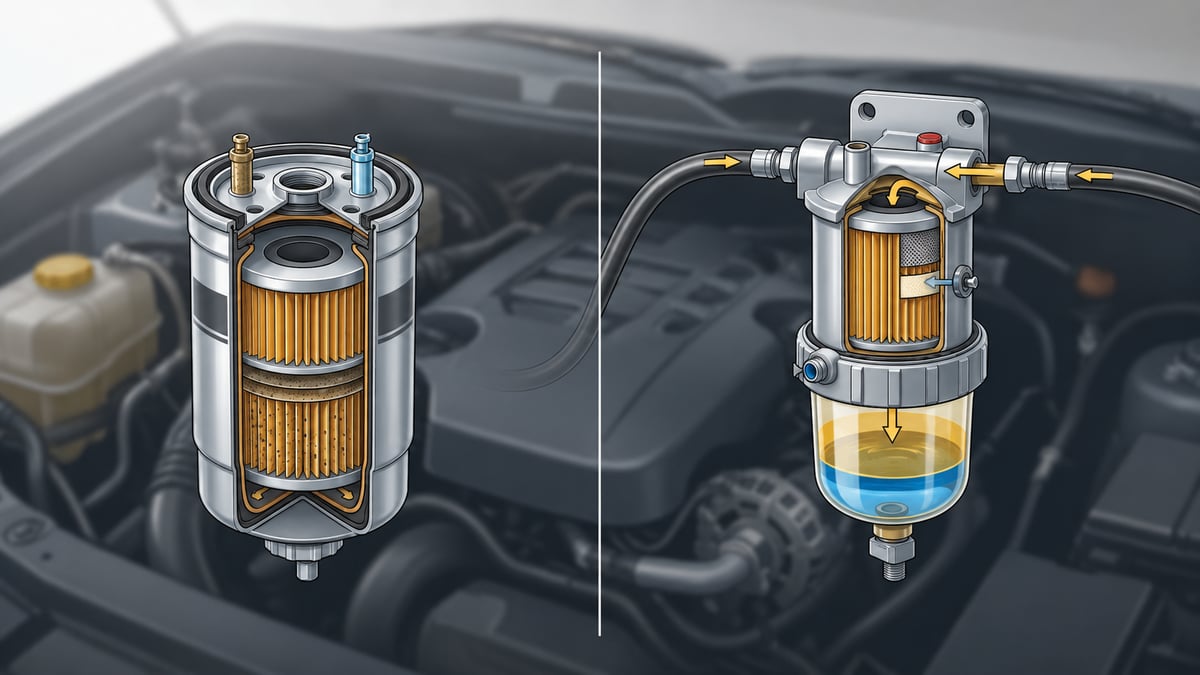
A tractor tops off its tank on a freezing morning and pulls back onto the highway. A small dash warning appears: water in fuel filter. The engine still runs fine, so the driver shrugs it off. Two days later, loaded and climbing a grade, the same truck stumbles and coasts to the shoulder. Back at the shop, the technician pulls the clear bowl off the pre-filter and a cloudy, milky fluid drains out, with brown sediment at the bottom. The fuel itself was not at fault; what was at fault was a bowl left unemptied for months, finally overflowing and sending its water straight into the high-pressure side in one shot. This guide does not cover the fuel filter's job in general — it isolates one function: water separation. Where does water get into diesel, what physics pulls it back out, what warning does it give, and where does the damage chain break when the job is skipped?
Where Does Water Get Into Diesel Fuel?
Diesel fuel does not mix with water in the true chemical sense, but that does not mean it never contains any. Water shows up in fuel in three distinct states, and each behaves differently from a service standpoint. Dissolved water is spread through the fuel at the molecular level, invisible and impossible to remove mechanically; warmer fuel holds more of it. Emulsified water hangs suspended as micron-scale droplets, giving the fuel a milky look, and must be grown into larger droplets before it can be pulled out. Free water is the only form already coalesced into a distinct layer that settles and can be drained away.
There is a constant back-and-forth between these states, and temperature is the main trigger. Fuel that warms up in the tank during the day dissolves more water; once it cools overnight, it releases what it can no longer hold, and that water first turns into an emulsion, then settles as free water. A truck can build up water at the tank bottom without ever taking on bad diesel — ordinary daily temperature swings are enough on their own. The entry points are well known, and most of them can be prevented with nothing more than habit.
| Source | Mechanism | Preventive habit |
|---|---|---|
| Condensation inside the tank | Moisture in the air gap liquefies on the cooling tank wall overnight | Keep the tank as full as practical overnight |
| Sediment in the fueling point's storage tank | Water settled at the bottom of an underground tank gets drawn up as the level drops or the tank is disturbed | Avoid fueling right after a tanker delivery |
| Contamination during fueling | Rain, snow, a wet nozzle tip, or a dirty makeshift funnel | Wipe the cap seat dry, use only clean fueling equipment |
| Fill cap and tank venting | An aging cap seal and a clogged breather vent both let water through | Inspect the cap gasket and vent valve on a periodic schedule |
| Biodiesel-blended fuel | Holds more water and stabilizes the resulting emulsion | Shorten storage time, drain more often |
None of these sources produces a symptom the driver notices at the time. Water gets in quietly, does its damage in small increments, and only becomes visible once it has already surfaced as the failure of some unrelated component. That is why managing water is not a one-time fix — it is an ongoing maintenance discipline.
What Does Water Do to the Diesel Fuel System?
Water's harm builds as a chain, each link feeding the next. The first link is lost lubrication. Diesel fuel does not only carry chemical energy — it also lubricates the high-pressure pump's internals and the injector needle, neither of which has a separate lubrication circuit. When water cuts through that thin oil film, surfaces machined to micron tolerances make direct metal-to-metal contact, and wear begins.
The second link is corrosion. Water starts oxidation on bare steel, and the flaking rust particles become a second abrasive contaminant circulating through the system — direct damage that manufactures its own follow-on source of wear. The third link is how water behaves under high pressure: it does not compress, and at the point where pressure drops it expands abruptly, leaving erosion marks. The injector nozzle tip takes the worst of this; the spray orifice edges wear, the spray pattern breaks down, and the engine starts smoking.
The fourth link is microbial growth. The interface between fuel and water is a comfortable habitat for bacteria and fungi, and the colonies that develop form a gel-like black mass that clogs the filter early while accelerating corrosion. This is the field problem known as "diesel bug," and it cannot appear in a tank with no water. The fifth link is freezing: water pooled at the bottom of the bowl, or in a line, can cut off flow, seize the drain plug shut, and expand enough to crack a plastic bowl.
The chain always ends the same way: the high-pressure pump and the injectors downstream. Lost lubrication means the pump turns under near-dry conditions, and the metal shavings it generates spread through the whole system from there. For the pump's own failure symptoms, its bleeding procedure, and replacement discipline, see the diesel injection pump guide — much of the damage described there traces back to an undrained bowl.
| Component | How water acts on it | Symptom seen in the field |
|---|---|---|
| Fuel tank and pickup screen | A settled water layer, ongoing corrosion, microbial colony growth | Repeated filter clogging, visible sediment at the bottom |
| Pre-filter and sediment bowl | The bowl fills up, separation efficiency drops, overflow begins | Water warning triggers, cloudy fluid visible in the bowl |
| Feed (low-pressure) pump | Lubricating film cut, corrosion sets in on internal surfaces | Falling feed pressure, hard starting |
| High-pressure pump | Unlubricated contact, accelerating wear, metal-shaving generation | Pressure won't build properly, stored fault codes |
| Injectors | Corrosion on the needle seat, erosion at the nozzle tip | Misfiring, smoke, an audible tick, higher fuel consumption |
The most important message in that table is that water never produces a fault code carrying its own name — diagnostics never say "there is water in the fuel." Instead they report "cylinder balancing deviation" or "low feed pressure." When the common cause behind entries like these is never investigated, the replacement fails the same way again soon after.
How Does a Water Separator Work? Density, Coalescing, and the Hydrophobic Media
A water separator relies on three sequential principles inside the same housing; losing even one drags down separation efficiency.
The first principle is density difference. Water is denser than diesel, so a large enough droplet settles toward the bottom under its own weight in a calm liquid. The lower bowl is a deliberately quiet zone where flow slows and turbulence dies down; the faster the flow, the less time a droplet has to settle before the current sweeps it back up.
The second principle is coalescing — droplets merging into larger ones. Emulsified droplets are too small to settle under gravity alone, and settling speed falls off sharply as diameter shrinks. That's why the separator contains a layer whose job is to grow those droplets first. As fuel passes through this layer of interwoven fine fibers, water droplets stick to the fiber surface, find one another, and merge into bigger droplets. Once heavy enough to overcome the passing flow, the droplet breaks free and drops into the bowl below. A filter with no coalescing layer cannot separate emulsified water, regardless of bowl size.
The third principle is the hydrophobic barrier. At the outlet sits a water-repelling screen with extremely fine pores. Fuel passes through freely; a grown water droplet cannot, held back by surface tension, so it collects on top, grows heavier, and falls back down. This layer's function is chemical, not mechanical — once its coating fouls or gets covered by surfactants, the media can start passing water even though it still looks intact.
Because the three stages work one after another, efficiency cannot be captured with a single number: the same separator can catch nearly all of a coarse water slug while still letting a stable emulsion mostly through. One point is widely misunderstood: a water separator is not a dryer. It does not remove water truly dissolved in the fuel; its job is only to catch free and emulsified water. In a system that keeps producing water right after a fresh drain, the real question stops being the part's performance and becomes where the water is getting into the tank.
Single-Stage vs. Two-Stage Water Separation: What's the Difference?
On heavy commercial vehicles, filtration is usually two-stage, but water separation falls overwhelmingly on the first stage, not both equally. The first stage sits ahead of the feed pump, on the suction side, as the pre-filter: it catches coarse particulate, and this is where the sediment bowl, drain plug, water-level sensor, and any heater are mounted. The second stage is the fine main filter, positioned downstream of the feed pump.
Serious installation mistakes happen when this is not understood. The feed pump's vanes or gears mix fuel vigorously and break large water droplets into sub-micron ones — water that has passed through the pump becomes an emulsion far harder to separate afterward. This is why real water separation always has to happen before the pump, never after it. On a truck where the pre-filter is bypassed, jumped because it kept clogging, or swapped for an element with no water-separating layer, the main filter cannot close that gap.
Sitting on the suction side carries a second consequence: this section operates under vacuum. When the bowl seal, drain plug, or sensor housing develops a leak, fuel does not leak outward — air leaks inward instead. Air bubbles disrupt feed pressure and stir up the bowl's calm settling zone, dragging efficiency down; a sealing defect here can't be dismissed just because "it isn't dripping." For how the feed side behaves, the hand-priming bleed procedure, and diagnosing suction-line leaks, the feed pump and hand primer guide is a thorough reference.
| Stage | Location | Role in water separation | Typical hardware |
|---|---|---|---|
| Pre-filter (first stage) | Between the tank and the feed pump, on the suction side | Real separation happens here; catches most free and emulsified water | Sediment bowl, drain plug, water sensor, heater, hand primer |
| Main filter (second stage) | Downstream of the feed pump, ahead of the high-pressure pump | Supporting role only; catches a portion of what got past, at lower efficiency | Fine filter media, occasionally a second coalescing layer |
| Single-stage setup | A combined filter housed in one body | Particulate removal and water separation share one element; capacity is limited | Small sediment bowl, usually with no dedicated sensor |
Filtration class, media pore size, general failure symptoms, and change intervals are a separate topic; for the complete picture, including the filter's particulate-removal side, see the fuel filter and water separator guide — everything past this point tracks water specifically.
How Does the Water-in-Fuel Sensor Work, and What Triggers the Warning?
Modern vehicles carry a water-level sensor inside the bowl or its lower cap. The most common principle is electrical conductivity difference: diesel is, for practical purposes, an insulator, while water conducts because of dissolved salts. As long as fuel fills the gap between the two electrodes, the circuit stays open; once rising water bridges both electrodes, the circuit closes and the warning triggers. The second common type is a float sensor, where a floating element trips a magnetic switch. Some use an optical principle instead: light refraction at a small prism tip changes depending on whether it sits in fuel or water.
Whichever type is fitted, reading the signal correctly matters as much as the sensor itself. It is not telling you "there is water in the bowl"; it is telling you "water has risen to reach the level where the sensor sits." This has two practical consequences. The warning staying off does not mean there is no water at all — the volume below the sensor's mounting height could still be full. And once the warning does come on, the bowl is already effectively full — this is not an early alert, it is a reminder that has already arrived late. The draining schedule should be built around a calendar, not around whether the sensor has lit up yet.
Two mistakes commonly show up here. In a false alarm, biofilm, soot, or corrosion on the probe bridges a conductive path between the electrodes, so the warning lights up even with an empty bowl; connector moisture and a weak ground produce the same result. The opposite failure is a silent sensor: a broken probe or open circuit means the warning never comes even once the bowl has filled. That's why a clear-bowl unit still deserves a quick visual check, sensor or not.
| Warning behavior | Likely meaning | What to do |
|---|---|---|
| Warning lights up while driving and stays lit | Water has reached the sensor's mounting level; the bowl is considered full | Pull over somewhere safe and drain, then confirm the warning has gone out |
| Warning stays lit even after draining | An incomplete drain, a fouled probe, or a short in the circuit | Fully empty the bowl again, clean the probe, check the connector |
| Warning appears together with power loss and stumbling | The bowl has already overflowed and water may have passed downstream | Do not continue driving; drain the system and evaluate both filters |
| No warning at all, but water is visible in the bowl | The sensor circuit is broken, or water sits below the sensor's level | Drain the bowl regardless, then test the sensor and its wiring |
| Warning appears together with power loss only in cold weather | Frozen water, or a wax-related flow restriction | Warm the system, then check the heater circuit and winter fuel grade |
Further reading
For a plain-language technical overview of this subject, see the reference article on Wikipedia. Always confirm specific figures and procedures against the vehicle manufacturer service data.
How Often — and How — Should You Drain the Water Separator Bowl?
Draining the bowl is the lowest-cost, highest-payoff task in a diesel fuel system. On most vehicles it needs no special tooling, takes only a few minutes, and, done regularly, heads off most fuel-related failures before they start. How often depends on duty cycle: long-haul trucks fueling regularly at trusted stations do fine on a weekly routine. In winter, after fueling from a questionable source, during extended parked periods, and whenever the tank is frequently left half-empty, that frequency should move to a daily check. Wherever the vehicle's manual specifies a fixed interval, that interval governs.
- Park the vehicle on level ground, set the parking brake, shut off the engine, and switch off the ignition; never loosen a fitting on this system while it is under pressure.
- Let the engine and exhaust components cool down fully; the drained fluid is flammable and can ignite if it drips onto a hot surface.
- Place a clean, lidded container, sized well above the volume you expect, under the bowl before opening anything.
- Wipe the bowl and surrounding area clean first; dirt around the drain plug ends up inside the bowl and on your hands once the plug is loosened.
- On some systems, the vent screw at the top also needs loosening; fluid will not drain cleanly out of a sealed volume.
- Open the drain plug or petcock by hand, slowly. If a tool is required, use the correctly sized wrench; excessive force on a plastic housing produces a crack.
- Watch the fluid as it drains: water and sediment come out first, fuel follows after. Once clear fuel starts flowing, you have reached the separation boundary.
- Let it run a little longer to be sure, then close the plug back up. Do not overtighten — the seal provides the sealing, never brute torque.
- If the vehicle has a sensor, switch the ignition on and confirm the warning has gone out; if not, the bowl may not be empty yet, or the probe is fouled.
- If the system took on air, bleed it using the manufacturer's procedure, usually with the hand primer; work the bleed screw until fuel runs bubble-free.
- Start the engine, let it idle, check around the bowl for leaks and bubbles, confirm with a brief load test, and log the fluid's appearance and rough volume before moving on.
Keeping a written record pays off most across a fleet: a truck that reliably produces a little water every week can be treated as normal, while one that has run bone dry for three weeks and then suddenly produces a slug of water points at a specific fueling location worth investigating — a distinction only a record can make.
What Does the Drained Fluid Tell You?
The fluid draining out of the bowl tells you a great deal without a lab. Color, cloudiness, odor, and sediment, read together, give a reliable first read on where the water came from and what secondary problems might be developing; for a firmer read, let a sample settle in a clear container and watch the layers separate.
| Appearance | Likely meaning | Recommended action |
|---|---|---|
| Clear, colorless water layer, with clearly separate fuel on top | Classic condensation water; the separator is doing its job | Treat as normal, keep the existing routine interval |
| Cloudy, milky, coffee-with-cream mixture | A stable emulsion; points to high water content or a surfactant additive | Question the fuel source, drain more often, evaluate the filter |
| Brown, rust-colored fluid with visible sediment | Advanced corrosion under way in the tank or the supply line | Inspect the tank bottom and suction line, track down the source |
| Black, gel-like or mucus-textured clumps | Microbial growth; a colony has established itself at the interface | Plan a tank cleaning, renew the filter, cut off the water source |
| Ice crystals, or a slushy, whitish mass | Frozen water, or the early stage of wax crystallization | Warm the system, verify the heater circuit and winter fuel grade |
| A foamy, bubbly mixture that will not settle out | Air ingress on the suction side, or a heavy emulsion | Check the bowl seal, drain plug, and suction line for leaks |
| Noticeably more water than expected | A bulk intrusion tied to fueling or a seal failure | Check the last fueling stop, fill cap seal, and tank venting |
None of these rows alone is a firm diagnosis, but together they give a strong lead. A milky appearance paired with black gel in the same sample means water has been present a long time and microbial activity has already started — draining alone will not be enough.
Heated Water Separators and Cold-Weather Behavior
Winter is when this part is both most needed and most stressed. There are two separate causes behind that stress, and they get mixed up constantly: wax crystallization and freezing.
Wax crystallization is a property of the fuel itself and has nothing to do with water. As temperature falls, diesel's heavier paraffin components turn hazy and then crystallize, and past a certain point that clogs the filter's pores directly. The fix is a fuel grade suited to the season; heading into winter on summer-grade fuel can strand even a sound truck on the filter alone. Freezing, by contrast, is water's doing: water pooled at the bottom of the bowl or in a line can freeze, seize the drain plug shut, and expand enough to crack a plastic bowl; ice crystals inside the media restrict flow further, and the engine typically stumbles under load before it stalls. This is very often described as "the fuel froze," when what froze in most cases was never the fuel — it was the water sitting inside it.
Heated designs counter these two problems with three methods. Electric heating uses a resistive element in the bowl or filter head, switched on by a temperature switch or control unit. Fuel-return heating routes some already-warmed fuel from the injectors and pump back to the filter inlet, giving passive heating. Engine-coolant heating runs a small circuit through the filter head, effective only once the engine itself has warmed up. A heater failing silently is the sneakiest winter problem — no symptom all summer, then trouble at the first real cold snap. That's why fuses, relays, wiring, and connector corrosion on this circuit should be verified every autumn, before the cold arrives.
What Happens If You Skip the Drain?
Skipping the drain is neglect whose consequences show up only after a delay — which is what makes it dangerous. The bowl keeps filling, and the rising level approaches the coalescing layer's lower boundary; past that point, already-settled droplets have nowhere left to go, the current sweeps them back up, and efficiency drops off rapidly. From there, water passes straight through the media and downstream. Hard braking, a steep grade, or heavy jolting can carry the water pooled at the bottom forward all at once, in a single bulk slug — which is why the failure often feels sudden rather than gradual.
Water that gets past the pre-filter becomes emulsified at the feed pump, then arrives at the main filter as a mixture that's hard to separate. The main filter cannot absorb that load; it either clogs prematurely or lets the water straight through. What comes after that is the high-pressure pump, and that is precisely where the most expensive segment of this chain begins — once wear debris from the pump reaches the rail and the injectors, the repair no longer closes out with a single part swap.
The second consequence is microbial: water sitting undisturbed for a long stretch gives colonies time to establish themselves, and an established colony becomes a self-renewing contamination source on the tank wall — at that stage, changing the filter only provides temporary relief. The third consequence is a winter one: a bowl left full overnight on a night below freezing means a frozen, seized bowl by morning, and the truck sits stranded on the road, loaded.
Why Should the Water Separator Get Its Own Attention During Filter Changes?
A filter change tends to get treated as one task, when the bowl, seal, drain plug, sensor probe, and heater (where fitted) all deserve the same scrutiny as the element itself.
- Drain the bowl completely before starting the change; pulling a full bowl apart leads to spillage and to sediment at the bottom getting stirred up and carried downstream.
- Once the bowl is off, inspect its inner surface by eye; on a clear housing, look for scratching, clouding, yellowing, and any early crack marks.
- Never wash the bowl with solvent or an aggressive cleaner — it starts stress cracking in clear plastic almost immediately. Rinsing with clean fuel and drying with a lint-free cloth is enough.
- Renew the bowl seal and any O-rings as a matter of course. Because this section runs under vacuum, an aged seal draws air in silently without ever showing a drip, and the fault never presents as a visible leak.
- Clean the sensor probe with a soft cloth and remove any film built up between the electrodes; take care never to scratch the probe or scrape it with a sharp tool.
- Check the sensor's connector and cable for corrosion, chafing, and trapped moisture; a significant share of false-alarm complaints trace back to a problem right here.
- Confirm the new element is the correct equivalent, complete with its own water-separating layer; not every filter sharing the same thread size carries that layer.
- Lightly wet the gasket surface with clean fuel, and make sure the old gasket has not stayed stuck to the housing by mistake; a doubled-up gasket is a classic cause of an air leak afterward.
- Torque down strictly per the manufacturer's procedure; on hand-tightened designs, never exceed the stated rotation — overtightening crushes the seal and destroys the sealing it was meant to provide.
- Run through the bleed procedure in full, visually check every connection at idle right after the first start, and log the change details in the vehicle's maintenance record.
One point where field practice diverges is pre-filling the new filter with fuel. This shortens the bleed time afterward, but if that fuel is not clean, it delivers dirt and water straight onto the filter's clean side; where the manufacturer allows it, pre-fill only from the dirty side, with clean fuel.
What Reduces a Water Separator's Efficiency?
A separator that looks perfectly sound often underperforms for reasons that have less to do with the part itself and more with the conditions around it.
Substances that lower the fuel's surface tension come first. Certain additives and detergent-type components make droplets harder to merge and stabilize the emulsion instead; the coalescing layer can no longer grow the droplets, and the hydrophobic screen downstream starts letting water through as a result. Additives applied haphazardly or used without understanding what they do can effectively blind a perfectly good separator. Biodiesel content is the second factor: blends containing fatty acid methyl ester hold more water and keep the emulsion stable for longer; this is not a defect, it is a natural property that calls for a more frequent draining schedule.
Choosing the wrong filter is the third factor: two filters sharing a thread size may not both carry a water-separating layer, and the difference only becomes obvious the first time a serious water load shows up; an undersized filter also raises internal velocity, which disables the settling zone regardless of the layers it contains. Aging media is the fourth factor: the hydrophobic screen fouls over time and loses its water-repelling property, and the element can pass water through even while still doing good work on the particulate side. This is why the pre-filter's change interval should never be stretched out based on pressure drop alone.
Installation and line defects make up the fifth factor. A suction-side fitting that draws in air keeps producing bubbles inside the bowl and disrupts the settling zone; a line that's too narrow, or one with a sharp elbow, changes the flow regime enough to matter, and a bowl mounted even slightly tilted wastes part of its usable volume.
Diagnosing Water-Related Faults
The real difficulty in diagnosis is that water never produces a symptom of its own. The driver never sees water — what they see instead is stumbling, a loss of power, or a hard, laboring start. The order to follow is working systematically backward from the symptom toward the actual common cause underneath it.
| Symptom | Likely mechanism | Confirmation |
|---|---|---|
| Stumbling under load that clears up on flat, level ground | A partially clogged element, or a water-related restriction in the line | Drain the bowl and inspect the drained fluid directly |
| Will not start cold, clears up once warm | Ice crystals, or a wax-related flow restriction | Warm the system, check the winter fuel grade and heater circuit |
| The filter clogs earlier than it should | Microbial colony growth, or an unusually heavy load of corrosion product | Cut the removed element open and inspect it, check the tank bottom |
| Rough idle with repeated cylinder-balancing deviation codes | Damage water has left on the injector's needle seating surface | Compare cylinder trim values and check return-flow readings |
| Falling feed pressure with hard, laboring starts | Air ingress on the suction side, or accelerated wear inside the feed pump | Leak-test the bowl seal, drain plug, and suction line in sequence |
| The water warning keeps repeating at short intervals | Continuous water ingress into the tank, or a lapsed draining routine | Review maintenance logs, fueling location, and fill cap seal |
The single most useful diagnostic method is taking a sample. Let the drained fluid settle in a clean, clear glass container; once the layers separate, water volume, sediment type, and emulsion stability can all be judged by eye. If the emulsion separates back out within a few minutes, that points toward a straightforward mechanical water load; if it still has not separated after several hours, that points toward a stable emulsion tied to an additive or biodiesel. The second rule is never to end the investigation the moment water is found. The question that still needs answering is "where is this coming from." Check the fill cap, venting, fueling location, and any bulk tank the fleet operates, one after another.
Reference Values and a Fleet Checklist
The table below helps weigh whether an observed condition is reasonable, rather than making the call on its own; none of it replaces the vehicle's manual.
| Metric | General reference | Interpretation |
|---|---|---|
| Density difference between water and diesel | Water is heavier than diesel fuel | The physics of separation rests on this difference |
| Drain frequency | Weekly on long-haul routes; daily checks through winter and after a questionable fueling | Where the vehicle manual specifies its own interval, that interval governs |
| Drain completion criterion | A short while after clear fuel first starts flowing out | Judged by the fluid's appearance, never by a fixed duration alone |
| What the water warning means | Water has already reached the sensor's mounting level | Not an early warning, and it never replaces the routine drain schedule |
| Where real separation takes place | The pre-filter on the suction side, ahead of the feed pump | Water that has passed through the pump becomes emulsified and harder to separate |
| Filter element selection | Confirm a genuine water-separating layer and correct sizing for the flow rate | An identical connection thread size does not guarantee an identical function |
Fleet-scale water management is more than the sum of individual trucks; it depends on discipline and record-keeping.
- Daily pre-trip check: On vehicles with a clear bowl, a quick visual look at the bowl along with observing how the warning behaves.
- Weekly drain routine: The same day, the same method, applied across every vehicle in the fleet, with the result logged every time.
- Pre-winter package: A full drain, renewal of both the pre-filter and main filter, confirmation of the heater circuit, and the switch to winter-grade fuel.
- Fueling-point audit: Bottom-tank drainage checks at the bulk supply, and a defined waiting period after every tanker delivery.
- Tank discipline: Keeping the tank topped up overnight as a habit, and checking the cap seal and vent valve on a regular schedule.
- Record and trend tracking: Logging the drained fluid's appearance and rough volume at every drain, and investigating any sudden deviation immediately.
- Root-cause search: After any injector or pump failure whatsoever, always going back to question where the water came from.
In a diesel fuel system, water is the cheapest problem to prevent and the costliest to ignore. The part that holds it back is one of the system's simplest components; maintaining it takes minutes and depends mainly on driver routine. Left unaddressed, the damage builds into a repair chain running from the high-pressure pump to the injectors — one that never closes with a single part swap. That is why water separation deserves its own maintenance line item, not a subheading under general filter care. In every case, the vehicle's current OE service documentation for its specific engine and chassis code remains the final authority.
Shop this part: Fuel Filter
Main guide: What Is a Fuel Injector? How to Recognize Injector Failure Symptoms
Tags
Frequently Asked Questions
- Where does water get into diesel fuel?
- The most common source is condensation inside the tank: moisture in the air gap liquefies on the tank wall as it cools overnight and settles to the bottom. Other sources include water pooling at the bottom of an underground storage tank at the fueling point, rain and snow getting in during fueling, an aging fill-cap seal combined with a clogged vent, and biodiesel blends holding more water than straight diesel. Sediment at the bottom of a fleet's own bulk tank can also carry water into vehicles if it is not drained regularly.
- What exactly does a water separator filter do, and how does it work?
- Three principles work together. First, flow is slowed down: because water is denser than diesel, large enough droplets settle to the bottom in the bowl's calm zone. A coalescing layer then takes over; sub-micron droplets passing through fine fibers merge on the fiber surface, grow, and become heavy enough to drop into the bowl. Finally, a water-repelling, extremely fine-pored hydrophobic screen lets fuel through while blocking the grown water droplet. This part is not a dryer — it does not remove water that is dissolved in the fuel.
- How often should the water separator bowl be drained?
- If the vehicle manual specifies an interval, follow that. The general approach is a weekly drain routine on long-haul trucks fueling regularly. In winter, after fueling from a questionable source, during long parked periods, and when the tank often sits half-empty, move to a daily check. On vehicles with a clear bowl, looking at it during the daily pre-trip check adds no extra step.
- How can you tell if there is water in the fuel?
- The most direct way is to look at the drained fluid: a separate water layer under clear fuel, or a milky, cloudy mixture. On sensor-equipped trucks, a dash warning lights up, but only once water has reached the sensor's level. Indirect signs include stumbling under load, hard cold starting, a filter clogging much earlier than expected, and repeated cylinder-balancing deviation codes. For a firm read, let a sample settle in a clear container and watch the layers.
- Can you keep driving once the water warning light comes on?
- No. The warning is not an early notice — it is a reminder that has already arrived late; once it lights up, the bowl's separation capacity is considered exhausted, and water entering the system passes straight to the feed pump and then the main filter. Pull over somewhere safe, shut off the engine, and drain it. If the warning does not go out after draining, the bowl may not be fully empty, or the sensor probe may be fouled.
- What does it mean if the drained fluid looks milky?
- A milky or coffee-with-cream appearance means the water is present as a stable emulsion rather than free water. There are two typical causes: a high water content in the fuel, or additives that lower surface tension and keep droplets from merging. Separation efficiency drops in this case. Question the fuel source, drain more often, and evaluate the filter. If a sample does not separate for hours, the emulsion is likely additive- or biodiesel-related.
- What damage does water in the fuel cause to the engine?
- The damage builds as a chain. Diesel fuel lubricates the high-pressure pump and injector needle; water breaks that oil film and wear begins on surfaces machined to micron tolerances. Corrosion follows, and the flaking oxide particles become an abrasive circulating through the system. In the high-pressure zone, water expands abruptly and leaves erosion marks at the injector nozzle tip. Water that sits around long enough also starts microbial growth, clogging filters early.
- Do you need to bleed the system after draining the bowl?
- In most cases, yes. Opening the drain plug lets air into the bowl, and because the suction side runs under vacuum, that air can stay in the system. Follow the manufacturer's procedure, usually with the hand primer, working the bleed screw until fuel runs bubble-free. Then let the engine idle, check around the bowl for leaks and bubbles, and confirm with a short load test.
- Is winter fuel freezing the same thing as a water-caused blockage?
- No, they are two separate events. Wax crystallization comes from the fuel itself: as temperature drops, the heavier paraffin components crystallize and clog the filter's pores, and the fix is using winter-grade fuel. Freezing is directly caused by water: water sitting at the bottom of the bowl can freeze, seize the drain plug, throw off the sensor, and expand enough to crack the bowl. In most cases where people say the fuel froze, it is not the fuel that froze — it is the water in it.
- Does the main fuel filter separate water, or is the pre-filter essential?
- The main filter plays a supporting role but cannot do the real separation job. The feed pump's vanes or gears mix the fuel vigorously and break large water droplets into sub-micron ones, so water that passes through the pump turns into an emulsion that is much harder to separate. That is why real separation always has to happen upstream of the pump, at the pre-filter on the suction side. On a truck where the pre-filter is bypassed or replaced with an element that has no separation layer, the main filter cannot make up for that gap.
Related Articles
What Is a Fuel Injector? How to Recognize Injector Failure Symptoms
What is a fuel injector and how does it work? Injector failure symptoms, leak-off testing, cleaning, replacement, and IMA/ISA coding for heavy-duty trucks.
What Is AdBlue? What Happens When It Runs Out?
What is AdBlue, how does it work in the SCR system, and what happens when a heavy commercial vehicle runs out? Warning stages, consumption and diagnosis.

Fuel Water Separator Filter: Symptoms, Replacement & Care
Truck fuel water separator filter and housing: how it works, water sensor, drain valve, heater, fault symptoms, replacement, bleeding and maintenance.