What Is AdBlue? What Happens When It Runs Out?
What is AdBlue, how does it work in the SCR system, and what happens when a heavy commercial vehicle runs out? Warning stages, consumption and diagnosis.
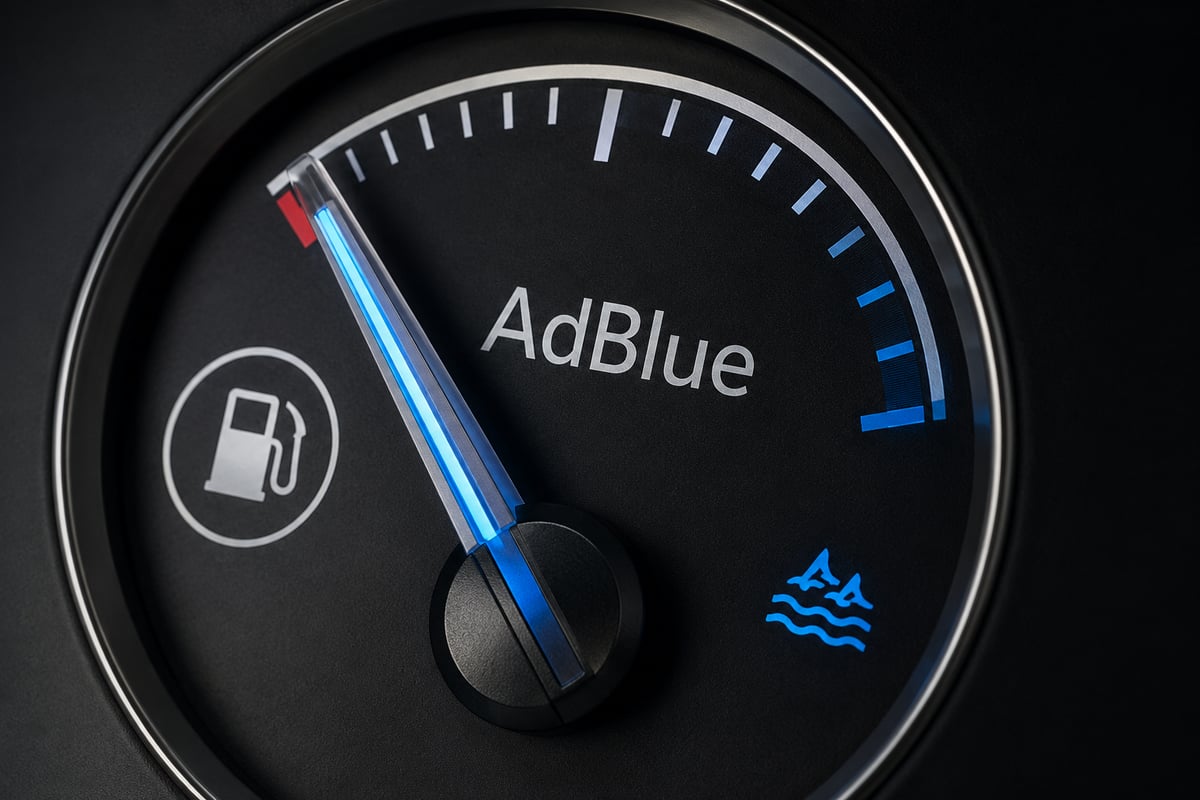
A long-haul tractor unit pulls out of a night rest stop and a small symbol lights up on the dash; the driver calls it "the AdBlue light" and shrugs it off until morning. In the morning the engine starts fine, but there's no torque on the climb. The tank isn't empty, though: the system has throttled itself because it can't bring the NOx reading at the catalyst outlet down to where it needs to be. This guide treats AdBlue not as a liquid to top up, but as a closed-loop chain running from the dosing valve to the sensor at the catalyst outlet.
What Is AdBlue? Composition, AUS 32 and the ISO 22241 Standard
AdBlue (known as Diesel Exhaust Fluid, DEF, in North America) is a colourless reducing agent with a faint smell of ammonia, made of 32.5% high-purity urea by weight and 67.5% demineralised water. It is not a fuel and not a fuel additive, and it is never injected into the engine; it is sprayed only into the exhaust line, ahead of the SCR catalyst.
AdBlue is a registered trade name owned by the German Association of the Automotive Industry (VDA). The fluid's technical name is AUS 32 (Aqueous Urea Solution 32), and ISO 22241 is the standard that defines its quality requirements. Different names don't mean different products, which is why the real answer to "which AdBlue brand is best" isn't a brand at all — it's the standard declaration printed on the packaging.
How Is AdBlue Made, and Why Exactly 32.5%?
Production is the controlled dissolving of high-purity urea in demineralised water. The ratio isn't arbitrary: 32.5% is the concentration at which the urea-water solution freezes at the lowest possible temperature. Move away from that ratio and the freezing point rises while the dosing calibration goes off, because the control unit assumes a fixed urea content — a diluted fluid simply can't produce the amount of ammonia the system is expecting. The real difficulty isn't the ratio, it's the purity: the standard sets tight limits on impurities and on metals that poison the catalyst. A mix of agricultural-grade urea and tap water is not AdBlue, no matter how carefully it's measured.
Which Vehicles Have AdBlue?
Nearly every Euro VI truck, articulated lorry, tractor unit, bus, refuse truck and concrete mixer runs SCR, and therefore AdBlue. Manufacturers split during the Euro IV and Euro V era: some adopted SCR and used AdBlue, others met the norm with heavy EGR alone, which is why older fleet vehicles vary by make and engine. The same system also appears on construction equipment and on a share of modern diesel passenger cars. The quickest way to check is to look for a separate filler neck next to the diesel one — usually with a blue cap — and a second level gauge on the dash.
What Does AdBlue Do? The Chemical Chain from Urea to Nitrogen
SCR has one job: reduce the nitrogen oxides (NOx) that form when a diesel engine burns fuel at high temperature and with excess air into harmless components, inside the exhaust pipe. Doing that takes ammonia, and since carrying ammonia as a pressurised gas on board would be unsafe, it is generated inside the exhaust pipe, on demand, at the moment it's needed. AdBlue is the transportable raw material for that generation.
The chain runs in three steps. Thermolysis: the droplet sprayed from the dosing valve into the hot exhaust stream loses its water to evaporation, and the remaining urea breaks down under heat into ammonia (NH3) and isocyanic acid (HNCO). Hydrolysis: the isocyanic acid reacts with water vapour in the exhaust to form a second ammonia molecule plus carbon dioxide; both steps complete in the decomposition zone between the dosing valve and the catalyst. Selective catalytic reduction: the ammonia produced binds to the catalyst's porous coating and converts the nitrogen oxides into nitrogen (N2) and water vapour.
This dependence on temperature is behind most of the failures seen in the field. Urea only breaks down cleanly once exhaust temperature sits roughly above 200°C; below that, the control unit either never starts dosing or cuts it early, and fluid hitting a cold surface condenses into a solid deposit instead. Urban delivery, refuse collection and city bus duty cycles hover right around that threshold, which is why they see both higher real-world NOx and a greater risk of crystallisation.
Ammonia Storage and Slip
The catalyst doesn't use ammonia on demand alone; it stores some in its coating and draws on it as NOx arrives, which keeps conversion efficiency from collapsing during load changes. When the catalyst heats up quickly, some of that stored ammonia can be released and escape through the exhaust — a condition called ammonia slip, unmistakable by its sharp smell, which the slip catalyst mounted downstream of the SCR is there to capture.
What Components Make Up an SCR System in a Heavy Commercial Vehicle?
Heavy-duty SCR architecture differs from a passenger car's in three ways: the tank is sized generously for range, the entire fluid path is heated, and conversion efficiency is monitored continuously by sensors at both ends of the catalyst.
| Component | Function | Typical failure symptom |
|---|---|---|
| AdBlue tank | Holds the fluid; houses the suction unit, heater, and level and temperature sensors | White residue, leaks, erratic level readings |
| Quality sensor | Measures urea concentration, in most designs from the speed of sound | Quality fault code with a full, clean tank |
| AdBlue filter | Traps particulates in the line, protects the pump and valve | Failure to build pressure, dosing running low |
| Supply-and-dosing module | Draws the fluid, pressurises it, and meters it out | No pump noise audible after ignition-on |
| Heated lines and tank heating | Thaws frozen fluid, keeps the line flowing | Dosing unavailable for a long stretch in cold weather |
| Dosing valve (injector) | Sprays fine droplets of fluid into the exhaust stream | Crystal crust on the tip, distorted spray pattern |
| Mixer and decomposition pipe | Mixes the droplet with the exhaust, provides distance for thermolysis | Deposits on the inner surface, rising back-pressure |
| SCR catalyst | Stores ammonia, reacts it with NOx | Low-efficiency code with normal dosing |
| Upstream NOx sensor | Measures raw NOx, feeds the dosing calculation | Dosing running too low or too high |
| Downstream NOx sensor | Measures residual NOx; the difference between the two sensors gives efficiency | Low-efficiency code, implausible signal |
What Do the Dual NOx Sensors and the Quality Sensor Do?
The upstream sensor measures raw NOx, the downstream one measures what's left; the control unit calculates conversion efficiency from the ratio of the two, corrects dosing, and makes the OBD call. If efficiency stays below expectation for long enough, a fault is logged even with a full tank and a working pump. This pairing also gives a useful diagnostic rule: with the engine cold and dosing not yet started, the two sensors should read close to each other; a persistent large gap points to one of the sensors, not the catalyst.
The quality sensor doesn't analyse the fluid's chemistry; in most implementations it measures the speed of sound with a temperature correction, because the speed of sound shifts with urea concentration. Fluid that's been diluted, mixed with diesel, or topped up with tap water falls outside the reference window. That fault triggers the same regulatory inducement stages as a low-level fault, and it's the most common reason behind a "full tank, no power" complaint.
What Do the AdBlue Warnings on the Dashboard Mean?
The warning reads through two elements: the canister- or droplet-shaped symbol, and the text line on the display. The symbol's colour tells you the stage, the text tells you why; amber means "act soon," red means "inducement has started, or is about to." If a separate check-engine light comes on alongside the emissions warning, the problem isn't the level — it's the system or the fluid quality itself.
| Stage | Typical dashboard display | What it means | What the driver should do |
|---|---|---|---|
| 1. Information | Steady amber symbol, low level bar | Tank approaching reserve, system normal | Add a refill stop to the route plan |
| 2. Persistent warning | Flashing amber symbol, audible alert | Level in reserve, restriction approaching | Refill at the first suitable stop |
| 3. Torque limitation | Red symbol, power-restriction alert | Inducement has started, power dropping in stages | Stop and refill |
| 4. Speed limit | Permanent red alert, speed-limit display | Final stage, speed capped around 20 km/h (12 mph) | Park somewhere safe and call for service |
| 5. System or quality fault | Check-engine light with a full tank | Level is fine; the fault is in dosing, quality or a sensor | Refilling won't help — read the fault code |
| 6. Tampering detected | Flashing emissions warning, repeating fault log | Unauthorised tampering or non-compliant fluid | Diagnosis at an authorised workshop is required |
Does the Warning Only Come On When the Tank Is Empty?
No. Euro VI legislation mandates staged inducement for three separate conditions: insufficient level, non-compliant fluid quality, and tampering with the system. If the dosing valve is blocked, the heating circuit isn't working, or the downstream sensor isn't seeing the expected reduction, the warning comes on regardless of level. The last two rows in the table above are the critical ones: pouring fluid from a jerrycan into a vehicle that's already warning with a full tank won't help, and an unsuitable funnel just adds a contamination risk on top. A delayed start to dosing on a cold first start-up isn't a stage at all — it's a temporary condition while the system waits for frozen fluid to thaw.
What Happens When AdBlue Runs Out? The Stages of the Inducement Protocol
The power and speed loss that follows once AdBlue runs out isn't a manufacturer's choice — it's the inducement mechanism mandated by Euro VI legislation. The engine doesn't stop; the vehicle is restricted until it's effectively unusable. The sequence runs from a warning, to staged torque limitation, to a final speed cap around 20 km/h (12 mph); how quickly one stage follows the next depends on distance covered or time elapsed.
The driver feels torque limitation as an inability to climb a grade and a change in the gearbox's shift program. On a loaded tractor unit, this stage alone is enough to stop the trip, because the vehicle starts holding up traffic on a hill. The roughly 20 km/h (12 mph) of the final stage is a walking pace meant only to get the vehicle to the nearest safe spot.
How Does the Vehicle Return to Normal Once Inducement Has Started?
The restrictions are reversible. When level was the cause, the control unit lifts the restriction once the tank is refilled with compliant fluid; that's not always instant — some vehicles need an ignition cycle, others need dosing to be confirmed over a short drive. If the restriction doesn't clear after a few cycles, the cause isn't level: check the quality sensor's signal, the dosing module's pressure, the supply line and its filter, and the heating circuit.
AdBlue Consumption: How Far Does It Go, and How Is It Calculated?
In a heavy commercial vehicle, AdBlue consumption depends far more on the amount of diesel burned than on distance covered, and typically runs at 3 to 6% of diesel consumption, with 5% the commonly used rule of thumb. The reason is simple: consumption is proportional to the NOx the engine produces, and NOx production is tied directly to the diesel burned. So the metric that actually tells you something isn't litres per kilometre — it's the ratio to diesel consumption.
| Calculation step | Method | Example |
|---|---|---|
| Based on diesel burned | Diesel amount times 3-6% | About 3-6 litres for a vehicle burning 100 litres of diesel |
| Per 100 kilometres | Diesel burned per 100 km times ratio | About 1.5 litres at 5% for a tractor unit burning 30 litres per 100 km |
| Range per litre | 100 divided by consumption per 100 km, times 100 | About 55-110 km per litre with the same inputs |
| Range of a full tank | Tank volume divided by consumption per 100 km, times 100 | Volume is given in the owner's manual |
| Fleet tracking indicator | AdBlue taken on divided by diesel taken on | Tracked monthly; a shifting ratio is the first clue |
The 30 litres in the table is only an example input chosen to illustrate the calculation — use your own fleet's measured figures. Duty cycle changes the outcome significantly: a loaded tractor unit on long-haul work burns the most AdBlue in absolute litres, but the system runs at its healthiest on this profile because exhaust temperature stays high enough; city driving and bus routes burn fewer litres but carry a higher crystallisation risk.
The ratio doubles as a diagnostic tool. If it drops well below the vehicle's own baseline, the system isn't spraying enough fluid — the pump may not be building pressure, the valve may be blocked, or the filter may be clogged. If it rises well above baseline, think leak, a valve stuck open, or another engine fault driving up raw NOx production.
Standards and further reading
For the regulatory background on this subject, see Regulation (EC) No 595/2009 (Euro VI heavy-duty emissions). Always confirm specific figures and procedures against the current regulation and the vehicle manufacturer service data.
How Do You Fill AdBlue, and Where Does It Go?
In heavy commercial vehicles, the AdBlue tank is usually a separate body bolted to the chassis next to the diesel tank; the filler neck sits right next to the diesel one or under the step on most tractor units, and in a separate compartment on buses. The neck is separate from the diesel one, a different diameter, and usually marked with a blue cap. Because the suction unit, heater and sensor package all sit inside the tank, the smallest bit of dirt entering through the neck reaches them directly — the most common cause of SCR failure isn't poor fluid quality, it's contamination introduced right here.
- Stop the vehicle on level ground, switch off the engine, and turn off the ignition; a level reading taken on a slope is misleading.
- Wipe the filler neck and the area around it with a clean cloth; any dust or dried residue that falls in as the cap opens goes straight into the tank.
- Make sure you're using the correct neck; if there's any doubt, check the owner's manual — don't fill by guesswork.
- Use only a funnel, pump or container dedicated to AdBlue; never use equipment that has carried diesel, oil, antifreeze or water.
- The packaging should carry an ISO 22241 or AUS 32 declaration, a production date, and an intact original cap seal.
- Fill slowly; a fast flow foams and throws off the level reading. Don't fill the tank right to the neck — leave room for the fluid to expand if it freezes.
- Rinse any spillage immediately with plenty of water; dried AdBlue leaves marks on painted surfaces, and if it reaches a connector it upsets contact resistance.
- Seat the cap fully home with its gasket. Rinse the funnel or pump and keep it capped, and store an opened container upright in a cool place.
- Switch the ignition on and confirm the level reading has updated. If the warning doesn't clear after a few ignition cycles, don't refill again — read the fault code instead. Log the quantity taken on in the vehicle's records.
How Do You Choose and Store Good-Quality AdBlue?
Quality is a matter of documentation, not brand. Look for an ISO 22241 compliance declaration and the AUS 32 designation on the packaging, with a legible production date and batch number. For bulk purchases, ask the supplier for the batch's analysis certificate, and confirm the delivery tanker and pump are used only for AdBlue.
| Condition | Why it matters | Fleet practice |
|---|---|---|
| Store below 25 °C | Shelf life is about 12 months under this condition | Keep stock in an enclosed, cool area |
| Don't exceed 30 °C | Urea breaks down, ammonia forms, concentration drifts | Avoid open-air storage in summer |
| Protect from sunlight | Light speeds up degradation, which is irreversible | Keep containers shaded and closed |
| Use the right container material | Copper, brass, zinc and galvanised surfaces contaminate the fluid | Use suitable plastic or stainless containers |
| First in, first out | An old batch that isn't used first can run past its shelf life | Mark the delivery date, use in order |
Fluid received on delivery can also be checked on the spot: a handheld refractometer measuring urea concentration shows within seconds whether the mixing ratio is where it should be. That test won't catch impurities, but it does block the most common intake error — a diluted or wrong product passing goods receipt unnoticed.
AdBlue and SCR Faults: Symptoms, Mechanisms and Diagnosis
The most common mistake in SCR diagnosis is replacing whatever component the fault code names, at face value. Because the system is closed-loop, the code usually points to the effect of the fault rather than its cause: a low-conversion-efficiency code tells you the catalyst isn't getting enough ammonia, or the right amount, not why.
| Symptom | Likely mechanism | Verification / check |
|---|---|---|
| Tank full, yet torque is restricted | A quality fault or system fault has triggered inducement | Read the code and inducement stage, measure concentration |
| AdBlue level isn't dropping at all | Clogged filter, pump not building pressure, or a blocked valve | Run a pressure-build test, watch dosing live |
| Consumption is well above expected | Line or valve leaking, or raw NOx production has increased | Check for crystal traces along the line, read engine codes |
| White crust on the dosing valve tip | Crystallisation: urea failed to break down at low exhaust temperature | Remove and inspect the valve, review the duty cycle |
| Sharp ammonia smell from the exhaust | Ammonia slip: overdosing, or a slip catalyst no longer working | Check dosing quantity and temperature sensors |
| Low-efficiency code with normal fluid and dosing | Catalyst has aged, or the downstream sensor is reading wrong | Compare the two NOx sensors with the engine cold |
| Dosing doesn't start for a long time in winter | Fluid is frozen, heating circuit isn't working | Measure heater voltage, fuse and temperature sensor |
How Does Crystallisation Form, and Where Does It Build Up?
Crystallisation comes from the chemical chain stalling halfway through. When exhaust temperature isn't high enough, the droplet's water evaporates but the urea doesn't fully break down; the isocyanic acid coming out of thermolysis, unable to convert to ammonia, combines with itself into solid compounds — biuret, cyanuric acid, melamine. These build up as a hard white crust on the dosing valve tip, on the mixer's vanes, and on the inner surface of the decomposition pipe. As the crust grows it distorts the spray pattern, droplets get coarser, and that produces more deposits still — the process feeds itself.
Four things trigger it: persistently low exhaust temperature, degraded cooling or calibration in the dosing valve, a line leak, and non-compliant fluid. The fix is therefore operational, not chemical: regular runs that are long and loaded enough, and less time spent idling. Clean a valve without removing the underlying condition, and the crust is back before long.
Why Is Contamination the Biggest Cause of Failure?
AdBlue's purity is the operating condition for the whole system. Diesel, engine oil, tap water, dust, or metal ions leached from a copper or zinc container all take the fluid out of spec — even tap water's mineral content is enough to form a precipitate in the tank. Contaminated fluid doesn't just trip the quality sensor; it poisons the catalyst's active surface and drops its efficiency permanently. The correct sequence is well established: drain the tank, replace the strainer and filter, flush the lines, then refill with clean fluid and test. Filter discipline isn't only an SCR concern — the same pattern plays out on the fuel side when fuel filter and water separator maintenance is skipped: a cheap consumable gets left out, and an expensive component pays for it.
Step-by-Step SCR Diagnostic Flow
- Read the fault codes and freeze-frame data; note the inducement stage and counter status.
- Inspect the fluid in the tank visually: if there's cloudiness, sediment, an oil film or an off smell, measure concentration.
- Check filter condition and the last change record; a clogged filter causes insufficient dosing even with a healthy pump.
- Run the pressure-build cycle with an actuator test; watch whether the pump builds and holds pressure.
- Inspect the dosing valve tip, then the mixer and decomposition pipe, for crystal deposits.
- Compare the two NOx sensors with the engine cold and no dosing active; a persistent large gap points to one of the sensors.
- Test the exhaust temperature sensors and the heating circuit (tank heater, line heaters, coolant valve).
- After the repair, clear the codes, reset the counter, and confirm efficiency with a loaded test drive.
AdBlue in Winter: Freezing, the Heating Circuit and Cold-Weather Use
AdBlue freezes around -11°C. Because the urea and water freeze together at the same temperature, the solution doesn't separate — which has a practical upshot: freezing doesn't damage AdBlue. Thawed fluid can be used at the same concentration; a frozen container isn't discarded, just left to thaw on its own in a warm-ish space.
On the vehicle side, the countermeasure is built into the design: the tank, suction unit and supply lines are all heated. Heat comes from two sources — hot coolant routed from the engine's cooling circuit to a heat exchanger inside the tank, and electric heaters in the suction unit. When the system finds frozen fluid, it delays dosing, runs the heating, and starts dosing once flow is sufficient; it's normal to see no consumption at all in the first few kilometres of a cold morning.
The real winter problem isn't freezing itself — it's a faulty heating circuit. A vehicle with a burnt-out heating element, a blown fuse, or a stuck coolant valve won't thaw its tank, dosing never starts, and the system eventually logs a fault and moves into an inducement stage. This fault gives no sign at all in summer; it tends to show up in the first cold week of the year, often on several vehicles at once.
Is There Such a Thing as "Winter-Grade" AdBlue?
No. There's a single formulation; no different mix is made for the season. Winter preparation isn't about the fluid, it's about the conditions: actually testing the heating circuit before winter, keeping spare containers somewhere that won't freeze, and keeping the tank topped up higher through the cold months.
Is Deleting AdBlue Legal? The Legal and Technical Consequences
Disabling the SCR system, stopping dosing through software, or gutting the catalyst is an intervention that renders the emissions control system non-functional. This guide does not explain or describe how to carry out such a modification; what follows summarises only the consequences.
On the technical side, tampering doesn't remove the underlying problem, it just hides it. With emissions-side monitoring disabled, a real fault developing in the dosing module, the heating circuit or a sensor produces no warning either; the problem progresses unnoticed while the engine and the aftertreatment hardware keep running without the early alert they'd otherwise give. Restoring the system to original afterwards is often more expensive than routine maintenance would have been, because of the catalyst and sensors that got fouled in the meantime.
Maintenance and Lifespan: An SCR Checklist for Fleets
What determines SCR's service life isn't its expensive components, it's fluid discipline. As long as the fluid entering the system is clean and compliant, the whole chain from dosing valve to catalyst delivers the service life it was designed for.
- Level and log at every diesel refill: Check the level, log the quantity taken on in the vehicle's records.
- Monthly consumption ratio tracking: Check whether AdBlue taken on divided by diesel taken on is still within the vehicle's own baseline.
- Dosing valve and AdBlue filter: At scheduled maintenance, check the valve tip for crystal crust and confirm the filter interval.
- Crystal and leak inspection: Look for white crust, dampness and a sharp smell around the valve, along the line, and at the exhaust outlet.
- Fault log review: Read conversion efficiency, dosing statistics and any recurring codes; review the trend even if no light is on.
- Pre-winter heating circuit test: Actually run the tank and line heaters and the coolant valve to confirm they work.
- Equipment and stock check: Confirm the funnel, pump and container are dedicated to AdBlue only, and verify storage temperature and stock rotation.
The lowest-cost item on this list is the AdBlue filter. It protects the pump and dosing valve by trapping particulates in the line, and when it isn't replaced on schedule, the failure doesn't show up in the filter — it shows up in the components it was there to protect. VADEN ORIGINAL manufactures AdBlue filters for heavy commercial vehicles.
Where Does SCR Sit in the Exhaust Emissions Chain?
SCR is the final link in a heavy commercial vehicle's aftertreatment chain, and it doesn't work alone. The chain starts inside the engine: the EGR valve, which routes a portion of exhaust gas back to the intake, lowers peak combustion chamber temperature so less NOx forms in the first place; SCR then cleans up whatever did form.
The particulate side sits in the middle of the chain: exhaust gas passes first through the diesel oxidation catalyst, then soot particles are trapped in a porous ceramic structure. The diesel particulate filter handles this stage, and its regeneration behaviour directly affects the exhaust temperature profile. The links feed each other: regenerations that don't complete disturb the temperature profile, a disturbed profile raises the tendency to crystallise in the SCR, and a sooted-up EGR valve shifts raw NOx production and throws off the dosing calculation. That's why a vehicle that arrives at the shop as an "AdBlue fault" can have its root cause sitting somewhere else in the chain entirely.
Nearly every problem falls under one of three headings: non-compliant or contaminated fluid, a duty cycle where exhaust temperature never reaches the dosing window, and filter or sensor maintenance that wasn't done on time. A fleet that logs level, tracks the consumption ratio, keeps filling equipment dedicated, and tests the heating circuit before winter takes SCR-related breakdowns almost entirely off the table. Whenever there's any doubt, the current OE service documentation specific to the vehicle's engine and chassis code is the final word.
Shop this part: Fuel System
In-depth technical guide: For fault diagnosis, step-by-step replacement and service intervals: Exhaust Manifold: Cracks, Leaks, Replacement & Torque Guide
Main guide: What Is a Fuel Injector? How to Recognize Injector Failure Symptoms
Tags
Frequently Asked Questions
- What is AdBlue, and what's it made of?
- AdBlue is the registered trade name for a urea solution made to the ISO 22241 standard, technically called AUS 32. It's 32.5% high-purity urea by weight and 67.5% demineralised water, and in North America the same fluid is sold as DEF (Diesel Exhaust Fluid). It's not a fuel or fuel additive and is never injected into the engine — it's sprayed only into the exhaust line.
- What does AdBlue do?
- Once sprayed into the exhaust line, AdBlue converts to ammonia under heat, which reacts with the nitrogen oxides (NOx) in the exhaust gas at the SCR catalyst and reduces them to harmless nitrogen and water vapour. That's what lets a heavy commercial vehicle meet Euro VI emissions limits. For the reaction to run efficiently, exhaust temperature needs to be roughly above 200°C.
- What happens if AdBlue runs out — does the vehicle stop?
- The engine doesn't stop, but the vehicle is restricted until it's effectively unusable. The inducement mechanism required by Euro VI legislation starts with a dashboard warning, then limits torque in stages, and finally caps speed at around 20 km/h (12 mph). On a loaded tractor unit, torque limitation alone is enough to end the trip, because the vehicle can no longer climb a grade.
- How far does one tank of AdBlue last?
- The right metric isn't distance, it's the ratio to diesel burned: AdBlue consumption in a heavy commercial vehicle typically runs at 3 to 6% of diesel consumption, with 5% the commonly used figure. For a tractor unit burning 30 litres of diesel per 100 km, that works out to roughly 1.5 litres of AdBlue. A tank's range comes from dividing its volume by that consumption rate; volume is listed in the vehicle's owner's manual.
- What does the AdBlue symbol on the dashboard mean?
- The symbol's colour tells you the stage, and the text next to it tells you why. An amber symbol means a refill is needed soon; a red symbol means inducement has started or is about to. If the check-engine light comes on together with the AdBlue warning and the tank is full, the problem isn't the level — it's the system itself or fluid quality, and refilling won't clear the warning.
- How do you fill AdBlue, and where does it go?
- The AdBlue tank is separate from the diesel tank; on most tractor units the filler neck sits next to the diesel one, has a different diameter, and is usually marked with a blue cap. Fill it on level ground with the ignition off, after wiping the neck and the surrounding area clean. Use only a funnel, pump or container dedicated to AdBlue — the most common cause of SCR failure isn't poor fluid quality, it's contamination introduced while filling.
- Which AdBlue brand is best, and how do you choose?
- Quality is a matter of documentation, not brand. Look for an ISO 22241 compliance declaration and the AUS 32 designation on the packaging, along with a legible production date and batch number. For bulk purchases, ask for the batch's analysis certificate and confirm the delivery tanker and pump are used only for AdBlue. Urea concentration can be checked on the spot with a handheld refractometer.
- Does AdBlue freeze, and does freezing ruin it?
- AdBlue freezes around -11°C, but freezing doesn't ruin it: the urea and water freeze together at the same temperature, so the mixture doesn't separate, and thawed fluid can be used at the same concentration. On the vehicle, the tank, suction unit and lines are all heated. The real winter problem isn't freezing itself — it's a faulty heating circuit, a fault that shows no sign in summer and only surfaces in the first cold week.
- What happens if AdBlue is deleted — is it legal?
- Tampering with emissions control equipment is against the law, and the SCR system is an inseparable part of Euro VI type approval. Periodic roadworthiness inspection includes an exhaust emissions check, and a vehicle's OBD log, an inconsistent fault history and sensor data can all reveal tampering. If it's detected, administrative penalties can follow, the manufacturer's warranty is void for emissions-related claims, and resale value drops.
- Does every diesel vehicle have AdBlue?
- No. AdBlue is fitted to vehicles that control NOx through SCR, which covers nearly all Euro VI trucks, tractor units and buses. Older-emission-class heavy vehicles, and some engines that control NOx with EGR alone, don't have an AdBlue system. A share of Euro 6 passenger cars and light commercial diesels use the same technology on a smaller scale too.
- What is DEF fluid in a truck?
- DEF (Diesel Exhaust Fluid) is the name used in the United States and Canada for AdBlue: the same solution of 32.5% urea in demineralised water, made to the ISO 22241 standard, whose technical designation is AUS 32. It isn't a different product with a different formula, only a regional name; Brazil uses ARLA 32 for the same fluid, and some packaging carries only the technical name AUS 32. It also behaves the same in cold weather, starting to freeze at about -11°C (12°F). Whatever name is printed on the jug or the pump, what confirms the fluid is the ISO 22241 or AUS 32 declaration on the label, not the brand next to it.
- Is AdBlue (DEF) flammable?
- AdBlue/DEF isn't flammable. As a 32.5% urea and demineralised-water solution it won't ignite, and manufacturer safety data sheets generally don't classify it as a hazardous material. It should still be kept away from prolonged heat, though - sustained high temperature breaks the urea down and can release ammonia. If it contacts skin or eyes, rinse with plenty of water; for the exact transport and storage classification, check the safety data sheet of the specific product you've bought.
- Does AdBlue (DEF) expire or go bad, and how should it be stored?
- Shelf life depends on storage temperature, and ISO 22241-3 defines that relationship in temperature bands - the cooler the fluid is kept, the longer it lasts. A sealed container stored out of direct sunlight and below about 25°C is good for at least a year from its production date. Stock that sits above 30°C for extended periods has a noticeably shorter usable life, and fluid that's been exposed above 35°C should have its concentration checked before use. Once opened, keep the cap tightly closed: in an open container water evaporates, which shifts the concentration, and dust gets in and contaminates the fluid.
- Does a truck have an AdBlue/DEF filter?
- Yes. SCR systems have a filter in the AdBlue supply circuit, on many designs housed in the supply-and-dosing module, that traps particulates before they reach the pump and dosing valve - a separate part from the engine's oil or fuel filters. Whether it's independently serviceable, and how often it needs changing, depends on the SCR supplier and the vehicle, so the OE service manual is the reference for the interval; a filter left in past its schedule doesn't usually fail itself, the pump or valve it was protecting does instead. VADEN ORIGINAL manufactures AdBlue filters for heavy commercial vehicles.
- Should you add an anti-crystallisation additive to AdBlue (DEF)?
- Fluid that meets the standard doesn't need one. ISO 22241 defines AdBlue as high-purity urea in demineralised water with set impurity limits, so anything added to the tank afterwards risks taking the fluid outside that definition and can trip the quality sensor. Crystal build-up on the dosing valve and in the exhaust pipe usually isn't a fluid problem at all: it comes from the chemical chain stalling at low exhaust temperature and from a spray pattern that has deteriorated. If you're considering an additive, check the vehicle manufacturer's instructions on it first.
- Should you fill AdBlue from a pump or from a jug?
- Either works, as long as the container or the pump carries an ISO 22241 or AUS 32 declaration - that's what confirms the fluid, not where it came from. A dedicated AdBlue pump feeds the filler neck through a closed line, so there's little chance of dirt or the wrong fluid getting in. A jug is fine on routes without pump access, or as backup stock, but it should come in its original sealed packaging, be poured through a clean funnel kept only for AdBlue, and never be refilled into a container that has held diesel, oil or coolant. A spare jug left for weeks in a hot cab or on a sun-facing shelf heats up and loses shelf life faster than one kept somewhere cool, so store backup stock that way and use the oldest jug first.
Related Articles
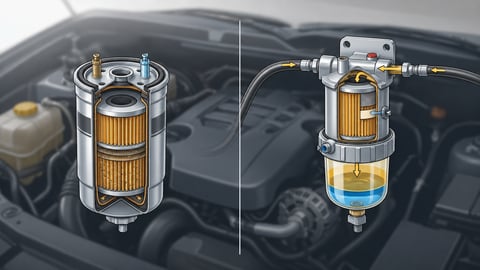
Water Separator Filter: Diesel Water Drain & Warning
Where does water get into diesel fuel, how does a water separator work, and what should you do when the warning light comes on? A heavy-duty vehicle guide.
Fuel Water Separator Filter: Symptoms, Replacement & Care
Truck fuel water separator filter and housing: how it works, water sensor, drain valve, heater, fault symptoms, replacement, bleeding and maintenance.
Solenoid Coil: Faults, Testing, Replacement and Maintenance
Understand how a solenoid coil works, spot open or shorted windings with a multimeter, replace it correctly and extend its service life on trucks.


