What Is a Turbocharger? Turbo Failure Symptoms in Diesel and Heavy-Duty Vehicles
What is a turbocharger and how does it work? Turbo failure symptoms, VGT vane sticking, and the oil habits that determine service life in heavy-duty diesels.
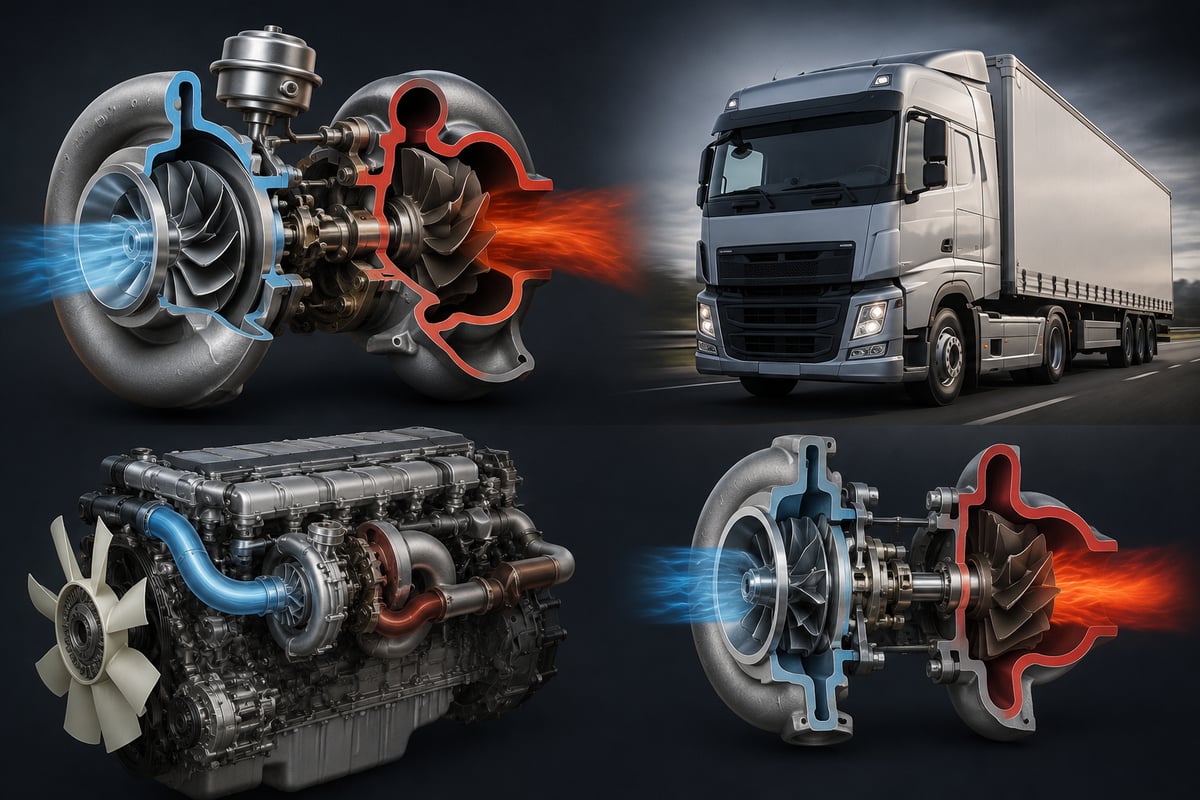
A loaded tractor unit fails to pull the way it should halfway up a long grade; the pedal is on the floor, the revs climb, but the truck won't accelerate, dark smoke rolls out of the stack, and a thin whistle comes from somewhere behind the dash. The driver's diagnosis is already written: "the turbo's gone." On the bench, once the charge air line is pressurised, the turbo turns out to be perfectly sound — the fault is a hose clamp that worked itself loose. This scene isn't the exception in the field, it's the rule: the turbocharger is one of the most frequently diagnosed parts on a heavy-duty diesel, and also one of the most frequently misdiagnosed. This guide treats the turbo not as an isolated part but as the energy converter sitting in the middle of a chain that starts at the air filter and ends at the tailpipe.
The Physics of Getting More Power From the Same Displacement
A turbocharger is an exhaust-driven air compressor: it captures energy left in the exhaust gas with a turbine wheel, uses that energy to spin a compressor wheel on the same shaft, and forces air into the engine at a pressure above atmospheric. It isn't a part that feeds the engine extra fuel — it's a part that feeds the engine extra air mass, and it's only because of that air that more fuel can be burned at all.
The power a diesel engine can produce is limited not by the volume of air drawn into the cylinder but by its mass. The oxygen needed for combustion lives inside that mass; if the air is cold and pressurised, more oxygen fits into the same volume. In a naturally aspirated engine, only as much air enters the cylinder as the atmosphere can push in, and adding more fuel beyond that point just raises exhaust temperature. A turbocharger removes that ceiling: by pressurising the intake manifold above atmospheric pressure, it packs noticeably more air mass into the same swept volume. It's the most efficient way to raise power and torque without growing the engine or adding weight.
The second gain is energy recovery: in a naturally aspirated engine, the heat and pressure leaving in the exhaust simply go to atmosphere, whereas a turbo converts part of that loss into mechanical work without stealing power from the crankshaft to spin the compressor. The third is altitude compensation — air thins out with elevation, and on a turbocharged engine the control unit works the turbo harder to hold the target boost target. Today, finding a Euro-emissions heavy-duty engine without a turbo is practically impossible.
What's the Difference Between a Turbocharger and a Supercharger?
Both compress air; where they differ is where they get the power to do it. A turbocharger spins on the waste energy of the exhaust gas and doesn't put a direct mechanical load on the engine, but because its output depends on exhaust flow, its response lags at low revs. A supercharger is driven directly off the crankshaft; it builds boost instantly but takes back part of the power it generates from the engine itself. One terminology mix-up is worth flagging: in a heavy-duty vehicle, "compressor" usually means the air compressor feeding the air-brake system — an entirely different unit from the compressor wheel inside a turbocharger that pressurises intake air.
How Does a Turbocharger Work? Turbine, Compressor, and Center Housing
A turbocharger has three sections. The turbine side bolts to the exhaust manifold; hot gas accelerates through the narrowing channel of the snail-shaped housing, strikes the turbine wheel's blades, and spins the wheel, giving up part of its energy in the process. The compressor side draws clean air in from the air filter through the eye of its own wheel; the blades fling the air outward, and the diffuser and volute convert that velocity into pressure. The center housing carries the shaft connecting the two wheels, along with its bearings, oil supply and return passages, sealing rings, and, in most heavy-duty applications, water-cooling passages.
The most critical feature of this layout is that shaft speed has no direct link to engine speed. The shaft spins as fast as the exhaust flow and temperature allow — depending on design, that can range from the tens of thousands of rpm up to roughly 100,000 rpm. The only thing that can carry a shaft at that speed is a bearing arrangement with no direct metal-to-metal contact: in a classic heavy-duty turbo, the shaft rides on a floating bushing suspended between two oil films and never touches bare metal.
From this comes the turbo's single most important rule: oil here isn't just a friction-reducer — it's the medium the shaft actually floats on, and at the same time the coolant that carries away heat arriving from the turbine side. If oil pressure drops even for a moment, the film collapses, the shaft touches metal, and bearing damage follows within seconds.
The sealing side is also commonly misunderstood. A turbo has no conventional oil seal at the shaft ends; it typically uses piston-ring-style metal seal rings, and those rings don't physically block oil — they hold it back through pressure balance. When that balance is upset — say, by excess vacuum at the compressor inlet from a clogged air filter, or oil pooling in the housing because the oil return line is restricted — even a perfectly healthy turbo will leak oil. Behind most "the turbo's throwing oil" complaints sits some other fault that has thrown this balance off, not the turbo itself.
Turbocharger Components and What Each One Does
From the outside a turbo looks like a single cast part, but inside it a group of interdependent components does the work. The table below collects those components, their job, and how a fault in each one shows up in the field.
| Component | Function | Visible result of a fault |
|---|---|---|
| Turbine housing and wheel | Transfers exhaust gas energy to the shaft | Cracking, leaks, or blade damage bring power loss and a howling noise |
| Compressor wheel and housing | Accelerates intake air and converts it to pressure | Foreign-object damage drops boost pressure |
| Shaft, floating bushing, and thrust bearing | Carries both wheels, rides on an oil film | Play noise, oil consumption, blue smoke |
| Seal rings | Hold oil inside the housing through pressure balance | Oil leaks from either side once the balance is upset |
| Oil supply and return lines | Feed the bearing, drain oil back to the sump by gravity flow | Blockage brings sudden bearing failure or an oil leak |
| Water-cooling passages | Carry away residual heat after shutdown | Blockage cooks the oil and forms coke deposits |
| Wastegate or vane assembly and actuator | Limits or regulates boost pressure | Sticking brings over-boost, under-boost, or a fault code |
Because the turbine and compressor wheels are balanced together on the shaft, a turbo is almost always renewed as a complete unit or, where the manufacturer permits it, at cartridge level. The real value of knowing the components isn't repair — it's diagnosis: knowing which symptom traces to which component keeps a healthy turbo from being pulled off the engine for nothing.
Wastegate vs. VGT/VNT: Two Different Ways to Manage Boost
A turbo's natural tendency is to keep accelerating as exhaust flow rises. As revs climb, the gas volume driving the turbine grows, the shaft spins faster, and boost pressure can exceed both the engine's mechanical limits and the turbo's own speed limit. That's why every turbocharged engine has some way of capping boost; two basic approaches are used.
The wastegate is the first approach. The turbine housing has a channel that bypasses the wheel and a flap that closes it off; once boost reaches its target, the flap opens, part of the exhaust gas skips the turbine and goes straight out, and the shaft can't speed up any further. It's simple, durable, and cheap; its downside is sluggish response at low revs and wasting the energy in the bypassed gas.
Variable geometry turbocharging is the second approach, and it has become standard on heavy-duty Euro-emissions engines. Depending on the manufacturer it's called VGT (variable geometry turbocharger) or VNT (variable nozzle turbine); the function is the same either way. A ring of vanes with adjustable angle surrounds the turbine wheel. At low revs the vanes close, narrowing the gas path, so the gas speeds up and drives the turbine hard even on low flow — giving strong low-rev torque and less lag. As revs rise, the vanes open, the path widens, and over-speeding is prevented. Because no gas is bypassed, no energy is wasted either.
| Criterion | Wastegate turbo | Variable geometry turbo (VGT/VNT) |
|---|---|---|
| Boost management method | Part of the gas bypasses the turbine | Turbine inlet area is changed with vanes |
| Low-rev response | Lag is more noticeable | Response is quick once vanes close |
| Mechanical complexity and control | Low; a pressure-opened mechanical flap | High; vacuum, pneumatic, or electric actuator |
| Sensitivity to carbon build-up | Limited effect on the flap shaft | Vanes can stick with soot — the leading failure mode |
| Contribution to engine braking | Negligible | Closing the vanes can support exhaust braking |
| Diagnostic approach | Flap freedom of movement and actuator travel | Commanded vs. measured position, live data |
The practical takeaway: variable-geometry turbos deliver more but are more maintenance-sensitive, because the vane ring gradually stiffens up with soot that accumulates at low exhaust temperatures.
Intercooler: The Turbo's Job Isn't Done Until the Compressed Air Is Cooled
Compressing air inevitably heats it up. Air leaving the compressor wheel comes out noticeably hotter than it went in; hot air expands, and its density falls. In other words, while the turbo is pressurising the air it's also thinning it out. The part that resolves this paradox is the intercooler, or charge-air cooler: it sits between the compressor and the intake manifold, is usually cooled by airflow in front of the radiator, and brings the compressed air back close to ambient temperature. The gain works two ways. Cooler air is denser, so it carries more oxygen mass at the same pressure and lets the engine burn more fuel; and the lower intake temperature also lowers peak combustion temperature, cutting NOx formation and thermal stress. That's why the intercooler isn't a performance add-on — it's part of the emissions architecture.
Faults on this side are almost always mistaken for a turbo problem in the field. Core fins clogged with mud and insects reduce heat transfer, so the air stays hot and power loss and smoke follow. A cracked core or a loose clamp is a direct pressure leak. The most deceptive symptom is oil pooling in the lower intercooler tank; that buildup can be a result of turbo seal leakage, but it can also just be normal vapour condensation from crankcase ventilation — the amount and the trend decide which.
What Really Determines Turbo Life: Lubrication and Cooling
Most turbos don't die from wear — they die from an oil-related event. In failure investigations, the most common root causes are oil not arriving, arriving late, arriving dirty, or being cooked inside the housing.
Oil starvation kills fastest. On a vehicle that's sat unused for a while, the first few seconds after start-up — before gallery pressure builds — is the moment the turbo is most exposed. A clogged oil filter going into bypass, the wrong oil viscosity, a tired oil pump, or a feed line narrowed by carbon all produce the same result more slowly. Dirty oil is the second cause: bearing clearances are measured in microns, and a hard particle entering that clearance scores the bushing surface and breaks down the film thickness; once wear starts, shaft play increases, the wheel moves closer to the housing, and balance is lost.
Cooked oil is the third cause, and the most often overlooked. The turbine side reaches several hundred degrees Celsius in operation, and part of that heat travels along the shaft into the center housing. While the engine is running, both the circulating oil and the coolant carry that heat away continuously. When the engine is shut down abruptly, circulation stops, but the heat sitting in the hot turbine housing has to go somewhere — it migrates into the center housing and cooks the small amount of oil left in the bearing clearance. The cooked oil first thickens, then turns into a hard carbon shell known as coke. That shell narrows the oil passages and delays oil reaching the bearing on the next start. The process is cumulative: every hot shutdown sets the stage for the next one, and one day the turbo fails "out of nowhere."
Start-Up and Shutdown Discipline: The Cheapest Insurance for Turbo Life
There are plenty of things worth spending money on to extend turbo life, but the single most effective measure is free: starting and stopping the engine correctly. The sequence below can be applied directly in the field and taught straight to drivers.
- After starting the engine, allow a short moment for oil pressure to build; don't load the throttle in the first few seconds — at that instant the turbo is spinning with almost no oil.
- Avoid high revs and full load on a cold engine; cold oil struggles to flow, the film stays thin, and the bearing can't handle the real load yet.
- Keep the first few kilometres light and avoid prolonged idling; low exhaust temperature both speeds up soot build-up and keeps the oil from reaching operating temperature.
- Don't shut the engine off right after a heavy load or a long grade; the turbo is fully hot and spinning fast at that point.
- Let the engine idle briefly before shutdown; during this time oil and coolant continue to circulate, heat is carried away from the turbine side, and the housing drops to a safe temperature. Adjust the duration to the preceding duty cycle: short in city driving, longer after a long haul or heavy load.
- Don't blip the throttle when shutting down; revving the engine as the ignition cuts spins the shaft faster at the exact moment it's about to lose oil. If there's an oil or coolant leak, don't take the vehicle out on the road at all.
- After a new or reconditioned turbo is fitted, follow the manufacturer's first start-up procedure exactly; it typically calls for building oil pressure first, then running at unloaded idle for a set period.
The total cost of these steps is a few minutes; in return, both the bearing film is protected and coke build-up is delayed. On vehicles with a turbo-timer, it's normal for the engine to keep running for a while after the ignition is switched off — that function should never be defeated.
Further reading
For a plain-language technical overview of this subject, see the reference article on Wikipedia. Always confirm specific figures and procedures against the vehicle manufacturer service data.
How Oil Quality and Change Intervals Directly Affect the Turbo
In a turbocharged engine, oil does a harder job than it would without a turbo: the same oil has to feed both the crankshaft bearings and a turbo bearing running at several hundred degrees Celsius. That puts two properties of the oil front and centre: resistance to oxidation at high temperature, and the ability to hold its viscosity under shear. Using the wrong performance class is the most common mistake: an oil below what the engine calls for can't withstand the temperature the turbo bearing sees and speeds up coke formation. An oil with too high a viscosity is slow to reach the bearing on a cold start, while one that's too low can't build enough film thickness once hot. The decision is made against the engine manufacturer's approval list — never on general opinion or price.
Change interval is the second determining factor. Short trips, excessive idling, dusty environments, sustained full load, and low average speed all age the oil faster; under these severe conditions, the change is done by whichever comes first, distance or time, and the interval is shortened if needed. The oil filter must be renewed at every change, because a clogged filter opens the bypass valve, and from that point on unfiltered oil reaches the turbo bearing. In-engine contamination reaches the turbo too: fuel diluting the oil lowers viscosity and thins the film, while coolant mixing in ruins the lubricating properties. That's why a rising oil level, thinning oil, or oil that has turned the colour of milky coffee is also an urgent finding from the turbo's point of view.
How to Read Turbo Failure Symptoms
Turbo failure doesn't come with a single face. A fault on the sealing side shows up as oil consumption and blue smoke, worn bearing play shows up as a howl and vibration, sticking vanes show up as power loss and a fault code, and an air leak shows up as a whistle. Reading symptoms correctly means matching each one to its likely mechanism and running the cheapest check first.
| Symptom | Likely mechanism | First check |
|---|---|---|
| Power loss, can't pull a grade | Boost pressure isn't reaching target | Compare commanded vs. measured boost in live data |
| Blue or greyish smoke from the exhaust | Burning engine oil, seal balance upset | Check intake tract and intercooler interior for oil traces |
| Heavy black smoke from the exhaust | Air-starved, fuel-rich; a leak or restriction | Check air filter, leaks, and boost pressure |
| High-pitched whistle or siren-like sound | Pressurised air leak or shaft play | Pressurise the line and trace the leak point |
| Continuous howl, grinding-like noise | Bearing worn, wheel rubbing the housing | Shut down and check shaft play by hand |
| Unexplained engine oil consumption | Turbo oil leak or high crankcase pressure | Check crankcase ventilation and oil return line |
| Rev-dependent lag in response | Vanes stiffened with soot, actuator underperforming | Monitor actuator travel and position feedback |
| Boost deviation fault code | Leak, sensor fault, or mechanical sticking | A code alone doesn't justify a part swap — rule out leaks first |
| Frequent regeneration and post-exhaust warnings | Rising soot load from insufficient air | Read boost pressure and air mass data |
None of the symptoms in this table is, on its own, enough to blame the turbo. The correct sequence is clear: first prove air reaches the turbo clean and unrestricted, then that boost reaches the manifold without leaking, then that the exhaust side isn't blocked; the turbo is questioned last. This guide focuses on what the turbo is and how it works; for removal, installation, oil-line flushing, cartridge renewal, and the post-replacement start-up steps, see the Turbocharger: Symptoms, Diagnosis, Replacement & Maintenance guide.
Faults That Look Like a Turbo Problem But Aren't
The turbo is a part that turns whatever's wrong upstream of it into a symptom; in most cases where a complaint persists after the turbo has already been replaced, the real fault lies outside the turbo itself.
Charge-air leaks. The path between the compressor outlet and the intake manifold is made up of clamps, bellows hoses, and intercooler joints. A leak here drops boost pressure and produces exactly the same symptom picture as a turbo fault. The distinguishing clue is that the leak grows under load and shows nothing at idle; pressurising the line in a controlled way sorts this out in minutes and should always be tried before pulling the turbo.
Clogged air filter. A dirty filter raises vacuum at the compressor inlet; the engine can't get enough air mass, and it also upsets the pressure balance the seal rings depend on, pulling oil toward the intake side. So a clogged air filter can produce both power loss and a "turbo's throwing oil" complaint.
Blocked oil return line and high crankcase pressure. Oil returning from the turbo to the sump flows by gravity, not pressure. If the line is narrowed with carbon, crushed, or fitted at the wrong angle, oil pools inside the housing and pushes past the seal rings; rising crankcase pressure from blocked ventilation produces the same outcome. In both cases a freshly fitted turbo repeats the same symptom in short order, because it's not the part that changed but the condition forcing it to leak oil.
Restriction on the exhaust side. When back-pressure at the turbine outlet rises, the turbo can't build the same boost and the engine chokes; the source can be a crushed exhaust pipe or an overloaded particulate filter.
Carbon Build-Up and VGT Vane Sticking
On variable-geometry turbos, the most common failure mechanism isn't wear — it's sticking. The vanes and the ring that moves them operate inside the exhaust gas stream, and soot, oil vapour, and combustion residue carried in that gas gradually build a hard layer over the mechanism. Once the layer reaches a certain thickness, the vanes' range of motion narrows, the force the actuator has to apply increases, and the system can no longer hold the commanded position.
The conditions that accelerate build-up are well known, and they're all conditions that keep exhaust temperature low: prolonged idling, short trips, sustained light load, frequent stop-start, and short runs in cold weather. Between an identical engine running long-haul and one running city delivery, the rate of carbon build-up differs noticeably; an engine burning excess oil also feeds soot into its own turbo faster. The symptom is progressive. First there's only a lag felt on cold start-up that clears up as the engine warms, because the warming housing softens the deposit somewhat. Over time the lag becomes permanent, then boost-deviation fault codes start dropping, and in the final stage the mechanism locks up; locking closed brings over-boost and strain, locking open brings pronounced power loss. Cleaning the mechanism with a suitable method can help at an early stage, but cleaning only removes the symptom — as long as the duty cycle doesn't change, the build-up returns.
Turbo, EGR, and DPF: Three Linked Rings in the Exhaust Chain
On a modern Euro-emissions engine, the turbo doesn't operate in isolation. Three systems share the same exhaust gas flow, and how one behaves directly affects the others. Understanding this relationship is the most practical way to separate faults that get tangled together in the field.
The link between the turbo and EGR runs through pressure. Exhaust gas recirculation sends part of the exhaust gas back to the intake side to lower combustion temperature and cut NOx formation. For that gas to flow, exhaust-side pressure has to be higher than intake-side pressure, and on a variable-geometry turbo the vanes are used to manage that difference. So a turbo with sticking vanes also disrupts EGR flow; the reverse is also true — an EGR valve stuck open or clogged changes the exhaust flow the turbo sees and produces a boost-deviation symptom. The What Is an EGR Valve? Failure Symptoms and Cleaning guide is a detailed reference for that system's own symptoms and cleaning approach.
The link between the turbo and the particulate filter runs through back-pressure. Gas leaving the turbo goes straight into the aftertreatment hardware. When the filter fills with soot, back-pressure at the turbine outlet rises, the turbo has to work harder to build the same boost, and efficiency drops. The relationship runs both ways: an engine running low boost burns fuel with insufficient air, produces more soot, and fills the filter faster. A small turbo-side air shortfall can therefore come back a few thousand kilometres later as a frequent-regeneration complaint. The filter's loading, regeneration, and cleaning behaviour is covered in the DPF (Diesel Particulate Filter) Guide: Symptoms & Cleaning.
The upshot: whenever a fault code appears on any one of these three systems, data from the other two should be read as well; replacing only the part the code points to reduces the symptom temporarily in most cases.
Technical Values and General Reference Ranges
The table below collects the figures most often needed in the field, given as orders of magnitude. These values aren't meant for making a decision — they're for judging whether a measured result is reasonable.
| Value | General reference range or criterion | Interpretation |
|---|---|---|
| Turbo shaft speed | Tens of thousands of rpm, up to around 100,000 rpm depending on design | Not tied to engine speed — set by exhaust flow |
| Boost pressure | On the order of a few bar of gauge pressure on heavy-duty diesels | Target is set by the control unit based on load and rpm |
| Turbine inlet gas temperature | On the order of several hundred degrees Celsius | Varies with load and injection strategy |
| Charge-air outlet temperature | Should approach ambient temperature after the intercooler | A large gap means a clogged cooler or insufficient airflow |
| Oil feed pressure and return line | Engine gallery pressure applies; the return must flow freely | Low pressure brings bearing damage, a blocked return brings an oil leak |
| Shaft radial and axial play | OE tolerance applies; noticeable play felt by hand is suspect | Wheel touching the housing means the bearing is finished |
| Exhaust back-pressure | OE limit applies; a high reading signals a restriction | Always assessed before the turbo is blamed |
| Engine oil grade and change interval | Manufacturer's approval list and severe-duty shortening | The single strongest variable determining turbo life |
The table's real rule is this: no numerical value related to the turbo can be used independent of the engine code. Two engines from the same manufacturer with the same displacement can call for entirely different target pressures and tolerances because of a different emissions level, a different turbo type, or a different software calibration.
Maintenance, Service Life, and the Turbo's Place in the Air Chain
The turbo has no fixed replacement interval. Its life is set not by mileage but by the cleanliness of the oil passing through it, the filtration of the air it receives, and how well the thermal load it's exposed to is managed. Of two vehicles with the same engine, one can complete high mileage on a single turbo while the other, with deferred maintenance and constant hot shutdowns, replaces its turbo far sooner. There's no separate "turbo maintenance" as such; turbo maintenance is oil and air chain maintenance.
- Oil and oil filter discipline: use the oil on the manufacturer's approval list, change on whichever comes first between mileage and time, and shorten the interval under severe conditions.
- Air filter and intake tract: change the filter by contamination indicator; a single open point in the tract between the filter and the turbo can finish the wheel off.
- Charge-air and oil lines: inspect hoses, clamps, and intercooler joints for leaks and cracks; inspect oil feed and return lines for carbon, crushing, and incorrect routing.
- Crankcase ventilation: a blocked vent raises crankcase pressure and makes the turbo look like it's leaking oil when it isn't.
- Driver habits and live data: build not forcing a cold engine, avoiding long idling, and a short wait before shutdown into the routine; periodically read boost pressure and VGT position deviation.
The turbo is the part sitting in the middle of the air chain, carrying the health of the whole chain on its shoulders. Dirty air at the inlet eats its wheel, dirty oil coming in wears its bearing, back-pressure at the outlet cuts its efficiency, and a hot shutdown cooks the oil inside it. That's why a vehicle arriving at the workshop with a "turbo failure" diagnosis is, more often than not, the start of the diagnostic process rather than the end of it. The sequence is clear: first prove air arrives clean and unrestricted, then that boost reaches the manifold without leaking, then that the exhaust side isn't blocked, and only then that oil arrives at the right pressure and cleanliness. And when a damaged turbo is replaced without finding the root cause of the damage, the new part follows the same path. In every case, the vehicle's current OE service documentation for its specific engine and chassis code is authoritative.
A clogged filter's effect is not limited to the turbo; what an air filter does and how a clogged filter affects the engine is covered in a separate guide.
Shop this part: Turbo
In-depth technical guide: For fault diagnosis, step-by-step replacement and service intervals: Turbocharger: Symptoms, Diagnosis, Replacement & Maintenance
Main guide: What Is an EGR Valve? Failure Symptoms and Cleaning (Heavy Commercial Vehicles)
Tags
Frequently Asked Questions
- What is a turbocharger and what does it do?
- A turbocharger is an exhaust-driven air compressor: it captures energy left in the exhaust gas with a turbine wheel, uses that energy to spin a compressor wheel on the same shaft, and forces air into the engine above atmospheric pressure. It isn't a part that feeds the engine extra fuel — it's a part that feeds it extra air mass, and only that air lets more fuel be burned. This produces more power and torque without growing the engine, and it also recovers part of the energy that would otherwise be lost out the exhaust.
- How does a turbocharger work?
- A turbo has three sections. The turbine side bolts to the exhaust manifold, and hot gas accelerates through the volute and spins the turbine wheel; the compressor side draws clean air from the air filter, flings it outward, and the diffuser converts that speed into pressure; the center housing carries the shaft joining the two wheels, along with its bearings and oil passages. Shaft speed isn't tied to engine speed — it rises with whatever the exhaust flow allows, reaching up to around 100,000 rpm depending on design.
- What's the difference between a turbocharger and a supercharger?
- Both compress air; the difference is where the power comes from. A turbocharger spins on the exhaust gas's waste energy and doesn't put a direct mechanical load on the engine, but because it depends on exhaust flow, its response lags at low revs. A supercharger is driven directly off the crankshaft, builds boost instantly, but takes back part of the power it makes from the engine. Turbocharging is the common solution on heavy-duty diesels.
- What is a VGT (variable geometry turbocharger), and how is it different from a wastegate turbo?
- On a wastegate turbo, a flap opens once boost reaches target and lets part of the exhaust gas skip the turbine. On a VGT or VNT (variable geometry/nozzle turbocharger), a ring of vanes around the turbine wheel changes angle: at low revs the vanes close, the path narrows, and the gas speeds up to spin the turbine hard even at low flow. No gas is bypassed, so no energy is wasted, but the vanes can stick with carbon build-up, making the system more maintenance-sensitive.
- What are the symptoms of a failing turbocharger?
- The most common ones are power loss and failing to pull a grade, blue or heavy black smoke from the exhaust, a high-pitched whistle or siren-like sound, a continuous grinding-type howl, unexplained engine oil consumption, and rev-dependent lag in response. A boost-deviation fault code and frequent-regeneration warnings can accompany the picture too. None of these symptoms alone is enough to blame the turbo — a charge-air leak, a clogged air filter, or a restriction on the exhaust side produces the exact same picture.
- Why does a turbo leak oil and produce blue smoke?
- A turbo has no conventional oil seal at the shaft ends; piston-ring-style metal seal rings hold oil back through pressure balance. As long as pressure on the wheel side stays above the oil cavity inside the housing, oil can't escape. That balance is upset when a clogged air filter creates excess vacuum at the compressor inlet, or oil pools in the housing because the return line is restricted — and then even a healthy turbo will leak oil. That's why the filter, the return line, and crankcase ventilation should be checked before the turbo is replaced.
- Do you really need to let the engine idle before shutting it off?
- Yes — it's the most effective and cheapest measure for turbo life. The turbine side reaches several hundred degrees Celsius in operation, and part of that heat travels along the shaft into the center housing; while running, circulating oil and coolant carry it away continuously. On an abrupt shutdown, circulation stops and the remaining heat cooks the small amount of oil left in the bearing clearance, forming a hard carbon shell called coke. That shell narrows the oil passages, the process builds up over time, and the turbo eventually fails "out of nowhere."
- What does the intercooler do, and how do you spot a fault?
- Air leaving the compressor heats up as it's compressed, expands, and loses density; the intercooler brings that air back close to ambient temperature, letting the same pressure carry more oxygen mass. It also lowers intake temperature, which cuts NOx formation and thermal stress — making it part of the emissions architecture, not a performance add-on. Clogged core fins cause power loss and smoke, while a cracked core or a loose clamp is a direct pressure leak that produces exactly the turbo-failure symptom picture.
- How many miles does a turbo last?
- A turbo has no fixed replacement interval. Its life is set not by mileage but by the cleanliness of the oil passing through it, the filtration of the air it receives, and how well the thermal load on it is managed. Of two vehicles with the same engine, one can complete high mileage on a single turbo while the other, with deferred maintenance and constant hot shutdowns, replaces its turbo far sooner. There's no separate turbo maintenance — turbo maintenance is oil and air chain maintenance.
- How are the turbo, EGR, and DPF connected?
- All three systems share the same exhaust gas flow. The link to EGR runs through pressure: for exhaust gas to flow back to the intake side, exhaust pressure has to be higher, and on a variable-geometry turbo the vanes manage that gap — so sticking vanes disrupt EGR flow too. The link to the particulate filter runs through back-pressure: a filling filter raises back-pressure at the turbine outlet and strains the turbo, while an engine running low boost burns fuel with less air, produces more soot, and fills the filter faster. That's why a fault code on any one of the three should prompt a check of data from the other two.
Related Articles

Turbocharger: Symptoms, Diagnosis, Replacement & Maintenance
How truck turbochargers work, early failure signs, measuring boost and shaft play, and replacing CHRA units correctly on heavy commercial diesel engines.
What Is an EGR Valve? Failure Symptoms and Cleaning (Heavy Commercial Vehicles)
What is an EGR valve? How it works, why it clogs, failure symptoms, diagnosis steps, and cleaning limits for heavy commercial vehicles.
Burnt Cylinder Head Gasket: Symptoms and Causes
Symptoms, leak paths and root causes of a burnt heavy-duty head gasket, plus pressure testing, block testing, torque procedure and replacement steps.