Volvo FH Maintenance Guide: Generations, Engines and Parts Selection
Volvo FH truck maintenance guide: generations from the FH12 to today, D11-D13-D16 engines, I-Shift, VEB engine brake and choosing the right spare parts.
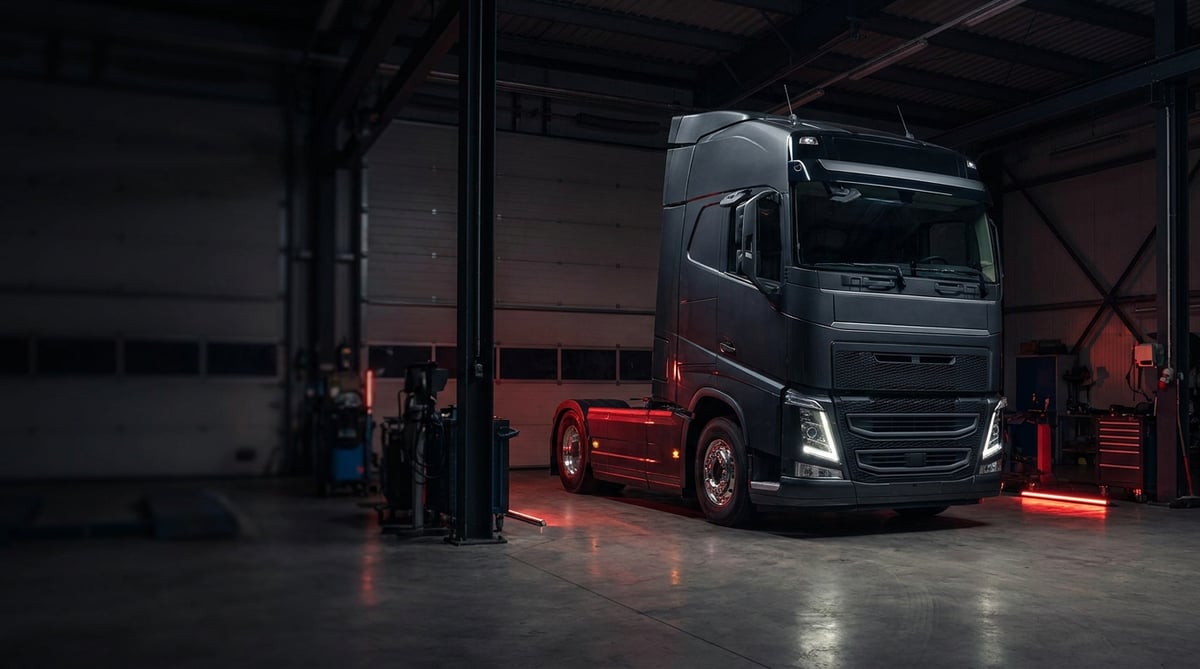
Spotting a Volvo FH in a yard is easy; knowing which FH you are actually looking at is a different matter. Two tractor units carrying the same nameplate can be worlds apart: one may still carry an older family remembered by its engine displacement, run short regional routes, and burn through brake pads at a fast clip; the other may belong to a newer, Euro VI-equipped generation that cruises long, flat motorway stretches under a steady load and barely touches the service brake thanks to the engine brake and retarder working together. Maintenance planning, fault diagnosis, and parts selection cannot be identical for these two trucks. This guide treats the Volvo FH not as a single model name but as a vehicle family whose cab, chassis, engine range, gearbox, and emissions hardware have changed repeatedly across more than three decades of production.
What Is the Volvo FH Built For? Cab, Chassis, and Axle Configurations
The Volvo FH is Volvo Trucks' heavy-class long-haul truck and tractor unit family, built for long-distance transport, international trailer haulage, and heavy-tonnage special transport work. Since it replaced the previous heavy series in the early 1990s, it has become one of the backbone models of the European fleet, and in Turkey it is one of the most common tractor units on long-haul routes. The model name spanning such a wide stretch of time creates the first trap: "Volvo FH" does not describe a single technical structure — it describes a family.
The truck comes in two basic body types. The tractor unit configuration is fitted with a fifth-wheel coupling to pull a semi-trailer and makes up the bulk of the fleet parc. The rigid chassis configuration provides a platform ready for a tipper body, curtain-sider box, tanker, or crane superstructure; the type of superstructure directly changes the vehicle's usage profile and service frequency. On the axle side, a two-axle layout is common on tractor units, while three- and four-axle configurations are used for heavy-tonnage and special transport work. Whether the support axle is liftable, the number of driven axles, and whether the rear axle uses a hub reduction determine not only load capacity but also the brake hardware, air consumption, axle oil selection, and pad wear pattern.
On the cab side, even within the same generation there is more than one height option: a day cab, a low-roof sleeper cab, and the tall-roof Globetrotter family serve different jobs on the same chassis. Cab choice looks invisible in maintenance terms, yet it is exactly where the parts differences in the cab heater, air-conditioning circuit, cab suspension bellows, tilt pump, and cabin filter originate. A tall-roof cab is heavier and puts more strain on its suspension; hotel loads running while the truck is parked place an extra burden on the battery and charging circuit.
Volvo FH Generations: What Changed from the FH12 and FH16 to Today's FH?
The most practical way to read the FH parc is by generation. In the family's early years, the model name stated the engine displacement outright: the FH12 and FH16 designations let you read which engine family a truck carried straight off the badge. Later generations dropped this naming convention, and engine identity moved to a code starting with the letter D. This single change alone is behind a large share of wrong parts orders in the field. Generation changeovers do not happen on a sharp date either; the periods below are given approximately, and a vehicle's generation must always be confirmed from its chassis data.
| Generation | Approximate period | Standout change | What it means for maintenance and parts |
|---|---|---|---|
| Original FH12 and FH16 | Early to late 1990s | New heavy-class platform; model name states engine displacement | Diagnosis is mostly mechanical; parts availability and generation verification are critical |
| Facelifted FH12 and FH16 | Late 1990s to mid-2000s | Cab and interior updated; electronic control became widespread | Different emissions stages and different control architectures inside the same body |
| FH without the displacement name | Mid-2000s to early 2010s | New engine family, wider uptake of the automated gearbox, SCR-based emissions hardware | Engine identity can no longer be read from the name; the AdBlue circuit enters the maintenance plan |
| New FH | Early to late 2010s | All-new cab and instrument architecture, Euro VI hardware, redesigned front axle and steering layout | Cab, electrical architecture, and emissions hardware are independent of the previous generation; parts compatibility breaks |
| Updated FH | Early 2020s to present | Refreshed cab interior and digital display, camera-based mirror option, updated driver-assistance systems | Dependence on coding increased; some jobs cannot be completed without a diagnostic tool |
The most critical break sits between the generation without the displacement name and the new FH that arrived in the early 2010s: this transition renewed not only the cab but also the chassis, the electrical architecture, and the aftertreatment hardware. A diagnostic path, fluid choice, or parts reference that was correct for the previous generation is usually invalid for the new FH. In the most recent update, the difference lies mostly on the cab equipment and auxiliary systems side; mechanical continuity is high, but because sensor types and coding requirements can still change, this transition should not be approached with a "looks the same" assumption either.
Engine Families: D11, D13, and D16, and the Maintenance Load of the Emissions Hardware
The second axis that defines the Volvo FH's maintenance identity is the engine family. Early generations used families known by their displacement; later generations moved the family name onto codes such as D11, D13, and D16. Today, both generations run side by side in the Turkish parc, and their diagnostic approaches diverge sharply: one follows a measurement-heavy mechanical path, the other starts by reading fault codes and live data.
| Engine family | Typical use | Emissions hardware | Standout maintenance topic |
|---|---|---|---|
| Early displacement-named families | Original FH12 and FH16 generations | Early Euro stages; aftertreatment limited or absent | Fuel and oil discipline is decisive; diagnosis is measurement-heavy |
| D11 | Distribution, regional haulage, jobs needing low kerb weight | SCR depending on generation, combined with EGR in later ones | Relatively small displacement, high duty ratio; watch cooling and the turbo |
| D13 (first generation) | Backbone of the long-haul tractor unit | Period when SCR-based systems became widespread | AdBlue circuit, dosing logs, and filter discipline |
| D13 (Euro VI generation) | Primary long-haul engine | Euro VI: EGR, DPF, and SCR working together | Regeneration behaviour, sensor and dosing-fault logs |
| D13 turbo compound version | Steady-speed, long flat-route, fuel-focused operation | Advanced Euro VI stages | Extra turbine and drivetrain unit; oil quality and circuit cleanliness are critical |
| D16 | Heavy tonnage, special transport, towing and gradient-heavy work | SCR and full Euro VI hardware depending on generation | Under heavy load, cooling, brakes, and the axle side come to the fore |
The descriptions in the table give positioning only; actual power and torque figures vary by calibration even within the same family and can only be read from the vehicle's own documentation. What actually governs maintenance is the family itself: it decides the filter type, oil specification, belt layout, and diagnostic path. The emissions class, in turn, describes the maintenance load: on a Euro VI-equipped FH, the EGR circuit, the particulate filter, and the SCR system all run at the same time, and the AdBlue filter, dosing module, and NOx sensors — absent on earlier-stage vehicles — become part of the maintenance plan. These systems depend on each other; reading a single fault code in isolation leads to replacing the wrong part.
How Do You Verify the Engine Code and Generation on the Vehicle?
The engine family is not determined by guesswork. The type plate on the engine block, the engine information on the registration document, and the control unit identity read from the diagnostic tool are used together; having all three confirm each other matters especially on vehicles that have had an engine replacement. In the field, you do encounter trucks whose body belongs to one generation while the engine belongs to another; on such a vehicle, ordering a part by model year alone is a direct route to the wrong part. The same cross-check should be carried out for the gearbox and the axle as well.
I-Shift: The Automated Gearbox and What It Means for Maintenance
The standout topic in the Volvo FH's drivetrain is its automated gearbox. Volvo's I-Shift is not an automatic gearbox in the classic sense: there is no torque converter, and the clutch and gear changes of what is fundamentally a mechanical gearbox are commanded electronically and pneumatically. The driver signals intent; the control unit makes the decision. For maintenance, this means two new component groups: pneumatic actuators and the electronic control unit. The range also includes versions with an extra low-range gear group for heavy towing and dual-clutch versions; their maintenance items differ from the standard version.
The most common complaints are late or harsh gear changes, loss of power on a gradient, being stuck in neutral, and clutch shudder on pull-away. A significant share of these symptoms come not from the gearbox itself but from the quality of the air reaching the system and from clutch wear: damp or oily air degrades actuator seals and valves, which is why air-dryer maintenance is directly part of gearbox health. Clutch wear values and actuator adaptation data should be read regularly, and the learning cycle must be completed after a clutch replacement. Gearbox oil should not be chosen on a "they're all the same" basis either. For fault symptoms and maintenance discipline on the gearbox, the heavy-duty truck gearbox faults, replacement, and maintenance guide offers a detailed framework.
Why Are I-See, I-Roll, and Cruise Management an Invisible Maintenance Item?
Among Volvo's driver-assistance features, two directly affect fuel consumption and drivetrain load. I-See uses the gradient profile of the road ahead to make gear and cruise-speed decisions in advance; it builds speed before a climb, cuts throttle at the crest, and evaluates free-rolling on the way down. I-Roll, under suitable conditions, disengages the drivetrain and lets the truck coast on its own inertia. When they work correctly, both reduce fuel consumption and the load placed on the brakes and clutch.
The maintenance counterpart is easy to miss: these systems need accurate position and gradient data, and healthy sensors and a healthy communication line. On a vehicle with an antenna or data-line fault, the system quietly drops out, the display may not give a clear warning, and consumption creeps up slowly. When fuel consumption rises without explanation, the status of these systems should be confirmed before moving on to the injectors and the turbo.
VEB Engine Brake and Retarder: Getting the Deceleration Chain Right
For an FH running gradient-heavy routes, what determines the brake bill is not the service brake but whether the deceleration chain has been set up correctly. Volvo offers this chain in two layers. The first is the engine brake, known as VEB: at the end of the compression stroke it intervenes in the exhaust valve control, making the engine act like an air compressor and generating braking torque; its effect increases when combined with the exhaust pressure regulator. The second is the hydraulic retarder, fitted optionally at the gearbox output: it converts rotational energy into heat through oil and transfers it to the cooling circuit via a heat exchanger.
Maintenance of the two systems is not independent of each other. On the VEB side, adjusting the engine brake unit is handled in the same job as the engine's periodic valve adjustment; when the adjustment drifts, engine brake power drops, the driver leans on the service brake without realising it, and pad life shortens. On the retarder side, the oil and its filter where fitted, the cleanliness of the heat exchanger, and the capacity of the cooling circuit are decisive; on a vehicle with a clogged radiator, a temperature warning on a long descent is to be expected. A sudden rise in pad replacement frequency usually points to a loss somewhere in this chain. For how the retarder works, its stages, and its maintenance points, see the guide to what a retarder is and how it works.
Further reading
For a plain-language technical overview of this subject, see the reference article on Wikipedia. Always confirm specific figures and procedures against the vehicle manufacturer service data.
How Are Maintenance Intervals Determined? Why Is a Fixed Mileage Misleading?
The most common mistake in heavy commercial vehicle maintenance is pinning it to a single mileage figure. On the Volvo FH, the maintenance interval is not a fixed number; it varies by generation, engine family, emissions class, the approved specification of the oil used, and, above all, the vehicle's actual duty profile. On modern generations, the truck does this calculation itself, reports remaining service life through the display, and fleets using connected service planning can monitor this data remotely.
The vehicle's maintenance calculator does not count mileage alone; it weighs operating hours, idle ratio, engine load, fuel consumption, regeneration history, and temperature history together. This is why one of two FH trucks with the same mileage can be called in for service much earlier. A tractor unit running a steady load on a long flat motorway and a truck stuck in stop-start urban distribution work with long idle periods are not in the same world in terms of the load placed on the engine oil; in the latter, the oil picks up far more soot and the particulate filter struggles to complete its regeneration.
The conditions that shorten a maintenance interval are well known: heavy idling and use of a parking heater, short-haul and frequent-stop operation, dusty environments, continuous maximum-load operation, steep gradient routes, and low-quality fuel. Under these conditions, bringing maintenance forward is the cheaper option. Oil analysis is the cheapest way to base this decision on measurement rather than guesswork; soot content, viscosity shift, and metal content are read together.
What Gets Replaced at Periodic Maintenance, and Why?
A maintenance list only earns its keep when it explains not just "what gets replaced" but "why." Some items are handled at every service, others only at certain stages; the vehicle's own maintenance plan sets the order.
| Item | Why it is addressed | Check point during the job |
|---|---|---|
| Engine oil and oil filter | Additives deplete; soot and fuel dilution build up | Approved specification, level trend, metal debris in the filter |
| Fuel filter and water separator | Particulates and water wear down the high-pressure hardware | Separator bowl, sediment coming out of the filter, heater circuit where fitted |
| Air filter | Intake restriction rises; life shortens in dusty conditions | Contamination indicator, housing seal, hoses and clamps |
| Air dryer cartridge | The desiccant saturates; moisture and oil pass into the system | Purge behaviour, water accumulation in the tanks, cartridge age |
| AdBlue filter and SCR checks | Crystallisation and residue block the dosing line | Warning history, dosing-fault logs, tank and strainer cleanliness |
| Coolant and cooling circuit | Corrosion-inhibiting additives deplete; the radiator core clogs | Freeze point, hose softening, radiator surface, fan clutch |
| Belt, automatic tensioner, and pulley bearings | Rubber ages; the tensioner spring weakens | Cracking and glazing on the belt, tensioner travel, bearing noise |
| Valve adjustment and engine brake unit | When adjustment drifts, power and engine brake effect drop | Adjustment values matching the OE manual, wear in the mechanism |
| Gearbox, retarder, and axle oils | The oil loses its shear properties and additives | Debris on the magnetic plug, sealing, breather, heat exchanger |
| Brake pads, discs, and bellows | Friction material and disc thickness wear away | Pad thickness, disc cracking, play in the adjustment mechanism |
| Battery and charging circuit | Capacity falls; hotel loads while parked add to the burden | Terminal corrosion, load test, belt tension, parasitic drain |
| Chassis greasing, steering, and joints | Grease dries out and gets contaminated; play develops in the joints | Tie-rod and ball-joint play, propshaft universal-joint noise, steering box leaks |
What to Watch on the Volvo FH's Air Brake System
In a heavy commercial vehicle, air is a shared source that feeds not only the service brake but also the parking brake, the I-Shift actuators, the cab and seat suspension, the axle-lift system, and the trailer line. This is why a fault in the air chain usually shows up somewhere other than the brakes: a late gear change, a chassis that settles on its own, a seat that drops, or a tank found empty in the morning.
At the head of the chain sits the air brake compressor; it is driven from the engine and sends the hot, moist air it produces to the dryer. Its most insidious failure is not stopping outright but continuing to run while passing oil: the system keeps holding pressure, but the oil carried down the line saturates the dryer cartridge, swells valve seals, and leaves marks in the brake bellows. Lengthening pressure build-up time, oily air coming out of the dryer purge, and emulsion building up in the tanks are the first warnings. For compressor fault symptoms, replacement discipline, and maintenance approach, see the air brake compressor faults, replacement, and maintenance guide.
The second link is the air dryer. When the desiccant fill inside the cartridge saturates, it can no longer hold moisture; the moisture works its way into the valves, actuators, and bellows, and in winter it freezes and blocks the line, causing the brakes to release late. Regular cartridge replacement is the cheapest insurance the whole air system has. The third link is the valve group: the protection valve, brake valves, trailer control valve, and level-control valves age quickly under moisture and oil, and on vehicles with an electronic brake system the modulators and speed sensors are also in play. Comparing the pressure of a truck parked in the evening against the following morning catches air leaks before they cause a breakdown.
Typical Wear Points and Symptoms on the Engine Side
The fuel system comes first. Depending on the vehicle's generation, it uses either a unit-pump/injector arrangement or a common-rail layout; in both, the injection components work to micron tolerances and are vulnerable to particulates and water in the fuel. Hard starting, rough idle, dark exhaust smoke, and unexplained rises in consumption are the classic warnings. In the unit-pump/injector arrangement, injector adjustment is handled in the same job as valve adjustment; when the adjustment drifts, the engine runs, but it does not run properly. After an injector or control-unit replacement, writing the calibration codes to the correct cylinder is mandatory.
The bottom end and crank assembly come second. A drop in oil pressure, a brief metallic noise on a cold start, rising metal content in oil analysis, and a changing vibration character are signs that something is developing on the main or big-end bearing side. In this area, the cost gap between a timely intervention and a full overhaul is enormous; an oil pressure warning should not be brushed off with the assumption that "it's just a sensor fault."
The air and exhaust side is the third topic. In the turbocharger assembly, a break in lubrication and dust entering through the intake wear down the blades; the symptoms are power loss, a whistling noise, and blue smoke from the exhaust. On turbo-compound versions, the second turbine is an extra maintenance point. On Euro VI vehicles, the EGR valve sticks with soot build-up, the particulate filter fails to complete regeneration on short trips, and crystallisation appears on the SCR side; rather than looking at a single fault code, regeneration history, differential pressure, and NOx sensor data should be read together.
Cooling, lubrication, and the auxiliary drive line are the last topic. A leak at the coolant pump seal, a faulty fan clutch, a clogged radiator core, and a thermostat stuck open are typical items; on a vehicle fitted with a retarder, the cooling circuit is already carrying extra load, so radiator cleaning should not be neglected. The belt, tensioner, pulley bearings, alternator, and air-conditioning compressor sit on the same line: when the belt fails, charging, cooling, and, on most vehicles, air production are all affected at once, which is why the belt and tensioner, cheap as they are, rank among the items with the highest breakdown risk.
Why Does Generation and Variant Matching Matter When Choosing Spare Parts?
On the Volvo FH, the source of parts errors is most often not the quality of the part but the ordering of the wrong variant. Production spread across three decades means a component serving the same function has changed repeatedly; the mounting flange, pulley diameter, connector type, sensor pin count, and mounting orientation can all change even within a single generation. An extra difficulty specific to the FH is that the model name once stated engine displacement: an "FH12" or "FH16" description given out of old habit points the parts search in the wrong direction from the very start on a newer-generation vehicle.
The only reliable way to reach the right part is to start from the vehicle. Model year alone is not enough; a truck can carry the older or the newer variant depending on which month of the year it was built. The other side of the same trap is remanufactured parts: two components that look identical can carry different calibrations. On sensors, valves, and electronically controlled parts, the need for coding or adaptation should be checked in advance; fitting a part that requires coding without coding it is the fastest way to make a sound part look faulty.
Breakdown Risks and Real Cost Items in Fleet Operation
The total cost of ownership of a tractor unit is not made up of fuel and maintenance alone. A truck that stops unplanned on the road generates, on top of its own repair bill, the cost of delayed cargo and an idle driver. This is why the right question in fleet maintenance is not "how much does this part cost" but "where does the truck stop if this part fails."
| Risk item | How it stops the truck | Preventive practice |
|---|---|---|
| Air production and conditioning chain | Pressure never builds, the parking brake won't release, the truck can't move | Cartridge replacement schedule, morning leak check, tank purging |
| Belt and automatic tensioner | Charging, cooling, and air production all stop at once | Check belt surface and tensioner travel at every service |
| I-Shift actuator and clutch assembly | The gearbox won't shift, the truck is stuck in neutral and has to be towed | Dry, oil-free air; regular reading of clutch wear data |
| Fuel filter and water separator | Power loss, winter wax clogging, the engine failing to run | Follow whichever comes first, time or mileage |
| SCR and AdBlue dosing system | Staged torque limitation and speed cap, slowing down mid-route | Disciplined use of quality AdBlue, regularly reading warning history |
| Battery and charging circuit | No crank in cold weather, hotel loads while parked drain the battery | Load test before winter, terminal maintenance, parasitic-drain measurement |
| Cooling circuit and retarder heat exchanger | Overheating warning, power derate, and a forced stop | Freeze-point check, radiator cleaning, hose inspection |
| Brake adjustment mechanism and bellows | The truck fails inspection and roadside checks | Measuring pad and bellows travel, checking for play |
Winter and Summer Preparation: What Gets Checked at the Season Change?
A significant share of the faults that surface in winter are defects that developed over the summer without showing symptoms; this is why the season change should be treated as a maintenance stage in its own right. In winter preparation, moisture in the air system is the biggest enemy: the condition of the dryer cartridge, purging the tanks, and water accumulated in the lines must all be addressed before winter sets in, because a frozen line causes the brakes to release late and the I-Shift actuators to misbehave. On the fuel side, winter-grade fuel and draining the water separator are needed. Coolant freeze point should also be measured, the battery load-tested, and the AdBlue heating circuit confirmed to be working.
Summer preparation is concentrated on cooling and cab comfort: cleaning the radiator, intercooler, and air-conditioning condenser cores, checking the fan clutch's engagement behaviour, hoses and clamps, and air-conditioning performance. When high ambient temperature combines with a full load, a clogged radiator core alone can trigger a power derate; on a vehicle fitted with a retarder, that limit arrives even sooner. In both seasons, tyre pressures, wear patterns, and axle alignment should be reviewed.
An Eight-Step Verification Checklist Before Ordering a Part
The list below is a practical sequence that almost entirely eliminates wrong-parts purchases; no step requires special equipment, and the whole sequence is done at the vehicle in a few minutes.
- Read the chassis number from the registration document and from the chassis stamp and cross-check them; if they differ, resolve the discrepancy before moving on to the part.
- Take the engine family and number from the type plate on the engine block; compare it against the control unit identity read by the diagnostic tool, and drop any displacement assumption based on the model name.
- Confirm the emissions class from the registration document and the vehicle plate; aftertreatment, sensor, and valve parts depend directly on this information.
- Confirm the gearbox type and variant from its housing plate; which version of the automated gearbox it is changes the actuator, clutch, and oil selection.
- Confirm the axle configuration on site: the number of driven axles, the liftable axle if fitted, and whether the rear axle has a hub reduction.
- Read and photograph the OE number and production stamp on the removed part; trust that number, not visual resemblance.
- Check the mounting interface: flange hole count and spacing, pulley type, hose and fitting diameter, connector pin count, and cable exit direction.
- Determine in advance whether the part requires coding or a learning cycle; add gaskets, seals, O-rings, copper washers, and single-use fasteners to the same order.
The Right Order for Volvo FH Maintenance: Summary and Practical Framework
If Volvo FH maintenance had to be reduced to one sentence, it would be: first prove which vehicle you are looking at, then read that vehicle's own data, and only then decide on the part. Most of the time lost in the field comes from running this order backwards; the part is bought first, found not to fit second, and only then is the question asked of which generation the vehicle belongs to.
The practical framework has four headings. Identity: chassis, engine family, gearbox variant, axle configuration, and emissions class are confirmed at the start of every job; on the FH, the model name does not give these reliably. Data: the maintenance indicator, fault-log history, regeneration records, and consumption trend are read. Condition: the actual duty profile is defined, gradient intensity and idle ratio are factored in, and the maintenance interval is brought forward accordingly. Discipline: no compromise is made on filters, the dryer cartridge, fluid specifications, valve and engine brake adjustment, or single-use fasteners.
When these four headings are applied, the Volvo FH covers high mileages with low unplanned downtime. When they are not, it produces a list of small failures that trigger one another: a saturated dryer cartridge damages the valves, damaged valves affect the I-Shift actuator, a delayed fuel filter wears down the injection hardware, drifted valve adjustment lowers engine brake power and eats the pads, and a neglected belt tensioner stops the truck in the middle of a route. For every item, the current OE service documentation matching the vehicle's own engine and chassis code takes precedence; the framework in this guide exists to open that documentation with the right question.
VADEN parts compatible with this vehicle: Volvo FH compatible spare parts list
Vehicles and engines mentioned in this guide: Volvo FH12 · Volvo D13 · Volvo D11 · Volvo D16
Sometimes what you have is not a vehicle number but a supplier number read off the component body; the WABCO cross-reference table can be used to convert such a number into a VADEN code.
Tags
Frequently Asked Questions
- What are the generations of the Volvo FH and what periods do they cover?
- The FH family reads roughly across five periods: the original FH12 and FH16 from the early 1990s, their facelifted versions from the late 1990s, the FH that dropped the displacement name in the mid-2000s, the new FH that arrived in the early 2010s with an all-new cab and Euro VI hardware, and the updated FH produced from the early 2020s onward. Because generation changeovers do not fall on a sharp date and two generations can be sold in the same year, a vehicle's generation should always be confirmed from its chassis data.
- What is the difference between the Volvo FH12 and FH16, and why was this naming dropped?
- In the family's early years, the model name stated the engine displacement directly; the FH12 and FH16 names let you read which engine family the truck carried straight from the badge. Later generations dropped this convention, the truck was simply called FH, and engine identity moved to a code starting with the letter D. This change is behind a large number of wrong parts orders in the field: a part requested out of old habit as an "FH12 part" has no match on a newer-generation vehicle.
- Which engine families are used in the Volvo FH?
- Early generations used families known by their displacement; later generations carried the family name in codes such as D11, D13, and D16. D11 is favoured for distribution and regional haulage, D13 is the backbone of the long-haul tractor unit, and D16 is chosen for heavy tonnage and special transport; the turbo-compound version of the D13 is aimed at steady-speed, long-haul operation. The engine on your own vehicle should be confirmed three ways: from the type plate on the engine block, from the registration document, and from the diagnostic tool.
- How many kilometres apart is Volvo FH maintenance done?
- There is no fixed maintenance mileage for the Volvo FH. The interval varies by generation, engine family, emissions class, the approved specification of the oil used, and the vehicle's actual duty profile. On modern generations, the truck calculates this itself and reports remaining service life through the display. The exact interval should be taken from the current OE service manual matching the vehicle's engine and chassis code.
- Why do two Volvo FH trucks with the same mileage go in for service at different times?
- The vehicle's maintenance calculator does not count mileage alone; it weighs operating hours, idle ratio, engine load, fuel consumption, regeneration history, and temperature history together. A tractor unit running a steady load on a long flat motorway and a truck stuck in constant stop-start urban work are not equal in terms of the load placed on the engine oil. Heavy idling, short-haul operation, dusty conditions, and steep gradient routes all make it cheaper to bring maintenance forward.
- What is the I-Shift gearbox and how is it maintained?
- I-Shift is not a classic automatic gearbox: there is no torque converter, and the clutch and gear changes of a fundamentally mechanical gearbox are commanded electronically and pneumatically. Its maintenance rests on three legs: timely replacement of the gearbox oil at the manufacturer's specification, dry and oil-free air reaching the system, and regular reading of clutch wear values and actuator adaptation data from the diagnostic tool. The learning cycle must always be completed after a clutch replacement.
- If a Volvo FH shifts late or harshly, where is the problem?
- A significant share of these complaints come not from the gearbox itself but from the quality of the air reaching the system and from clutch wear. Damp or oily air damages actuator seals and valves, which is why a saturated air dryer cartridge is one of the most common causes behind a late or harsh gear change. Before touching the gearbox, air quality, clutch wear data, and actuator adaptation values should be checked.
- What is the difference between the VEB engine brake and the retarder?
- VEB is the engine brake: at the end of the compression stroke it intervenes in the exhaust valve control, making the engine act like an air compressor and generating braking torque, with its effect increasing alongside the exhaust pressure regulator. The retarder is an optional hydraulic device fitted at the gearbox output that converts rotational energy into heat through oil and transfers it to the cooling circuit via a heat exchanger. Together, they reduce the load on the service brake and extend pad life.
- What happens if the air dryer cartridge isn't replaced on a Volvo FH?
- When the desiccant fill inside the cartridge saturates, it can no longer hold the moisture in the air. That moisture works its way into the valves, actuators, and bellows, and in winter it freezes and blocks the line, causing the brakes to release late. Because the same air also feeds the parking brake, the I-Shift actuators, and the cab and seat suspension, the effect of moisture often shows up not as a brake problem but as a late gear change or a settling chassis. Regular cartridge replacement is the cheapest insurance the air system has.
- Why is the chassis number needed when ordering a Volvo FH spare part?
- Because the FH name spans more than three decades of production, a component serving the same function has changed repeatedly; the mounting flange, pulley diameter, connector pin count, and mounting orientation can differ even within one generation. Model year alone is not enough, because a truck can carry the older or newer variant depending on the month it was built. Using the chassis number, engine type plate, gearbox variant, and the OE number on the removed part together keeps the margin for error to a minimum.
Related Articles

Ford F-MAX Maintenance Guide: Service Intervals, Engine and Parts Selection
Ford F-MAX truck maintenance guide: the Ecotorq engine, Euro 6 emissions, service intervals, air brake system checks and how to choose the right parts.

MAN TGX Maintenance Guide: Generations, Engines and Parts Selection
MAN TGX truck maintenance guide: generations, D20 and D26 engines, TipMatic, air brake system, service intervals and choosing the correct spare parts.
DAF XF Maintenance Guide: Generations, Engines and Parts Selection
DAF XF truck maintenance guide: generations from the 95XF to the new XF, MX-11 vs MX-13 engines, air brake care and ordering the right part first time.


