Low Engine Oil Pressure: Causes, Symptoms and the Lubrication System Explained
Low engine oil pressure in heavy-duty trucks: causes, warning signs, a step-by-step diagnostic order, gauge testing and how the lubrication system works.
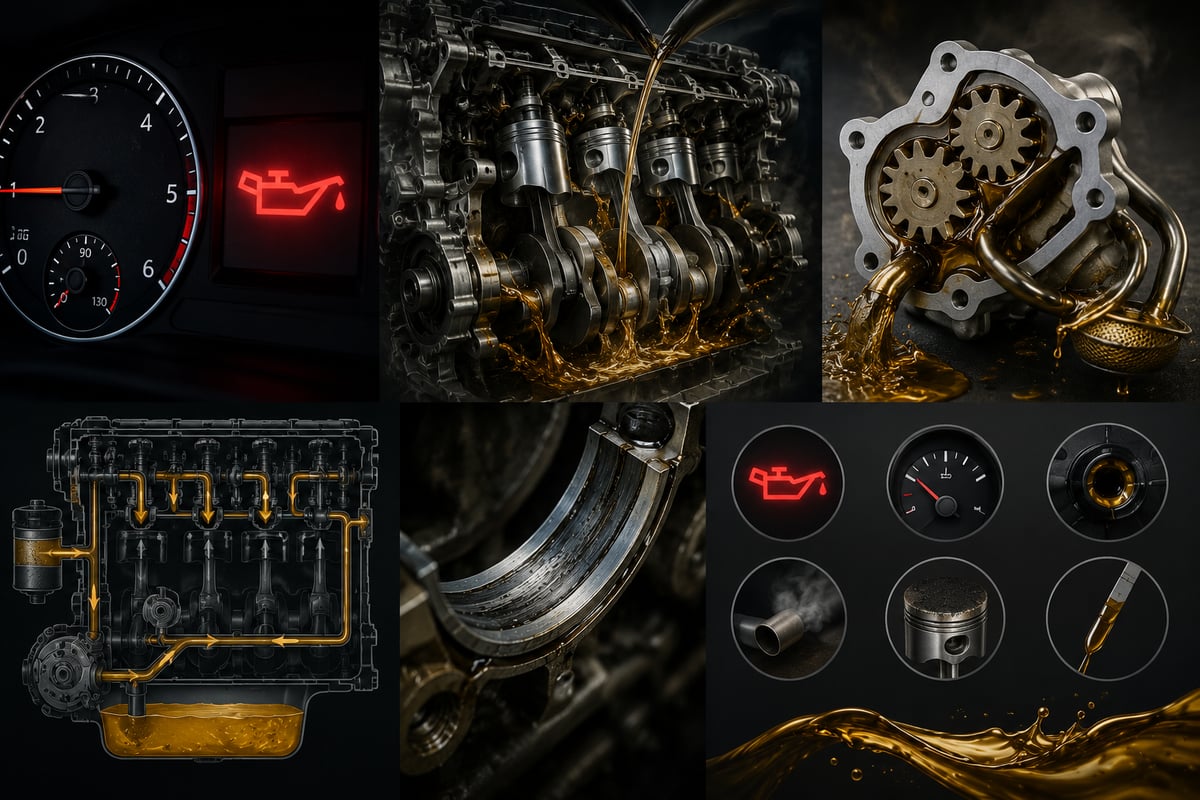
On a loaded grade, a driver downshifts and lets the revs climb — for a split second the red oil pressure light on the dash flickers, then goes dark again. The driver shrugs it off; the lamp is out. Two days later the same light comes on again, this time at idle with the engine hot, and it stays lit. The first thing done in the shop is pull the dipstick: the level sits below the low mark, the oil runs thin as water between two fingers, and it carries a faint smell of diesel. For two days the engine has been quietly grinding its own bearings. In a heavy-duty engine, the oil pressure warning is one of the few alarms that tolerates no delay — by the time the lamp lights, the problem hasn't just started, it has already matured. This guide treats low oil pressure not as the failure of a single part, but as a report card on the entire lubrication circuit, from the pan to the bearing.
What is engine oil pressure? The difference between flow and pressure
Engine oil pressure is the internal resistance that builds up when the flow the oil pump delivers meets the resistance the circuit puts up against it. In other words, pressure isn't a quantity the pump manufactures on its own — it's the outcome of the balance between the flow being sent out and how freely the circuit lets that flow pass through. That single distinction rules out most of the wrong calls made in the field: when pressure drops, the pump is usually the first part blamed, yet in most cases the pump is intact and doing exactly what it's designed to do; what has actually changed is the circuit's resistance.
The quantity that does the real work inside the engine is flow — the volume of oil reaching the bearings in a given time. Oil doesn't just cut friction; it carries heat away, flushes out wear debris, and helps seal the piston rings. Pressure is simply the proof that this flow is reaching even the farthest, tightest points of the circuit. What happens at the bearing itself is called hydrodynamic lubrication: the rotating journal wedges oil into a converging gap, a film only microns thick forms, and the shaft rides on that film instead of on the bearing shell. The film holds up as long as three things are in place — continuous supply, the correct viscosity, and adequate pressure. Lose any one of the three and the engine drops into the wear-heavy boundary lubrication regime.
This is exactly why the dash warning lamp is misleading. It doesn't watch oil level at all — it watches pressure, and it typically lights up at a threshold well below the engine's healthy operating range. In other words, the lamp isn't saying "pressure has dropped"; it's saying "pressure is almost gone." Pressure can already have fallen to half its healthy value while the lamp stays dark. Knowing that gap is what tells you how much damage has already been done.
How oil pressure is generated: the pump, resistance and the oil-film chain
As long as the engine is running, oil circulates in a closed loop. Oil pooled in the pan is drawn through the suction strainer into the pump; the pump pressurizes it and sends it on to the filter and, where fitted, the oil cooler; from there it enters the block's main gallery and is distributed through drilled passages to the main bearings, the rod and cam bearings, the rocker shaft, the turbocharger bearing, and the piston-cooling jets. Once its job is done, the oil drains back to the pan under gravity.
The pump's role is one of the most commonly misread parts of this whole story. The gear or rotor pumps used in heavy-duty engines are positive-displacement units: each revolution moves a fixed volume, so the flow they deliver is tied directly to engine speed. The pump doesn't "make pressure" — it delivers flow; pressure is simply what results when that flow meets resistance in the bearing clearances, the gallery cross-sections, and the filter media. Two things set that resistance: the combined bearing clearance, which grows as wear accumulates, and the viscosity of the oil. Between them, these two account for almost every low-pressure case on record. For the pump's own condition, its wear limits and replacement, see the engine oil pump guide — though in a proper diagnosis the pump belongs near the end of the suspect list, not the start.
The suction side stays quiet, which is exactly why it gets overlooked. A pump can pull oil, but it can't push what isn't there to begin with. If the strainer is partly clogged, the level is low enough that the strainer mouth intermittently breaks the surface, or the suction pipe's gasket is drawing air, the pump ends up moving an oil-air mixture instead of clean oil; the gauge flutters and pressure bottoms out on corners, under braking and on pull-away. The oil pan group guide covers the condition of the pan, strainer and suction assembly in detail, and it's one of the first places worth checking whenever the reading is unstable rather than simply low.
Mapping the lubrication circuit: from the pan to the bearings
Diagnosing low pressure without a clear map of the circuit in your head turns into random parts-swapping. The table below lists the oil's path in order and shows what a fault in each component actually does to the pressure reading.
| Component | Job | What its fault does to pressure |
|---|---|---|
| Oil pan (sump) | Collects, settles and cools the returning oil | Low level lets the suction aerate; pressure flutters |
| Suction strainer and pipe | Screens out coarse debris, feeds oil toward the pump | Clogging or an air leak drops pressure at every speed |
| Oil pump | Delivers a fixed volume per revolution | Worn gears or rotor cut flow; pressure never builds |
| Pressure relief (regulator) valve | Caps pressure at its upper limit, bleeds the excess back to the pan | Stuck open, pressure never rises; stuck shut, pressure spikes |
| Oil filter and housing | Traps wear debris and soot | A clogged element opens bypass; unfiltered oil circulates |
| Oil cooler (heat exchanger) | Keeps oil temperature within its design range | Failure lets oil overheat and thin; hot pressure drops |
| Main gallery | Carries pressurized oil the length of the block | A leaking plug or crack starves the farthest points |
| Main and rod bearings | Carry the crankshaft on a film of oil | Growing clearance collapses hot-idle pressure |
| Camshaft bearings and rocker line | Lubricate the valve gear | Reduced feed shows up as top-end tapping and wear |
| Piston-cooling jets | Spray oil under the piston crown to pull heat away | A jet stuck open causes a noticeable idle pressure drop |
| Turbocharger oil line | Feeds and cools the turbo shaft bearing | A cut-off feed cooks the turbo bearing in short order |
| Pressure sensor and switch | Measures pressure and triggers the warning | A faulty one reads wrong while actual pressure is fine |
Two things matter when reading this map. The reading is almost always taken from the main gallery; the gauge reports the pressure reaching the gallery, not the actual film thickness inside any one bearing. The circuit also feeds several consumers in parallel, so when the cooling jets and the turbo line come on line, a modest dip in pressure is by design, not a fault.
What do the relief valve and the filter bypass valve actually do?
Two small valves in the lubrication circuit shape pressure behaviour far more than their size suggests, and they get mixed up constantly. The pressure relief valve, often called the regulator valve, is the spring-loaded valve sitting at the pump outlet. Because the pump's output scales with engine speed, it delivers more than the circuit needs at high rpm; the valve opens past a set threshold and bleeds the excess back to the pan or the pump inlet, holding the upper limit steady. If its spring weakens, or the valve sticks open on debris, pressure never reaches target at any speed; if it sticks shut, pressure — especially cold — climbs too high. In the field, "everything checks out but there's no pressure" is most often explained by this one valve, and it's usually the last thing anyone thinks to check.
The filter bypass valve does something entirely different. When the filter element clogs, or the oil is too cold to pass through it, this valve opens and routes oil straight into the circuit, unfiltered. The logic is blunt but sound: dirty oil beats no oil at all. When bypass opens, the pressure gauge usually shows nothing out of the ordinary — and that's exactly what makes it dangerous. The driver sees no warning while the engine runs for extended periods on unfiltered oil, and wear debris keeps accumulating in the circuit. For filter selection, change intervals and how the valve behaves, see the engine oil filter guide.
The distinction comes down to one line: the relief valve stops pressure from climbing too high; the bypass valve stops oil from stopping altogether. When the first one fails, pressure turns abnormal; when the second engages, pressure looks perfectly normal while oil quality quietly falls apart.
Symptoms of low oil pressure: the lamp, the gauge and the sound
Low oil pressure rarely shows up as a single symptom, and the symptoms differ enormously in how urgent they are. Some build up over weeks and can be tracked; others call for shutting the engine down on the spot.
| Symptom | Likely mechanism | Urgency and first move |
|---|---|---|
| Red oil lamp lights at hot idle | Viscosity drops when hot; bearing clearances have grown | High. Stop the engine, check the level, confirm with a gauge |
| Lamp flickers briefly under braking or on corners | Level is low; the suction strainer is aerating | High. Top up, then look for the leak or the consumption |
| Gauge reads constantly low but the lamp stays off | Pressure is below healthy but above the warning threshold | Medium. Confirm with a real measurement before continuing |
| Lamp stays lit a few seconds longer on cold start | Filter has drained down; the check valve is leaking back | Medium. Inspect the filter and the housing's non-return valve |
| Tapping from the top end, near the rocker gear | Not enough flow is reaching the valve gear | High. Inspect the oil line and the far end of the gallery |
| Deep knock from below that grows with rpm | A rod bearing has lost its oil film | Very high. Shut the engine down immediately, do not restart |
| Pressure normal but oil consumption has risen | Ring or seal leakage is eating into the level | Medium. Log consumption, trace the leak |
| Whistling from the turbo, blue smoke at the exhaust | Turbo bearing has run dry or is leaking oil | High. Check the turbo feed and drain lines |
| Oil temperature running higher than usual | Cooler is restricted; flow can't carry the heat away | Medium. Check the cooler and its thermostatic valve |
| Pressure only drops on a long grade | Oil is heating up, thinning enough to escape the clearances | Medium. Review the viscosity choice and bearing condition |
The most common mistake is reading the lamp going out as "problem solved" — pressure only has to nudge above the threshold for the lamp to go dark, while the engine may still be running well below its design lubrication level. The second mistake is taking too long to take a strange noise seriously: a deep knock that grows in pitch and intensity with rpm means bearing damage has already started.
Causes of low oil pressure: a cheapest-to-costliest diagnostic order
Causes of low pressure fall into a fairly reliable order of likelihood and cost. The right method is to work through that order and confirm each step before moving to the next one — most cases get resolved in the first three.
| Order | Cause | How to confirm it |
|---|---|---|
| 1 | Low oil level | Measure with the dipstick, engine level and settled |
| 2 | Wrong viscosity grade in use | Check service records and the container label against OE spec |
| 3 | Oil diluted by fuel or coolant | Smell, rising level, colour or consistency change on the dipstick |
| 4 | Clogged filter or a bypass valve stuck open | Check change records, cut open and inspect the element |
| 5 | Pressure sensor or gauge reading wrong | Compare the reading against a mechanical gauge |
| 6 | Suction strainer clogged or drawing air | Drop the pan, inspect the strainer and gasket face |
| 7 | Relief valve stuck open | Remove the valve, check the spring and seat |
| 8 | Pump worn or its drive damaged | Measure pump clearances, check the drive gear or chain |
| 9 | Bearing clearances grown from wear | Hot-idle pressure test, pull the bearing caps, measure clearance |
| 10 | Gallery plug leak, internal crack or assembly error | Pressure test, measure at the far feed points |
That order can be turned into a screening sequence you run before pulling anything apart. Each step only leads to the next once it comes back clean.
- Park the vehicle on level ground, shut the engine off, wait the manufacturer's specified settling time for the oil to drain back to the pan, then read the level on the dipstick. If it's below the low mark, top up and re-check.
- Assess the condition of the oil itself: a fuel smell, a milky colour, unusual thinning or a burnt smell all point to the oil as the cause.
- Confirm from service records when the oil and filter were last changed and with what product; if a viscosity grade lighter than specified was used, that's very likely the answer.
- Scan the underside of the engine, the front and rear seals, the pan gasket and the filter housing for visible leaks; if there's no obvious leak, trace where the oil is going through the consumption record.
- Verify with a mechanical gauge whether the dash reading or warning lamp agrees with actual pressure. Skip this step and everything after it is built on bad data.
- Record pressure at three points: cold idle, hot idle, and hot high rpm. The pattern between them shows which mechanism is behind the fault.
- If pressure collapses at hot idle and recovers at higher rpm, look toward clearance and viscosity; if it's low across every speed, look toward the pump, the suction side and the relief valve.
- Pull the filter and cut the element open for inspection; metallic sheen, coarse chips or heavy soot mean the investigation has moved from pressure to the source of the wear.
- If the case is still clean at this point, drop the pan and visually inspect the suction strainer, its pipe, the gasket face and the relief valve.
- As a last step, measure the pump and bearing clearances against OE spec; at this stage the decision is about the scope of the repair, not the diagnosis itself.
Further reading
For a plain-language technical overview of this subject, see the reference article on Wikipedia. Always confirm specific figures and procedures against the vehicle manufacturer service data.
Could the pressure sensor be lying?
In a meaningful share of low-pressure complaints, nothing is actually wrong with the engine — the fault sits in the measurement chain itself. That chain has three links: the pressure-sensing element, the wiring harness, and the control unit driving the gauge. Heavy-duty engines use two different types of element, and mixing them up derails the diagnosis. A pressure switch only knows two states: it closes below the threshold to light the lamp, and opens above it — it never reports a value in between. A pressure sensor, by contrast, outputs a continuous signal that drives the needle or the on-screen figure.
A faulty sensor leaves a fairly recognisable signature. Suspect the electrical side if the reading jumps around in ways that aren't physically possible, reads something other than zero with the engine off, pegs full-scale with the ignition on, or the warning comes and goes with no relation to engine speed at all. On the other hand, if the warning always shows up under the same condition — say, only at hot idle, then disappears as rpm rises — the cause is most likely real pressure.
On the electrical side, check in order: the cleanliness of the connector and its pins, whether the harness has been resting against a hot spot and starting to melt, the resistance of the ground connection, and supply voltage against OE spec. If there's a clear gap between what the control unit is reading and what a mechanical gauge shows at the same moment, the answer is settled — replacing the sensor without ever making that comparison is the leading reason vehicles come back in with the same complaint.
Measuring true oil pressure with a mechanical gauge
The backbone of any real diagnosis is trusting a mechanical gauge, not the dash. The measurement is usually taken at the sensor port on the main gallery, with the sensor removed and a suitable adapter fitted in its place to connect the gauge. The goal isn't a single number — it's seeing how pressure behaves with speed and temperature; the diagnosis lives in the shape of that behaviour, not in one reading on its own.
- Park the engine on level ground, let it cool, and confirm the oil level before taking any reading; a measurement taken with a low level is invalid from the start.
- Locate the sensor position on the main gallery from OE documentation. Readings taken at different points give different values, so if you're comparing over time, always use the same point.
- Remove the sensor, clean the port, and fit the gauge using an adapter with the correct thread; forcing the wrong thread leaves permanent damage in the gallery housing.
- Make sure the gauge's range comfortably covers the pressure you expect to see; a reading pegged at the top of the scale carries a large margin of error.
- Start the engine and watch whether pressure comes up in the first few seconds; if it never rises at all, shut the engine down immediately.
- Record the value at cold idle, then bring the engine up to operating temperature. Temperature is the variable that skews this measurement the most, so always note the temperature at which each reading was taken.
- Record a second value at hot idle; this is the most informative point in the whole test, and it's where bearing wear shows up first.
- Bring the speed up gradually and take readings at mid and high rpm. Pressure should rise with speed and then level off; the point where it levels off marks the relief valve taking over.
- Bring the speed back down and confirm pressure retraces the same path; if it reads differently rising versus falling, the valve or the sensor is sticking.
- Once finished, remove the adapter, refit the sensor with a new gasket at OE torque, start the engine and check for leaks, then re-confirm the oil level.
Interpretation comes down to three questions: does pressure rise with rpm, does it stay in an acceptable range at hot idle, and is there a declining trend against that same engine's own history? The third question is the fleet's strongest tool — a single reading only tells you the state of the moment, while a maintained log gives weeks of warning before a failure ever shows up.
Why is the difference between hot and cold pressure so large?
On the same engine, the pressure measured on a cold morning start can be several times the pressure measured at hot idle in the afternoon, and that's entirely normal. The reason is that oil viscosity changes with temperature. Cold oil is thick, struggles to pass through tight clearances, meets more resistance in the circuit, and pressure climbs quickly. As the oil warms up, it thins, slips through those same clearances more easily, resistance drops, and pressure eases back down.
This behaviour sits at the center of diagnosis, because hot idle is the only condition that reveals bearing wear. Cold oil temporarily masks clearances that have grown; a diagnosis run on a cold engine can declare a worn engine perfectly healthy. Once the oil warms up, viscosity drops and the flow escaping through the enlarged clearances increases, while pump output is also at its lowest because rpm is low. With all three effects stacking up together, pressure settles at its weakest point.
The oil cooler is the component that keeps this balance in check; when it's restricted, or its thermostatic valve fails, oil temperature climbs above its design range, the oil thins further, and hot pressure drops. A pressure drop that shows up on a long grade and disappears again on flat road is one of the first places to check for exactly this.
High oil pressure is a problem too
Nearly all the attention goes to low readings, yet excessively high pressure damages the engine as well, and it gets overlooked in diagnosis just as often. Pressure climbing past its design limit means the circuit is fighting more resistance than intended, or the path meant to bleed off the excess has closed up. The usual causes are a relief valve stuck shut by debris or a fatigued spring, a viscosity grade noticeably heavier than specified, sludge narrowing a passage in the cooler or gallery, and the wrong type of filter.
The consequences are concrete: excess pressure pushes the filter housing and gaskets to leak, blows seals, and overloads the cooler. Less obviously, it also forces the pump and its drive to work under unnecessary load; over time that turns into mechanical damage on a chain or gear drive. The telltale sign is pressure that fails to settle into its expected band even after the engine has fully warmed up — in a healthy system, pressure eases down gradually as the oil heats up and settles into the band the relief valve defines.
Oil choice and the effect of viscosity on pressure
The viscosity grade of the engine oil is the single consumer-side choice that most directly sets oil pressure. That's exactly why, in a low-pressure case, what grade is actually in the engine and whether it meets the right specification should be checked well before the pump is. On a multigrade label, the number and letter at the front describe cold behaviour, while the number at the end describes viscosity at operating temperature.
| Condition | Expected effect on pressure | Consequence for the engine |
|---|---|---|
| Viscosity matches OE spec | Rises quickly when cold, settles into its band when hot | Oil film holds up across every regime |
| Oil thinner than specified | Noticeable drop at hot idle | Film thins at the bearing, wear accelerates |
| Oil thicker than specified | Excessive rise when cold, settles late | Distant points are starved in the first few seconds |
| Fuel-diluted oil | Fast drop when hot, level rises | Film-carrying capacity drops, wear begins |
| Coolant-contaminated oil | Fluctuation and drop, milky appearance | Lubrication breaks down, corrosion and sludge form |
| Oil past its service life, oxidised | Rises or drops depending on sludge build-up | Passage and strainer cross-sections narrow, flow drops |
| Overfilled oil | Fluctuation from foaming | Crank churns the oil, air mixes in, film breaks up |
| Wrong-spec, low-quality oil | Loses viscosity quickly | Protection weakens before the interval is even up |
For heavy-duty engines, oil selection is never just about viscosity. The engine maker's approval list, limits on ash content, compatibility with the aftertreatment hardware, and approval for extended drain intervals all matter just as much as the viscosity grade. The right choice is always read from the current OE approval list for that specific engine code.
Oil dilution: fuel, water and the effect of idling
The cases that catch technicians most off guard in the field are the ones where the level looks normal, or even high. In those cases, the oil itself has broken down, and the most common cause is fuel dilution. Unburned fuel reaching the cylinder wall washes the oil film down into the pan, thinning its viscosity and raising the level. Oil sitting above the full mark, noticeably thin and smelling of diesel, is a worse sign than oil that's simply low.
The duty cycle that drives dilution is well known: long idle periods, short trips at low load, and frequent stop-and-go driving. Under those conditions the engine never reaches full operating temperature, unburned fuel can't flash off, and it accumulates in the pan instead; the same engine that runs trouble-free on long highway hauls can develop an oil problem far sooner in city delivery service. A dribbling injector or a distorted spray pattern speeds up dilution, and that may well be the real root of a low-pressure complaint.
The second cause is coolant getting into the oil. A head gasket, the oil cooler's heat exchanger, or a leak on the block side can carry coolant into the oil circuit; the signs are a milky emulsion on the dipstick and filler cap, a dropping level in the expansion tank, and a change in the oil's consistency. With either type of dilution, the sequence is the same: change the oil and filter first, then find and fix the source, then re-measure pressure. Changing the oil without fixing the source brings the same picture right back within a few thousand kilometres.
Technical values and general reference ranges
The table below gathers the figures most often needed in the field, given as orders of magnitude. They aren't meant to drive a decision on their own — only to judge whether a measured result looks plausible — and none of them can be used independently of the engine code.
| Value | General reference range or criterion | Interpretation |
|---|---|---|
| Hot idle pressure | Generally expected above roughly 1 bar | The most honest indicator of bearing wear |
| Hot pressure at mid/high rpm | Generally sits in a band of roughly 3-5 bar | The upper limit is set by the relief valve |
| Cold-start pressure | Noticeably higher for a short period | Normal due to thicker cold oil, should settle quickly |
| Warning lamp threshold | Well below the healthy operating value | The lamp being out doesn't mean pressure is sufficient |
| Time for pressure to build | Within a few seconds of startup | A longer delay points to the filter or the check valve |
| Oil operating temperature | Should stay within the engine's design band | Excess heat lowers viscosity and pressure together |
| Bearing clearances | Compared only against OE spec | Hot-idle pressure collapses as clearance grows |
| Pump internal clearances | Measured against the OE service limit | Past the limit, flow and pressure drop together |
| Oil and filter change interval | Whichever comes first, distance or time | Shortened under severe duty and city driving |
| Sensor tightening torque | OE spec value, with a new gasket | Overtightening permanently damages the gallery port |
| Oil level check condition | Level ground, engine off and settled | A reading taken under the wrong condition misleads diagnosis |
The real rule behind this table is that with oil pressure, trend and comparison matter far more than any single absolute number. The gap between the same engine's hot-idle reading today and its reading six months ago says more than any one figure read in isolation. If two identical trucks in the same fleet, measured under the same conditions, show a clear difference between them, the outlier is the one to investigate.
Maintenance, service life, and a fleet checklist
Oil pressure has no maintenance item of its own; maintaining the lubrication system is what maintains pressure. Most lubrication-related engine damage doesn't come from one sudden failure — it comes from small oversights that add up over months.
- Level checks: Check the oil level regularly, on level ground, with the engine settled; report a rising level just as readily as a falling one.
- Consumption log: Know each vehicle's normal oil consumption; any deviation from that baseline is the earliest warning of a leak or dilution.
- Change discipline: Change oil and filter at whichever comes first, distance or time; shorten the interval for city and heavy-idle duty cycles.
- The right product: Confirm viscosity grade and OE approval at every change, and log the product used against the vehicle's file.
- Cold-start habit: Don't load the engine or push rpm before pressure has settled; the first few seconds are when wear is heaviest.
- Idle management: Limit unnecessary idling; it drives both dilution and sludge formation.
- Leak checks: Inspect the pan gasket, front and rear seals, filter housing, cooler connections and sensor port on a regular schedule.
- Measurement log: Record hot-idle pressure alongside oil temperature and viscosity grade at regular intervals, and track the trend.
- Pan-group inspection: Whenever a job requires dropping the pan, check the suction strainer, its pipe and the gasket face.
- Warning response rule: Driver instructions should state clearly, in writing, that an oil pressure warning means stopping the vehicle.
Oil pressure is the single densest piece of information a driver can read off one gauge about an engine's health. A low reading is usually telling you that something in the chain has failed, not necessarily the pump: a low level, the wrong oil, dilution, a clogged filter, an aerating suction side, a fatigued relief valve, and, at the end of the line, enlarged bearing clearances. The right approach is to work through that order, prove each step, and trust the measurement over the gauge. In every case, the vehicle's current OE service documentation for its specific engine and chassis code is the final word.
Oil Pump Failure Symptoms: Is Low Pressure Coming From the Pump?
The oil pump is the part most often blamed for low oil pressure, yet in a systematic diagnosis it's usually the last place to check. The pump itself rarely fails suddenly; its wear is gradual and its symptoms are characteristic. This section focuses on telling whether low pressure is really coming from the pump.
The most telling sign of pump-related low pressure is that pressure fails to rise as expected with engine speed. In a healthy system, pressure that's low at idle rises noticeably as revs increase and holds there. In a worn pump this response becomes sluggish: you rev the engine and the gauge needle crawls up reluctantly. The gap widens further on a hot engine and with thinned-out oil, since more flow escapes through the worn clearances.
| Observation | Likely source | What to check first |
|---|---|---|
| Pressure is fine when cold, drops when hot | Viscosity, bearing clearance, or oil dilution | Check oil grade and for fuel/water contamination |
| Pressure barely rises with engine speed | Pump wear or a leak on the suction side | Check the pickup strainer and gaskets, then the pump |
| Pressure is erratic, gauge needle fluctuates | Clogged pickup strainer, low oil level | Check oil level and clean the strainer |
| Gauge reads low but the engine sounds normal | Sensor or gauge circuit | Measure actual pressure with a mechanical gauge |
| Accompanied by a knocking sound from below | Bearing wear (a result, not the pump itself) | Shut the engine down immediately; get a service diagnosis |
Removing the pump, measuring gear clearance, checking the pressure relief valve, and the installation sequence are covered in detail in the Engine Oil Pump: Faults, Diagnosis, Replacement Guide.
What is normal engine oil pressure on a heavy-duty diesel?
Engine oil pressure is the resistance the oil pump has to overcome to push oil through the bearings, galleries and turbocharger feed. On heavy commercial diesel engines the reading is normally lowest at hot idle and rises with engine speed, typically settling into a band of a few bar at rated speed and a noticeably lower value at idle. The absolute figure matters less than its behaviour: a stable reading that rises with revs and falls predictably when hot is healthy, while a reading that keeps dropping as the engine warms, or that swings while the load is steady, points to a fault. Exact limits are given in the vehicle's current OE service manual and vary with engine family, oil grade and sender type.
Low oil pressure at idle only — is that a problem?
Pressure that falls at hot idle but recovers with engine speed is the classic signature of increased bearing clearance: worn bearings leak more oil, and only the higher pump output at speed can make up the loss. Before condemning the bearings, three cheaper causes must be ruled out. Oil that is too thin, either because the wrong grade was used or because fuel has diluted it, cannot hold pressure when hot. A clogged suction strainer starves the pump under load. A worn or sticking relief valve bleeds pressure back to the sump. Only when all three are excluded does the reading point to bearing wear.
| Symptom | Likely cause | Check / verification |
|---|---|---|
| Warning lamp at hot idle, clears with revs | Bearing clearance increased, or oil too thin | Fit a mechanical gauge and compare against the OE figure hot and cold |
| Pressure low at all speeds | Worn oil pump or blocked pickup strainer | Drop the sump, inspect the strainer and pump backlash |
| Pressure fluctuates while load is steady | Relief valve sticking, or air drawn into the suction | Remove and clean the relief valve, check pickup pipe sealing |
| Lamp on but oil level correct | Faulty pressure sender or wiring | Compare the sender reading with a mechanical gauge |
| Deep knock that rises with revs | Bearing damage already in progress | Stop the engine, look for metal in the oil and filter |
| Oil level rising, fuel smell | Fuel dilution thinning the oil | Check injector sealing and take an oil sample |
Shop this part: Oil Pump
In-depth technical guide: For fault diagnosis, step-by-step replacement and service intervals: Engine Oil Pump: Faults, Diagnosis, Replacement Guide
All our technical guides on this topic
- Engine Oil Filter & Cap: Replacement and Maintenance Guide
- Engine Oil Filter: Faults, Diagnosis, Replacement Guide
- Oil Spray Jet: Faults, Replacement and Maintenance Guide
- Engine Oil Pump: Faults, Diagnosis, Replacement Guide
- Oil Separator: Faults, Replacement & Maintenance Guide
- Truck Oil Pan Group: Faults, Replacement & Maintenance Guide
- What Is an Oil Cooler? Failure Symptoms and Rupture
- Oil Cooler: Failure Symptoms, Replacement & Maintenance Guide
- Crankshaft Seal Oil Leak: Symptoms and Causes
VADEN ORIGINAL products
- Oil Cooler (Engine) — 92 products
- Oil Sumps — 69 products
- Oil Filter (Engine) — 54 products
- Oil Pumps — 26 products
Tags
Frequently Asked Questions
- What does low engine oil pressure actually mean?
- Low oil pressure means the flow the pump is delivering isn't reaching the bearings and galleries with the force it needs to. When that happens, the oil film between the journal and the bearing thins out and metal surfaces start to touch. Low pressure on its own isn't the fault — it's the symptom of something else failing in the lubrication circuit, so it isn't considered fixed until the actual cause has been found.
- What should I do when the oil pressure light comes on?
- Bring the vehicle to a safe stop and shut the engine off. The warning lamp typically comes on well below the engine's healthy operating pressure, meaning pressure hasn't just dropped — it's almost gone. Don't restart the engine until pressure has been verified with a mechanical gauge; a bearing spinning dry can seize in seconds.
- What happens if oil pressure stays low?
- First the hydrodynamic oil film at the bearings thins out and the engine slips into the wear-heavy boundary lubrication regime. At that stage you may hear top-end tapping, a deep knock from below, turbo noise and a loss of power. If it continues, the damage spreads from the rod and main bearings to the crankshaft and eventually the block, turning a repair into a full engine rebuild.
- Why does oil pressure drop when the engine is hot?
- Oil viscosity drops as it heats up; thinner oil escapes more easily through worn bearing clearances, which lowers the circuit's resistance. At hot idle, pump speed — and therefore flow — is also at its lowest. With all three effects stacking up together, pressure hits its weakest point, which is why hot-idle pressure is the most honest indicator of bearing wear.
- What causes low oil pressure?
- In order of frequency: a low oil level, the wrong viscosity grade, oil diluted by fuel or coolant, and a clogged filter. Less common causes are a misreading pressure sensor, a clogged or air-drawing suction strainer, a relief valve stuck open, a worn pump, and enlarged bearing clearances. Diagnosis should work through that list in order, cheapest first.
- How do you tell a faulty oil pressure sensor from a real pressure problem?
- The only reliable way is to measure at the sensor port with a mechanical gauge and compare it against what the control unit reports. A reading that jumps around unpredictably, shows something other than zero with the engine off, or triggers a warning with no relation to engine speed points to the electrical side. If the warning always shows up under the same condition — say, only at hot idle — the cause is most likely real pressure.
- What should normal oil pressure be, in bar?
- As a general reference, expect roughly 1 bar or more at hot idle, and roughly 3 to 5 bar at hot mid-to-high rpm. These figures are only for judging whether a measured result looks plausible. The exact limits for a given vehicle come from its current OE service manual, matched to the engine and chassis code.
- Is high oil pressure harmful too?
- Yes — excessively high pressure damages the engine too, and it's often overlooked. It can push the filter housing and gaskets to leak, blow seals, overload the cooler, and load the pump drive unnecessarily. If pressure doesn't settle into its expected band even after the engine is fully warm, both the relief valve and the oil's viscosity grade need checking.
- Does adding oil fix low oil pressure?
- If the level really is low, topping it up can bring pressure back to normal by stopping the suction from aerating. But if where the oil went hasn't been found, it will happen again — check for a leak, unusual consumption, or dilution. If the level is already normal or high and pressure is still low, adding oil won't fix anything, and overfilling can actually make things worse through foaming.
- Is the oil pump usually to blame for low oil pressure?
- Usually not. Because the pump delivers a fixed volume per revolution, pressure is really governed by the circuit's resistance — a low level, thin oil, dilution, a clogged filter and enlarged bearing clearances are all far more common causes. The pump belongs near the end of the diagnostic sequence, not the start, and the suction side and relief valve should be checked before it's blamed.
- What are the symptoms of oil pump failure?
- The most telling symptom is that oil pressure fails to rise as expected when engine speed increases; in a healthy system, pressure rises noticeably as you rev the engine. This can be accompanied by pressure dropping further on a hot engine, the warning light flickering at idle, and, in advanced cases, a knocking sound from below. Before drawing a conclusion, actual pressure should be measured with a mechanical gauge, since a sensor fault can show the same reading.
Related Articles
Burnt Cylinder Head Gasket: Symptoms and Causes
Symptoms, leak paths and root causes of a burnt heavy-duty head gasket, plus pressure testing, block testing, torque procedure and replacement steps.
What Is an EGR Valve? Failure Symptoms and Cleaning (Heavy Commercial Vehicles)
What is an EGR valve? How it works, why it clogs, failure symptoms, diagnosis steps, and cleaning limits for heavy commercial vehicles.
What Is a Turbocharger? Turbo Failure Symptoms in Diesel and Heavy-Duty Vehicles
What is a turbocharger and how does it work? Turbo failure symptoms, VGT vane sticking, and the oil habits that determine service life in heavy-duty diesels.