What Is an Exhaust Manifold? Leak Symptoms and Causes
What is an exhaust manifold and how does it work? Leak symptoms, crack causes, turbo impact and diagnosis steps for heavy-duty trucks.
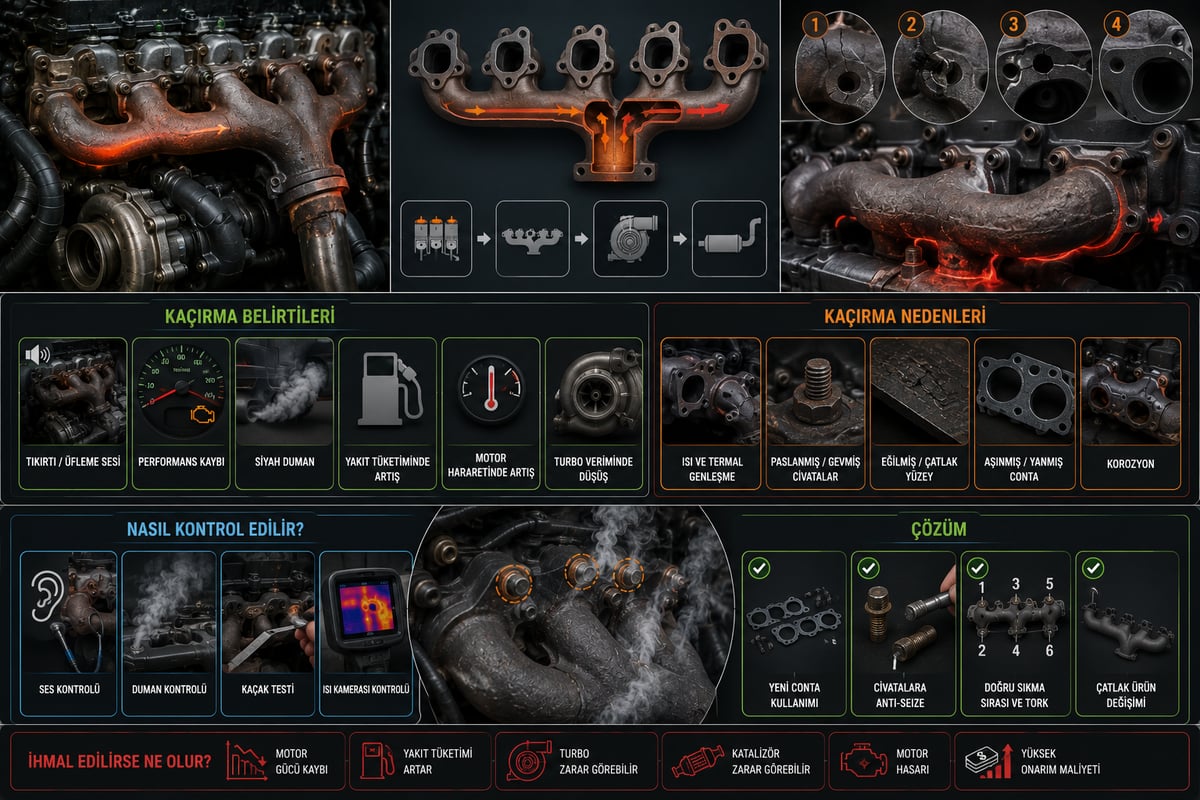
On the first cold start of winter, a thin hiss comes from the right side of the tractor unit. The sound isn't random: it's locked to the engine's firing rhythm and repeats on every pulse. As the engine warms up, the hiss quietens, and after a few minutes it's almost inaudible. The driver's report is short: "it does it cold, then it goes away." Yet shine a torch along the exhaust side of the cylinder head and there's a dry, velvety black trace along the flange line. Burnt gas is escaping from one point in the gasket, widening the gap it escapes through a little more each day, and dumping part of the energy that should be driving the turbo straight into the engine bay. This guide treats the exhaust manifold not as a length of pipe but as the first component downstream of the combustion chamber that has to hold pressure, and the sole supplier of energy to the turbine.
What Does an Exhaust Manifold Do? Function, Construction and Its Place in the System
The exhaust manifold is a pressure-carrying, typically cast, gas-collection component that gathers the high-temperature burnt gas leaving the exhaust ports in the cylinder head into a single collector body and routes it to the turbine inlet, or on naturally aspirated applications, directly into the exhaust pipe. The name isn't accidental: "manifold" means a body that brings several branches together into one outlet.
One detail is easy to miss in that definition: the manifold doesn't just carry the gas away, it's also responsible for preserving the gas's temperature and pressure pulses. What spins the turbine isn't the mass of the gas alone but the combination of its pressure and heat. Where there's a leak, the turbine never sees part of the energy it was promised. That's why the manifold is best thought of not as "the first piece of exhaust pipe" but as part of the boost system.
A typical heavy-duty manifold consists of: machined flange faces that seat on the exhaust ports, one runner per cylinder, the collector volume where the runners join, the turbo flange, a stud and nut set worn down by the thermal cycle, a multi-layer steel or graphite-metal gasket depending on the design, and a heat shield that protects the surrounding hoses and wiring from radiant heat. On many Euro V and Euro VI engines, EGR gas is also drawn from the manifold or from a point very close to it.
What's the Difference Between an Exhaust Manifold and an Intake Manifold?
Both bring several runners together into one volume, but their operating conditions are practically opposite. The intake manifold distributes cold, clean, low-pressure air; its body can be cast from aluminium or reinforced plastic. The exhaust manifold collects post-combustion gas: a flow that goes from a few hundred degrees at idle to considerably higher at full load, carrying soot in an oxidising environment. A leak on the intake side creates "false air" that upsets the mixture; on the exhaust side, a leak bleeds off energy and pressure. How to read intake-side leaks and cracks is covered separately in the Intake Manifold and Intake Pipe guide; keeping the two manifolds' symptoms apart is the fastest time you can save in diagnosis.
How Does an Exhaust Manifold Work? Pressure Pulses and Turbo Feed
When the exhaust valve opens, the gas in the cylinder is still under high pressure. The initial discharge happens because of that pressure difference, not because the piston is pushing it out, and it sends a sharp pressure pulse into the manifold. As the piston rises it sweeps out what's left. So the inside of the manifold isn't a steady flow at all — it's a wave-like environment made up of pulses that follow one another according to cylinder count and firing order.
Managing these pulses is the manifold's real design job. If one cylinder's pulse pushes back into a neighbour whose exhaust valve is still open, that cylinder can't scavenge properly and the leftover burnt gas spoils the next cycle's charge. Heavy-duty diesel engines use two approaches. In a pulse (tuned) manifold, the runners are kept short and narrow, and cylinders that don't fire next to each other are grouped separately — on an inline-six, grouping 1-2-3 and 4-5-6 is common, with the two groups entering the turbine through separate passages. This way the pulse energy reaches the turbine without being damped out, sharpening low-speed response. In a constant-pressure manifold, one large collector smooths the pulses into a steady pressure at the turbine; it's efficient at high, steady load but slower to respond at low revs.
The practical consequence of that split: on a pulse manifold, a leak in one runner isn't just a gas loss — it's a bypass that opens right at the peak of that group's pulse energy. The loss doesn't scale with the size of the hole; because it flows exactly when the pressure difference is highest, its effect is disproportionate. A driver's description of "fine at idle, won't pull under load" is very often exactly this.
The manifold's second, quieter job is holding heat in the gas. The hotter the gas reaching the turbine inlet, the more work it produces at the same pressure; that same heat is also what the diesel particulate filter needs to regenerate itself and what the SCR catalyst needs to do its job. A leaking manifold drags the whole chain down.
Manifold Material and Casting: Why Cast Iron?
Manifold material has to satisfy three demands at once: strength that holds its shape at high temperature, resistance to repeated heating-and-cooling cycles, and the ability to produce a complex internal geometry economically. For heavy-duty vehicles, casting is still the method that best satisfies all three.
Casting's advantage isn't only cost. Where wall thickness varies and the turbo connection needs a thick section, a welded sheet-steel construction adds weld seams — and with them, more fatigue-initiation points. A cast body also uses its thermal mass to smooth out temperature swings and damp vibration. The trade-off is that cast iron has limited ductility: pushed past its limit, it responds by cracking rather than bending. That's the root of how manifold failures behave.
| Material | Standout property | Weak point |
|---|---|---|
| Grey (flake graphite) cast iron | Good thermal conductivity, high damping, economical to cast | Low ductility, tends to grow in volume with repeated oxidation |
| Ductile (spheroidal graphite / SG) cast iron | Markedly higher ductility and crack resistance | Higher cost and more demanding casting control |
| SiMo-type heat-resistant ductile iron | High-temperature strength from silicon and molybdenum alloying | Higher material cost |
| Cast or welded stainless steel | Lightweight, fast to heat up | Fatigue risk at weld seams under heavy-duty load |
Why Are Exhaust Manifolds Built in Multiple Segments?
On an inline-six heavy-duty engine, the manifold can run close to a metre end to end. Cast iron's thermal expansion coefficient is roughly 10-12 micrometres per metre per degree — meaning a metre-long body going from cold to full load lengthens by a few millimetres. That sounds small, but if both ends of the body are bolted rigidly to the cylinder head, that movement has nowhere to go.
With nowhere to go, it turns into stress inside the material; the cylinder head doesn't expand at the same rate or by the same amount as the manifold. The result is that the manifold either cracks internally, crushes the gasket by loading the flange face unevenly, or shears its studs. A single long, one-piece manifold eventually reaches one of those three outcomes.
The fix is to split the body into two or three segments joined by a connection that can slide. In most designs this is an internal slip joint (sliding sleeve) with sealing rings. Each segment expands by sliding a few millimetres relative to its neighbour, so the total expansion doesn't pile up at one point. The second benefit shows up in the workshop: a cracked segment can be replaced on its own.
But this solution needs upkeep. If the slip joint clogs with soot, seizes from corrosion, or the sealing rings harden, the joint stops sliding and the multi-piece manifold starts behaving like one solid piece — and the stress builds up again. A good share of the field complaint "we fitted a new manifold and it cracked again within six months" traces back to exactly this.
Thermal Expansion and Thermal Fatigue: The Physical Cause of Cracking
The exhaust manifold goes through a cycle no other part on the vehicle sees: from cold to several hundred degrees within minutes, holding there for hours, then cooling quickly again. That cycle repeats every day, sometimes several times a day. The failure isn't simply wear — its proper name is low-cycle thermal fatigue.
The mechanism works like this. The inner surface in contact with the gas heats up far faster than the thick outer section around it; it wants to expand, but the cold mass around it won't let it. Held under compression, if the temperature is high enough, that hot layer yields and is permanently compressed a little. When the body cools, the compressed layer can't return to its original length, and this time it sits under tensile stress. Each cycle adds a little more to that residual tension; after a certain number of cycles, the material cracks at the point where stress is most concentrated.
Where the crack starts isn't random. The usual addresses are the fillet radius where a runner meets the flange, the junction where the runners feed into the collector, the area around the turbo flange carrying the weight of the turbine and the exhaust pipe, the bridges between stud holes — which crack fastest when combined with overtightening — and casting defects such as porosity or slag inclusions.
Three things speed this process up. First, restraint: a seized slip joint, a body forced onto a warped flange, over-tightened nuts, or an exhaust pipe pulling sideways on the manifold. Second, rapid cooling: water splashing on a hot manifold right after heavy load, or a pressure washer aimed directly at it. Third, oxide growth: repeated high heat forms an oxide layer on the surface that permanently grows the material's volume a little and distorts the flatness of the flange.
The key point here: the crack and the leak feed each other. The high-velocity hot gas jet from even a small leak erodes the gasket and flange surface it touches, heats that spot locally even further, and widens the temperature difference. That's why a manifold leak is one of the few faults that doesn't get cheaper the longer you wait. Crack detection, removal sequence and torque discipline are a separate subject; for the step-by-step procedure, see the Exhaust Manifold: Cracks, Leaks, Replacement & Torque Guide.
What Are the Symptoms of an Exhaust Manifold Leak?
The most distinctive feature of a manifold leak is that its symptom changes with temperature. On a cold engine the metal has contracted, the gap at a crack or gasket line is at its widest, and the leak is at its worst. As the engine warms, the material expands, the gap partly closes, and the noise fades. A driver saying "it goes away once it's warm" isn't reporting the absence of a fault — that's the signature of a typical manifold leak.
The sound has its own character too. A manifold leak isn't a steady roar; it's a sharp, rhythmic hiss locked to the firing frequency that gets both louder and faster under throttle. It's often mistaken for valve tap, but valve noise doesn't change nearly as sharply with load, and doesn't show anywhere near the same cold-to-hot difference.
| Symptom | Likely mechanism | First check |
|---|---|---|
| Rhythmic hiss on a cold engine that fades as it warms | Gap at the gasket line or crack that opens wider when cold | Listen along the flange line during a cold start |
| Dry black soot trace around the flange | Escaping gas carrying soot to the surface | Clean the area and re-inspect after a short run |
| Cone-shaped soot fan at the base of a stud | Loose or broken stud, flange lifting | Check nut tightness and stud integrity |
| Turbo slow to spool, delayed throttle response | Pulse energy escaping before reaching the turbine | Log boost pressure under load |
| Power loss under load, can't hold a grade | Drop in pressure and temperature at the turbine inlet | Compare requested versus measured boost on a road test |
| Increased black smoke on acceleration | Fuel dosing continuing without matching air | Cross-check smoke against boost pressure data |
| Exhaust smell in the cab | Leaking gas reaching the cabin from the engine bay | Keep the vehicle in for service until the leak is located |
Two traps to watch for when reading these symptoms. First, most items on this list aren't unique to the manifold: a clogged air filter, a leaking intercooler hose, or a worn turbo can all cause power loss and smoke too. Second, the leak's location isn't always where the sound seems to come from — sheet-metal shields can carry the sound to a different spot. So sound alone isn't proof; it has to be weighed together with a visible trace.
Further reading
For a plain-language technical overview of this subject, see the reference article on Wikipedia. Always confirm specific figures and procedures against the vehicle manufacturer service data.
How Does a Manifold Leak Weaken the Turbo?
The turbine converts part of the pressure and heat energy in the gas passing through it into mechanical work; the manifold is the only path that energy has to reach the turbine. Any leak upstream of the turbine inlet does damage through three channels. Pressure loss: the leak acts like an uncontrolled bypass that's always open; the pressure difference across the wheel drops, and torque output falls with it. Pulse energy loss: the leak bleeds off gas mostly in the milliseconds when pressure peaks — exactly when the turbine needs it most — which shows up as noticeably slower response at low revs. Heat loss: the escaping gas takes its heat with it, so the same pressure produces less work, and the diesel particulate filter and SCR catalyst downstream lose part of their temperature budget.
On engines with a variable-geometry turbine, the picture gets more complicated because of the control loop. The control unit sees that it can't reach its target boost and tries to compensate by driving the vanes further closed. The actuator ends up working at the extreme of its travel almost constantly, exhaust back-pressure rises, the mechanism clogs with soot faster, and over time a fault gets logged as a "turbo failure" — when the part that's actually broken isn't the turbo.
This is where the most expensive mistake in the field happens: the turbo gets replaced because boost pressure is low, and the same complaint comes back a few weeks later. Before blaming the turbo, prove that the path up to the turbine inlet is sealed; for turbo-side symptoms and measurements, see the Turbocharger: Symptoms, Diagnosis, Replacement & Maintenance guide.
Gasket and Studs: The Two Most Common Leak Points
A manifold can leak without ever cracking. The two most common sources found in the field are the gasket line and the stud connection; both are really the same problem wearing two faces: the flange isn't pressing against the cylinder head evenly and continuously.
The gasket fills the microscopic irregularity between two machined surfaces. That takes three conditions: flat surfaces, clamping force distributed evenly all the way around, and a gasket material suited to the thermal cycle. Break any one of those and a leak starts and grows on its own; the hot, high-velocity gas jet erodes the gasket material right at that point and widens the hole.
Studs should be treated as a consumable. They stretch and shrink with every thermal cycle, loosen slightly at high temperature, and their threads are exposed to soot and corrosion. Once preload drops, the flange lifts microscopically with every pulse and the gasket gets "pumped." A broken stud concentrates the leak at one point and shifts extra load onto its neighbours, setting up a chain of further failures.
| Leak source | Typical field sign | Correct approach |
|---|---|---|
| Fatigued or crushed gasket | Thin, continuous soot line along the flange | Gasket renewed at every removal, never reused |
| Loose nut, stud that has lost preload | Cone-shaped soot trail from the base of a stud | Nuts torqued to OE value and sequence |
| Broken or stripped stud | Concentrated leak at one point, flange lifting at that corner | Studs renewed as a set |
| Bent or warped flange face | Leak returns quickly even with a new gasket | Flatness checked with a straightedge and feeler gauge |
| Body crack | Dry black trace, distinct cold hiss, visible crack line | Crack cleaned up and made visible; replace after assessment |
The table's message can be summed up in one line: a gasket doesn't compensate for a bad surface or insufficient clamping force. Fitting a new gasket to a bent flange isn't fixing the fault, it's postponing it — the leak usually comes back at the same spot within a few weeks.
Why Does the Heat Shield Matter?
The heat shield looks like an unremarkable piece of sheet metal and, once removed, often never goes back on. But at full load a manifold surface can get hot enough to glow visibly in the dark, and most of that heat radiates outward as radiant heat. Radiation doesn't depend on airflow — it heats every surface facing it directly.
Once the shield is removed or deformed, the parts affected are predictable: oil in the turbo oil lines overheats and cokes, starving the bearings; wiring harnesses and sensor connectors harden and crack their insulation, triggering intermittent faults; fuel and air hoses lose their elasticity and start leaking under their clamps; the starter motor's main cable, which often runs close to the manifold, is one of the most frequent victims of heat damage.
The shield's second job is keeping heat inside the gas to protect the turbo and the exhaust after-treatment group's temperature budget; its third is keeping technicians from contacting a hot manifold during service. So a missing, crushed, or bolt-broken shield doesn't belong on the "we'll deal with it later" list. A loose shield also cracks its own mounting tabs from vibration and is one of the most common causes of a metallic rattle.
Diagnosis: Cold Listening, Soot-Trace Search and the Smoke-Test Concept
Diagnosing a manifold leak doesn't need expensive equipment, it needs a disciplined sequence. The goal isn't to find where the sound comes from, it's to find where the gas is escaping.
- Start with the vehicle cold, having sat overnight. A manifold leak is heard best on a cold engine; a warmed-up engine can hide the fault.
- Before starting the engine, inspect the exhaust side of the cylinder head, the flange line and the base of the studs with good lighting and a mirror; look for a dry, matte, velvety black trace — an oily, shiny stain points to a different source.
- Clean the suspect area with solvent and a clean cloth and let it dry; until the old trace is removed, you can't tell when a new one has formed.
- Start the engine cold and, at idle, work slowly along the flange line listening carefully; note whether the sound is locked to the firing rhythm.
- Have a helper raise the revs in steps; a manifold leak's sound gets both sharper and faster with revs, which makes it easier to separate from valve noise at this point. If needed, remove the heat shield appropriately and listen again, since the shield can carry the sound elsewhere and hide the source.
- Stop the engine after a short run and check the cleaned area again. A fresh soot trace is the most conclusive visual evidence of a leak.
- If the visual trace is inconclusive, use a smoke test: controlled, low-pressure smoke is introduced into the exhaust system and the point where it escapes is found by eye. Only do this on a cold engine and within the pressure and time limits set by the equipment's instructions.
- Check nut tightness and stud integrity. A nut that turns by hand or a broken stud can explain the leak on its own.
- If the manifold has been removed, measure flange flatness with a straightedge and feeler gauge and check that slip joints move freely; compare the result against OE tolerance.
- Back up your findings with live data: record requested versus measured boost pressure under load, exhaust temperatures and back-pressure if available.
- After the repair, run a short road test, repeat the same measurement, and re-inspect the area once the engine has cooled; verification on manifold work is done on the first cold start.
The last step is the one most often skipped. A new gasket beds in during the first thermal cycles; many manufacturers ask for the nuts to be re-checked to the OE value after a set running period for exactly this reason. Whether that check gets done is what decides whether the repair lasts six months or several years.
How Does a Manifold Leak Indirectly Affect the EGR and Emissions System?
On modern heavy-duty engines the exhaust side isn't just a discharge path, it's also a measurement and control environment. The control unit reads boost pressure, air mass, exhaust temperature and NOx values together; if one drifts, it throws off how the others are interpreted. A manifold leak acts like a silent hole opened in the middle of that network.
The most direct effect is on the EGR side. Exhaust gas recirculation works because pressure on the exhaust side is higher than on the intake side. A leak opened upstream of the take-off point lowers that pressure difference; even with the valve fully open, the targeted amount of gas doesn't get through. The control unit sees the shortfall, logs a deviation from expected EGR flow, and the fault is usually written up against the valve or the cooler. The valve gets replaced, and the code comes back shortly after.
The second effect is on NOx. When EGR flow falls short, combustion temperature rises, NOx formation increases, and the system tries to compensate by increasing urea dosing. That compensation works up to a point; once it's exceeded, an emissions warning and staged power derating follow.
The third effect is on the temperature budget. Hot gas escaping upstream of the turbine leaves the exhaust after-treatment group with a cooler flow. The diesel particulate filter has a harder time regenerating itself, passive regeneration drops off, active regeneration becomes more frequent — and frequent regeneration increases fuel consumption and speeds up fuel dilution of the engine oil. The same low temperature makes it harder for the SCR side to fully convert the urea solution and sets up crystallisation at the dosing point.
The fourth effect is on diagnostic quality. A leak makes back-pressure and air-mass readings show something other than reality, and any interpretation built on those readings starts a step off course. That's why, on complex boost- and emissions-related complaints, the first step isn't a complex measurement — it's proving the exhaust side is sealed.
Technical Values and General Reference Ranges
The table below gathers the figures most often needed when working on a manifold, at the order-of-magnitude level. These values aren't for making a decision — they're for judging whether a measurement looks reasonable; the numerical decision always comes from the OE document.
| Quantity | General reference range or criterion | Interpretation |
|---|---|---|
| Exhaust gas temperature inside the manifold | A few hundred degrees at idle, markedly higher at full load | Set by engine calibration, load and ambient temperature |
| Thermal expansion coefficient of cast iron | Roughly 10-12 micrometres per metre per degree | Means several millimetres of length change over a metre-long body |
| Flange face flatness | OE tolerance is the reference, checked with a straightedge and feeler gauge | A face outside tolerance will leak again even with a new gasket |
| Nut torque and tightening sequence | OE value and OE sequence used | Usually applied from the centre outward, in stages |
| Stud and nut use | Renewed as a set due to thermal fatigue and corrosion | Renewing a single stud shifts load onto its neighbours |
| Slip joint and sealing rings | Free movement checked, rings renewed | A seized joint is the leading cause of repeat cracking |
The table's real rule: no numerical value related to the manifold can be used independently of the engine code. The same manufacturer's two engines of the same displacement can call for completely different torque and tolerance values depending on emissions level or turbo hardware.
Maintenance, Service Life and Habits That Prevent Leaks
The exhaust manifold has no fixed replacement interval. Its life is set not by mileage but by the number of thermal cycles it goes through and by installation discipline; the manifold on a long-haul tractor unit doing steady highway runs can easily outlast the one on a construction site truck that goes from cold to full load several times a day.
- Cold listening routine: during scheduled maintenance, run the engine briefly while cold and listen along the exhaust side; a leak is cheapest to catch at this stage.
- Soot-trace sweep: at every service, visually check the flange line, the base of the studs and the area around the turbo flange for soot traces.
- Heat shield check: confirm the shield is in place, intact and fully bolted; a crushed shield is replaced, not straightened.
- Avoid rapid cooling: don't aim pressurised water at the manifold right after heavy load; let it cool before washing.
- Fastener discipline: renew the gasket every time the manifold is removed, evaluate studs and nuts as a set, and follow the correct torque sequence.
- Alignment check: check exhaust pipe hangers, bellows and connections; a pipe pulling on the manifold from the side will beat even the best gasket.
- Early action: don't put off a small hiss when you first hear it; what starts as a gasket leak goes on to become flange wear and then a cracked body.
Where Does the Exhaust Manifold Sit in the Boost and Exhaust Chain?
Judging the manifold in isolation is the fastest way to misread a fault. The chain runs like this: fresh air from the intake is pressurised by the turbo compressor, cooled in the intercooler, and distributed to the cylinders through the intake manifold; post-combustion gas leaves through the exhaust valves and collects in the exhaust manifold. From there, part of it is diverted to the EGR circuit while the main flow spins the turbine, then passes through the particulate filter and SCR catalyst on its way to the silencer.
In this chain, a fault in any one link shows up at its neighbour: a clogged air filter strains the turbo, a leaking intercooler hose drops boost pressure, and a leaking manifold weakens the turbine and cools the after-treatment group. Because the symptoms overlap, diagnosis has to be built by flow direction, not by guessing the part: first prove air is getting in freely, then that pressure is being built, then that the exhaust side is sealed.
In short, the exhaust manifold is the first component downstream of the combustion chamber that has to hold pressure, and it's the sole carrier of the energy that reaches the turbine. The only reason it's cast from iron, and built in multiple segments joined by slip joints on longer engines, is so it can absorb the thermal expansion it experiences every day without damage; once that ability is restricted, the material answers by cracking. The thin hiss heard on a cold engine and the dry soot trace along the flange line are the earliest and cheapest warnings of that process. In every case, the vehicle's current OE service documentation for its specific engine and chassis code is the final authority.
Shop this part: Exhaust Manifold
In-depth technical guide: For fault diagnosis, step-by-step replacement and service intervals: Exhaust Manifold: Cracks, Leaks, Replacement & Torque Guide
Main guide: What Is an EGR Valve? Failure Symptoms and Cleaning (Heavy Commercial Vehicles)
Tags
Frequently Asked Questions
- What is an exhaust manifold and what does it do?
- The exhaust manifold is a pressure-carrying, usually cast component that gathers the burnt gas leaving the cylinder head's exhaust ports into a single collector body and routes it to the turbine inlet. Its job isn't only to carry the gas away — it's to hold the gas's temperature and pressure pulses all the way to the turbine. That's why, on a heavy-duty vehicle, the manifold is best treated as part of the boost system rather than part of the exhaust line.
- How can you tell an exhaust manifold is leaking?
- The most distinctive sign is a rhythmic hiss heard on a cold engine, locked to the firing rhythm, that fades as the engine warms up. The second piece of evidence is visual: look for a dry, velvety black soot trace along the flange line, at the base of the studs, or around the turbo flange. Sound alone isn't enough, because sheet-metal shields can carry the noise to a different spot.
- Why does an exhaust manifold hiss when cold but go quiet once warm?
- On a cold engine the metal is contracted and the gap at a crack or gasket line is at its widest, so the leak is at its worst. As the engine warms, the material expands, the gap partly closes and the sound quietens. The noise disappearing once warm isn't the absence of a fault — it's the signature of a typical manifold leak.
- Why do exhaust manifolds crack?
- The manifold goes from cold to several hundred degrees and back every day; this low-cycle thermal fatigue builds up permanent tensile stress in the material and eventually starts a crack once a certain number of cycles is reached. Cracks usually appear at the flange root, where the runners join the collector, around the turbo flange and across the bridges between stud holes. A seized slip joint, over-tightening, a warped flange and rapid cooling all speed the process up markedly.
- Why are exhaust manifolds built in multiple pieces?
- On an inline-six heavy-duty engine the manifold's length approaches a metre, and cast iron lengthens by several millimetres over that span when it goes from cold to full load. In a one-piece body fixed at both ends, that movement has nowhere to go and turns into stress. Splitting the body into two or three segments joined by slip joints lets each segment expand freely and lets a cracked segment be replaced on its own.
- Can a manifold leak weaken the turbo?
- Yes. Any leak upstream of the turbine inlet drops pressure, bleeds off pulse energy right at its peak, and carries away heat — the result is a slow-spooling turbo, low boost pressure and power loss under load. On engines with variable-geometry turbines, the control unit tries to compensate by holding the vanes more closed, and the fault is often logged against the turbo. Before replacing the turbo, prove that the path up to the turbine inlet is sealed.
- Does an exhaust manifold leak affect the EGR and emissions system?
- It does. EGR relies on exhaust-side pressure being higher than intake-side pressure; a leak opened upstream of the take-off point lowers that difference, so the targeted amount of gas doesn't get through even with the valve fully open. The control unit logs this as a flow deviation and the fault is often written up against the valve. Cooler gas reaching the after-treatment group also increases how often regeneration is needed and raises the risk of crystallisation on the SCR side.
- Does the exhaust manifold gasket need to be replaced every time it's removed?
- Yes, the gasket should be renewed every time the manifold is removed; a gasket that's already been compressed won't seal the same way twice. But a gasket alone isn't enough — if the flange face is warped or the studs have lost preload, a new gasket will leak again within a short time. That's why flatness is checked before assembly, studs and nuts are evaluated as a set, and tightening follows the OE torque value and sequence.
- Can a vehicle be driven without a heat shield?
- It shouldn't be. Radiant heat from the manifold surface cokes the oil in turbo oil lines, cracks the insulation on wiring harnesses, and hardens hoses until they leak. The shield also keeps heat inside the gas to protect the turbo and exhaust after-treatment group's temperature budget. A crushed or bolt-broken shield should be replaced, not straightened back into shape.
- How many kilometres does an exhaust manifold last?
- The manifold has no fixed replacement interval; its life is set by the number of thermal cycles it goes through and by installation discipline, not by mileage. A long-haul tractor unit's manifold can easily outlast one on a vehicle that goes from cold to full load several times a day. On vehicles where cold listening, soot-trace checks and heat shield inspection are done at every service, a fault is usually caught at the gasket stage, long before it becomes a crack.
Related Articles

DPF (Diesel Particulate Filter) Guide: Symptoms & Cleaning
Learn what a DPF is, how passive and active regeneration work, warning signs of clogging, and safe cleaning methods for heavy commercial diesel trucks.
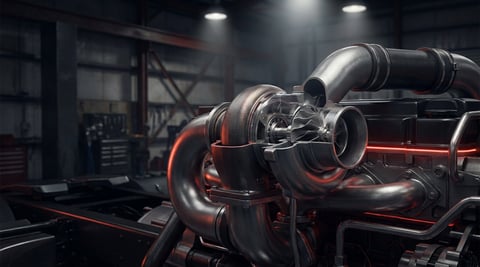
Turbo Intake & Exhaust Inlet Pipe: Faults and Replacement
Turbo intake and exhaust inlet pipe faults on trucks: leak symptoms, diagnosis, step-by-step replacement, torque values and maintenance tips from VADEN.
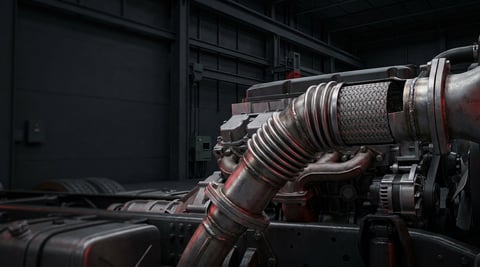
Exhaust Flex Pipe: Faults, Replacement and Maintenance Guide
On a truck a collapsed exhaust flex pipe strains the whole line from turbo to DPF: how the bellows absorbs engine movement, fault signs and replacement.