What Is a Fuel Injector? How to Recognize Injector Failure Symptoms
What is a fuel injector and how does it work? Injector failure symptoms, leak-off testing, cleaning, replacement, and IMA/ISA coding for heavy-duty trucks.
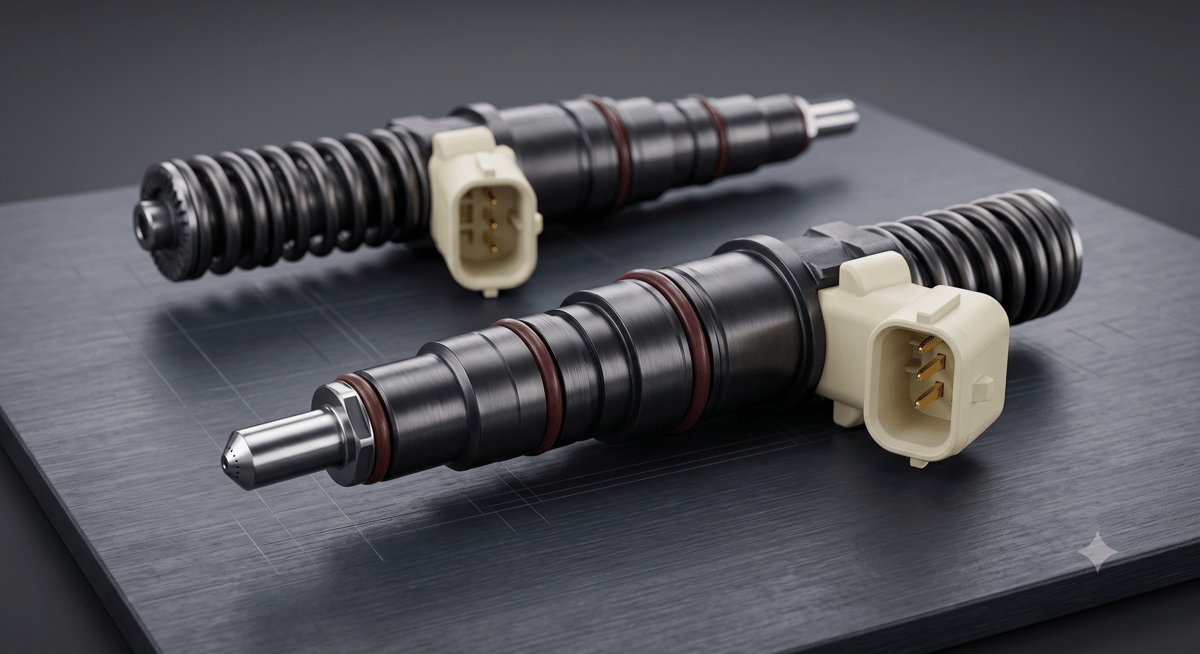
A loaded line-haul tractor struggles to wake up on a cold morning: the starter cranks longer than usual, one cylinder refuses to catch when the engine finally fires, and a dark cloud rolls out of the stack under load. The driver's diagnosis is already in — "injector's gone." In the shop, graduated tubes clipped onto the return hoses tell the real story within minutes: one cylinder throws off the pattern, its injector sending back several times more fuel than its neighbors. Finding the faulty part takes a few minutes; figuring out what killed it is the real question. This guide treats the fuel injector not as an isolated part, but as the most sensitive link in a diesel fuel chain that starts at the tank and closes through the return line.
What Is a Fuel Injector? Its Role, Construction, and Function in a Diesel Engine
A fuel injector is a hydraulic-electric actuator that delivers pressurized diesel fuel straight into the combustion chamber, in a precisely calculated quantity, at sub-millisecond timing, broken into micron-sized droplets. It isn't a tap that simply lets fuel through — it is the final component that decides how much fuel enters the chamber, at what crank angle, in how many pulses, and in what spray geometry.
Diesel engines have no spark to start combustion; fuel injected into hot, compressed air has to ignite on its own, and the quality of that ignition depends directly on the quality of the spray. Coarse droplets leave the stack as soot; an uneven mixture makes the pressure rise harsher. That's why the injector governs fuel consumption, emissions, noise, and the engine's mechanical life all at the same time.
Inside a body that looks simple, several functions sit side by side: the high-pressure inlet, the control section that turns an electrical command into hydraulic motion (a solenoid coil or a piezo stack), the nozzle assembly with its needle and spray holes, the control volume, the sealing copper washer, and the return-line fitting. These parts work to micron-level tolerances — the only reason the injector is this sensitive to contamination.
What Is the Difference Between an Injector and a Nozzle?
The nozzle is the spray assembly at the tip of the injector — the needle and the drilled tip that meters the spray; the injector is the complete assembly that houses the nozzle. In older mechanical systems the nozzle was a separate service part, and reconditioning it was routine shop work. In modern common rail and unit injector designs, the nozzle is matched to the body and calibrated as one set; it can only be serviced to the extent the manufacturer allows, and only with the correct test equipment.
How Does an Injector Work? Pressure, Needle Movement, and Spray Pattern
In a common rail system, fuel arrives at the injector under continuous high pressure and simply waits inside. What starts the spray isn't the arrival of pressure — it's the moment the needle's balance is upset. Pressure in the small control volume above the needle holds it shut. When current is applied to the solenoid, a small control valve opens, fuel in the control volume drains into the return line, and pressure above the needle drops; the high pressure below then lifts the needle, the spray holes open, and injection begins. When current is cut, the valve closes, the volume refills, and the needle reseats.
This has two consequences. The force behind the command comes directly from fuel pressure — the solenoid only has to move a tiny valve. And on every single injection event, the fuel in the control volume drains to the return line; in other words, even a perfectly healthy injector always sends some fuel back to the tank. What signals a fault isn't the presence of return flow, but its imbalance across cylinders.
The control unit gives the injector four commands at once: quantity, set by how long it stays open; timing, tied to crank angle; the number of pulses fired in one cycle; and the spray pattern shaped by the nozzle holes. Modern engines fire several injections per cycle: a pilot injection softens the sudden pressure rise, the main injection produces power, and a post injection raises exhaust temperature. As an injector ages, the pilot injection — working with the smallest quantities — is usually the first to degrade; a growing tick at idle often traces back to exactly this.
The return line carries fuel drained from the control volume back to the tank, and the fuel flowing through it also cools the injector. If the line clogs or back-pressure builds inside it, the needle's closing behavior is disturbed — which is why hoses and fittings deserve just as much early attention as the injector itself.
Mapping the Diesel Fuel System: The Chain from Tank to Injector
The injector isn't responsible for the quality or pressure of the fuel reaching it — it only bears the consequences. Fuel travels from the tank through the low-pressure side, gets pressurized on the high-pressure side, is consumed at the injectors, and closes the loop back to the tank through the return line. A fault anywhere in that chain shows its symptoms at the most sensitive link.
The low-pressure side cleans the fuel and delivers it to the pump without interruption: the tank, a coarse strainer, a water-separating pre-filter, a manual priming pump, the transfer (lift) pump, and the main fuel filter all belong here. The high-pressure pump, through its metering valve, pressurizes only the portion of incoming fuel that's actually needed; for this component's failure symptoms, priming procedure, and replacement, see the diesel injection pump guide. Pressurized fuel enters the common rail, then travels through steel lines to the injectors.
| Component | Function | Consequence for the injector if it fails |
|---|---|---|
| Fuel tank and coarse strainer | Stores and carries fuel, holds back coarse debris | Sediment and water fill the filter early |
| Water-separating pre-filter | Separates condensation water and particulate | Water reaching the nozzle causes needle corrosion and sticking |
| Transfer (low-pressure) pump | Draws fuel from the tank to the high-pressure pump | Insufficient feed, rail pressure fails to build |
| Main fuel filter | Traps fine particulate, protects precision surfaces | Delayed changes cause wear and needle sticking |
| High-pressure pump | Raises fuel to injection pressure | Pressure fluctuation, power loss, fault codes |
| Common rail and pressure sensor | Stores, stabilizes, and measures pressure | Wrong signal, dosing error across all cylinders |
| High-pressure lines | Carry fuel to the rail and injectors | Leakage, pressure drop, fuel odor |
| Injectors | Meter and atomize the fuel spray | Misfire, smoke, ticking, higher consumption |
| Return line | Sends excess fuel back to the tank, cools the injector | Clogging disrupts needle closing and causes misfire |
The quietest link in the chain is the high-pressure line; once a fitting face has been torqued and then loosened, it rarely seals with the same confidence again. Leakage, vibration cracking, and installation strain in these lines are covered in the injection line and fuel pipe guide. A common shop mistake is chasing a remaining misfire back to the injector after it's already been replaced — when the real culprit can be a line that was strained during installation.
Injector Types: Mechanical, Solenoid, Piezo, Unit Injector
Four generations run side by side in the heavy-duty fleet, and the difference isn't just technology — the diagnostic method changes too. In a mechanical injector, a pressure wave from the inline pump overcomes spring force to lift the needle, and the pump itself sets the timing. The solenoid common rail injector is the most common type on the road today; current applied to the solenoid opens a small control valve. The piezo injector uses crystal stacks that change length under voltage and can deliver more, smaller pulses per cycle. In a unit injector, pressure isn't built in a common rail — it's generated inside the injector itself by a plunger driven off the camshaft.
| Type | What triggers injection | Pressure range (general reference) | Diagnostic and service approach |
|---|---|---|---|
| Mechanical injector (nozzle-type) | Pressure wave from the inline pump overcomes spring force | Opening pressure roughly 150–300 bar | Bench-tested opening pressure and spray pattern; nozzle can be reconditioned |
| Solenoid common rail | Solenoid opens the control valve | Rail pressure roughly 1,400–2,500 bar | Leak-off measurement, coil resistance, bench test, coding required |
| Piezo common rail | Piezo stack changes length under voltage | Rail pressure roughly 1,600–2,500 bar | Return-flow interpretation is design-dependent; repair mostly limited |
| Unit injector | Camshaft-driven plunger builds pressure | Peak pressure can exceed 2,000 bar | Rocker arm and preload adjustment are critical, set to OE value |
| Unit pump (separate pump, short line) | Dedicated pump element per cylinder | High pressure generated over a short line | Pump element and injector are assessed separately |
The ranges in the table only give a sense of scale; the exact value is read from the OE document for that specific engine code. Starting diagnosis without knowing the system type wastes time: a leak-off measurement means something different on a unit-injector engine, and chasing a fault code on a mechanical nozzle-type engine is pointless.
How to Recognize Injector Failure Symptoms
Injector failure never shows up as a single symptom — it wears a different face depending on which fault is developing. A needle that won't fully close shows up as soot and smoke; hardened closing shows up as misfire and power loss; a growing internal leak shows up as hard starting and rough idle.
| Symptom | Likely mechanism | First check |
|---|---|---|
| Hard starting, extended cranking (especially in cold weather) | Internal leak has grown, pressure can't build during cranking | Monitor rail pressure during cranking, measure return flow |
| Rough idle, misfire, vibration | One cylinder's dosing is off, or the needle is sticking | Read cylinder balance / trim correction values |
| Black smoke from the exhaust | Excess fuel, coarse droplets, distorted spray pattern | Monitor smoke and trim values under load |
| White or bluish smoke from the exhaust | Unburned fuel, delayed ignition, dribbling needle | Compare cylinders during a cold start |
| Metallic ticking noise at idle | Pilot injection has degraded, pressure rise has hardened | Identify pilot injection data and which cylinder the noise comes from |
| Return flow that differs between cylinders | Control valve or needle seat is worn | Comparative leak-off measurement with graduated tubes |
| Power loss, can't hold a grade | Insufficient dosing, pressure can't be held at target | Log pressure and dosing data under load |
| Unexplained rise in fuel consumption | Dribbling needle, leaking injector, distorted pattern | Match fleet fuel records against cylinder data |
| Rising, thinning engine oil level | Unburned fuel getting into the crankcase oil | Check oil level and smell, investigate the dosing fault |
| Black soot and a hissing sound around the injector | Copper washer or seat seal has failed | Clean the area around the body and recheck for leaks |
There are two traps when reading these symptoms. First, most of them aren't exclusive to the injector: a clogged fuel filter, an air leak in the intake, or a cylinder with low compression can produce the same picture. Second, a fault code usually shows the result, not the cause; a "cylinder 3 dosing deviation" record doesn't say that injector must be replaced — it says the expected contribution isn't showing up there.
Finding a Faulty Injector with a Leak-Off (Return Flow) Measurement
On a common rail engine, the cheapest and fastest way to find a faulty injector is a leak-off measurement. Healthy injectors return similar flow rates; an injector with a growing leak returns noticeably more than the others. The test isn't looking for an absolute number — it compares cylinders against each other.
- Bring the engine to operating temperature, shut it down, turn off the ignition, and wait the manufacturer-specified time for pressure to bleed off.
- Clean the injector tops and the return fittings thoroughly with compressed air and a clean rag; any debris that falls here ends up in the system once the test is done.
- Disconnect the return hoses one at a time, connect an identical-length, identical-diameter graduated tube to each injector, and label each tube with its cylinder number.
- Keep the tube ends level and unrestrained; a different height or a kinked hose creates back-pressure and skews the result.
- Run the engine under the condition the manufacturer specifies — the test is usually done by cranking for a set time or by holding idle. Apply the same condition to every cylinder.
- When the time is up, stop the engine and read the levels side by side. What matters is the spread, not the number — if one tube reads noticeably higher than the rest, that injector is suspect.
- If every tube reads high together, the fault isn't in a single injector; look at system pressure, the pump, and pressure regulation instead.
- Confirm the suspect injector by swapping it into a healthy cylinder if possible; if the symptom follows the injector, the diagnosis is confirmed.
- Once the test is done, reinstall the hoses and fittings clean, bleed the system, and confirm the result with a short test drive under load.
The method's limits should be understood too. Leak-off measurement catches internal leakage; clogged spray holes or a distorted spray pattern may not show up in return flow at all. On some direct-driven piezo designs, return flow is also very low and doesn't read the same way.
Further reading
For a plain-language technical overview of this subject, see the reference article on Wikipedia. Always confirm specific figures and procedures against the vehicle manufacturer service data.
Injector Diagnostics in the Shop: What Does Each Measurement Tell You?
Leak-off measurement does a rough sort; understanding what a specific injector is doing takes several readings taken together. The basic rule is to prove the conditions reaching the injector before blaming the injector itself: adequate feed pressure, clean fuel, sound compression, and a proper connection.
The control unit constantly compensates for differences between cylinders and reports this as a cylinder balance or trim correction value. If one cylinder's correction value keeps drifting apart at idle, the expected contribution isn't showing up there — but low compression or a leaking copper washer can produce the exact same picture. Other values worth checking are the gap between commanded and measured rail pressure, the metering valve's duty cycle, and the pressure built during cranking.
Two tests stand out on the high-pressure side. A pressure-hold test shows how fast pressure is lost once dosing is cut off; a fast drop points to a leak in the injectors, the pump, or the pressure-limiting valve. A cylinder cutout test switches off one cylinder's dosing and measures how the engine responds: cutting a healthy cylinder produces a noticeable change in speed and vibration, while a cylinder that's already contributing almost nothing barely changes anything. Compression, the electrical side, and the feed line are also confirmed at this stage; symptoms confined to one cylinder point to the injector, symptoms spanning all cylinders point to a shared part of the chain.
Injector Cleaning and Test Bench: What It Does, and Where It Stops
In-tank chemical cleaners added at fill-up can be effective against light carbon buildup at the nozzle tip, but they won't restore a worn needle seat, an enlarged spray hole, or a fatigued control valve. The step that actually matters is removing the injector and running it through ultrasonic cleaning and a flow bench.
The bench doesn't just clean the injector — it measures it: running it at defined operating points and recording the actual fuel quantity delivered, return flow, response time, and spray pattern. Results are compared against the manufacturer's tolerance window; an injector inside the window can be reconditioned, one outside it needs replacement. The bench's real value is breaking the "we cleaned it but it didn't help" loop, because the process ends with a measured report in hand.
Its limits are just as clear. On solenoid injectors, the nozzle assembly and control valve can often be reconditioned to the extent the manufacturer allows; on piezo designs, repair is mostly not an option. The reconditioned injector's calibration values also change; if the new code isn't written to the vehicle, even a sound part won't let the engine run cleanly.
Injector Replacement: Removal, Installation, and Sealing
Replacing an injector isn't hard — it's a job that demands discipline. Most comebacks trace not to the part, but to dirt getting into an open line, single-use parts being reused, and torque sequence being skipped. Tightening values and special tools vary by engine and always come from the OE manual.
- Secure the vehicle, disconnect the battery the way the manufacturer specifies, and let the engine cool; pulling an injector from a hot head can damage the seating surface.
- Blow the area around the injector clean with compressed air, and have clean plugs and caps ready for every line you're about to open.
- Confirm pressure has bled off, then disconnect the return line and the high-pressure lines; don't bend the lines, and don't reuse them if the manufacturer doesn't allow it.
- Remove the hold-down clamps and fasteners. If the injector is seized in its bore, don't force it — use the correct puller; leverage or a hammer permanently damages the bore.
- Clean the injector bore of carbon and old gasket material with the proper tool; a single leftover flake will keep the new washer from seating.
- Always renew the copper washer, the seal, and any O-rings. A reused washer holds its seal only briefly before combustion gas starts leaking past it.
- Seat the new injector, bring the fasteners to a hand-tight fit, then torque them to the OE value and sequence with a torque wrench; overtightening distorts the body and disturbs needle movement.
- When fitting the new high-pressure line, seat both ends of the fitting loosely first, then tighten; forcing a line into place under strain creates a stress crack.
- Reconnect the return line and the electrical connector, and confirm the wiring is clear of any chafe points.
- Bleed the system following the manufacturer's procedure, and visually inspect every connection before the first start.
- Start the engine, let it idle, check for leaks, then write the new injector's correction code to the correct cylinder and complete any required learning cycle.
Post-Replacement Coding: The IMA/ISA Value and Learning Cycles
Modern injectors aren't identical twins straight off the production line. Micron-level manufacturing tolerances mean every injector delivers a slightly different fuel quantity for the same electrical command. The manufacturer measures this difference and stamps it on the injector as a code; once the control unit knows this code, it issues each injector a command corrected for its own individual deviation.
The code's name varies by manufacturer: commonly known as IMA (injector quantity adjustment) on solenoid applications, and ISA on piezo applications; other systems use different letters for the same type of calibration value. The code is printed on the injector body or its label, and it must be matched to the cylinder it's installed in and written into the control unit with a diagnostic tool. Swapping two injectors' codes is worse than writing no code at all, because the system then applies correction in the wrong direction on both cylinders.
Without the code written, the engine will usually still run, but the control unit assumes an average injector and commands accordingly; the result is rough idle, ticking under load, more smoke and consumption, and eventually a fault code. A large share of "we put in a new injector and it didn't fix it" complaints trace back not to a bad part, but to a code that was never written, or written to the wrong cylinder. Some systems also require adaptation values to be reset and a short learning drive after coding.
What Kills an Injector, and How to Prevent It
Injectors rarely fail on their own. Behind most failures sit four causes: dirty fuel, water, delayed filter maintenance, and improper handling. All four are foreign influences reaching surfaces machined to micron tolerances.
Particulate contamination is the most common: hard particles in the fuel sand down the needle seat and the control valve like grit, and that wear first grows the leak, then throws off the dosing. Water is more destructive still; it strips the fuel's lubricity, starts corrosion on seating surfaces, and drives surface wear under high pressure. Water from condensation in the tank builds up unavoidably in winter and in tanks that run half-full. The same component is responsible for stopping both of these, and it's the cheapest link in the chain — which is why, when fuel filter and water separator maintenance is deferred, the injector pays the bill.
The third cause is a wrong or overdue filter: a filter coarser than the engine calls for provides no real protection even while installed, and an overdue filter forces open the bypass valve. The fourth is installation and maintenance error: an injector fitted into an uncleaned bore, a reused copper washer, overtightening, and dirt getting into the system. Add to that extended idling and a low-load duty cycle — both accelerate carbon buildup at the nozzle tip.
Technical Values and General Reference Ranges
The table below gathers the figures most often needed in the field, given as general order of magnitude; they exist to judge whether a measured result looks reasonable, not to make a decision on their own.
| Value | General reference range or criterion | Interpretation |
|---|---|---|
| Common rail operating pressure | Roughly 1,400–2,500 bar | Set by the control unit based on speed and load |
| Mechanical nozzle opening pressure | Roughly 150–300 bar | Measured on the bench, adjusted to OE value |
| Low-pressure (feed) side | On the order of a few bar | Low feed pressure collapses the high-pressure side |
| Leak-off (return flow) criterion | Not an absolute number — spread across cylinders | One tube noticeably higher than the rest is suspect |
| Injector clamping torque | OE manual value and tightening sequence | Overtightening distorts the body and disturbs needle motion |
| Copper washer and O-ring | Renewed at every removal | Reuse leads to combustion gas leakage |
| High-pressure line | Not reused if the manufacturer disallows it | A torqued fitting face doesn't seal the same way twice |
| Fuel filter change interval | Whichever comes first — mileage or time | Interval shortened under severe duty |
| Coding (IMA/ISA) requirement | Every injector replacement and after bench service | Engine won't dose correctly without the code written |
The table's real rule is this: no numerical value tied to the injector can be used independently of the engine code. Two engines of the same displacement from the same manufacturer can call for entirely different values because of a different emissions level or different injection hardware.
Maintenance, Life, and the Injector's Place in the Fuel Chain
The injector has no set replacement interval; its life is determined not by mileage but by the cleanliness of the fuel that passes through it. Of two trucks with the identical engine, one can complete high mileage without issue while the other, because its filter was neglected, needs a new injector set far earlier. There's no separate "injector maintenance" — injector maintenance is fuel-chain maintenance.
- Filter discipline: The main fuel filter and the water-separating pre-filter are changed on whichever comes first, mileage or time, per the manufacturer's schedule.
- Water separator draining: Drain periodically, more often in winter; recurring water buildup should be investigated on the tank side.
- Fuel source audit: The fueling point, the bulk tank's bottom sediment, and any in-fleet pump filter are checked regularly.
- Keeping the tank full: A tank left full overnight reduces condensation; a half-full tank produces water in cold weather.
- Leak and carbon inspection: The area around the injector, the return hoses, and the high-pressure lines are checked for soot marks, moisture, and chafing.
- Live data logging: Cylinder correction values and rail pressure are read periodically even without a warning light; a trend is the earliest sign of a developing fault.
- Consumption tracking: Fuel consumption that drifts from the vehicle's own baseline is the earliest indicator of injector-side deterioration.
- Service record keeping: The replaced injector's serial number, the code written, and the cylinder number are logged in the vehicle's file.
The injector is the last link in the diesel fuel chain, and it carries the health of the entire chain on its shoulders. Water coming from the tank wears it down, a neglected filter sands it, a tired transfer pump starves it of pressure. That's why a vehicle rolling into the shop with an "injector failure" diagnosis is, more often than not, the start of the diagnosis rather than the end of it. The order is fixed: first prove the fuel is clean, then that pressure is building, then that compression is adequate — the injector is questioned last. In every case, the current OE service documentation for the vehicle's engine and chassis code is authoritative.
Shop this part: Injector
Related technical guides: Exhaust Manifold: Cracks, Leaks, Replacement & Torque Guide · Engine Cylinder Head Group: Faults, Replacement & Maintenance · Exhaust / Engine Brake: Faults, Replacement & Maintenance Guide · Oil Cooler: Failure Symptoms, Replacement & Maintenance Guide · Truck Oil Pan Group: Faults, Replacement & Maintenance Guide
Application and compatibility: Vehicle compatibility catalogue · Engine compatibility catalogue
In-depth technical guide: For fault diagnosis, step-by-step replacement and service intervals: Diesel Injection Pump: Faults, Replacement & Maintenance
All our technical guides on this topic
- What Is AdBlue? What Does It Do, and What Happens When It Runs Out?
- Diesel Fuel Filter and Water Separator Filter: Function and Replacement Interval
- Fuel Filter & Water Separator: Faults, Change and Care Guide
- Fuel Water Separator Filter: Symptoms, Replacement & Care
- Feed Pump & Hand Primer: Faults, Replacement, Maintenance
- Diesel Injection Pump: Faults, Replacement & Maintenance
- Diesel Injection Line & Fuel Pipe: Faults, Repair, Maintenance
- Injection Pump and Fuel Transfer Pump: Function and Failure Symptoms
- Solenoid Coil: Faults, Testing, Replacement and Maintenance
- What Does an Air Filter Do? How Does a Clogged Filter Affect the Engine?
- Belt Tensioner: Failure, Replacement & Maintenance Guide
VADEN ORIGINAL products
- Fuel System — 272 products
- Fuel Filters — 105 products
- Injector Pump — 46 products
- Cylinder Head Injector Sleeve — 38 products
Tags
Frequently Asked Questions
- What is a fuel injector and what does it do?
- A fuel injector is a hydraulic-electric component that delivers pressurized diesel fuel straight into the combustion chamber in a precise, metered quantity, broken into micron-sized droplets. It's the part that decides how much fuel enters the chamber, at what crank angle, in how many pulses, and in what spray pattern. Diesel engines have no spark, so ignition quality depends directly on spray quality — which is why the injector governs power, fuel consumption, emissions, and engine noise all at once.
- What are the symptoms of a failing fuel injector?
- The most common signs are hard starting with extended cranking, rough idle with misfire and vibration, black or whitish smoke from the exhaust, a metallic ticking noise at idle, power loss, and an unexplained rise in fuel consumption. If the injector's seat is leaking, you'll see black soot around the body and hear a hissing sound. Most of these symptoms aren't exclusive to the injector — a clogged fuel filter, an intake air leak, or low compression can produce the exact same picture.
- How do you tell which cylinder has a bad injector?
- On a common rail engine, the fastest method is a leak-off (return flow) measurement: identical graduated tubes are connected to each injector's return hose, and the amounts collected under the same conditions are compared side by side. What matters is the spread between cylinders, not an absolute number — if one tube collects noticeably more than the rest, that injector is the suspect. The result is confirmed alongside live cylinder correction values and a cylinder cutout test.
- What does it mean when an injector's return flow is too high?
- Even a healthy injector always sends some fuel back to the tank, because the control volume that operates the needle drains into the return line on every injection event. A cylinder whose return flow rises noticeably above the others means the control valve or needle seat has worn and the internal leak has grown. If every tube reads high together, the fault isn't a single injector — look at the pump or system pressure regulation instead.
- Does injector cleaning actually work?
- In-tank chemical cleaners can help with light carbon buildup at the nozzle tip, but they won't restore a worn needle seat or a fatigued control valve. What actually makes a difference is pulling the injector and running it through ultrasonic cleaning and a flow bench, which measures the fuel quantity delivered, return flow, and spray pattern against the manufacturer's tolerance window. If the injector falls outside that window, reconditioning isn't enough — it needs to be replaced.
- Is coding required after replacing an injector?
- Yes. Because of manufacturing tolerances, every injector delivers a slightly different fuel quantity for the same electrical command; that deviation is stamped on the part as a code and written into the control unit, matched to the cylinder it's installed in. Without the code written, the engine will run but with rough idle, ticking, more smoke, and higher consumption. Swapping two injectors' codes is worse than writing no code at all, since the system then corrects in the wrong direction on both cylinders.
- How many miles do fuel injectors last?
- There's no fixed replacement interval; injector life is determined by the cleanliness of the fuel that passes through it, not by mileage. A truck with disciplined filter changes and a properly drained water separator can rack up high mileage on its original injectors, while an identical truck with deferred maintenance can need a new injector set far earlier. In practice, there's no separate injector maintenance — injector maintenance is fuel-chain maintenance.
- What causes fuel injectors to fail?
- Four causes account for most failures: particulate contamination in the fuel, water, overdue or incorrect filtration, and installation errors. Hard particles sand down the needle seat and control valve, while water strips the fuel's lubricity and starts corrosion. Add reused copper washers, overtightening, and dirt getting into an open line during service, plus extended idling and low-load duty cycles that speed up carbon buildup at the nozzle tip.
- Does the whole injector get replaced, or can just the nozzle be reworked?
- In older mechanical systems the nozzle was a separate service part and reconditioning it was routine. In modern common rail and unit injector designs, the nozzle is matched to the body and calibrated as a set, so it can only be serviced to the extent the manufacturer allows and with the correct test bench. On solenoid injectors the nozzle and control valve are often reconditionable; on piezo designs, repair is mostly not an option.
- Is it safe to keep driving with a bad injector?
- No. An injector that won't fully close or that sprays with a distorted pattern carries unburned fuel into the cylinder and exhaust, which can wash oil off the cylinder walls, thin the crankcase oil, and clog the aftertreatment system. A single failing injector is also a warning sign for the others running on the same fuel — diagnosis should start as soon as symptoms appear, not after the vehicle breaks down.
Related Articles
Water Separator Filter: Diesel Water Drain & Warning
Where does water get into diesel fuel, how does a water separator work, and what should you do when the warning light comes on? A heavy-duty vehicle guide.

Fuel Water Separator Filter: Symptoms, Replacement & Care
Truck fuel water separator filter and housing: how it works, water sensor, drain valve, heater, fault symptoms, replacement, bleeding and maintenance.
Solenoid Coil: Faults, Testing, Replacement and Maintenance
Understand how a solenoid coil works, spot open or shorted windings with a multimeter, replace it correctly and extend its service life on trucks.