What Is a Shock Absorber? Bushing, Failure Symptoms, and Service Life
What is a shock absorber? Heavy-duty bushing wear, failure symptoms, field tests, the pair-replacement rule, and realistic service life.
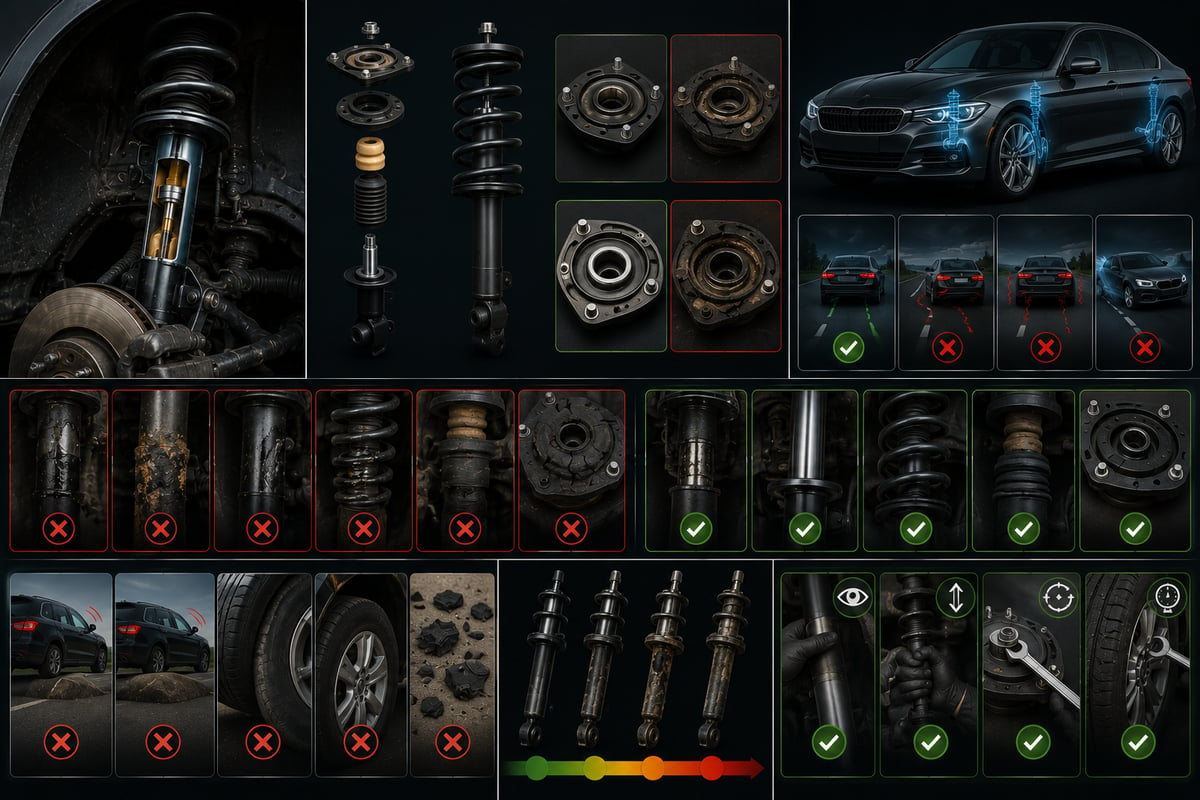
When a loaded tractor unit crosses a rough patch of asphalt, the jolt arrives once and is over — that is what a healthy vehicle should do. A second vehicle crossing the same spot bounces two or three more times as the trailer visibly moves in the mirror, and when the driver brakes, the nose dips further than expected. On inspection, part of the tread shows a wavy, cupped wear pattern; after a long run, one rear-axle shock absorber is cold to the touch while its neighbour is still warm. There is no broken part and no warning light on the dash — only a damping component that has quietly stopped doing its job, and it never triggers a fault code. This guide treats the shock absorber not as an isolated spare part, but as the link in the damping chain that keeps the load carried by the spring or air spring stable on the road.
Division of labour in the suspension: what a shock absorber does and doesn't do
A shock absorber is a damping component that slows the vertical motion between the wheel and the chassis, converting the energy stored by the spring into heat through hydraulic resistance and dissipating it from the system. The English name is misleading: the part that actually cushions the impact is not the shock absorber but the leaf spring, coil spring, or — on a heavy commercial vehicle — the air spring. The shock absorber's job is not to absorb the impact but to bring the up-and-down motion that follows the impact to an end as quickly as possible. In short: the spring stores energy and gives it back; the shock absorber spends energy and never gives it back.
Remove the shock absorber from the system and the vehicle still won't sit on the ground; on a smooth road it will often look normal. The only change is that after a bump, it bounces not once but repeatedly. The cost of this oscillation is not comfort: as the wheel moves up and down, the vertical force the tyre puts on the road also fluctuates, at some instants rising above the design value and at others dropping to almost zero. Since braking, steering, and traction forces are all generated from this vertical force, an oscillating wheel fails to generate grip over part of the road surface. Because a loaded tractor-and-trailer combination weighs in the tens of tonnes, that oscillation carries far more energy than in a passenger car.
Some of the expectations placed on the shock absorber are simply unfounded. A shock absorber does not carry the vehicle and does not set its ride height; in a vehicle that has sagged at the rear or sits low on one side, the culprit is the spring element — a fatigued leaf spring, a leaking air spring, or a leveling valve that has drifted out of adjustment. With no motion, a shock absorber produces no force. Nor is a shock absorber a stiffness setting; damping that is too firm ruins the wheel's ability to follow the road surface, and damping that is too soft cannot settle the oscillation. Not every suspension noise is the shock absorber's fault, either; most dull knocks come from the mount, the bushing, or a loose fastener.
How does a shock absorber work? The logic of hydraulic damping
Inside the shock absorber is a chamber filled with oil. A piston attached to the piston rod moves through this oil; it carries very small cross-section orifices with thin leaf valves seated over them. As the piston moves, the oil has no way to get from one side to the other except by being forced through these openings. The damping force is the hydraulic resistance that arises from forcing the oil through those narrow passages.
The most important feature of this mechanism is that resistance depends on speed, not on position. When the suspension moves slowly, oil passes through the narrow orifices with relative ease and the shock absorber produces little force; as the motion speeds up, flow resistance rises sharply. This is why leaning slowly into a corner feels different from hitting a sudden pothole. Oil forced through a restriction heats up: damping is the process of converting mechanical energy into heat and shedding it from the body into the air. This is why it is normal for a working shock absorber to get hot, and the temperature comparison described later in this guide relies on that principle.
Why is compression damped differently from rebound?
A shock absorber works in both directions, but its resistance is not equal in each. Compression is the movement in which the wheel strikes an obstacle and moves toward the chassis; because the goal is to avoid transmitting the impact to the chassis, resistance is kept relatively low here. Rebound is the movement in which the energy stored by the spring is released and pushes the wheel back down onto the road; this is the direction where the oscillation is actually damped, and resistance is markedly higher. This asymmetry is easy to feel in the field: on a removed shock absorber, the pull (rebound) stroke should feel heavier than the push (compression) stroke.
What does the gas charge in a shock absorber do?
As the piston rod moves in and out of the body, it creates a volume displacement equal to the rod's own volume, and because oil cannot be compressed, that volume has to be accommodated somehow. The second, more important problem is foaming: during fast movements, low-pressure zones form behind the piston and bubbles appear in the oil. Because aerated oil is compressible, the shock absorber briefly stops producing force; the driver feels this as the shock absorber "falling into a gap." Pressurised nitrogen solves both problems: it accommodates the volume change and keeps the oil under pressure, delaying bubble formation. A new gas-charged shock absorber extending on its own is also a result of this pressure — a feature of the design, not a defect.
Twin-tube, monotube, and the gas-pressure difference
A twin-tube shock absorber has two concentric tubes; the piston moves inside the inner tube, the volume between the two tubes acts as an oil reservoir, and a base valve at the bottom end manages the piston rod's volume displacement. The design is forgiving — a light knock on the outer tube does not affect piston movement — but heat has a harder time reaching the outer surface, and under continuous heavy-duty operation the tendency to foam is higher. In a monotube shock absorber, the oil and the high-pressure nitrogen are separated by a free-floating dividing piston. Because the oil is in direct contact with the outer body, heat is shed easily and damping stays more consistent under sustained loading. The trade-off is that the body is sensitive to impact: a small dent from a stone strike will pinch the piston at that point.
| Feature | Twin-tube | Monotube (high-pressure gas) |
|---|---|---|
| Construction | Inner and outer tube, base valve at the bottom | Single body, free piston separating oil and gas |
| Gas pressure level | Low pressure, on the order of a few bar | Roughly 20-30 bar, varies by manufacturer |
| Heat dissipation | Oil sits between the two tubes, so heat is shed slowly | Oil contacts the outer body, so heat is shed easily |
| Damping under sustained load | Force loss from foaming can occur | Force stays more consistent |
| Mounting orientation freedom | Usually needs a near-vertical position | More freedom thanks to the dividing piston |
| Resistance to outer impact | A light dent in the outer tube does not affect the piston | A dent in the body pinches the piston; the part is finished |
| Behaviour when removed | Self-extension is weak or absent | Extends on its own due to internal pressure |
| Service approach | Not repaired when removed, replaced as a complete unit | Opening it is dangerous due to pressure, replaced as a complete unit |
The table gives an order-of-magnitude picture; which type a given vehicle calls for is set out, together with axle load and spring type, in the OE part specification. Fitting one type in place of the other may look possible because the mounting dimensions match, but it takes the vehicle's road-holding outside its design envelope.
Working together with air suspension: the air spring carries, the shock absorber damps
What sets a heavy commercial vehicle's shock absorber apart from a passenger car's is its relationship with the air suspension. In a leaf spring, the layers slide against one another and produce friction, and that friction supplies some damping on its own. An air spring has no such internal friction. The air spring carries the load and cushions the impact, but it does not settle the oscillation by itself. This is why the shock absorber's share of the job is larger on an air-sprung vehicle, and why its weakening is noticed earlier.
Splitting the system into four jobs makes diagnosis easier: the air spring carries the load, the leveling valve holds static ride height, the electronic control adjusts height to the operating condition, and the shock absorber damps the motion. These jobs don't substitute for one another, but they do wear on one another. On a vehicle with worn-out damping, the air spring works through a larger amplitude than the design intends on every oscillation, and the risk of a leak rises; as the leveling valve keeps trying to correct the height, air consumption and compressor run time both increase. The bill for a dead shock absorber is never limited to the shock absorber alone.
In diagnosis, two patterns need to be kept apart. A static fault shows up while the vehicle is standing still: one side sits low, height is not set correctly for the load, or the vehicle settles over time. This pattern originates on the air spring, leveling valve, or air line side, and is covered in detail in the heavy-duty air suspension failures guide. A dynamic fault, on the other hand, only shows up while the vehicle is moving: the height is correct, but the vehicle keeps bouncing after a bump; this second pattern points to the shock absorber. There is a third possibility on electronically leveled systems: a solenoid valve that responds late can feel like an oscillation to the driver. Reading up on how the valve side behaves in the ECAS solenoid valves guide saves time before deciding on a shock absorber replacement.
Where are shock absorbers found on the vehicle? Axle, cab, trailer, and steering
On a heavy commercial vehicle, shock absorbers are not found in just one place; the same vehicle carries several independent damping groups, each exposed to a different amplitude and cycle count, and telling which group a complaint belongs to is the first diagnostic step. Axle shock absorbers damp the motion between the wheel and the chassis and have a direct effect on road holding, braking distance, and tyre life. Cab shock absorbers, mounted between the chassis and the cab, are a world of their own: amplitudes are small, cycle counts are high, and a fault shows up not in road holding but in driver fatigue, cab sway, and interior rattles. Because the diagnosis of the cab suspension's air spring, leveling valve, and shock absorber together is covered in the cab suspension and cab shock absorber guide, this guide treats the cab side only at the level needed to tell it apart from the axle side.
| Location | What it damps | Typical symptom when weakened |
|---|---|---|
| Front axle | Vertical oscillation of the steered wheels | Wandering steering, brake dive, cupped tyre wear |
| Drive (rear) axle | Oscillation of the loaded axle and chassis motion | Continued bouncing after a bump, hopping under traction |
| Cab front and rear mounts | Vibration passing from the chassis into the cab | Cab sway, interior rattles, driver fatigue |
| Steering damper | Impact transmitted from the front axle to the steering | Steering shimmy, the wheel kicking out of the driver's hands on rough roads |
| Trailer and semi-trailer axles | Oscillation of the load and the axle group | Trailer bouncing visibly in the mirror, cargo damage, uneven tyre wear |
| Engine and transmission mounts | Motion of the drivetrain (not a damping component) | Vibration at idle, a dull thump on pull-away |
The last row is deliberate: engine and transmission mounts are not shock absorbers, but their thumps are often mistaken for suspension noise. Establishing whether the sound appears when revving the engine at a standstill or only while driving separates the two groups. The trailer side, meanwhile, is the most neglected area in fleets — yet it carries the bulk of the load.
Shock absorber mounts, bushings, and fasteners
A shock absorber is never bolted metal-to-metal to the chassis or axle. Both connection points carry bushings of rubber vulcanised between a metal outer sleeve and an inner sleeve. In the field, this part is called a shock absorber mount or a shock bushing; on eye-and-loop connections, the bushing is pressed directly into the shock absorber's eye.
The bushing has three jobs: vibration isolation, keeping high-frequency vibration from passing straight into the chassis; accommodating angular motion, because as the axle swings, the angle between the shock absorber's two ends keeps changing, and the rubber's deformation absorbs that; and softening end-of-travel impacts, because the hard contact at the end of the stroke is cushioned by the bushing.
When a bushing wears out, the first symptom is noise. Once the rubber hardens and cracks, or its bond to the inner sleeve fails, a dull knock appears on every change of direction, and the noise becomes especially noticeable on rough roads. The second symptom is geometric: as play increases, the shock absorber swings on its own axis, the piston rod is loaded sideways, and the seal wears unevenly. This is why a perfectly sound shock absorber running on a worn bushing starts leaking far earlier than expected. Checking it is simple: the mounting point is levered gently with a suitable pry bar; the rubber deforming is normal, the inner sleeve moving freely inside the outer sleeve is not. Deep cracks, a sleeve that has shifted off-centre, a polished metal witness mark, and a fastener that spins easily all call for replacement. Bushings are renewed together with the shock absorber; a new part fitted with an old bushing starts making noise and leaking within a short time.
Further reading
For a plain-language technical overview of this subject, see the reference article on Wikipedia. Always confirm specific figures and procedures against the vehicle manufacturer service data.
How to recognise the symptoms of a failing shock absorber
A shock absorber failure is never sudden. Damping force drops slowly over months, and because the driver adapts to the change, the loss goes unnoticed; a worn-out shock absorber is routinely found on a vehicle whose driver insists "it feels fine." The symptoms are therefore read not from the driver's complaint but from the traces left on the vehicle. The two most characteristic traces are oscillation continuing after a bump and cupped wear repeating at regular intervals across the tyre tread. The second is especially noticeable on non-driven axles and trailer tyres.
| Symptom | Likely mechanism | First check |
|---|---|---|
| Continued bouncing after a bump | Rebound damping force has dropped | Observe on a rough road; check resistance by hand on the removed part |
| Wavy, cupped wear across the tyre tread | The wheel is pressing on the road with fluctuating force | Compare the tyres on the same axle side by side |
| Nose dive under braking and increased stopping distance | Load transfer is not controlled, tyre load fluctuates | Controlled brake test, with the brake system also checked separately |
| Steering wander, constant correction on a straight road | Vertical load fluctuation on the front axle | Check the tie rod, ball joint, and steering damper |
| Dull knocking, metallic clunk on rough roads | Mount or bushing has worn out, a fastener has loosened | Lever the mounting point with a pry bar |
| Trailer bouncing visibly in the mirror, cargo damage | Loss of damping in the trailer axle shock absorbers | Inspect each trailer axle individually |
| Oil running down the body, damp patch holding dirt | Piston rod seal has cut, oil loss is advanced | Wipe the body clean and re-check after a short drive |
None of the symptoms in the table are unique to the shock absorber, and that is the biggest trap in diagnosis. A lengthened stopping distance can just as easily be caused by worn pads or a misadjusted brake; cupped wear can come from an unbalanced tyre; a knock on a rough road can come from a ball joint. The shock absorber is one possibility on this list, not an automatic conclusion. The right approach is to look for a second finding that confirms the first: cupped wear plus continued oscillation makes for a stronger diagnosis.
How to test a shock absorber in the field: methods and their limits
The push-and-release bounce test common on passenger cars mostly fails on a heavy commercial vehicle; the vehicle's mass is too great for one person's push to produce a meaningful amplitude, and on a loaded vehicle it gives no result at all. Several methods are therefore used together, each interpreted with its limits in mind.
- Park the vehicle on level ground, set the parking brake, chock the wheels, and on air-sprung vehicles confirm the system is at its normal ride height.
- Visually inspect every shock absorber's body, piston rod, dust boot, and mounting points. A dent in the body, a scratch or rust on the rod, a torn dust boot, or a missing fastener is, on its own, grounds for replacement.
- Lever the mounting points gently with a suitable pry bar. The rubber flexing is normal; the inner sleeve moving freely, or a polished metal witness mark on the contact surface, is not.
- Drive the vehicle over a few kilometres of rough road or a suitable test track to bring the shock absorbers up to working temperature.
- After returning, carefully touch each shock absorber's body with the back of your hand and compare both sides of the same axle. A working shock absorber sits noticeably above ambient temperature; one that stays cold next to its neighbour is not producing force.
- Rule out misleading heat sources before interpreting temperature: a shock absorber mounted near the exhaust, the brake assembly, or in direct sun can warm up regardless of its own operation.
- Listen for noise while driving over rough road. A dull, single-hit sound points to the mount or bushing side; a continuous motion accompanying the spring's movement points to the damping side.
- After removing the suspect part, cycle it by hand through its full stroke a few times in the vertical position. What you are looking for is smooth, continuous resistance, a pull (rebound) stroke heavier than the push (compression) stroke, and no dead spot anywhere in the travel.
- Hearing a rattle during the hand test, resistance disappearing over part of the stroke, or the rod collapsing back in on its own all show that the part is finished.
The common limitation of all these methods is that none of them actually measures damping force. A hand test is a coarse filter: it catches a part that has completely died, but cannot distinguish a part whose force has dropped below the design value yet still shows some resistance. A definitive measurement needs a dedicated test bench that runs the shock absorber at set speeds and plots its force-versus-velocity curve. Where that is not available, age, operating conditions, and visual findings are weighed together instead.
Is a shock absorber that looks oily always faulty?
The most common unnecessary part replacement in the field comes from getting this question wrong. The piston rod enters the body through a seal, and that seal leaves a very thin film of oil on the rod. This film lubricates the rod's surface and keeps the seal from running dry and burning out; a slightly damp rod and an oily sheen on the upper body are therefore a normal sign the part is working, not a fault.
The fault begins at the point where that film turns into a flow. The telltale findings are: visible streaks of oil running down the body, a muddy build-up mixed with dirt at the lower mounting point, the entire body being wet and caked with grime, and drips on the ground. At that point oil loss is already advanced; as oil volume drops, the gas-to-oil balance is upset and damping force falls. The reliable method: wipe the body clean, drive a few kilometres of rough road, and check the same spot again. A thin film of dampness returning is normal; a streak or a drip means the seal has stopped doing its job. The root cause of a persistent leak is often not the seal itself: a stone strike on the piston rod, corrosion, or grit let in by a torn dust boot scores the rod's surface and cuts the seal.
Shock absorber replacement: the pair rule and installation discipline
The most important rule of replacement concerns the count, not the part itself. Shock absorbers are replaced in pairs, one axle at a time. The reason is physical: when the damping on the two wheels of the same axle differs, the two sides respond differently under braking and cornering, the vehicle tends to pull to one side under braking, and the tyres wear unevenly. For the same reason, replacement on tandem-axle groups and on the trailer side is planned as a group. The second rule concerns part selection: a shock absorber is not defined by mounting dimensions alone; compressed and extended length, stroke, mounting type, and damping character all belong to the OE specification. A part that is too short takes an end-of-travel impact when the suspension fully extends; one that is too long bottoms out.
- Park the vehicle on level ground, switch off the engine, chock the wheels, and support the chassis securely on stands using the lifting and support points specified by the manufacturer.
- On air-sprung vehicles, keep in mind that the air spring can over-extend once the axle hangs free; support the axle separately and, if required, secure the system the way the manufacturer specifies.
- Clean dirt off the mounting areas, apply penetrating fluid to rusted fasteners and let it soak in, then remove the top mount first and the bottom mount second; on a seized bolt, use the right tool rather than forcing it, and never apply enough force to bend the chassis or axle bracket.
- After removing the old part, inspect the mounting brackets, pins, and washers; an elongated hole, a cracked bracket, or a fatigued bushing will finish off the new part in short order.
- Before fitting the new shock absorber, follow the preparation step specified by the manufacturer; some parts call for cycling it by hand a few times in the vertical position. Never drill the part, and never try to release the pressure inside it.
- Renew the bushings and the dust boot. Do not use mineral oil or grease on the rubber components; it swells the rubber and degrades it prematurely.
- Seat the shock absorber freely in place, fit the fasteners by hand first, and confirm the part does not touch the chassis, the tyre, the air spring, an air line, or a wiring harness.
- Tighten the fasteners to the OE torque value with a torque wrench. On rubber-bushed connections, over-tightening crushes the rubber and destroys its ability to accommodate angular motion, while under-tightening leaves play and produces knocking.
- Lower the vehicle, do a final torque check at normal ride height if the manufacturer calls for it, evaluate noise and oscillation behaviour with a short test drive, and log the replacement in the vehicle's file.
Loaded versus empty operation, and trailer axles
The toughest design constraint on a heavy commercial vehicle is that the same suspension must serve two very different conditions at once: axle load can differ several-fold between an empty tractor unit and one loaded to its maximum. In an air suspension, because the air spring's pressure changes with load, spring stiffness changes with it too, letting the system stay balanced across a wide load range.
On the shock absorber side, things differ: damping force does not scale with load, so the part is chosen to strike an acceptable compromise between loaded and empty. The practical result is this: a loss of damping is usually noticed first in empty operation. An empty trailer is light, bounces with a larger amplitude over the same bump, and on a system with weakened damping, loses contact with the road more easily. A driver saying "it bounces empty but feels fine loaded" is not a contradiction — it is a typical description of a fault. In loaded operation, the loss shows up elsewhere: nose dive under braking increases and the vehicle is slower to settle out of a corner.
Trailer and semi-trailer axles are frequently forgotten in the maintenance plan; the tractor unit gets regular service while the trailer may be assessed only for brakes and tyres. Yet a trailer axle with worn-out damping affects not only its own tyres but also the towing vehicle's road holding, and it makes the axle load fluctuate under braking. Adding trailer shock absorbers to the periodic maintenance checklist is one of the lowest-cost improvements available at fleet level.
Factors that shorten shock absorber life, and fleet maintenance discipline
A shock absorber has no replacement interval fixed to mileage; its life is set not by the distance covered but by how that distance was covered. If one of two identical vehicles runs on smooth asphalt and the other on a construction site road, the second vehicle's shock absorbers wear out noticeably sooner. For this reason, the replacement decision is made from periodic-inspection findings, not from a calendar. The factors that shorten life are not independent of each other either; more often than not, one triggers another.
- Excessive and uneven loading: Load above axle capacity keeps the damping element working at continuously high force and raises the oil's temperature.
- Rough roads and construction-site conditions: Large-amplitude, frequently repeated motion raises both heat and mechanical fatigue.
- Fatigued mount and bushing: As play increases, the piston rod is loaded sideways, the seal wears unevenly, and a leak begins.
- Torn dust boot: Sand and salt reaching the rod scratch its surface and cut the seal; a small, cheap part ends up causing an expensive failure.
- Impact and denting on the body: Especially on monotube designs, a dent pinches the piston; corrosion and stone strikes on the piston rod act as a cutting edge against the seal.
- Wrong part selection: A shock absorber whose length, stroke, or damping character does not match the vehicle takes an end-of-travel impact on every stroke.
- Faulty installation and single-side replacement: An over-tightened rubber bushing cannot accommodate angular motion; mismatched damping on the same axle forces the new part to work to the rhythm of the old one.
Technical values, maintenance checklist, and general reference ranges
The table below gathers the figures and decision criteria most often needed in the field; these values are not meant for making the decision itself, but for weighing whether a finding obtained on site is plausible.
| Quantity or topic | General reference or criterion | Interpretation |
|---|---|---|
| Damping force | Speed-dependent, defined by the OE force-velocity curve | Determined by motion speed, not position; measured on a bench |
| Monotube gas pressure | Roughly 20-30 bar, varies by manufacturer | The part's self-extension comes from this pressure |
| Operating temperature | A working body sits noticeably above ambient temperature | Getting hot is proof of function, not a fault |
| Replacement principle | In pairs per axle, in groups on the trailer | Single-side replacement upsets braking and cornering behaviour |
| Fastener torque | The value and tightening sequence in the OE manual | Over-tightening crushes the rubber bushing; under-tightening leaves play |
| Dust boot and bushing | Renewed together with the shock absorber | A new part fitted with an old bushing leaks early |
| Oil film criterion | A thin film is normal; a running streak or drip is a fault | Wiping it and re-checking after a short drive tells them apart |
| Service life | Not fixed to mileage; determined by operating conditions | Decided from periodic-inspection findings |
Checking shock absorbers at a periodic service is a matter of a few minutes and follows this order: signs of leakage on the body and piston rod, a torn dust boot, a dent in the body, play at the mounting points, cupped wear on the tyre tread, and excessive fatigue marks on the air spring's surface. If two of these findings turn up together, the part is renewed; the check is never limited to the tractor unit alone.
In the end, on a heavy commercial vehicle the shock absorber is a safety part, not a comfort part. When it fails, it lights no warning lamp, sets no fault code, and weakens too slowly for the driver to notice — yet it directly affects the force the tyre puts on the road, the stopping distance, cornering behaviour, and the service life of the air suspension components. The right order is clear: first the ride height and spring element are confirmed, then the mounts and bushings are checked, then damping is assessed, and the decision is applied in pairs per axle. In every case, the current OE service documentation for the vehicle's engine and chassis code is authoritative.
Shop this part: Suspension
In-depth technical guide: For fault diagnosis, step-by-step replacement and service intervals: Cab Suspension (Shock Absorber, Air Bellow, Leveling Valve): Faults & Repair
Main guide: Heavy-Duty Air Suspension Failures: Air Springs, Leveling Valves and ECAS
Tags
Frequently Asked Questions
- What is a shock absorber and what does it do?
- A shock absorber is a damping component that slows the vertical motion between the wheel and the chassis, converting the energy stored by the spring into heat through hydraulic resistance and dissipating it from the system. The part that cushions the impact is the spring or the air spring; the shock absorber's job is to bring the up-and-down motion that follows the impact to an end as quickly as possible. When the oscillation is not damped, the force the tyre puts on the road fluctuates, and the wheel fails to generate grip over part of the road surface.
- Does a shock absorber carry the vehicle or set its ride height?
- No. Static ride height and load carrying are the job of the spring element: leaf spring, coil spring, or air spring. In a vehicle that has sagged at the rear or sits low on one side, the source is usually a fatigued spring, a leaking air spring, or a leveling valve that has drifted out of adjustment. Since there is no motion while the vehicle is standing still, the shock absorber produces no force at all.
- How can you tell a shock absorber has gone bad?
- The two most characteristic traces are bouncing that continues after a bump and cupped wear that repeats at regular intervals across the tyre tread. These can be joined by nose dive under braking, slow recovery in a corner, a streak of oil running down the body, and a dull knock on rough roads. Since none of these symptoms is unique to the shock absorber, the diagnosis is only confirmed when at least two findings back each other up.
- Can a faulty shock absorber increase stopping distance?
- Yes. Because an undamped wheel presses on the road with alternating force, at some instants the contact load drops to almost zero. Since braking force is generated from that vertical load, stopping distance in an emergency stop increases, and the fluctuation in the wheel-speed signal also makes it harder for driving-safety systems to make the right call.
- What do the shock absorber mount and bushing do?
- The bushing is the rubber-and-metal element that holds the shock absorber to the chassis and axle without a metal-to-metal joint. It isolates vibration, accommodates the change in angle between the two ends as the axle swings, and cushions the hard contact at the end of the stroke. Once it wears out, a dull knock is heard first, and then the piston rod is loaded sideways, causing the seal to leak early — which is why bushings are renewed together with the shock absorber.
- Why are shock absorbers replaced in pairs per axle?
- When the damping on the two wheels of the same axle differs, the two sides respond differently under braking and cornering; the vehicle tends to pull to one side under braking and the tyres wear unevenly. An axle with one new side and one old side can actually behave worse than an axle where both sides are old. For the same reason, replacement on tandem-axle groups and on the trailer side is planned as a group.
- Is a shock absorber that looks oily necessarily faulty?
- No. The seal leaves a very thin film of oil on the piston rod; this film lubricates the rod and keeps the seal from running dry, so a slight dampness is normal. A fault exists once you see a streak running down the body, a muddy build-up at the lower mount, or drips on the ground. To tell the two apart, wipe the body clean, drive the vehicle over a few kilometres of rough road, and check the same spot again.
- What is the difference between a monotube and a twin-tube shock absorber?
- A twin-tube design has two concentric tubes and a base valve at the bottom end; the construction tolerates impact well but sheds heat poorly, and under continuous heavy-duty operation it tends to foam. A monotube design separates the oil from the high-pressure nitrogen with a free-floating dividing piston; heat is shed more easily and damping stays more stable under sustained loading. The trade-off is that even a small dent in the body can render the part unusable.
- Why does the shock absorber matter more on an air-suspended vehicle?
- Friction between the layers of a leaf spring provides some damping on its own; an air spring has no such internal friction. The air spring carries the load and cushions the impact, but it does not settle the oscillation by itself, so the whole job falls to the shock absorber. Once damping weakens, the air spring works through a larger amplitude than the design intends, the leveling valve keeps making corrections, and air consumption rises.
- How many kilometres does a shock absorber last?
- A shock absorber has no replacement interval fixed to mileage; its life is determined not by the distance covered but by how that distance was covered. Overloading, rough roads, a fatigued bushing, a torn dust boot, and installation errors all shorten its life noticeably. The decision is made from periodic-inspection findings rather than a calendar, and the current OE maintenance plan for the vehicle's engine and chassis code is authoritative.
Related Articles
Levelling Valve: Faults, Replacement & Maintenance Guide
An air-suspended truck or trailer sitting low on one side or not holding ride height points to the levelling valve lever setting: diagnosis and replacement.
ECAS Solenoid Valve: Faults, Replacement & Maintenance Guide
A truck sitting low on one side or a trailer that will not settle to ride height points to the ECAS solenoid valve block: diagnosis, replacement and calibration.

Heavy-Duty Air Suspension Failures: Air Springs, Leveling Valves and ECAS
Heavy-duty air suspension explained: air springs, leveling valve vs ECAS faults, leak diagnosis, and maintenance for trucks, trailers and buses.