Heavy-Duty Air Suspension Failures: Air Springs, Leveling Valves and ECAS
Heavy-duty air suspension explained: air springs, leveling valve vs ECAS faults, leak diagnosis, and maintenance for trucks, trailers and buses.
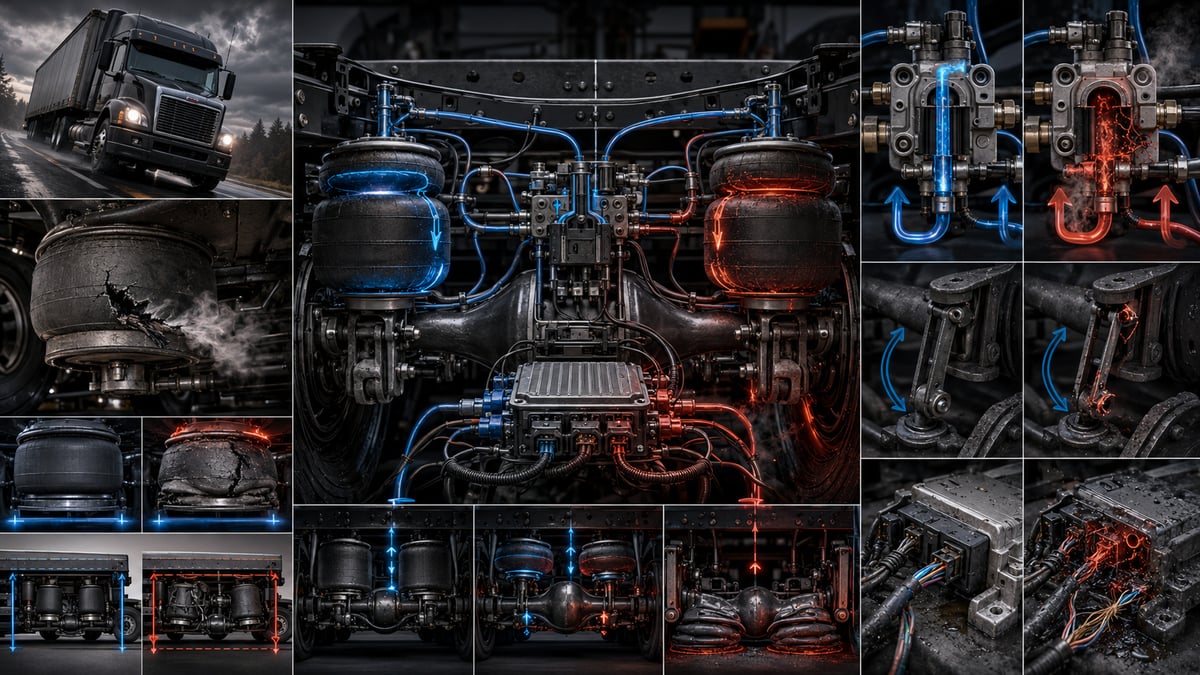
In the yard on a cold morning, a tractor unit is sitting visibly low on its right rear corner. The driver's diagnosis is ready before anyone looks underneath: the air spring must have burst. Yet the chassis was level the night before, and there is no visible tear in the bellows. Once the ignition is on and pressure builds, the rear axle rights itself within a couple of minutes and shows no symptom for the rest of the day. This pattern is not the death of a single part; it is the early warning of a circuit that is losing air quietly overnight, and the leak could just as easily sit in the air spring as in the leveling valve, the solenoid valve block, or a fitting thread nobody suspected. In a heavy commercial vehicle, air suspension is not a single assembly; it is a chain that links the functions of producing, drying, metering, distributing and carrying the air. This guide maps that chain from end to end.
Why replace the leaf with air in a heavy-duty vehicle?
Air suspension is a suspension system that carries the vehicle's weight on air compressed inside a sealed volume instead of a steel spring, and continuously varies that air's pressure with load to keep the chassis height constant. A rubber-reinforced air spring carries the load, a shock absorber damps the oscillation, and a leveling device makes the position decision. What sets the system apart is not softness but its ability to behave independently of load.
A steel leaf spring has a fixed spring rate. An empty tractor on leaf springs rides hard; fully loaded, the same springs feel inadequate — no single spring pack can satisfy both conditions at once. The compromise is set for the loaded state, and the empty vehicle pays for it in road holding. In an air spring, pressure inside the bellows rises with load, so the spring rate scales with it; the vehicle behaves with a similar oscillation character whether empty or fully loaded.
The practical result is that chassis height stays constant, and that matters for more than comfort. A fixed ride height sets the driveshaft working angle, headlamp aim, the relationship between aerodynamic body panels and the road, and the fifth-wheel height on a tractor unit, all at once. On a leaf-sprung tractor, the rear sags when a trailer is coupled and rises when it is dropped, so kingpin height shifts with every load. On an air-suspended tractor, that height stays within the same band regardless of load, and the geometry of the combination stays predictable.
The second consequence is the impact on the road surface and on the load itself. Suspension systems that reduce the shock transmitted to the road surface are classed in regulation as road-friendly suspension; air suspension and systems recognised as equivalent fall into this class, and a somewhat higher axle load may be permitted on the drive axle as a result. Because the allowances vary by country, the vehicle's registration documents and the applicable national regulation govern. The same softness benefits the cargo too: for fragile loads and sensitive machinery transport, air suspension is not a comfort feature but a damage-prevention tool.
Leaf springs versus air suspension
Splitting the two systems into "old and new" is misleading. In heavy construction and off-road service, leaf springs are still preferred; in long-haul, distribution and passenger transport, air suspension has become close to standard. The choice follows the vehicle's duty cycle.
| Criterion | Leaf spring | Air suspension |
|---|---|---|
| Spring rate | Fixed, independent of load | Rises with load, self-scaling |
| Chassis height | Changes with load | Held constant regardless of load |
| Load-height adjustment | Not available | Adjustable by raising and lowering |
| Kneeling and axle lift | Not possible | Managed through the air circuit |
| Failure character | Mechanical: broken leaf, worn bushing | Pneumatic and electronic: leak, valve, sensor |
| Typical use | Construction, tipper, off-road, heavy haulage | Long-haul, distribution, coach, tanker, curtain-sider |
The most important row in the table is failure character. On a leaf-sprung vehicle, a fault is seen and heard; on an air-suspended vehicle, a fault is more often measured over time. A vehicle that settles overnight can behave completely normally once it is moving. Diagnosis therefore has to look at the circuit, not just the part.
System map: what does each part do, and what does a fault break?
Air suspension is made up of three layers. The supply layer produces, dries, protects and stores the air. The control layer decides how much air goes to which air spring; that decision is made either by a mechanical arm or by an electronic control unit. The carrying and damping layer holds the load, damps motion and locates the axle to the chassis. The table below brings all three layers together in one list.
| Component | Function | Consequence of a fault |
|---|---|---|
| Air compressor | Produces compressed air for the whole system | Pressure builds late, suspension is the last circuit fed and lags behind |
| Air dryer | Separates moisture and oil from the air, keeps circuits dry | Water and oil are carried to the air spring and valves, freezing starts in winter |
| Multi-circuit protection valve | Distributes air to circuits by priority | The suspension circuit never fills, or the brake circuit is damaged |
| Suspension air tank | Holds the circuit's own air reserve | Reserve drops, leveling cannot be done with the engine off |
| Mechanical leveling valve | Measures the distance between axle and chassis with an arm, fills or empties the air spring | Height is not held, the vehicle keeps rising or stays low |
| ECAS solenoid valve block | Opens fill and exhaust paths on the control unit's command | One corner does not respond, the vehicle leans, air consumption runs continuously |
| ECAS control unit | Reads sensor data, calculates target height, drives the valves | Warning lamp, fault code, functions disabled altogether |
| Height sensor | Converts the real distance between axle and chassis into an electrical signal | Wrong height, spontaneous settling or excessive rise |
| Control panel (kneeling switch box) | Gives the driver manual raise, lower and return-to-ride-height control | Dock levelling cannot be done, stored heights cannot be recalled |
| Air spring (air bag) | Carries the load, provides springing, cushions road shock | Leak, vehicle leaning, harsh ride on the bump stop |
| Shock absorber | Damps the oscillation produced by the air spring, keeps the tyre on the road | Persistent oscillation, bouncing, shortened air spring and bearing life |
| Anti-roll bar and drop links | Limits body roll in corners and on ramps | Excessive roll, trailer sway, knocking noise at the link |
| Trailing arm and chassis mounts | Holds the axle in longitudinal and lateral position | Axle misalignment, uneven tyre wear, wandering |
| Air lines and fittings | Carry air between components | Leaks from chafing and vibration, overnight settling |
| Bump stop | Mechanically protects the chassis when the air spring is fully deflated | Without it, chassis and axle make metal contact, risk of serious damage |
| Lift-axle air spring and valve | Lifts the tag axle clear of the road when running light | Axle does not lift or lower, tyre and fuel consumption rise |
Where the air comes from: when and how is the suspension circuit fed?
Air suspension does not generate its own air; it is fed from the same source as the brake system. The compressor produces the air, the dryer separates moisture and oil vapour, and the multi-circuit protection valve distributes the incoming air in a defined priority order. In that order, the brake circuits always come first; the suspension circuit only fills once the brake circuits have reached their defined threshold pressure. A vehicle not rising immediately on a cold morning is not a fault — it is proof that the priority order is working correctly. The real fault is the vehicle not rising once pressure has reached normal.
The dryer's effect on suspension deserves separate emphasis. Once the cartridge is saturated, or the purge valve fails to do its job, moisture and oil are carried into every circuit. Water collects inside the solenoid block, freezes there in winter, and one corner simply stops responding; oil reaches the inner surface of the air spring and chemically ages the rubber-reinforced body. In a vehicle with recurring suspension faults, the dryer's condition should be questioned before the air spring is.
How is ride height controlled? The difference between a mechanical valve and ECAS
The part that actually makes a system "air suspension" is not the air spring, but the leveling device that decides how much air enters it. That decision is made in one of two ways, and the difference defines everything the vehicle can do.
A mechanical leveling valve consists of a body bolted to the chassis, and an arm and link rod connected to the axle. When the vehicle is loaded, the chassis drops, the arm rotates upward and the valve opens the fill path; once the chassis reaches design height, the arm returns to neutral and the valve closes. There is no interpretation, no memory, no electricity; the arm's position is close to being the target itself. The adjustment logic and failure symptoms of this device are covered in detail in the levelling valve guide.
ECAS does the same job electronically. Height is measured by a sensor, compared against a target, and the difference is interpreted by the control unit. The unit can fill or empty each air spring separately by opening the solenoids in the valve block. The key difference is delay and threshold management: the system does not react to every small deviation, and it takes into account whether the vehicle is moving and at what speed. Air consumption drops as a result, and no unnecessary correction is made while driving.
| Criterion | Mechanical leveling valve | ECAS electronic control |
|---|---|---|
| Measurement method | Mechanical, via arm and link rod | Electrical, via height sensor |
| Decision maker | The valve's own internal geometry | Software in the control unit |
| Adjustability | Limited to arm length and link position | Set as a parameter from a diagnostic tool |
| Memory levels | None | Available, stored load heights can be recalled |
| Speed-dependent behaviour | None, behaves the same in every condition | Available, returns to ride height above a set speed |
| Fault diagnosis | Visual and by hand, from arm position | Fault code and live data |
| Typical fault | Worn bushing, bent arm, blocked exhaust port | Sensor signal, solenoid coil, wiring and connector |
| Post-repair step | Ride height is reset | Calibration and a learning cycle are required |
Raising, lowering and kneeling: the system's additional functions
Every capability of air suspension beyond constant height comes from deliberately taking the same circuit out of its balanced state. Foremost among these is raising and lowering: the driver can command the chassis below or above design height from the control panel. This function is intended for loading and unloading while parked, and only for limited, low-speed situations while driving.
Traction assist (kneel-forward) temporarily shifts extra load onto the drive axle. The tag axle's air springs are partially or fully emptied, weight shifts to the drive axle, and traction increases. This is the function that saves a start-off on slippery ground, a snowy ramp or a muddy site exit. Because it temporarily pushes past axle-load limits, it is restricted in time and speed and disengages automatically above a set speed. The scope of the limits depends on vehicle type approval, so the owner's manual and applicable regulation govern.
Lift-axle control works in the opposite direction: when running empty or lightly loaded, the tag axle is lifted clear of the road; tyre wear drops, rolling resistance falls and manoeuvrability improves. Once loading begins, the system lowers the axle automatically. The most common complaint is the axle not lowering under load, or not lifting when empty; this usually points to a fault in the lift axle valve, pressure switch or lift air spring's own circuit, while the main suspension circuit can be perfectly healthy.
Dock ramps and load-height adjustment
The platform height of a trailer waiting at a warehouse dock and the height of the dock itself often do not match. Air suspension removes that mismatch: a command from the control panel brings the platform level with the dock, the forklift crosses a flat surface, and loading time is shortened. This is the capability the system sees the most use for day to day.
On electronically controlled systems, the process is faster with memory levels: the driver saves a frequently used dock height once, and on the next visit drops to that height with a single button; the return-to-ride-height button then brings the vehicle back to design height. Confirming that return before setting off is the driver's responsibility. Although the system pulls itself back to ride height above a set speed, the vehicle can run low until that speed is reached, and the underbody can contact the ground.
During loading, the vehicle settles after every pallet and the system tops up automatically to hold the level. These corrections use air; on long loading operations with the engine off, the tank can run down and the system quietly stops responding. A vehicle lowered at the dock is also not a vehicle to work under: the lowered position is not mechanically locked, and a valve command or a leak can move the chassis.
From symptom to cause: the air suspension fault-diagnosis table
Most faults are narrowed down by asking three questions in order. Is the problem at one corner or across the whole vehicle? Does it appear while driving or once parked? Does the system not respond at all, or respond incorrectly? The table below matches these three questions to field symptoms.
| Symptom | Probable causes | Verification method |
|---|---|---|
| Vehicle leans to one side, the other side is normal | Leak in that corner's air spring or line, solenoid coil failure, height sensor drift | Soak-test with leak solution, compare live sensor values on both sides |
| Settles overnight, chassis close to the ground by morning | Slow leak: air spring skirt area, fitting thread, solenoid internal seal, leveling valve exhaust port | Overnight pressure and height tracking, circuit isolation and hold test |
| Height never establishes, vehicle stays down | Suspension circuit not fed, protection valve fault, empty tank, large leak | Measure circuit pressure at the test port, inspect compressor and dryer |
| Vehicle keeps rising, never settles at target | Leveling valve stuck in fill position, solenoid stuck open, sensor signal frozen | Check the valve arm moves freely at neutral, watch sensor value while lifting the axle |
| Vehicle oscillates, does not settle after a bump | Shock absorber not working, worn bump stops, loose anti-roll bar links | Temperature difference across the shock body, hand-rock test, check link play |
| ECAS warning lamp on, functions restricted | Sensor circuit, solenoid coil circuit, supply voltage, wiring harness | Read fault codes, check live data, inspect connectors and harness |
| Compressor cycles often, air consumption has risen | Continuous leak in the suspension circuit, leveling device correcting constantly | Isolate circuits one by one to find which line is consuming air |
| One corner does not respond on cold mornings, clears during the day | Water frozen in the valve block or a line, dryer insufficiency | Inspect dryer cartridge and purge valve, drain water from the tanks |
The most common mix-up is confusing the first two rows. A vehicle leaning to one side usually points to a single component, while a vehicle settling overnight points to a leak somewhere in the circuit; the real evidence is gathered while the vehicle is parked.
How is an air leak found? A methodical search
Leak-hunting is the most time-consuming job in air suspension, because a leak is not heard, is not seen, and is usually looked for at the place its result shows up rather than where it actually is. A methodical search puts the checks in order.
- Put the vehicle on level, solid ground, apply the parking brake, chock the wheels and let the system reach full pressure before shutting off the engine.
- Stop the engine, note the pressure value, and leave the vehicle undisturbed for at least several hours, ideally overnight; then read pressure and chassis height again. The rate of drop gives a first idea of leak size.
- Measure chassis height at all four corners separately. Only one corner dropping points to that corner; all corners dropping equally points to the shared supply side.
- Re-pressurise the system and sweep the suspect areas with leak-detection solution: the air spring's top cap, the lower skirt, the retaining nuts, the air inlet fitting and the last stretch of line before the air spring come first.
- Check the solenoid valve block's exhaust port. If air keeps coming from this port while the system is at target height, the leak is not in the air spring but in the valve's internal seal. On mechanical systems, the same check is made at the leveling valve's exhaust port.
- Follow the air lines by hand along the chassis; a clip that has slipped, a line rubbing on the chassis rail, or a section worn by vibration are the most common leak points. Do not over-tighten fittings on reflex — over-tightening plastic lines creates a new leak.
- If the leak still cannot be found, isolate the circuits one by one. If the drop stops after the point where a circuit is cut off, the leak is in that section; if it does not stop, move the search further upstream.
- Repeat the measurement after the repair. The search can only be closed once pressure and height hold over the same waiting period as before.
Air spring service life, causes of damage, and replacement
An air spring works by changing shape on every cycle through its rubber and textile-reinforced body. There is no defined replacement interval; its service life is set not by distance but by the conditions it is exposed to. Of two vehicles on the same route, one can complete high mileage without issue while the other needs a new air spring far sooner because of a misaligned air line rubbing against it.
The causes that kill an air spring are limited in number and nearly all preventable. Oil and fuel contact softens and swells the rubber; the source is most often oil vapour carried through the dryer. Ozone and ultraviolet exposure produce a fine network of surface cracking. Chafing is the most insidious: an air line with a loosened clip, or a loose wiring harness, wears against the air spring's side wall on every cycle and opens a hole within weeks. Overload and bottoming on the bump stop stresses the fold area outside its design range. An incorrect ride height keeps the air spring running either permanently over-extended or permanently over-folded. Continuing to drive on a deflated air spring can finish the body off within a few kilometres.
Replacement is not mechanically complicated; the real risk is safety, and mistakes made in preparation cannot be corrected afterwards.
- Put the vehicle on level ground, apply the parking brake, chock the wheels and unload the vehicle if possible.
- Support the chassis mechanically on stands of adequate capacity; never work underneath relying on air pressure or a jack's hydraulics.
- Vent the suspension circuit's air in the manner specified by the manufacturer, and take the precaution that prevents the circuit from re-pressurising on its own.
- Disconnect the air spring's air fitting, cap the end and check the line's condition; then remove the upper and lower retaining fasteners. Use a suitable release agent and penetrating oil on corroded fasteners, and do not score the mounting surfaces.
- Remove the air spring and clean rust, dirt and old gasket residue from the mounting surfaces; surface flatness directly determines the new air spring's seal.
- Fit the new air spring without twisting its body or forcing the fold area; an air spring installed already folded will be damaged on its first cycle.
- Tighten the retaining fasteners to the manufacturer's torque and sequence, reconnect the air fitting cleanly, route the line so it cannot chafe, and fit new clips.
- Pressurise the system gradually, confirm the seal with leak solution, and only then remove the stands; check ride height and recalibrate if required.
Shock absorber, anti-roll bar and chassis mounts
The air spring carries the load but cannot stop the oscillation. The part that turns the spring's energy into heat and damps the motion is the shock absorber, and its importance is greater on an air-suspended vehicle: in a leaf-spring pack, friction between the leaves produces damping on its own, while an air spring has no such internal friction. When the shock absorber stops doing its job, the air spring oscillates freely, the tyre loses contact with the road, and stopping distance increases. The factors that determine shock absorber life and replacement criteria are covered in the shock absorber guide.
The anti-roll bar limits the vehicle's roll through corners and over ramps; on high-bodied vehicles and loads with a high centre of gravity, this bar and its drop links are a direct part of driving safety. Play in the link joints shows up first as noise: a single sharp knock heard at low speed over a kerb transition usually comes from here.
Trailing arms and chassis-mount bushings hold the axle's position. When these bushings wear, the axle wanders both longitudinally and laterally; the result is one-sided tyre wear, a wandering feel on a straight road and slight pulling under braking. Air suspension can hide this wear for a while, because the system keeps correcting height. The bump stop, meanwhile, is the quiet safety part: a disintegrated bump stop allows metal-to-metal contact the moment an air spring bursts, and spreads the damage to air lines, brake hoses and the trailing arm.
ECAS electronics: sensor, control unit and fault codes
Diagnosis follows a different order on electronically controlled systems. The control unit bases its decisions on the signal produced by the height sensor; if the signal is wrong, every decision the unit makes is wrong too, and the system holds the vehicle at the wrong height while believing it is working perfectly. For this reason, the first place to look is not the valve block, it is the sensor's live data.
The height sensor measures the angle of rotation through an arm connected to the axle. Even with a healthy sensor, a bent arm, a link rod that has changed length, or play in a joint shifts the reading. A situation commonly seen in the field is the fault persisting after the sensor has been replaced, because the defect was never in the sensor but in the mechanical linkage that transmits motion to it. The sensor's wiring harness also works in a moving area; intermittent connections there can appear while the vehicle is moving and disappear once it is parked.
The valve block has two fault classes. An electrical fault is a coil going open-circuit or a driver stage failing, and it usually produces a clear fault code. A pneumatic fault, on the other hand, is a valve leaking or not fully closing while the coil itself is fine; this type of fault often produces no code at all. The absence of a code does not clear the system: continuous air consumption and one corner settling overnight are the typical signature of a codeless pneumatic fault. The failure symptoms of the solenoid valve and the calibration required after replacement are explained in the ECAS solenoid valve guide.
A third factor that gets overlooked is power supply and chassis grounding. Low battery voltage, a corroded chassis ground point, or a loose connector can distort the sensor signal and produce a large number of seemingly unrelated fault codes at once; when the code list grows crowded, supply and grounding should be checked before reaching for a parts replacement. Calibration is mandatory after a repair: the system has to relearn its ride height and level limits.
Winter conditions: moisture, freezing and the effect of cold on the system
The season when faults cluster is winter, and the cause is not the cold itself but the cold making the water already in the system visible. The compressor draws in ambient moisture along with the air it compresses; separating that moisture is the dryer's job. Once the cartridge is saturated, water passes into the circuits and collects at the lowest points and narrowest sections. This build-up stays silent through summer, then shows up on the first frost as a single corner failing to respond, clearing on its own once the day warms up. That explains faults present in the morning and gone by afternoon.
The second effect is the rubber body stiffening: at low temperature the air spring material becomes less flexible, and one frozen in a folded position can be damaged on the very first movement. The third effect is salt and road chemicals; salted water corrodes retaining fasteners, sensor arms, link joints and the valve block's connectors.
Maintenance checklist and general reference ranges
Air suspension has no separate maintenance schedule of its own; its upkeep is a handful of checks folded into the vehicle's regular maintenance. What these steps share is that all of them try to catch a fault before it appears.
- Ride height measurement: The distance between chassis and axle is checked periodically against the value in the vehicle's own documentation. An incorrect height is the most common hidden cause of later air spring, shock absorber and tyre faults.
- Overnight pressure and height tracking: The vehicle is left parked overnight, then pressure and all four corner heights are read again in the morning. This single check catches slow leaks early.
- Air spring body inspection: The side walls are checked for chafing marks, cuts, crack networks, oil contamination and bulging; any line or clip routing causing the chafing is corrected at the same time.
- Air line, fitting and dryer inspection: Lines are followed by hand along the chassis, loosened clips are renewed; the dryer cartridge is checked and water is drained from the tanks. This step is moved up ahead of winter.
- Shock absorber, link and bump stop inspection: The body is checked for oil leakage, bump stops for crushing, and anti-roll bar links and trailing-arm bushings for play; the bump stop's integrity is confirmed.
- Fault-code reading, function check and logging: The fault memory is read even if the warning lamp is off, and sensor values are compared; raise, lower, return-to-ride-height, traction assist and lift-axle functions are each tried in turn. The replaced part's position, date and calibration data are logged in the vehicle file.
| Topic | General reference | Note |
|---|---|---|
| Suspension circuit working pressure | Within the vehicle air system's normal working band, roughly in the order of eight bar | The exact value and circuit priority thresholds are defined in the OE manual |
| Ride height | A vehicle-specific fixed value, measurement point defined by the manufacturer | Never copied from a similar vehicle, taken from the documentation |
| Air spring replacement interval | No defined interval, depends on conditions | Duty cycle, line chafing and height setting are the determining factors |
| Air spring retaining torque | Value and tightening sequence from the OE manual | Overtightening damages the top cap and the seal |
| Post-repair calibration | Mandatory after sensor, valve block or control unit replacement | The system will not run at the correct height without calibration |
| Working underneath the vehicle | Chassis mechanically supported on stands | Never work underneath relying on air pressure |
Air suspension in a heavy commercial vehicle is not a part that can be understood on its own; it is a chain of function running from the supply side all the way to the electronics. The quality of the air leaving the compressor determines the air spring's service life; the moisture the dryer fails to remove freezes in the valve block come winter; a ride height set incorrectly is read months later as tyre wear. That is why a vehicle arriving at the workshop with an "air spring burst" diagnosis is at the beginning of the job, not the end of it: first the air is proven clean and sufficient, then the control device is proven to be deciding correctly, and only then are the carrying and damping parts proven sound. In every case, the vehicle's current OE service documentation for its specific chassis code is authoritative.
Shock absorbers, which work alongside the air springs, belong in the same inspection round; for their make-up and warning signs, see the guide what is a shock absorber and its failure symptoms.
Shop this part: Suspension
All our technical guides on this topic
- What Is a Shock Absorber? Bushing, Failure Symptoms, and Service Life
- ECAS Solenoid Valve: Faults, Replacement & Maintenance Guide
- ECAS Solenoid Valves: The Precision Control Point for Heavy-Duty Air Suspension
- Levelling Valve: Faults, Replacement & Maintenance Guide
- Cab Suspension (Shock Absorber, Air Bellow, Leveling Valve): Faults & Repair
- Cab Tilt Pump: Faults, Replacement & Maintenance Guide
VADEN ORIGINAL products
- Suspension — 255 products
- ECAS Solenoid Valves — 171 products
- Suspension (Cabin) — 44 products
- Cab Suspension Levelling Valve — 32 products
Tags
Frequently Asked Questions
- What does air suspension do on a heavy commercial vehicle?
- Air suspension carries the vehicle's weight on air compressed inside a sealed volume instead of a steel spring, and varies that pressure with load to keep chassis height constant. A constant ride height makes the driveshaft angle, headlamp aim, fifth-wheel height and therefore the trailer's stance predictable regardless of load. Because it also reduces the shock transmitted to the road and the cargo, it falls into the road-friendly suspension class in regulation.
- What is the main difference between air suspension and leaf springs?
- A leaf spring has a fixed spring rate; the vehicle rides hard when empty and feels inadequate when loaded, and chassis height changes with load. In an air spring, pressure inside the bellows rises with load, so the spring rate scales with it and height stays constant. The failure character differs too: a leaf-spring fault is seen and heard, while an air suspension fault is usually measured over time, while the vehicle is parked.
- Why does a truck settle overnight, with the chassis low by morning?
- This is a classic slow-leak symptom. The leak can sit in the air spring's skirt area, a fitting thread, the solenoid valve's internal seal, or the mechanical leveling valve's exhaust port. Because the system keeps correcting itself while driving, the symptom only shows up after a long stop; diagnosis therefore starts by parking the vehicle overnight and reading pressure and all four corner heights again in the morning.
- Why is the vehicle leaning to one side?
- Leaning to one side usually points to a single component at that corner: a leak in the air spring or its supply line, a solenoid coil failure, or height sensor drift. To confirm it, the sealing surfaces are swept with leak-detection solution while the system is pressurised, and on electronic systems the live sensor values on both sides are compared. If no leak is found, the circuits are isolated one by one to narrow the search.
- What is the difference between a mechanical leveling valve and ECAS?
- A mechanical valve measures distance through an arm connected to the axle and opens the fill or exhaust path using its own internal geometry; it has no memory, no speed input and produces no fault code. ECAS measures height with a sensor, and the decision is made by software in the control unit, which drives the solenoid valves. ECAS offers memory load heights and speed-dependent behaviour, but calibration is mandatory after replacing the sensor, valve block or control unit.
- What is traction assist (kneel-forward), and can it be left on all the time?
- Traction assist is a temporary function that empties the tag axle's air springs partially or fully, shifting weight onto the drive axle to increase traction. Because it pushes past axle-load limits, it is restricted in time and speed and disengages automatically above a set speed. Leaving it engaged continuously, or tampering with its limits, exceeds the legal axle load and stresses the chassis and axle components outside their design range.
- How long do air springs last?
- There is no defined replacement interval for an air spring; its service life depends on the conditions it is exposed to, not on distance covered. The most common causes of early failure are oil and fuel contact, ozone and UV exposure, chafing from a loose air line or wiring harness, overload that bottoms the fold area on the bump stop, and an incorrectly set ride height. Continuing to drive on a deflated air spring can finish it off within a few kilometres.
- How do you find an air leak in an air suspension system?
- The vehicle is brought to full pressure, the engine is stopped, the pressure value is noted, and the vehicle is left parked, ideally overnight; pressure and all four corner heights are then read again. One corner dropping points to that corner; all corners dropping equally points to the shared supply side. The system is re-pressurised and the air spring skirt and top cap, fittings, valve exhaust ports and chafe points along the lines are swept with leak solution; if nothing is found, the circuits are isolated one at a time.
- Why does air suspension fail more often in winter?
- The problem is not the cold itself, but the cold making water already in the system visible. Once the dryer cartridge is saturated or its purge valve fails, moisture passes into the circuits, collects at the narrowest points, and causes one corner to stop responding on the first frost, clearing again once the day warms up. Checking the dryer and draining accumulated water from the tanks before winter prevents most of these faults.
- Why does ride height matter so much, and how is it checked?
- An incorrectly set ride height throws off the driveshaft angle, trailing-arm geometry, shock absorber working stroke and kingpin alignment all at once, and it also shortens air spring life by keeping it permanently over-extended or over-folded. It is checked by measuring the distance between chassis and axle. The target value is never copied from a similar vehicle; it comes from the current OE service documentation for that vehicle's specific chassis code.
Related Articles
Levelling Valve: Faults, Replacement & Maintenance Guide
An air-suspended truck or trailer sitting low on one side or not holding ride height points to the levelling valve lever setting: diagnosis and replacement.
ECAS Solenoid Valve: Faults, Replacement & Maintenance Guide
A truck sitting low on one side or a trailer that will not settle to ride height points to the ECAS solenoid valve block: diagnosis, replacement and calibration.
What Is a Shock Absorber? Bushing, Failure Symptoms, and Service Life
What is a shock absorber? Heavy-duty bushing wear, failure symptoms, field tests, the pair-replacement rule, and realistic service life.