What Is Brake Fade? Long-Descent Braking Strategy
What causes brake fade, and how do you use the engine brake, exhaust brake, and retarder on a long descent? A heat management guide for heavy trucks.

A forty-tonne tractor unit pauses for a moment on the flat stretch at the top of a hill, a long descent and a string of gradient-warning signs waiting ahead. For the first few kilometres the pedal feels firm and the truck responds exactly as expected. A few kilometres further down, the smell of hot resin creeps into the cab; a little lower still, the pedal needs another inch of travel and the same push no longer slows the truck the way it did. Nothing has broken here, and no reservoir has run dry. What has changed is simply how the friction surface behaves as its temperature climbs. This guide treats a long descent not as a fault to troubleshoot but as a heat-management and retardation problem: where the energy comes from, where it has to go, which system should be doing which job, and what decision the driver needs to make before the descent even starts.
Where Does a Descending Truck's Energy Go?
Braking isn't about shedding speed; it's about converting energy. The energy in a moving vehicle is turned into heat at the friction surfaces, and that heat is then thrown off into the air. On flat ground this job is finite: a vehicle travelling at a given speed carries a fixed amount of kinetic energy, you bring it to a stop once, and the job is done. On a long descent the picture changes completely. Every metre the vehicle drops, gravity hands it fresh energy. If the driver wants to hold a steady speed, that energy has to be converted into heat continuously, at the same rate it arrives. A long descent isn't a single stop for the brakes — it's a power-generation job that can run for several minutes at a stretch.
Three variables set the size of that job: the vehicle's total weight, the gradient, and the speed of the descent. For a vehicle holding a constant speed, the power that has to be dissipated is roughly proportional to the product of all three. The practical consequence is very clear. A driver who comes down a given grade comfortably empty, then uses the exact same technique fully loaded, is asking the brakes to dissipate close to twice the power. In the same way, halving the descent speed roughly halves the power that needs dissipating. On a long descent, speed isn't a comfort setting — it's a direct heat-load control.
Air is the only place that heat can ultimately go. In the first phase, the drum or disc acts like a heat reservoir: its mass absorbs energy and delays the rise in temperature. But that's only a temporary buffer. The longer the descent runs, the deciding factor stops being how fast the friction surface can absorb heat and becomes how fast it can shed it. If heat input keeps outrunning heat output, temperature inevitably climbs and the system moves outside its design envelope. Heavy-vehicle brakes are sized to stop the vehicle, not to dissipate power continuously for ten minutes straight. That's where the basic rule of long descents comes from: the job of continuous slowing has to be handed to systems that don't rely on friction.
What Is Brake Fade, and What Happens at the Friction Surface?
Brake fade is the drop in the friction coefficient between the lining and the drum or disc as the friction surface heats up, and the resulting loss of stopping power for the same pedal effort. Air pressure is where it should be, the chamber does its job, the lever moves, the lining presses onto the surface — but that clamping force no longer converts into as much braking force as before. Fade isn't a fault; it's a sign that the material has been pushed past its physical limit. That's why a truck that comes into the workshop after a fade event often shows "nothing found": the parts have cooled down and gone back to behaving normally.
Three mechanisms explain what's happening at the surface. The first is gas film. Lining material is held together by resin and organic binders, and as temperature rises these binders start to break down; the gases they release form a thin, slippery layer between the lining and the mating surface. The lining is now pressing partly against its own gas film instead of the metal. The second is a change in the material itself: at high temperature the lining's surface layer changes structurally, turning into a hard, glazed skin. In this state, known as glazing, surface roughness disappears and friction drops permanently. The third is geometric: a heated drum expands, its diameter grows, it moves away from the lining, and the same braking effort now needs a longer stroke of the lever.
For the driver, fade is deceptive precisely because it's gradual rather than sudden. At first the truck just feels "a bit heavier," the driver presses a little deeper, the correction works, and the problem stays invisible. A sharp smell in the cab is often the first real warning. In the next stage, pressing deeper stops being enough and speed starts creeping up on its own. By that point, the distance the driver has left has already ruled out most of the decisions that were available at the start of the descent. The most effective place to fight fade isn't halfway down the hill — it's at the top.
Types of Brake Fade: Different Causes, Same Symptom
In the field, the phrase "the brakes just didn't hold" can hide several distinct mechanisms. Telling them apart matters, because some resolve on their own once things cool down, while others are permanent damage that calls for parts to be replaced.
| Type of fade | How it forms | What the driver notices | Does it reverse on cooling? |
|---|---|---|---|
| Thermal (gas-film) fade | Lining binder breaks down under heat, forming a slippery gas layer at the surface | Reduced braking for the same pedal effort, smell of hot resin | Largely reversible |
| New-lining (bedding-in) fade | An unbedded new lining outgasses heavily the first time it gets hot | Unexpected weakness in new linings, felt in the first few days | Resolves permanently once bedding-in is complete |
| Surface glazing | Sustained light friction turns the surface into a hard, glossy skin | Permanent weakening, sometimes a squeal or screech | Usually doesn't reverse; needs resurfacing or replacement |
| Mechanical fade (drum expansion) | Heated drum grows in diameter and moves away from the lining | Longer lever/pedal stroke, higher air consumption | Reverses on cooling, though permanent distortion can remain |
| Water and dirt fade | A film of water, mud, or road salt forms on the surface | Delay on the first brake application, then back to normal | Clears itself within a few brake applications |
| Permanent damage after overheating | Thermal cracking in the drum or disc, charring and breakup of the lining material | Vibration, noise, permanent loss of performance, uneven braking | Doesn't reverse; parts must be replaced |
The most critical line in that table is the last one. Even when a truck that has experienced fade seems to behave normally once it has cooled down, the temperature reached during that descent may have left damage that never reverses. Thermal cracking, drum distortion, lining material separating from its backing, and loosened fasteners top the list. So after any serious overheating event, the vehicle should get a visual inspection before it goes back on the road, and a proper workshop check if there's any doubt.
Why Can't the Service Brake Handle a Long Descent Alone?
The service brake is a fast, powerful energy converter; the problem isn't its capacity, it's where it puts the heat. It releases all of that energy directly into the thin contact zone between the lining and the drum or disc — the smallest, worst-cooled spot on the whole vehicle. Retarder systems, by contrast, spread the same energy across a much larger volume: the engine brake into the cylinder air and the exhaust, a hydrodynamic retarder into oil and from there into the coolant and radiator, an electromagnetic retarder into the whole mass of its rotor. The same amount of energy produces a lower temperature the larger the volume it's spread across.
The second issue is continuity and the cooling window. After a single brake application on flat ground, the surface gets time to cool in the airflow. On a long descent, if the service brake is used continuously, that window never opens. Heat input never stops while heat output stays roughly fixed, temperature climbs a little more with every kilometre, and at some point the friction coefficient starts to fall. That's not a bad lining talking — it's the laws of physics.
Air brake systems have a third limit of their own: air balance. Every application fills the brake chambers, and every release dumps that air back out. On a long descent, frequent, heavy brake applications can draw air faster than the compressor and governor can refill the reservoirs. As pressure drops, braking force drops with it, and the driver ends up confusing that pressure loss with fade. If the system already has a leak, a misadjustment, or a dryer problem, this limit arrives much sooner — the symptom-to-cause pairings in the air brake fault diagnosis guide are a good place to start telling them apart.
The Retarder Hierarchy: Which System Should Do Which Job?
In a heavy commercial vehicle, slowing down isn't the job of a single component — there's a sequence of systems that complement each other. The logic behind that sequence is simple: systems that don't wear and spread heat over a large volume carry the continuous load; the one that wears and concentrates heat in a small zone only steps in when it's actually needed. On a correctly driven truck, almost the entire descent is managed by the retarder systems, and the service brake is kept in reserve for trimming speed in a bend, matching the vehicle ahead, and coming to a stop.
| Retarder | How it works | Speed/rev range where it's effective | Its limit |
|---|---|---|---|
| Engine drag (throttle off) | Friction and pumping losses slow the engine | A small contribution at any speed, in the right gear | Not enough on its own on a graded descent |
| Exhaust brake | A valve in the exhaust line restricts flow, and the engine has to push air against back-pressure | Effective at mid-to-high engine speed, falls off quickly at low revs | Its output is tied directly to engine speed, may not be enough alone on a steep, long descent |
| Compression-release engine brake | A valve opens at the top of the compression stroke and releases the compressed charge to the exhaust before it can push back | Grows markedly stronger as engine speed climbs toward the top of its range | Restricted in some built-up areas due to noise, must not exceed the rated speed limit |
| Hydrodynamic (hydraulic) retarder | Oil sheared between a rotor and a stator absorbs the energy, which passes to the coolant | Produces high torque at medium-to-high speed, torque falls as speed drops | The cooling system's heat-rejection capacity is the limit, output is throttled back automatically as coolant temperature rises |
| Electromagnetic retarder | Eddy currents induced in the rotating mass brake the motion, turning energy directly into heat | Effective at medium-to-high speed, torque falls at low speed | Efficiency drops as the rotor heats up, adds load to the electrical system and to vehicle weight |
| Service brake (air) | Lining is pressed onto the drum or disc, energy turns to heat at the contact surface | Produces full force at any speed | Concentrates heat in the smallest zone, continuous use runs into fade and an air-consumption limit |
| Spring-applied park brake | Spring force mechanically locks the chamber | Only for use on a stationary vehicle | Not a retarder while moving — it locks the wheel and can put the vehicle out of control |
The practical takeaway from that table: on a long descent, the driver's first move is choosing gear and retarder, not the pedal. On modern trucks a lot of this is already automated — downhill speed control, grade-sensing transmission strategies, and integrated brake management all balance the split between the retarder and the service brake on their own. Even so, every one of those systems still works within the speed and gear the driver has chosen; no amount of electronics can rescue a descent that was entered at the wrong speed.
Engine Brake and Exhaust Brake Are Not the Same Thing
In everyday shop talk both get called "engine brake," yet they work on different principles and produce very different amounts of power. The exhaust brake works through a butterfly valve or restrictor fitted in the exhaust line. When the valve closes, it becomes harder for the cylinders to push air out during the exhaust stroke, and the engine generates resistance against the wheels that are turning it. It's a simple, rugged, inexpensive solution.
A compression-release engine brake attacks the problem from a different angle. In normal operation, the air compressed on the way up pushes the piston back down again, handing most of that work back — so compression alone produces no net slowing. This system briefly opens the exhaust valve at the top of the compression stroke and lets the compressed air escape into the exhaust instead. The piston never gets that work back, so every cycle produces a genuine energy loss — real retardation. Its characteristic hard rattle comes from that sudden release.
What the two have in common is that their output depends on engine speed. The more cycles the engine turns per minute, the more energy gets dissipated in that time. On the road, that translates directly into gear choice: dropping one gear raises engine speed at the same road speed and noticeably increases braking power. Most of what gets described as "the engine brake isn't working" on a long descent is actually a truck running at too low an engine speed — in other words, left in too high a gear. When you do raise the revs, don't exceed the maximum retarding speed the manufacturer allows; watch the warning band on the tachometer.
Further reading
For a plain-language technical overview of this subject, see the reference article on Wikipedia. Always confirm specific figures and procedures against the vehicle manufacturer service data.
How Does a Retarder Work, and When Should You Engage It?
A retarder is a system that runs independently of the engine and produces slowing directly through the drivetrain. Two types are in common use. A hydrodynamic retarder consists of a rotor and stator with facing vanes inside an oil-filled housing. When the driver selects a higher stage, more oil fills the housing, the rotor has to work harder to shear through it, and that work turns into retardation. The resulting heat goes first into the oil, then through a heat exchanger into the engine coolant. So the real limit on a hydrodynamic retarder is the radiator's heat-rejection capacity: if coolant temperature rises, the electronics throttle retarder output back automatically. That's exactly why it's worth keeping an eye on the coolant temperature gauge during a long descent.
An electromagnetic retarder works through the magnetic field between fixed coils and a rotating rotor. Eddy currents induced in the rotor brake its motion, and the energy turns directly into heat in the rotor itself. It doesn't load the coolant, but its efficiency falls as the rotors heat up, and its added weight and electrical draw both need to be factored in.
Both types share one behaviour: the torque they produce depends on road speed. A retarder that's powerful at high speed weakens as speed drops, and contributes almost nothing at low speed. That has an important consequence for a long descent: a retarder isn't there to hold the truck at low speed — it's there to stop speed from building up in the first place. Once speed has already got away, the rescue drivers expect from the retarder often doesn't come.
Choosing the Right Gear: Descend in the Gear You'd Climb In
The oldest and most reliable rule of long-descent driving is this: come down a grade in close to the gear you'd need to climb it loaded. That rule follows directly from the fact that the engine's retarding power depends on engine speed. Enter a descent in the right gear and the engine and auxiliary retarders carry most of the load, leaving only fine trimming to the service brake.
The second half of the rule is the more critical one: the gear is chosen before the descent starts, not during it. Trying to downshift after the descent is under way and speed has already built up carries two risks at once. First, because speed is already high, the engine speed that a lower gear would demand may exceed the engine's limit, and the system may simply refuse the shift. Second, during the few seconds while the clutch is disengaged, or an automated transmission is hunting for a gear, engine braking is completely absent — the truck accelerates as if it were in neutral, and the driver is left leaning on the one system still available, the service brake. In other words, a downshift made at the wrong moment makes the problem it was meant to solve worse.
On automated transmissions the same logic applies through a different interface. Before the descent, the driver selects manual or descent mode, locks in an upper gear limit if needed, and sets the retarder stage. Left to itself, the transmission tends to hunt for the most fuel-efficient gear — the highest one available — which is exactly right for fuel economy and exactly wrong for a descent. Descent mode exists specifically to override that tendency.
| Variable | Effect on heat load | What it looks like in practice |
|---|---|---|
| Total weight | Directly proportional: double the weight, roughly double the power to dissipate | A grade that's comfortable empty is a completely different grade fully loaded |
| Gradient percentage | Directly proportional: the steeper the grade, the more energy gained per unit distance | A technique that works on a gentle grade falls short on a steep one |
| Descent speed | Directly proportional: at constant speed, dissipated power rises with speed | Halving the speed roughly halves the power that needs dissipating |
| Descent length | Sets total heat quantity and stretches the time to reach equilibrium temperature | On a short grade the mass absorbs the heat; on a long one, equilibrium temperature is what decides |
| Retarder share | Directly cuts the share of energy landing on the service brake | If the retarder is doing most of the work, the lining surface never reaches critical temperature at all |
| Air temperature and airflow | Sets the rate of heat rejection, shifts equilibrium temperature up or down | Cooling slows noticeably in summer heat and in slow-moving traffic |
| Brake balance and adjustment | Determines how heat is shared between axles | A misadjusted or weak axle won't take its share of the load, and the axle that overheats first is the one that fades first |
Intermittent Braking or Continuous Light Braking?
This is the most debated topic in long-descent training, and it comes down to two competing methods. With continuous light braking, the driver holds the pedal lightly applied the whole way down and tries to hold a constant speed. With intermittent (or "snub") braking, the driver picks a target speed band; once speed reaches the top of that band, they brake firmly to bring it down to the bottom of the band, then release the pedal completely and let speed build back up before repeating the cycle.
Standard practice favours intermittent braking, and the reason is heat physics. Both methods convert the same amount of energy to heat over the same distance; what differs is how that heat gets distributed. With continuous braking the friction surface is never unloaded, the cooling window created by airflow never opens, and temperature climbs in one direction only. With intermittent braking, every interval where the pedal is fully released is a chance for the surface to shed heat. A short, firm application also drives heat deeper into the mass of the drum or disc rather than leaving it at the surface, and that mass then cools in the airflow while the pedal is off.
The second drawback of continuous light braking is surface behaviour. Prolonged, low-pressure friction encourages glazing on the lining surface — so even if the driver doesn't experience fade on that particular descent, the lining's future performance can take a permanent hit. The third drawback is lost feedback: with the pedal held down continuously, the driver has no way to feel how much reserve capacity is left. With the intermittent method, every application tells the driver the system's real, current strength, so any weakening shows up several kilometres before it becomes a real problem.
How Do Drum and Disc Brakes Respond Differently to Heat?
Both systems run side by side across a heavy-vehicle fleet, and their behaviour on a long descent is markedly different. The difference isn't just in cooling — it's in which way their geometry moves as they heat up.
| Property | Drum brake | Disc brake |
|---|---|---|
| Heat-absorbing mass | Generally large, absorbs heat well in the first phase | Smaller, temperature rises faster |
| Heat rejection (cooling) | Enclosed design, limited airflow, cools slowly | Open, ventilated design, cools markedly faster |
| Direction of thermal expansion | Diameter grows, friction surface moves away from the lining | Thickness grows, friction surface moves toward the pads |
| Stroke behaviour | Lever stroke lengthens as it heats up, air consumption rises | Stroke change is far smaller |
| Water and dirt | Enclosed design holds water and mud inside longer | Water is thrown off quickly, cleared on the first application |
| Overheating damage | Distortion, bell-mouthing, thermal cracking | Network of thermal cracks on the surface, thickness loss, pad glazing |
| Field inspection | Limited view of lining thickness, stroke measurement is important | Pads and disc are easier to assess visually |
The most instructive line in that table is the direction of expansion. A drum moves away from the lining as it heats up, so the lever has to travel further for the same braking force, and that's how mechanical fade shows up. A disc's heated surface expands toward the pads instead, so there's no stroke loss. On the other hand, a disc has less mass, so it reaches a higher temperature sooner — but thanks to its open design it sheds that heat far faster. The full weight, cost, maintenance, and performance trade-off between the two systems is covered in detail in the disc brake vs. drum brake comparison.
What to Do (and Not Do) Once Brake Fade Starts
By the time fade is noticed, the distance the driver has left has already shrunk, so decisions need to come in order and stay calm. The sequence below starts with the step that buys the most time.
- Accept it early. A pedal that needs to travel deeper, a burning smell, or speed creeping up on its own are the first signs of fade. Waiting for it to "sort itself out" makes every step that follows harder.
- Take the retarders to maximum stage. Whatever stage the engine brake, exhaust brake, and retarder are currently on, take it up a notch. This is the single move that immediately cuts the load on the service brake.
- Only downshift if it's safe to. If speed is still within the lower gear's rev limit, drop a gear. If speed is already too high, don't force it — engine braking cuts out completely while the transmission hunts for the gear, and that makes things worse.
- Brake intermittently and firmly. Whatever braking power remains is used more effectively with short, firm applications than with continuous light pressure. Release the pedal completely between applications.
- Start looking for a runaway ramp or a safe pull-out point right away. Add the runaway ramp to your list of options the moment you see the sign for it. Once you're past it, the number of decisions still open to you drops sharply.
- If speed is getting away from you, use the runaway ramp. A runaway ramp isn't a last resort — it's infrastructure built precisely for this situation. Whatever damage the truck takes doesn't compare to the outcome of an uncontrolled descent.
- Stop somewhere safe and let the system cool. Pull into a wide, flat, visible spot, chock the wheels, and let the system cool on its own. Don't cut the wait short.
- Check everything before you move on. Look for smoke, a burning smell, signs of a leak, discoloration around the lining or the chamber, and any difference in stroke. If there's any doubt, call for service support.
The list of things not to do matters just as much:
- Don't shift into neutral. A truck coasting in neutral has zero engine braking, all the work falls on the service brake, and fade accelerates as a result.
- Don't pump the pedal repeatedly. On an air system, repeated pumping drains reservoir pressure fast and cuts braking force even further.
- Don't pull the spring-applied park brake while moving. It isn't a retarder — it locks the wheels and can take away all control of the vehicle.
- Don't pour water on a hot drum or disc. Sudden cooling raises the risk of distortion and thermal cracking; temporary relief turns into permanent damage.
- Don't assume cooling down means the problem is closed. A system that has overheated can behave normally once it's cooled — the material damage can still be there underneath.
- Don't park briefly on overheated brakes and carry straight on. Hot surfaces can behave unpredictably while cooling; don't load or manoeuvre the vehicle before cooling is complete.
Pre-Descent Checklist: The Decision Is Made at the Top of the Hill
Most of what determines long-descent safety is settled in the one minute before the descent begins — the minute when the driver decides at what speed and in what gear the truck is going to come down that grade.
- Read the signage and route information. Gradient percentage, descent length, the curve layout, and the location of any runaway ramps should all be known in advance.
- Account for the actual load. For the same driver and the same truck, the same grade becomes a different grade the moment the load changes. Check the load's distribution and how well it's secured, not just its weight.
- Get down to target speed before the descent starts. Set your target speed on flat ground. Shedding speed once you're already on the grade means doing the most expensive energy conversion of the whole descent in the first kilometre.
- Select and lock the gear in advance. On an automated transmission, engage descent mode or manual mode and set an upper gear limit.
- Engage the retarder in advance. Set the retarder and engine brake stage while you're still on flat ground, not in the first few metres of the grade.
- Confirm air pressure. Check that the reservoirs are full, the gauge sits in its normal working range, and pressure is holding steady.
- Check the cooling system. On a truck fitted with a hydrodynamic retarder, coolant temperature and level are critical, since retarder output is tied directly to that capacity.
- Don't forget the trailer side. Check trailer brake adjustment, lining condition, and the electrical connections — the weakest axle in the combination sets the character of the whole descent.
- Assess road and weather conditions. On a wet, snowy, or icy surface, pull both the retarder stage and the target speed down.
- Leave a safety margin. The speed you choose shouldn't be the maximum the truck can technically descend that grade at — it should be the speed you can comfortably manage.
Brake Balance, Adjustment, and Maintenance's Role in Heat Management
Two trucks can come down the same grade using the same technique, and one gets through fine while the other experiences fade. Most of the time, the difference isn't in the driving — it's in brake balance. An air brake system splits the braking job across the axles and across the vehicles in a combination. If one axle isn't taking its share because of misadjustment, wear, an air leak, or a valve problem, the other axles pick up the slack. The result is that a single axle reaches critical temperature fast, and the whole truck ends up experiencing fade.
That's why long-descent safety is as much a maintenance discipline as it is a driving technique. Stroke should be measured periodically, automatic slack adjusters checked to confirm they're actually adjusting, lining thickness compared across axles, and drum or disc surfaces inspected for thermal cracking, distortion, and discoloration. Detailed criteria for remaining lining life and replacement signs are covered in the guide to when brake pads should be replaced; on trucks that regularly run long descents, it makes sense to apply those criteria more strictly.
On the system side, air quality and pressure stability are decisive. In a system with a worn-out dryer, valves respond slowly, one axle's braking lags behind, and balance is lost. Leaks create a power loss on a long descent that gets mistaken for fade. This is usually where the driver's "the brakes aren't holding" and the technician's measured values meet: the symptom is the same, the cause is different. There's no lasting fix until fade, pressure loss, and mechanical misadjustment have been told apart.
Route-Based Risk Assessment for Fleets
Long-descent risk is a risk that can be managed at fleet level, because which grade sits on which route is known well in advance. What needs to happen is turning that knowledge into an institutional asset instead of leaving it to a driver's in-the-moment judgement.
A workable approach looks like this. Start by listing the critical descents on the routes the fleet runs regularly, noting gradient percentage, length, curve density, whether a runaway ramp exists, and seasonal conditions. Then, for each critical descent, work out a recommendation by vehicle type and load condition: target speed band, recommended gear, and retarder setting. Get that information to drivers through a route card or an in-cab system. For new drivers and new routes, make the first run together with an experienced driver.
Telematics data fills out the rest of the picture. Retarder usage rate, the number and duration of service-brake applications, harsh-braking events, and engine-brake use can all be compared across drivers coming down the same grade. A truck that consistently shows high service-brake use on a given grade is telling you one of two things: either the driving technique needs correcting, or that truck's retarder system isn't working the way it should. Both are fixable findings.
Finally, a post-descent check should become part of the fleet's culture. At the first suitable stop after a long descent, wheel-hub and brake-area temperatures should be assessed by eye and by smell, not by touch; a noticeable temperature difference between axles is the earliest sign that one of them is out of adjustment. A long descent is the most honest test a fleet's brake system ever gets, and every observation that comes out of it belongs on the agenda for the next service. In every case, the current OE service documentation and driver's handbook for the vehicle's specific engine, chassis, and transmission code take precedence.
Readers who want to review the system as a whole, with its working principle, maintenance headings and safety advice, can start from air brake systems: working principle, maintenance and safety.
Shop this part: Brake System
Tags
Frequently Asked Questions
- What is brake fade and what causes it?
- Brake fade is the drop in the friction coefficient between the lining and the drum or disc as the friction surface heats up, along with the resulting loss of stopping power for the same pedal effort. The main mechanisms are the lining binder breaking down under heat and forming a slippery gas film, the surface glazing over, and a heated drum expanding away from the lining. Nothing in the system has actually failed; the material has simply been pushed past its thermal limit. That's why the truck often behaves normally again once the parts have cooled down.
- Which retarder should you use first on a long descent?
- The logic is to hand continuous slowing to systems that don't wear and spread heat over a large volume. Start with the right gear and engine drag, then bring in the exhaust brake or a compression-release engine brake, then a retarder if the truck has one. The service brake is kept for last, used only to trim speed in a bend, match the vehicle ahead, and come to a stop. On a correctly driven truck, the retarders handle almost the whole descent.
- What's the difference between an engine brake and an exhaust brake?
- An exhaust brake restricts flow through a valve in the exhaust line, making it harder for the engine to push air out and creating resistance. A compression-release engine brake opens the exhaust valve at the top of the compression stroke, so the piston never gets back the work it put into compressing the air, producing a genuine energy loss each cycle. The second is noticeably stronger. Both depend on engine speed, so dropping a gear directly increases how much slowing either one produces.
- Is a retarder enough on its own for a long descent?
- A retarder can carry most of the load, but it has two limits. Its torque depends on road speed, so it weakens as speed drops — it's there to stop speed from building up in the first place, not to rescue a truck that's already too fast. On a hydrodynamic retarder, heat goes into the coolant, so the real limit is the radiator's heat-rejection capacity, and output is throttled back automatically if coolant temperature rises. On steep, long grades, correct gear selection remains the retarder's essential partner.
- Why should you downshift before starting a descent, not during it?
- Downshifting after a descent is under way and speed has already built up carries two risks. First, the engine speed a lower gear demands may already exceed the engine's limit, so the system may refuse the shift. Second, during the seconds the clutch is out or an automated transmission is hunting for a gear, engine braking disappears completely and the truck accelerates as if in neutral, forcing the driver onto the service brake alone. That's why gear and target speed are set on flat ground, before the grade begins.
- Is intermittent braking or continuous light braking safer?
- Standard practice favours intermittent braking. Both methods convert the same energy to heat over the same distance, but with continuous light braking the surface is never unloaded and the cooling window never opens, which also encourages glazing. With intermittent braking, speed is held in a narrow band and the pedal is released completely between applications, giving the surface a chance to cool. Each firm application also tells the driver how much braking reserve is actually left.
- Is it safe to pour water on an overheated brake?
- No. Pouring water on a hot drum or disc causes sudden cooling that raises the risk of distortion and thermal cracking, turning temporary relief into permanent damage. The right approach is to stop in a wide, flat, visible spot, chock the wheels, and let the system cool on its own without rushing it. Once it has cooled, check for smoke, burning smell, leaks, discoloration, and any difference in stroke, and get a service check if there's any doubt.
- On a long descent, are drum brakes or disc brakes better?
- A drum has more mass and absorbs heat well at first, but its enclosed design cools slowly, and as it heats up its diameter grows and moves away from the lining, lengthening the stroke and producing mechanical fade. A disc has less mass and heats up faster, but its open, ventilated design sheds heat far more quickly, and it expands toward the pads instead of away from them, so it doesn't lose stroke. On long, repeated descents, how fast heat can be shed is usually the deciding factor.
- What should a driver do first when brake fade begins?
- Accept it early, then take the engine brake, exhaust brake, and retarder up to their maximum stage — that's the one move that immediately reduces the load on the service brake. Downshift only if speed still allows it. Use short, firm, intermittent braking rather than continuous light pressure, and start looking for a runaway ramp or a safe place to pull over. Never shift into neutral, pump the pedal repeatedly, or apply the spring-loaded park brake while moving.
- How do load and gradient affect brake heat?
- For a vehicle holding a constant speed, the power that has to be dissipated is roughly proportional to total weight, gradient, and speed multiplied together. Doubling the load roughly doubles the heat load, so a grade that's easy empty becomes a very different grade fully loaded. Halving the speed roughly halves the power that has to be dissipated. Descent length sets the total amount of heat generated, while air temperature and airflow determine how fast that heat can be shed.
Related Articles
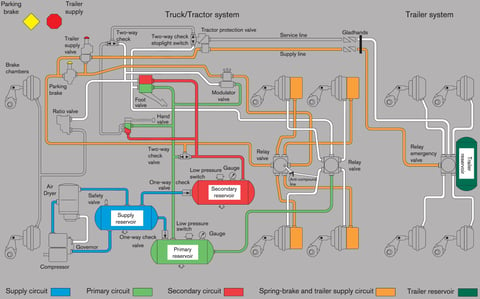
Air Brake Systems: Working Principle, Maintenance and Safety Tips
How does an air brake system work? Pre-trip inspection, long descents, winter drain discipline and a fleet maintenance schedule for heavy commercial vehicles.
Air Dryer: Faults, Replacement & Maintenance Guide
How a truck air dryer's charge and purge cycle keeps moisture and oil out of the brake system, and what a hissing purge valve or water in the tanks means.
Brake Chamber: Faults, Replacement & Maintenance Guide
Service and spring brake chambers on trucks and trailers: diaphragm-leak and stroke diagnosis, why caging is mandatory before removal, and safe replacement.


