Heavy-Duty Truck Air Dryer: Bendix, WABCO & When to Replace the Cartridge
Almost every question about a truck's air dryer needs one piece of information before it can be answered: which family the dryer on that vehicle belongs to.
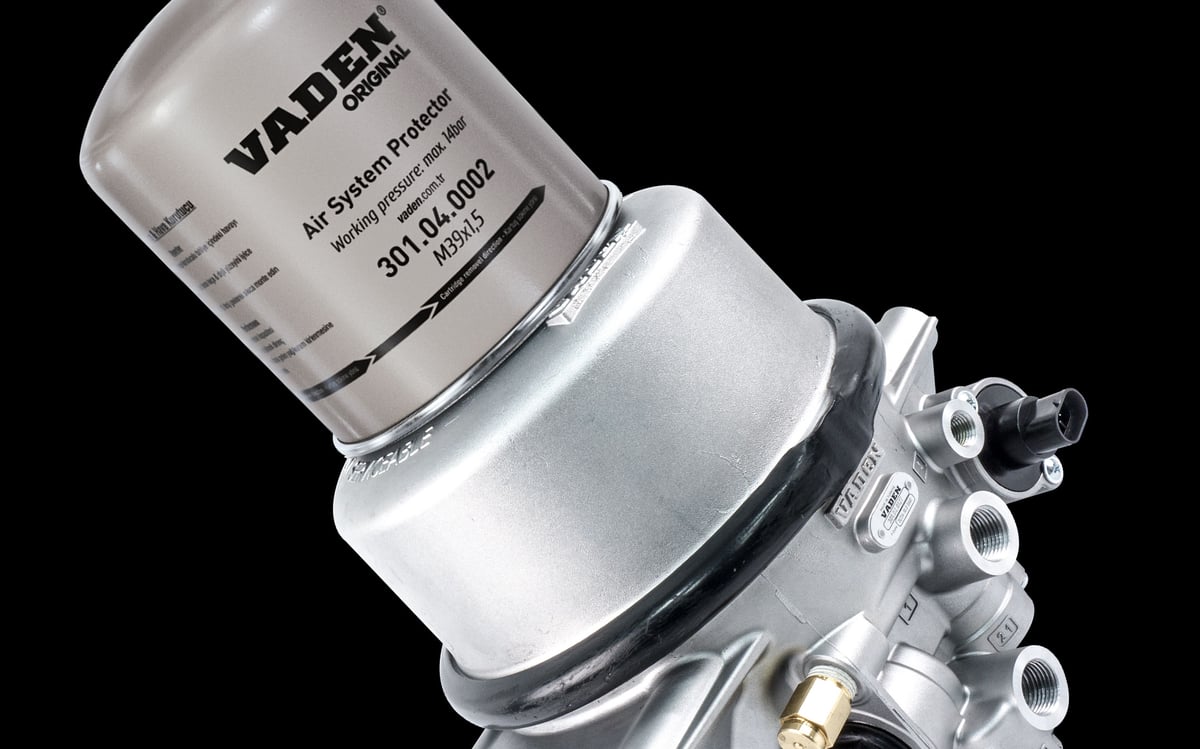
Almost every question about a truck's air dryer needs one piece of information before it can be answered: which family the dryer on that vehicle belongs to. This is exactly where the service conversation stalls. A driver notices water coming out of the reservoir drain, picks up the phone and says "I need an air dryer cartridge"; the first question back is "which type", and the conversation stops there. The same bottleneck shows up on a fleet maintenance schedule: the line item simply reads "air dryer service", while on part of the fleet the desiccant sits in a canister that spins onto the top of the housing from the outside, and on the rest the housing is closed by a bolted cover with the desiccant held inside. These are not the same job. The time booked, the tools needed and the item ordered are all different.
On a heavy commercial vehicle the air dryer is the stage that treats the hot, wet air leaving the compressor before it reaches the reservoirs. What that stage actually does, and what it breaks downstream when it stops doing it, is a separate subject covered in Air Dryer: Faults, Replacement & Maintenance Guide. This page has a different job and stays on one question: which original-equipment family does the air dryer on my truck come from, is it a standalone dryer or an integrated air processing unit, and how do I tell by looking at the housing and reading the label.
Which family is the air dryer on my truck? Identifying it from the housing and the label
Identification starts at the vehicle, not in a parts catalogue. On a heavy commercial vehicle the air dryer sits almost always between the compressor and the air reservoirs, mounted to a frame rail, behind the cab or near the tanks. It is usually a cylindrical, vertically mounted housing with a purge port opening to atmosphere at the bottom. Water and vapour staining below that port often makes it easier to spot. Even a driver who has run the truck for years can overlook this component, because it draws no attention as long as it does its job.
Once you have found the housing, the order of observation is the same on every vehicle. This is not a removal or service sequence; it is purely a sequence for gathering information by looking, and it can be carried out with the engine shut down and the system still pressurised.
- Establish the location. Follow the line leaving the compressor; the first cylindrical housing you meet before the reservoir inlet is most likely the dryer. Do not confuse it with the smaller, generally simpler components sitting close to the compressor.
- Look at the top. Is there a separate canister on top of the housing, resembling an oil filter, that unscrews from the outside? If so, this is a spin-on cartridge arrangement. If not, and the top is a cover held down by bolts, the desiccant sits inside the housing.
- Count the lines. Note how many hoses and pipes enter and leave the housing, whether they are large or small bore, and where they run. This is the strongest single criterion separating a standalone dryer from an integrated unit.
- Check for an electrical connector. A connector on the lower or side face of the housing indicates the heated version found in part of these families; the detail is useful for identification, while electrical testing is outside the scope of this page.
- Read the markings. Adhesive labels, raised lettering cast into the body and stamps on the lower flange: clean them all and try to read them, then record exactly what you read.
- Photograph it. Shoot the complete housing, the top section and the label separately, with light coming in from the side. Those three photographs are usually the only thing that allows the identification question to be answered remotely.
At the end of these six steps you hold five pieces of information: the location of the housing, whether the top is spin-on or bolted, the number of lines, the presence of an electrical connection and the type designation read off the label. The sections that follow translate that information into families.
The Bendix air dryer family: telling AD-9 and AD-IP apart
Bendix is one of the original-equipment manufacturers that has supplied heavy commercial vehicle air systems for many years, and it lists its dryers under a series designation beginning with AD. Housings from this family are commonly met on North American tractors and trucks, and on vehicles built on those platforms. The family look is familiar: a vertically mounted cylindrical housing, a supply line entering the body, a delivery line running to the reservoirs, a small-bore control line connected separately, and a purge port opening to atmosphere at the bottom, usually capped by a muffler.
Within this family the two arrangements most often confused are two arrangements that genuinely differ in service terms, and the difference can be established from the outside.
The arrangement with the desiccant held inside the housing
In the classic AD-9 arrangement the desiccant sits inside the housing as a separate unit. The top of the housing is closed by a bolted cover, and reaching the desiccant means opening that cover. The component performing the purge function is part of the housing in this arrangement; it does not come with the desiccant and is handled as a service item in its own right. Seen from outside, the distinguishing mark is clear: there is no canister on top that unscrews, and instead you see a flat or slightly domed cover ringed by bolt heads.
The arrangement with the purge function integrated into the cartridge
The IP in the AD-IP designation describes the arrangement in which the purge function is integrated into the cartridge. Here the desiccant sits inside a cartridge that screws on and off from the outside; the cartridge threads onto the top of the housing and the element performing the purge duty sits inside that cartridge. In practice this means that when the cartridge is renewed, the consumable element on the purge side is renewed with it. Seen from outside, the distinguishing mark is the canister on top of the housing, resembling an oil filter, that can be turned by hand or with a strap wrench.
Confusing these two arrangements turns directly into an ordering error, because the item called for on one will not fit the other. The family also contains further variants beyond these two arrangements; on some versions the housing shape is similar while the internal arrangement differs. For that reason a classification made by looking at the housing must always be confirmed against the type designation read off the label. Part of the Bendix family is also available in heated versions, which is evident from the electrical connector on the housing.
The WABCO air dryer family and its typical housing layout
WABCO is one of the original-equipment manufacturers most frequently met in the air systems of European-built heavy commercial vehicles. Working with housings from this family is routine on Mercedes-Benz, MAN, Scania, Volvo, DAF and Iveco platforms. The typical appearance separates itself from the Bendix layout at first glance: the housing is mostly cast aluminium, with cast ribbing and raised lettering on the outer surface, and a cartridge that unscrews from the outside threads onto the top. The section of housing below the cartridge has a more complex cast form than the plain cylindrical Bendix body.
The second clear criterion is on the side face of the housing. In the WABCO layout the pressure regulating function is taken into the same housing on the majority of products, and this appears as a separate section, a separate cover or a separate adjusting cap on the side of the body. On such a housing there is no point in hunting elsewhere on the vehicle for a separate pressure regulator. The third criterion is electrical: in this family an electrical connector in the lower region of the housing is common.
The manufacturer lists its dryers under its own commercial series names; in the field these names may be visible on the label or in the raised lettering on the housing. Housings from Knorr-Bremse, another European original-equipment manufacturer following the same architectural approach, leave a similar impression. The reliable way to tell these two manufacturers apart is not to interpret the housing shape but to read the label and the casting marks; a decision made on silhouette alone often turns out wrong.
The difference between a standalone dryer and an integrated air processing unit (APU)
The most expensive mistake in the identification question is made here. The housing you see on a vehicle may be a standalone dryer that only dries the air, or it may be an air processing unit that combines the drying function with other functions in the same body. These two cases are different from end to end, both in service scope and in the item ordered, and they can be told apart from the outside.
A standalone dryer is single-function. A supply line from the compressor enters its housing, a delivery line to the reservoirs leaves it, a small-bore control line is connected, and there is a purge port at the bottom. In other words, the number of large-bore lines connected to the housing is low and their destinations are obvious. When this housing is removed, only the drying stage has been separated from the vehicle.
An integrated air processing unit, known in the industry by the abbreviation APU, takes pressure regulation and the distribution of air to different circuits alongside the drying function. Its appearance is therefore distinctly different: the housing is larger, the cast form is more complex, and most importantly several lines branch away from the body in different directions. If four or five separate lines leave one housing and run to different areas of the vehicle, what you are looking at is not a standalone dryer. On electronically controlled versions the housing also carries a multi-pin electrical connector.
The practical consequence of this distinction is as follows: on an integrated unit the dryer cartridge may still be replaced periodically, but the housing itself is a completely different item, and in a fault situation the sentence "let us change the dryer" describes a far larger job. When a vehicle's maintenance record simply says "dryer", the next workshop cannot know which of these two cases it will meet. The record has to include the housing type as well.
Where the Bendix and WABCO architectures diverge: is the governor external or integrated?
The most useful criterion separating the housings of the two families is where the pressure regulating function sits. This section is purely an identification criterion; how the governor manages the dryer, how the system behaves loaded and unloaded, and how the unloading logic works belong to the compressor side and are not covered on this page.
In the common Bendix layout the pressure regulating function is carried out by a separate component. That component usually sits on or near the compressor, and only a small-bore control line runs to the dryer. As a result no separate regulating section is visible on the dryer housing; the body looks plain and single-function, but there is a second component to be located on the vehicle.
In the common European layout, by contrast, the pressure regulating function has been taken into the dryer housing on most products. A separate section, cover or adjusting cap is visible on the side of the body, and there is no need to look for a separate regulator elsewhere on the vehicle. This makes the dryer housing on its own a more complex component.
In the field the criterion is used like this. If you see a small-bore control line running to the dryer housing and, following that line, you arrive at a separate component near the compressor, you are working with an external-governor architecture. If you see a separate regulating section on the side face of the dryer housing and you cannot find another regulator on the vehicle, you are making your decision on an integrated-governor architecture. This finding is not enough on its own to select a part, but it does let you understand correctly which family you are working with and how many separate housings are involved when a fault occurs.
Single-tower and twin-tower layouts as an identification criterion
Dryers also fall into two groups according to the number of towers on the housing, and this distinction is visible even from a photograph. The great majority of heavy commercial vehicles carry a single-tower layout: one cylindrical housing and one desiccant unit. If you see two symmetrical cylinders standing side by side under the vehicle and seated on a common body, what you have in front of you is a twin-tower layout.
The twin-tower layout appears in applications where air consumption is continuous and high; city buses and specially equipped vehicles are typical examples. The point that matters for identification is that this layout doubles the service item: the consumable being replaced is not one but two, and the maintenance time is planned accordingly. How the towers alternate with one another, which one is regenerated at which moment and how that cycle works is not a matter of identification; it belongs to the cartridge and moisture management guide, where the drying science is set out.
Reading the tower count as an indicator of quality is a common mistake. A twin-tower layout does not mean a "better" dryer; it is a different layout selected for a different duty profile. Considering the substitution of one layout for the other moves out of the identification question and into the field of equipment selection.
| Feature observed | What you see | What it means for identification |
|---|---|---|
| Top of the housing | Canister resembling an oil filter that unscrews | Spin-on cartridge arrangement; the consumable is changed from the outside |
| Top of the housing | Cover held down by bolts | Desiccant inside the housing; access requires the cover to be opened |
| Housing material and surface | Plain cylindrical body with a steel appearance | Common impression on AD series layouts of North American origin |
| Housing material and surface | Ribbed cast aluminium body with raised lettering | Common impression on families of European origin |
| Side face of the housing | A separate section, cover or adjusting cap | The pressure regulating function may be integrated into the housing |
| Route of the control line | Small-bore line runs to a separate component near the compressor | External governor architecture; there is a second housing on the vehicle |
| Number of lines on the housing | One supply, one delivery, one small-bore control line | Standalone dryer |
| Number of lines on the housing | Several lines branching in different directions | Strong likelihood of an integrated air processing unit |
| Tower count | Single cylinder | Single-tower layout; one consumable |
| Tower count | Two symmetrical cylinders on a common body | Twin-tower layout; the consumable comes in pairs |
| Electrical connection | Single-pin or multi-pin connector on the housing | Sign of a heated type or an electronically controlled unit |
Standards and further reading
This subject is governed by the equipment rules for air-braked commercial vehicles. In the United States the federal air brake standard, FMVSS 121 (49 CFR 571.121) defines the reservoirs, protection and timing a compliant system must provide, and Europe applies the equivalent limits of UNECE Regulation No. 13. For further detail, see the illustrated reference guide at airbrakecompressor.com. Always confirm specific figures against the current regulation and the vehicle manufacturer service data.
Readers outside the United States should work from their own national framework: in the United Kingdom the braking system must be maintained under regulation 18 of the Road Vehicles (Construction and Use) Regulations 1986, and in India the governing rules are published by the Ministry of Road Transport and Highways.
Two concepts often confused: are we talking about the dryer housing or the cartridge?
The second big trap in the identification question is hidden in the language. In everyday speech the phrase "air dryer" is used to describe two different things, and the two sides of the conversation are often unaware that they mean different things.
The dryer housing is the permanent component bolted to the vehicle, carrying the line connections and the type label. It generally stays in place for the life of the vehicle and is only replaced complete in case of damage, wear or an internal fault. The answer to the family identification question is on this component.
The dryer cartridge, on the other hand, is the consumable that sits inside or on top of the housing and is renewed periodically. Replacing the cartridge is a maintenance operation; replacing the housing is a repair decision. Their cost, duration and justification are entirely separate.
The field equivalent of this distinction is very concrete. The sentence "we changed the dryer last year" may mean that the cartridge was renewed on one vehicle and that the complete housing was replaced on another. When the same vehicle comes back to the workshop, that ambiguity ends in an unnecessary teardown or a wrong order item. The remedy is simple: the maintenance record always states separately which of the two was done. In the same way, when a cartridge is ordered, the question to ask is not about the cartridge itself but about the type of housing the cartridge sits on, because the cartridge is always tied to the housing and cannot be determined without knowing it.
Terms that change from one manufacturer to another: purge, unloader and regeneration
Documents from different manufacturers describe the same phenomenon with different words. This creates an unexpected slowdown in identification work: the term in the document in your hand does not match the term the person opposite you is using, and it takes time to realise you are talking about the same thing. The equivalents below are at glossary level; how each concept works is not the subject of this page and is covered in detail in the related guides.
| Term | Variants heard in the field | What it refers to |
|---|---|---|
| Air dryer | Dryer, air drier | The drying stage as a whole |
| Desiccant | Drying agent, desiccant bed, beads | The material that holds the moisture |
| Cartridge | Canister, element; incorrectly, filter | The consumable replaced periodically |
| Purge | Blow-down, exhaust, discharge | The event in which the dryer releases air and liquid to atmosphere |
| Regeneration | Reactivation, renewal of the desiccant | The desiccant returning to a serviceable condition |
| Unloader | Unloading, running off-load, no-load operation | The load cut-off function on the compressor side |
| Governor | Pressure regulator, air governor | The component performing the pressure regulating function |
| Spin-on | Screw-on cartridge, threaded cartridge | The cartridge arrangement removed and fitted from the outside |
| APU | Air processing unit, air treatment unit | Drying and other functions combined in a single housing |
| Muffler, silencer | Exhaust silencer, purge muffler | The element reducing the noise of the purge port |
| Heater | Heating element, resistor | The electrical heating element found in some families |
There is one point in this table to watch. Because the word "purge" is used both for the discharge event and for regeneration, it is not always clear what the speaker means when someone says a vehicle "keeps purging". The same ambiguity appears with the word "filter": calling the dryer cartridge a filter out of habit can lead to confusion with a genuine filter somewhere else on the vehicle. At the identification stage the safest approach is to describe the component being discussed not by a word but by its position on the housing.
Reading the manufacturer markings and the type label on the dryer housing
Classification by looking at the housing is a good start, but the definitive answer is in the lettering. On heavy commercial vehicle air systems there are generally three separate sources of lettering on dryer housings, and all three have to be assessed together.
The adhesive or riveted type label is mostly on the side face of the housing. It carries the manufacturer name or logo, the type or series name of the product, a number sequence and, in some cases, a production date code and the supply voltage of the heater. The label fades with time and disappears under road dirt and oil; the first job is to clean the surface and hold a light at a shallow angle.
Raised lettering cast into the body is more durable because it was produced together with the part itself. The manufacturer name, the casting code and marks indicating flow direction may be found here. Raised lettering becomes invisible under paint; running a finger across the surface is the fastest way to notice lettering the eye cannot see.
Stamps in the flange and connection areas are generally small and hard to read, but they sometimes carry more reliable information than the label because they have not been changed after the fact.
One point deserves particular emphasis: assuming the dryer family from the make and model of the vehicle is not reliable. On the same model, housings from different families may have been used depending on the production year, the market and the equipment option; and if the housing has been changed once during the life of the vehicle, a part from a family other than the original equipment may have been fitted. For that reason identification is always carried out by looking at the actual housing on the vehicle, not from a record or from memory. Nor is the type designation read off the label converted on its own into an ordering decision; matching is carried out through authorised catalogues and service documentation.
Which guide for which question: the air dryer family road map
Once you have the answer to the family identification question, the remaining questions can be directed to the right page. The subject of air dryers is too broad to fit into a single article, and the guides in this family have been divided so that they do not repeat one another.
Cartridge service life, moisture management and winter conditions. How the desiccant holds moisture, what shortens cartridge life, how the replacement interval is determined, what the liquid coming from the reservoir drain tells you and the precautions to be taken against freezing in winter are the subject of a separate page. For those questions see Air Dryer Cartridge and Moisture Management: Selection, Service Life and Winter Conditions.
Fault symptoms, diagnosis and unit replacement. The symptoms showing that the dryer is not doing its job, the diagnosis of conditions such as continuous purging, water reaching the reservoir and failure to hold pressure, and replacement of the unit are handled in a separate guide. Air Dryer: Faults, Replacement & Maintenance Guide, also mentioned above, is the address for those questions.
Purge valve, leakage and field tests. The faults specific to the dryer purge valve, confirming a leak and the tests applied in the field are the subject of another page; for that, read Air Dryer Purge Valve: Faults, Replacement and Maintenance.
Completing the identification work before going to these three pages saves time, because the answer in all of them varies with the housing type.
VADEN ORIGINAL is a manufacturer of compressors and air system components for heavy commercial vehicle air brake systems; you can review our product pages for the product family and technical documentation, and draw on authorised service and catalogue support to determine the correct item for your vehicle.
The general logic of this layout, where drying, governing and circuit protection sit in one housing, is explained component by component in our guide what is an air processing unit.
Shop this part: Air Processing Unit
Main guide: Air Dryer: Faults, Replacement & Maintenance Guide
Tags
Frequently Asked Questions
- What is the fastest way to tell which family the air dryer on my truck belongs to?
- The fastest route is to look at the top of the housing and at the number of lines connected to it. If there is a canister on top resembling an oil filter that unscrews, you are on a spin-on cartridge arrangement; if there is a bolted cover, the desiccant sits inside the housing. Then count the lines connected to the body: if you see one supply, one delivery and a small-bore control line, you are dealing with a standalone dryer, and if you see several lines branching in different directions, with an integrated air processing unit. The last step is to read the label and record exactly what it says.
- When should the air dryer cartridge be replaced?
- Cartridge replacement depends both on the calendar and on the operating conditions of the vehicle. Manufacturers generally give a time period together with a mileage interval, and replacement is carried out when whichever comes first is reached; the vehicle's current service documentation is authoritative for the exact interval, and no figure is given on this page. Independently of the calendar, water appearing at the reservoir drain or the dryer behaving differently from expected brings the replacement forward. Dusty, humid and short-distance operation, together with oil carry-over from the compressor, shortens cartridge life noticeably. For the detail of the subject, the factors that determine service life and practice in winter conditions, see Air Dryer Cartridge and Moisture Management: Selection, Service Life and Winter Conditions.
- What is the visible difference between Bendix AD-9 and AD-IP?
- The difference is seen at the top of the housing. In the classic AD-9 arrangement the desiccant sits inside the housing and the top is closed by a cover held down by bolts. In the AD-IP arrangement the purge function is integrated into the cartridge; the cartridge screws onto the top of the housing from the outside and is removed by turning. Because the family contains other variants as well, a decision made by looking at the housing must be confirmed against the type designation read off the label.
- How do I recognise a WABCO dryer from the housing?
- The typical appearance of this family is a ribbed cast aluminium body with raised lettering and a cartridge that screws onto the top. A separate section, cover or adjusting cap on the side face of the housing indicates that the pressure regulating function may have been taken into the same body. An electrical connector in the lower region of the housing is also common in this family. Even so, to avoid confusion with other original-equipment manufacturers using a similar architecture, the decision is confirmed from the label and the casting marks.
- Does my dryer have a separate governor, and how do I find out?
- Follow the small-bore control line connected to the dryer housing. If that line runs to a separate component on or near the compressor, the vehicle has an external pressure regulator. If you see a separate regulating section beside the dryer housing and the line does not lead to another body, the regulating function is integrated into the dryer. This finding only shows which architecture you are working with; how the governor operates belongs to the compressor side.
- Several lines leave my dryer housing. Is that a sign of a fault?
- No. Several lines branching in different directions show that the housing is not a standalone dryer but an integrated air processing unit. Because these units combine the drying function with other functions in the same body, they naturally carry more connections. Fault assessment is a separate subject, and reading the symptoms is the job of the fault guide.
- Is a twin-tower dryer better than a single-tower one?
- A twin-tower layout is not a quality grade but a different layout selected for a different duty profile. It appears in applications where air consumption is continuous and high, for example on city buses and specially equipped vehicles. In identification terms its only practical consequence is that the consumable comes in pairs rather than singly, and that maintenance time is planned accordingly.
- The label is unreadable. Can I determine the dryer type from the vehicle make and model?
- That route is not reliable. On the same model, housings from different families may have been used depending on the production year, the market and the equipment option; and if the housing has been changed once during the life of the vehicle, a part from a family other than the original equipment may have been fitted. If the label is unreadable, clean the surface and hold a light at a shallow angle, run a finger over the raised lettering cast into the body, and look at the stamps in the flange area. If that still produces no result, approaching an authorised workshop with photographs of the housing is the right step.
- Are the dryer housing and the cartridge the same thing?
- They are not. The housing is the permanent component bolted to the vehicle, carrying the line connections and the type label; the cartridge is the consumable that sits inside or on top of the housing and is renewed periodically. Replacing the cartridge is a maintenance operation, replacing the housing a repair decision. If the maintenance record does not state separately which was done, the next visit carries the risk of an unnecessary teardown or a wrong order.
- Can a heated dryer be told apart from an unheated one by the housing?
- Yes, the clearest sign is an electrical connector on the lower or side face of the housing. Heated versions exist in some families and are preferred in cold climate conditions. The presence of the connector is a useful clue for identification; electrical testing of the heater circuit is outside the scope of this page and is covered in the related technical guide.
Related Articles

Air Dryer: Faults, Replacement & Maintenance Guide
How a truck air dryer's charge and purge cycle keeps moisture and oil out of the brake system, and what a hissing purge valve or water in the tanks means.
Air Brake System: How It Works on Heavy Commercial Vehicles
When a tractor unit rolls into the workshop, the complaint is not always "the brakes don't hold". More often it is "the brakes hold late". The driver feels a
Truck Air Brake Valves Explained: Types, Functions and Failure Symptoms
Truck air brake valves explained: what relay, ALB, foot brake and trailer valves do, their failure symptoms, and how to diagnose faults with a pressure gauge set.