Viscous Fan Clutch: Fault, Replacement & Maintenance Guide
Heavy-duty viscous fan clutch guide: how it works, fault symptoms, diagnosis, correct replacement steps and safe technical values for trucks and buses.
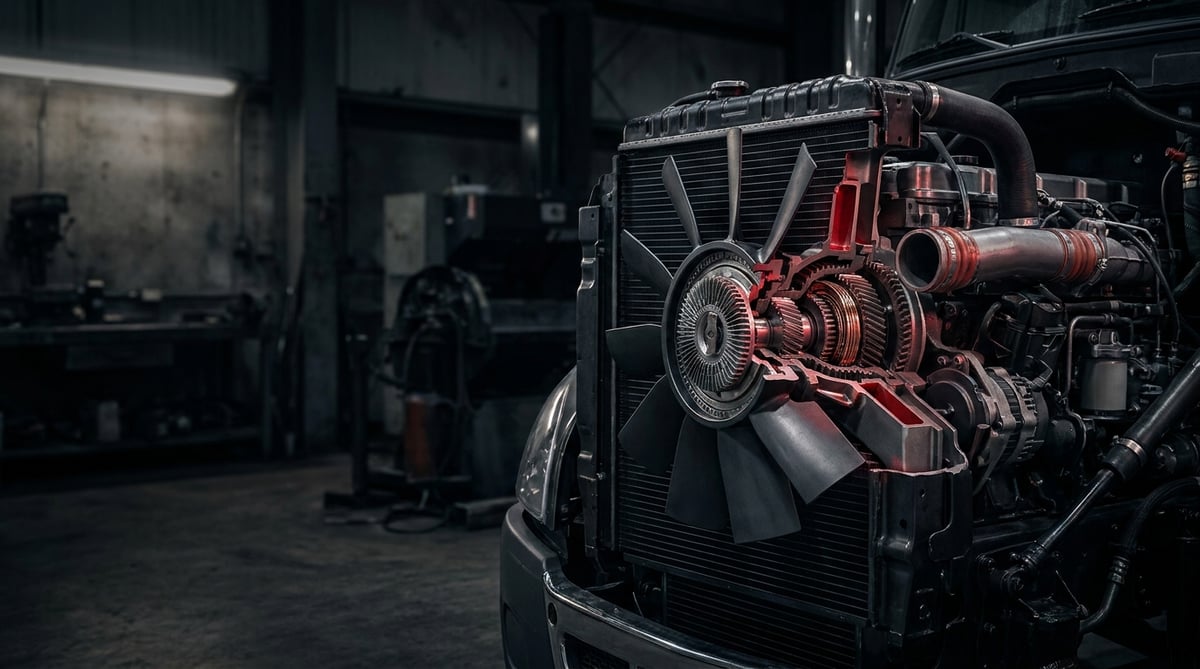
On a heavy commercial vehicle, an engine that stays too cold is just as much of a problem as one that runs too hot. The viscous fan clutch — known in the field simply as the fan coupling — is a smart clutch that engages the cooling fan to the engine exactly when it is needed and releases it the rest of the time. When a tractor unit is climbing a grade, the fan must turn at full speed; when cruising level on the motorway, it should idle freely. When the part that strikes this balance fails, the engine either overheats, or the fan runs constantly and eats into power and fuel, or an aircraft-like roar starts in the cab. This guide brings together the working logic of the viscous fan clutch on heavy diesel vehicles, its fault diagnosis, correct replacement practice and safe technical values, all in field language.
What Is a Viscous Fan Clutch? Its Function and Working Principle
The viscous fan clutch is a heat-sensitive coupling unit that engages and releases the engine's cooling fan according to radiator temperature; thanks to the silicone fluid and bimetallic thermostatic spring inside it, it brings the fan into action only when needed. When the engine is cold or the cooling demand is low, the clutch stays disengaged and the fan turns almost freely; when the air passing through the radiator heats up, the bimetallic spring opens the valve, silicone fluid fills the working chamber and the fan gradually locks up with engine speed. This way the fan does not have to turn at full speed all the time; that means fuel savings, lower noise and less power loss. On heavy diesel applications this unit works on the same logic as Behr/Mahle, Horton and BorgWarner type clutches; the VADEN product family is also manufactured to replace these OE-type designs.
Although the fan clutch looks like a simple pulley, it contains several components that work together:
- Bimetallic thermostatic spring: The coil spring on the front face of the clutch; it senses the temperature of the air coming from the radiator and is the "brain" that opens and closes the engagement valve.
- Silicone (viscous) fluid: The high-viscosity special fluid that transmits the drag force; by circulating between the storage and working chambers it determines how strongly the fan locks up.
- Working and storage chambers: The internal reservoir the fluid moves through; when the valve is open the fluid fills the working chamber (the fan engages), when it is closed the fluid is drawn back into the storage chamber (the fan idles).
- Body and grooves (labyrinth): The grooved labyrinth structure on the inner surface; it is the surface that lets the silicone fluid transmit torque through shear force.
- Bearing and drive shaft/flange: The bearing that turns the clutch via the water pump or a separate hub; when it wears it produces noise and run-out.
How do the silicone fluid and labyrinth transmit torque?
The heart of the viscous clutch is the thin silicone fluid film between two surfaces. Between the inner disc turned by the engine and the body attached to the fan, the high-viscosity fluid that collects on the grooved labyrinth surfaces transmits torque through shear friction. The more fluid there is in the working chamber, the more tightly the fan is engaged; as it decreases, the fan idles. This is an entirely mechanical-hydraulic system; it requires no electricity and is highly reliable, but the fluid thins over time and loses its properties, or when the bearing/seal wears out the clutch can turn into a "permanently disengaged" or "permanently locked" unit.
The bimetallic spring and engagement: what happens with a hot radiator?
The bimetallic spring on the front face of the clutch reads the temperature of the air passing through the radiator and striking the fan. When the air is cold the spring keeps the valve closed, the fluid waits in the storage chamber and the fan turns almost freely. When the radiator temperature reaches the threshold, the bimetallic spring bends, opens the valve and the fluid flows into the working chamber, bringing the fan into action. As the temperature drops the spring closes the valve, the fluid is drawn back and the fan idles again. This gradual transition provides control in which the fan is not just "on-off" but partially engages according to demand.
Viscous, electronic viscous and on/off clutch types
On heavy commercial vehicles there is more than one fan clutch architecture, and the correct part selection depends on this type. The table below summarises the common types and their typical behaviour.
| Clutch type | Control method | Typical use / behaviour |
|---|---|---|
| Classic viscous (bimetallic) | Bimetallic spring on the front face, by air temperature | Common truck/tractor unit; gradual, self-controlled engagement |
| Electronic viscous (ECU controlled) | Temperature sensor + solenoid, by engine control unit command | Modern Euro 5/6 vehicles; more precise, can generate fault codes |
| On/off (engage-release) clutch | Compressed air or electromagnet | Some heavy applications; two-position, non-graduated engagement |
| Direct drive / silicone-free | No clutch, fan fixed in place | Simple/old systems; constant power draw and noise, low efficiency |
Fault Symptoms and Diagnosis
Fan clutch faults basically fall into two opposite poles: the permanently disengaged (non-engaging) clutch and the permanently locked (always engaged) clutch; to these is added bearing/seal wear and silicone fluid leakage. The critical point is this: the same symptom (for example the engine overheating) can be caused both by a non-engaging fan clutch and by a blocked radiator, low coolant or a faulty thermostat. That is why the diagnosis must be made by observing the system as a whole before removing the clutch.
| Symptom | Possible Cause | Check / Verification |
|---|---|---|
| Engine overheats especially on a grade/under load and at idle | Permanently disengaged fan clutch (silicone fluid emptied, valve not opening) | With the engine hot, turn the fan by hand (carefully, engine off); if it turns very easily and freely the clutch is not engaging |
| Constant high fan noise (aircraft/roar) from cold start onward | Permanently locked clutch (fluid stuck in the working chamber) | Observe that on a cold engine the fan still engages tightly and the noise increases with revs |
| Power loss and increased fuel consumption | Permanently locked clutch turning the fan needlessly, parasitic power loss | Check whether the fan idles freely when cold; if it is always locked it draws power |
| Oily leakage from the clutch area, silicone trace on the hub | Silicone fluid leak, worn seal/O-ring | Wipe the clutch front face and hub dry and run it; fluid weeping/dripping indicates a silicone leak |
| Metallic hum, rattle or run-out/vibration from the fan area | Worn bearing, ball play, unbalanced/cracked fan blade | With the engine off, rock the fan back and forth to check bearing play and inspect the blade for cracks/broken vanes |
| Fan fault/warning lamp, DTC record on an electronic viscous clutch | Solenoid, sensor or clutch feedback fault | Read fan speed/command data and DTC records with a diagnostic tool; verify command-response consistency |
| Temperature gauge fine while cruising, climbing in stop-and-go/at idle | Weak/late-engaging clutch (tired bimetal or reduced fluid) | Observe whether the fan clearly engages while the temperature in front of the radiator rises at idle |
Identifying a permanently disengaged (non-engaging) clutch
This is the most insidious fault, because the vehicle runs fine on level roads and in cold weather; the problem only appears under load, on a grade, in hot weather or during long idling. The symptom is typical: the engine overheats while climbing or waiting in traffic, the gauge needle climbs, but it recovers during motorway cruising (because air flow is already plentiful). A simple field tip: after the engine has warmed up thoroughly, stop it and try to turn the fan by hand (engine off, ignition off) — a hot clutch should show clear resistance; if it turns as freely as paper, the clutch is not engaging.
Identifying a permanently locked (always engaged) clutch
This fault does not damage the engine but ruins efficiency and comfort. Because the fan turns at full speed even from a cold start, there is a distinct hum/aircraft noise inside and outside the cab, power drops and fuel rises. The most practical way to identify it is to start the engine cold and observe the fan's behaviour: a sound clutch idles the fan when cold and runs quietly, whereas a locked clutch turns loudly from the very first second. This usually stems from the silicone fluid being stuck in the working chamber or the valve mechanism jamming.
Identifying bearing/seal wear and silicone leakage
The fan clutch supports a unit that turns constantly and is subject to vibration; the bearing develops play over time, and the seal/O-ring hardens and lets the silicone fluid leak. With the engine off, hold the fan with both hands and rock it back and forth and side to side; if there is noticeable play (a click) or run-out, the bearing is worn out. If oily weeping, a thin silicone film or a dust-caked fluid trace is seen on the front face and hub of the clutch, a fluid leak has begun; these two symptoms often progress together and call for complete replacement of the clutch.
The belt run driving the fan clutch is a maintenance item of its own; how tension is held and which noises betray it are covered in the fan belt tensioner and idler pulley guide.
If the clutch is sound but the engine still runs hot, the causes of overheating and the full fault chain are examined in our guide to engine overheating causes and cooling system failures.
Further reading
For a plain-language technical overview of this subject, see the reference article on Wikipedia. Always confirm specific figures and procedures against the vehicle manufacturer service data.
Replacement / Installation Steps
The following steps are a general sequence for heavy diesel (truck/tractor unit/bus); always rely on the torque, direction of rotation and procedure values in the vehicle's and engine's service manual.
- Secure the engine: Stop the vehicle on level ground, chock it, stop the engine and wait for it to cool down completely. Disconnecting the battery prevents accidental cranking and fan movement.
- Gain access: Loosen the fan shroud and, if necessary, the lower/upper radiator connections, or pull the shroud back. Photograph and label the belt, tensioner and air hoses if needed.
- Determine the direction of rotation and thread type: The fan clutch hub nut/thread may be a reverse (left-hand) thread. Before removal, confirm the thread direction and the clutch's direction of rotation; forcing the wrong direction will strip the thread.
- Separate the clutch from the drive: Fix the water pump pulley (with a special holding/wrench set) and loosen the hub nut or flange bolts. Do not force it by turning the pulley with the belt; use a suitable counter-holding tool.
- Remove the fan + clutch assembly: Take out the blade and clutch together carefully, without hitting the radiator. In the tight gap, take care not to damage the fan vanes and the radiator core.
- Separate the blade from the clutch (if needed): If only the clutch is to be replaced, remove the fan blade from the clutch; inspect the blade for cracks, broken vanes or loss of balance.
- Check the new clutch and flange: Confirm that the new fan clutch's type (viscous/electronic), flange pattern, thread direction and hub dimension are exactly the same as the old one. Carry the clutch in an upright position so the silicone fluid settles.
- Clean the mating surfaces: Clean the flange and shaft mating surfaces and the threads; remove corrosion and old gasket residue. If a thread-locker (loctite) is required, use the type specified by the manual.
- Fit the new clutch and torque it: Seat the fan + clutch in place and tighten the hub nut/flange bolts to the manufacturer's torque, in the correct thread direction. Do not confuse the tightening direction on a reverse-threaded nut.
- Adjust the shroud and blade clearance: Fit the fan shroud and confirm that the clearance between the blade and the shroud/radiator is equal and sufficient in every direction; there must be no rubbing noise or blade contact. On an electronic clutch, reconnect the connector.
- First start and engagement confirmation: Start the engine; observe that the fan idles/is quiet when cold, and that when the engine warms up and the radiator temperature rises the fan clearly engages and the hum increases. Confirm there is no vibration, rubbing noise or fluid leak in the clutch area.
Points to Watch (Common Mistakes)
- The "if there's an overheating problem, let me fix/direct-couple the clutch" fallacy: Permanently locking the clutch turns the fan constantly, causing power and fuel loss, excessive noise and slow engine warm-up in cold operation. The correct solution is to replace the clutch with the right type.
- Fitting the wrong clutch type: Fitting an electronically controlled clutch in place of a classic bimetallic viscous one (or vice versa) breaks the system; the engine control unit cannot manage the fan, producing fault codes and an overheating problem. Confirm the type by the engine code.
- Ignoring a cracked/unbalanced blade: A blade with a crack or broken vane creates vibration, premature bearing death and a risk of a vane flying off, even if the clutch is renewed. Always check the blade.
- Bending the radiator core: Hitting the blade against the radiator while removing/fitting the clutch crushes the core fins, lowering cooling and contributing to overheating.
- Storing the clutch lying flat/upside down: The silicone fluid of a viscous clutch can shift between the chambers; unless the manual says otherwise, carry and store the clutch in an upright position.
- Changing the part without confirming the root cause: Overheating is not always due to the fan clutch. Also rule out a blocked radiator, low coolant, a faulty thermostat or the water pump; otherwise a new clutch will not solve the problem.
Technical Values and Check Points
The following values are general/safe references for common heavy commercial vehicle cooling/fan systems. Critical values such as engagement temperature, torque and fan speed vary by vehicle and engine model; for exact figures always rely on the relevant service manual.
| Parameter | Typical / Safe Reference | Note |
|---|---|---|
| Clutch engagement (air in front of radiator) temperature | ~70–95°C band (typical) | The bimetal/sensor threshold is set exactly by engine family |
| Normal engine operating temperature band | ~85–95°C (typical) | The fan engages to keep this band |
| Fan idle (disengaged) speed ratio | ~20–40% of shaft speed (general reference) | When the clutch is not open the fan drags and turns slowly |
| Fan fully engaged speed ratio | ~80–95% of shaft speed (general reference) | A small amount of slip is normal even at full lock-up |
| Cooling system cap pressure | ~0.9–1.4 bar (13–20 psi) | A system value, not the clutch; checked together during overheating diagnosis |
| Blade–shroud/radiator clearance | Equal in every direction, manufacturer value (typically a few mm) | There must be no rubbing; the clearance is model-specific |
The engagement temperature band and fan speed ratios above are general values consistent with the viscous clutch behaviour of OE-type manufacturers such as Behr/Mahle, Horton and BorgWarner for heavy commercial diesel engines. Fan speed is given as a "percentage" because the absolute speed depends on engine speed; a sound clutch turns noticeably slowly at idle and close to the shaft speed at full engagement. Regional regulations and vehicle manufacturer values always take priority.
Typical mounting torque and tightening notes
The fan clutch connection is made with a hub nut (often a reverse/left-hand thread) or flange bolts. Torque varies by size, bolt class and connection type. The values below are general references only; for exact torque and thread direction, always use the vehicle/engine manual.
| Connection (size / type) | Typical torque range | Note |
|---|---|---|
| M8 / 8.8 flange bolt | ~22–25 Nm | Tighten crosswise and in stages |
| M10 / 8.8 flange bolt | ~43–48 Nm | General reference |
| Hub nut (large, single) | Manufacturer value (usually high) | May be a reverse thread; direction and torque from the manual |
| Fan blade–clutch bolts | ~8–12 Nm (small size) | Tighten equally for balance, do not over-tighten |
Quick field check points
- After the engine has warmed up thoroughly (engine off, ignition off), turn the fan by hand; a hot clutch should show clear resistance, and if it turns freely it is not engaging.
- Observe that the fan idles/is quiet at cold start, then engages with a distinct increase in the hum as it warms up; if it is always loud even when cold, the clutch may be locked.
- With the engine off, rock the fan back and forth and side to side to check bearing play and blade run-out.
- Wipe the clutch front face and hub dry and run it; oily weeping/silicone trace indicates a silicone leak.
- Check the blade–shroud clearance in every direction; there must be no rubbing noise and no crack/break in the vane.
Maintenance and Service Life
The service life of a fan clutch depends largely on two things: the condition of the silicone fluid and bearing inside it, and the cleanliness of the environment it works in. The clutch is a part that turns constantly and is exposed to vibration and heat; over time the fluid thins and loses its engagement performance, and the bearing and seal wear out. A layer of dust, insects and dirt building up in front of the radiator reduces air flow, forcing the clutch to work harder and shortening its life. A routine that keeps maintenance simple extends the life not only of the clutch but also of the radiator, water pump and belt group.
- Daily / pre-trip: Listen for abnormal fan noise at cold start and for shroud/blade rubbing while running; observe that the temperature gauge stays on target, especially at idle and while climbing.
- At periodic services: Clean the dirt/blockage in front of the radiator core and fan shroud; scan for cracks/broken vanes on the blade, fluid leaks on the hub and bearing play.
- On overheating/efficiency complaints: Test the clutch's engagement behaviour (hot-fan resistance, cold-idle quietness); to isolate the root cause, also assess the radiator, thermostat and water pump together.
- At clutch replacement: When replacing the fan clutch, also check the blade; a cracked/unbalanced blade will quickly kill the new clutch's bearing. Renew both together if necessary.
- On an electronic clutch: Periodically check the solenoid, sensor and connector connections and the fault records with a diagnostic tool.
If rising temperature under load/at idle, constant high fan noise, power and fuel loss or a fluid leak on the hub are seen together, it is time to replace the fan clutch. The clutch alone will not stop the engine, but when it fails to do its job the price is paid as efficiency and fuel loss, excessive noise and, in the worst case, engine damage due to overheating. Assessing the blade, bearing condition and radiator-front cleanliness together when renewing the clutch is the most reliable way to prevent the fault from recurring.
After correct diagnosis and a clean installation, the decisive factor is that the fan clutch you fit meets the engagement temperature, gradual engagement character, direction of rotation and durability of the OE-type design. The VADEN Viscous Fan Clutch family has been developed as an equivalent to Behr/Mahle, Horton and BorgWarner type units on heavy diesel trucks, tractor units and buses, to meet the safe technical values and field expectations in this guide; you only need to select the model suited to your needs together with the vehicle and engine match, assessing it as a whole with cooling system product groups such as the VADEN fan blade, shroud, water pump and belt.
Shop this part: Fan
Related categories: Fan · Visco Drive · Blade
Related technical guides: Truck Radiator & Expansion Tank: Faults, Replacement & Care · Engine Coolant Thermostat: Faults, Replacement & Care · Belt Tensioner: Failure, Replacement & Maintenance Guide
Application and compatibility: Vehicle compatibility catalogue · Engine compatibility catalogue
Main guide: Water Pump: Faults, Replacement & Maintenance Guide
Tags
Frequently Asked Questions
- Is the fan clutch disengaged or locked? How do I tell?
- The most practical method is a two-stage observation. At cold start a sound clutch idles the fan and is quiet; if there is a loud hum from the first second, the clutch may be locked. After the engine has warmed up thoroughly, stop it (engine and ignition off) and turn the fan by hand; a hot clutch should show clear resistance. If it turns freely, the clutch is not engaging (it has stayed disengaged).
- Can't I just fix/direct-couple the fan clutch?
- No. Permanently locking the clutch turns the fan at full speed all the time, causing power and fuel loss, high noise and slow engine warm-up in cold weather; on some systems it also tires the belt/tensioner and bearing. The correct solution is not to remove and fix the clutch, but to replace it with a new fan clutch of the correct type.
- The engine overheats on a grade/at idle, is the fan clutch the cause?
- It is a very likely scenario: an engine that overheats under load and in stop-and-go but recovers during motorway cruising is the classic "non-engaging fan clutch" picture, because air flow is already plentiful while cruising. Even so, before concluding, also rule out radiator blockage, low coolant, the thermostat and the water pump; the clutch is not always the sole culprit of overheating.
- The fan turns constantly at a loud volume (aircraft noise), is that normal?
- A brief hum that increases as the engine warms up is normal — the clutch has engaged. But if there is constant loud noise from cold start onward, the clutch is probably locked: the silicone fluid is stuck in the working chamber or the valve is jammed. In this case power and fuel loss accompany it and the clutch must be replaced.
- When I replace the fan clutch, should I also replace the blade?
- It is not mandatory, but the opportunity is right there. While the blade is removed, inspect it for cracks, broken vanes and loss of balance. If the blade is sound you can reuse it; if it is cracked or unbalanced, renew it without fail, because it will quickly kill the new clutch's bearing and create a risk of vibration/vane flying off.
- Can I fit an electronic clutch instead of a classic viscous one?
- No. An electronic (ECU controlled) clutch and a classic bimetallic viscous clutch are different control architectures and cannot be fitted interchangeably; the sensor/solenoid and software that would manage the electronic one do not exist on the bimetallic one. Always choose the part suited to the vehicle's engine code and the original clutch's type.
- I fitted a new fan clutch but the engine still overheats, why?
- First confirm that the clutch is fitted in the correct type and correct direction of rotation, that the fan shroud is in place and the clearances are suitable. If the problem persists, the source of the overheating may be outside the clutch: a blocked/dirty radiator, low coolant, a faulty thermostat, a weak water pump or an air lock in the system. Proceed by reading the real coolant temperature with a diagnostic tool.
- Fluid is leaking from the hub, will just the seal be replaced?
- Usually no. The fan clutch is a sealed, non-serviceable (replaced as a whole) unit; the silicone fluid and bearing/seal inside it are sealed together at the factory. If silicone fluid weeping has begun from the hub, this is a sign that the clutch has reached the end of its life, and instead of replacing a single seal the clutch is renewed complete.
- Is the fan clutch hub nut left-hand threaded, and how do I loosen it safely?
- On many applications the hub nut has a reverse (left-hand) thread, so confirm the thread direction and the clutch's direction of rotation before you touch it. Force applied the wrong way strips the hub thread and the water pump shaft, turning a simple job into a major repair. Hold the water pump pulley with a proper counter-holding tool rather than the belt, and use the manufacturer's torque when refitting.
- What happens if I run the engine without the fan shroud fitted?
- The engine runs hot. Without the shroud the fan cannot draw air through the whole radiator, so temperature climbs at idle and under load even when the clutch itself is sound. A badly positioned shroud is worse: the blade rubs, can break a vane and throw parts. After fitting, check that the blade-to-shroud and blade-to-radiator clearance is equal and sufficient in every direction.
Related Articles

Engine Overheating in Heavy-Duty Trucks: Causes & Fixes
Learn why heavy-duty truck engines overheat, how to read the gauge, step-by-step diagnosis, and how coolant, water pump, thermostat, and fan clutch fail.
Truck Radiator & Expansion Tank: Faults, Replacement & Care
Diagnose radiator and expansion tank faults on heavy trucks: overheating, coolant loss, pressure caps, correct replacement steps and safe technical values.
Engine Coolant Thermostat: Faults, Replacement & Care
Heavy truck engine coolant thermostat guide: stuck-open vs stuck-closed faults, diagnosis, correct replacement, torque values and maintenance tips.