Hydraulic Steering Pump: Failure, Replacement & Care Guide
Whining at the wheel and heavy steering at manoeuvring speed in a truck usually trace to the hydraulic steering pump: diagnosis, replacement, fluid care.
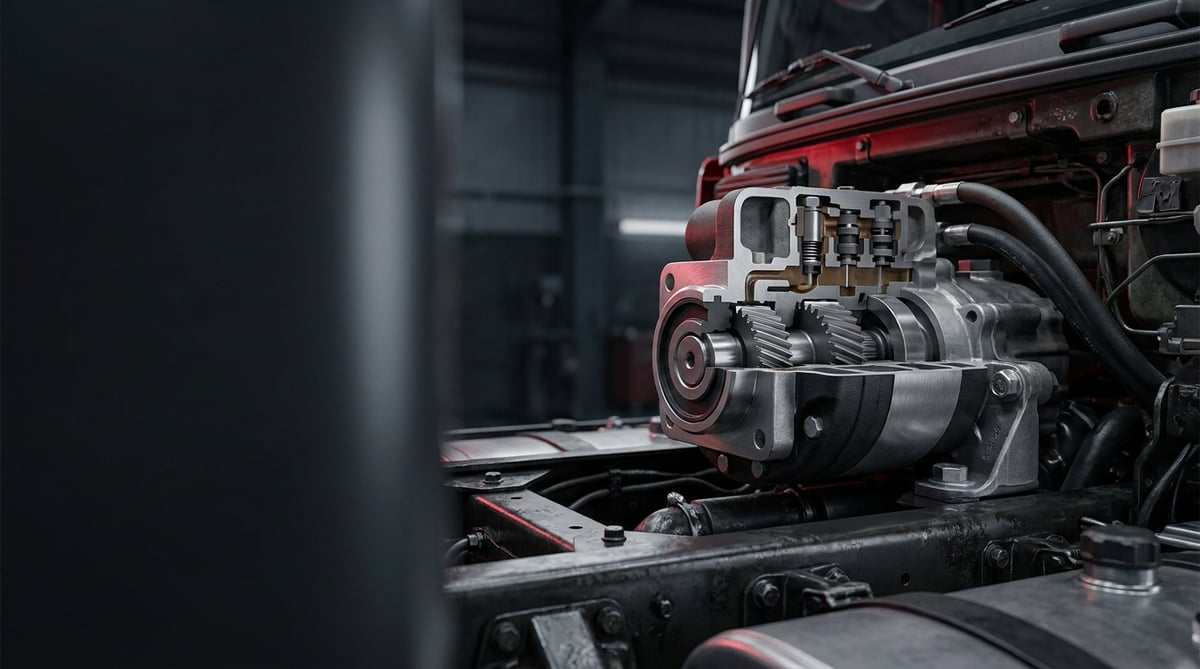
The fact that the steering wheel of a heavy commercial vehicle can be turned with a single finger is no accident: during a maneuver, the tons of load bearing down on the front axle are carried by hydraulic pressure instead of the driver. The heart that generates this pressure is the hydraulic steering pump, driven by the engine. Unlike passenger cars, the steering system in trucks, tractor units and buses operates at far higher pressure and flow; the pump does its job in a hot, vibrating environment under constant load. This guide covers the operation of the hydraulic steering pump in heavy-duty diesel applications, the correct diagnosis of failure symptoms, field-applicable replacement practice, and the hydraulic-fluid discipline that determines pump life, all in the light of the OE brand context (ZF, Bosch, TRW-type systems) and the service specifications of engine/chassis manufacturers.
What Is a Hydraulic Steering Pump? Its Function and Working Principle
A hydraulic steering pump is a hydraulic pump that, driven by the engine, pressurizes the steering fluid and delivers this pressure to the steering box (servo unit), greatly reducing the steering effort required from the driver.
The most common type in heavy commercial vehicles is the vane pump; in some applications gear or radial piston pumps are also used. The pump is turned by the engine via a belt (poly-V/V-belt) or directly by a gear. As the rotor turns, the vanes are pressed against the cam ring by centrifugal force; the cells that grow on the intake side and shrink on the discharge side draw fluid from the reservoir and push it to the steering box at high pressure. When the driver turns the steering wheel, the valve inside the box directs this pressure to the relevant side, generating the force that turns the wheel.
The basic building blocks of a heavy-duty diesel steering pump are as follows:
- Housing: Usually cast aluminum or cast iron; it holds the pressure and intake ports and the internal cartridge.
- Rotor & vanes: The moving group that generates the pressure. The contact between the vane tip and the cam ring is the area most prone to wear.
- Cam ring: The oval inner profile the vanes follow; it determines the flow and pressure character.
- Shaft, bearing/bush and seal: Carries the drive shaft and prevents fluid from leaking out. The shaft seal is the most common leaking element.
- Flow control & relief valve: Usually a single cartridge; it keeps flow constant independent of engine speed and cuts pressure at the safety limit at full lock.
- Pulley or drive gear: The connecting element that takes motion from the engine.
Its Place in the System: The Pump – Reservoir – Box Chain
The pump does not work on its own; it is part of a closed hydraulic circuit. Fluid is drawn from the reservoir, travels from the pump via the pressure line to the steering box, and returns from the box via the return line (in most systems through a return filter) back to the reservoir. Every element in this chain affects the health of the pump: a clogged return filter, a collapsed reservoir or a narrowed hose drives the pump into cavitation and early failure.
Pressure or Flow?
Two quantities determine steering feel: flow (how fast the steering provides assistance) and pressure (how heavy a load it can lift). The pump provides high flow at low speeds such as parking maneuvers; pressure, however, only peaks when the wheel bears against an obstacle or reaches full lock. This distinction is critical in diagnosis: steering that becomes heavy when parking but is normal when driving usually points to low flow (pump/cavitation), whereas heavy steering under all conditions indicates a different problem.
The section of the circuit downstream of the pump also affects the pump's health; for the layout of the pressure, return and suction lines and their sealing checks, see the power steering hydraulic line guide.
Comparison by Drive Type
| Feature | Belt-Driven Vane Pump | Gear-Driven Pump |
|---|---|---|
| Common use | Trucks, tractor units, buses (very common) | Some heavy engines, tandem/dual circuit |
| Drive | Via poly-V / V-belt | Directly from the timing/auxiliary gear group |
| Belt dependency | Yes (tension/alignment critical) | No |
| Typical failure point | Vane/cam wear, shaft seal | Internal cartridge wear, seal |
| Service access | Usually easy | Difficult if close to the engine front cover |
Failure Symptoms and Diagnosis
Steering pump failures usually progress first with noise, then with loss of performance. The table below is a quick reference for field diagnosis; afterward we detail the distinguishing symptoms. Since most symptoms can be mimicked by low fluid level or air drawn into the system, the fluid level and condition should always be checked before blaming the pump.
| Symptom | Possible Cause | Check / Verification |
|---|---|---|
| Moaning/whining when turning the wheel (especially when cold) | Air drawn into the system, low fluid, intake-side cavitation | Fluid level and foam check; intake hose/clamp seal integrity; bleeding |
| Steering becomes heavy at parking/low speed | Low flow, vane-cam wear, clogged return filter | Measurement with a flow/pressure tester; filter and line check |
| Squeal/growl at full lock and drop in assistance | Weak pressure relief valve, internal leakage | Pressure measurement at full lock (brief); valve/cartridge check |
| Fluid leak from the pump housing/pulley area | Shaft seal or port O-ring wear | Clean and restart to trace the source of the leak |
| Foamy, milky or darkened/burnt-smelling fluid in the reservoir | Air ingress or overheating/fluid degradation | Fluid color/smell check; investigation of the air source and cooling |
| Metallic particles in the fluid, rattling in the system | Advanced stage of internal wear (vane/cam/bearing) | Check for swarf at the reservoir bottom and in the filter; decision to recondition the pump |
| Assistance coming and going (intermittent), feel changing with engine speed | Belt slip/looseness, flow valve sticking | Belt tension and alignment; valve cleaning/replacement |
Noise Diagnosis: Distinguishing Whine, Moan and Squeal
The moan/whine heard when turning the wheel is usually a sign of air drawn into the system or a low fluid level; air forms incompressible bubbles within the fluid, and the pump produces noise as it tries to compress them (cavitation). Noise that becomes pronounced when cold and eases as the engine warms up usually points to an intake-side air leak. The growl that appears at full lock, on the other hand, shows that the pressure relief valve is engaging; it is normal for short periods, but if assistance also drops, the valve or internal leakage is suspect. A metallic grinding noise whose frequency changes with engine speed suggests internal mechanical wear (vane/cam/bearing).
Pressure and Flow Test
The most reliable diagnosis is made with a flow/pressure tester connected in series with the pressure line. The flow measured with the engine at idle and the peak pressure at full lock are compared with the manufacturer's specification. There are two important rules during measurement: the steering must not be held at full lock for more than 5 seconds (excessive pressure and heat damage the pump) and the tester's shut-off valve must be used only briefly. Below-expected pressure points to the pump; normal pressure but heavy steering points to the box/valve side.
Fluid Condition and Level Check
The simplest but most overlooked step of diagnosis is the reservoir. If the fluid level is low, or if it is foamy/milky, it means air or water has entered the system; darkened and burnt-smelling fluid indicates overheating and the end of the fluid's life; if there is metallic swarf at the bottom, internal wear has progressed. If these findings are not resolved before fitting a new pump, the new pump will share the same fate in a short time.
How this noise-led picture continues on the driver's side, and what to watch for, is presented as a whole in the hydraulic power steering pump failure symptoms guide.
Further reading
For a plain-language technical overview of this subject, see the reference article on Wikipedia. Always confirm specific figures and procedures against the vehicle manufacturer service data.
Replacement / Installation Steps
The following steps are a general good-practice flow on a heavy-duty diesel vehicle. For engine/chassis-specific torque, line fitting type and disassembly sequence, the manufacturer service manual must always be followed.
- Prepare the vehicle and release the pressure: Stop the engine, switch off the ignition; turn the steering wheel a few times to release residual pressure in the system.
- Collect the fluid in a suitable container: Drain the reservoir and, if possible, the lines. Hydraulic fluid is collected in accordance with waste regulations; it is not discharged to the ground/drain.
- Release the belt or drive connection: On a belt-driven system, loosen the tensioner and remove the belt; photograph the belt routing before removal. Take this opportunity to assess a worn belt and a tired tensioner bearing.
- Separate the lines and cap the openings: Disconnect the pressure and return lines; immediately cap all open openings with a clean plug/bag to prevent dirt/dust from getting inside. Dirt is the greatest enemy in a hydraulic system.
- Remove the old pump: Loosen the mounting bolts gradually. If there are bolts of different lengths, mark their positions.
- Transfer the pulley/gear if necessary: If the new pump comes without a pulley, transfer the pulley undamaged using a suitable puller/press; hammering ruins the shaft and bearing.
- Fill the new pump before installation (priming): Before fitting the new pump, fill it with clean fluid of the correct type and turn the shaft a few revolutions by hand. A dry initial start damages the vanes and cam ring within seconds; this step must not be skipped.
- Fit the pump in place and torque it: Tighten the mounting bolts to the manufacturer's torque, gradually and in the proper sequence. On an aluminum housing, excessive torque means cracking, insufficient torque means vibration/leakage.
- Connect the lines with new sealing elements: Use new O-rings or gaskets on banjo/union connections; do not reuse old, crushed seals. Tighten the unions to the manufacturer's torque (over-tightening damages the thread/union).
- Renew the return filter and clean the reservoir: If there is a return filter in the system, replace it; clean the sediment at the bottom of the reservoir. A dirty reservoir will finish off the new pump.
- Fill with the correct fluid and bleed the air: Fill the reservoir with the fluid required by the manufacturer. With the engine not running, turn the steering wheel a few times from lock to lock, top up the level; then run the engine at idle and slowly turn from lock to lock a few times to bleed the air (without dwelling at full lock). Repeat until the level stabilizes and the foam stops.
- Perform leak, pressure and feel checks: Monitor all connections, the shaft seal and the reservoir level; verify that the steering feel is smooth and the noise is clean. After the first drive, check the level and for leaks again.
Points to Watch (Common Mistakes)
The success of a steering pump replacement lies less in the installation itself than in correct fluid selection, cleanliness and bleeding discipline. The most common mistakes:
- Bleeding the air insufficiently: Air remaining in the system creates constant whine, foam and cavitation; bleeding requires patience and may take several cycles.
- Not capping the open lines/ports: Dust and dirt that gets in during removal scratches the sensitive flow/pressure valve and the vane surface, causing early failure.
- Neglecting the return filter and reservoir: A clogged filter starves the intake side, a dirty reservoir feeds the new pump; both mean cavitation and wear.
- Skipping belt tension/alignment: A slipping belt causes intermittent assistance and squealing, while an over-tensioned belt puts excessive load on the shaft bearing and causes early failure.
- Replacing only the pump without looking for the root cause: If there is metallic swarf, the dirt has spread throughout the system; replacing only the pump reproduces the problem. The system must be flushed and the lines checked.
Technical Values and Checkpoints
The values below are typical/general references for heavy commercial vehicles in general; exact torque, pressure and flow figures vary by vehicle and pump variant. For model-specific values, the manufacturer service data is authoritative.
- System operating pressure: Heavy commercial steering systems typically operate at medium pressure during driving/maneuvering; the peak pressure at full lock can reach the ~120–175 bar (approximately 1,700–2,500 psi) band as a general reference. In some heavy applications the relief setting is higher. The exact relief pressure is stated in the pump/box specification.
- Flow: Depending on the application, it is on the order of ~8–16 L/min as a general reference; the flow control valve tries to keep this value constant independent of engine speed.
- Fluid temperature: In normal operation it is typically expected to stay in the ~80–100 °C band; continuously exceeding ~120 °C due to prolonged dwelling at full lock or clogged cooling rapidly consumes fluid life and the seal.
- Fluid type: Depending on the vehicle, ATF (Dexron type), CHF/central hydraulic fluid or a manufacturer-specific steering fluid. The type and approval code are stated on the reservoir cap/service manual; they are not mixed.
- Belt tension and alignment: On belt-driven systems the tension must be set to the manufacturer's value and the pulley alignment must be correct; looseness means intermittent assistance, excessive tension means bearing load.
Typical Torque References (General)
The torque values below are only general references giving an idea of magnitude; for the actual value, always use the vehicle service manual.
| Connection | Typical Range (general reference) | Note |
|---|---|---|
| Pump housing/bracket bolts | ~20–45 Nm | Gradual, proper sequence; do not over-tighten on aluminum |
| Pressure line banjo/union bolt | ~35–70 Nm | With new O-ring/gasket; watch for thread damage |
| Return line connection | Clamp / low torque | Hose clamp to the manufacturer's value |
| Pulley nut (if any) | Manufacturer's value is authoritative | Mostly model-specific; refer to the manual |
Field checkpoints:
- Is the level in the reservoir between MIN–MAX and is the fluid clear/foam-free?
- Are there any leaks at the shaft seal, port connections and lines (clean and look again)?
- Is the noise clean and the assistance balanced at idle and during maneuvering?
- Are the belt tension/alignment and tensioner bearing sound?
- Is the return filter new and the reservoir clean?
Maintenance and Service Life
The life of a steering pump depends largely on the condition of the hydraulic fluid and the cleanliness of the system; the pump often dies not because of itself, but because of neglected fluid and air that has leaked in. For proactive maintenance:
- Monitor fluid level and condition regularly: Color darkening, foam, a milky appearance or a burnt smell are early heralds of an internal problem.
- Follow the change interval and the correct type: Use the fluid and change interval specified by the manufacturer; avoid mixing types.
- Renew the return filter on time: Filter clogging creates intake starvation and cavitation; it directly shortens pump life.
- Find the leak and air source early: A loose clamp/cracked hose on the intake side constantly draws in air, producing whine and wear.
- Manage the belt and tensioner together: A worn belt and a weak tensioner bearing will finish off even a new pump early.
- Change the full-lock habit: Holding the steering at full lock (keeping it fixed while parking) heats the pump unnecessarily; backing off a few degrees extends its life.
With this discipline, a heavy-duty diesel steering pump delivers a long and predictable service life even under high load; because failure usually comes not suddenly but with traceable symptoms that begin with noise, planned replacement is possible.
The hydraulic steering pump is a component that directly determines the steering safety of a heavy commercial vehicle and, with correct fluid and cleanliness discipline, delivers a long service life. Correct vane-cam quality, precise flow/pressure setting and OE-equivalent manufacturing standard are decisive for both driving safety and pump durability. The VADEN Hydraulic Steering Pump product family is manufactured with the aim of OE-equivalent tolerance and durability, designed for the high-pressure and constant-load conditions of truck, tractor-unit and bus applications; used together with the diagnosis and installation practices in this guide, it provides reliable and predictable steering performance.
Shop this part: Steering pump
Related categories: Steering pump · Steering pump
Related technical guides: Steering Drag Link & Tie Rod: Faults, Replacement, Care
Application and compatibility: Vehicle compatibility catalogue · Engine compatibility catalogue
Tags
Frequently Asked Questions
- What are the symptoms of a hydraulic steering pump failure?
- The most typical symptoms are a moaning/whining noise heard when turning the wheel, steering becoming heavy especially at parking and low speed, a growl and drop in assistance at full lock, fluid leaking from the pump/pulley area, and foamy/darkened fluid in the reservoir. Since most of these symptoms can be mimicked by low fluid level or air drawn into the system, the fluid level and condition must always be checked before blaming the pump.
- The steering pump is moaning/whining — what is the cause?
- The most common cause is air drawn into the system or a low fluid level; air forms incompressible bubbles within the fluid, producing cavitation and noise. Noise that becomes pronounced when cold usually points to an intake-side air leak. If the noise persists even though the fluid is fine and the air has been bled, internal wear (vane/cam) or a flow valve problem should be investigated.
- The steering has become heavy — is it definitely the pump?
- Not always. Heaviness only at parking/low speed is usually related to low flow (pump, cavitation, clogged return filter). Heavy steering at every speed and under all conditions suggests the steering box/valve side or the mechanical linkages rather than the pump. The precise distinction is made with a pressure/flow test.
- Which hydraulic fluid / steering fluid should I use?
- Use only the type approved by the vehicle manufacturer: depending on the application, this may be ATF (Dexron type), CHF/central hydraulic fluid or a manufacturer-specific steering fluid. The type and approval code are stated on the reservoir cap or in the service manual. Mixing different fluids can damage the seals and cause foaming and internal wear; if you are unsure of the type, drain the system and refill with the correct fluid.
- Is a steering pump repaired or replaced completely?
- In the early stage, if only the shaft seal is leaking and the internal surfaces are sound, seal/cartridge reconditioning may be possible. However, if there is metallic swarf in the fluid, vane-cam wear or low pressure, the internal group is worn; in that case, replacement with a complete pump that has OE-equivalent tolerance and durability gives a safer and more economical result. The decision is made based on the pressure test and the fluid/swarf findings.
- How many km does a hydraulic steering pump last?
- A pump that is properly maintained on fluid, runs with the correct fluid and a clean system, delivers a long life in heavy commercial use; however, life is not a fixed number. Wrong/mixed fluid, air ingress, a clogged return filter, a slipping belt or the full-lock habit can shorten this greatly. What is decisive is not the km but the condition of the fluid and the cleanliness of the system; the pump should be assessed not by a schedule but when noise and performance symptoms appear.
- How is the fluid air bled after the pump is replaced?
- First, fill the new pump with the correct fluid before installation (priming). After filling the reservoir, with the engine not running turn the steering a few times from lock to lock and top up the level; then run the engine at idle and slowly turn from lock to lock a few times (without dwelling at full lock) to bleed the air. Repeat until the level stabilizes and the foam stops.
- Is holding the steering at full lock harmful?
- Yes. Dwelling at full lock locks the pressure at the limit of the relief valve and rapidly heats the fluid; this unnecessarily fatigues the pump and the seal. Instead of holding the steering fixed at full lock while parking, backing it off a few degrees is beneficial for both the pump and the system's service life.
- Will a pump that looks identical fit my vehicle?
- Not necessarily. Within the same vehicle family there are several pump variants with different pressure settings, flow, pulley type and port orientation, and a pump with the wrong flow or pressure setting can make the steering heavy or overstress the steering box. Visual similarity is not a criterion. Before replacement, match the OE number on the old pump, the pulley or gear type and the port positions exactly against the VADEN equivalent reference.
- I fitted a new pump but it failed again quickly, what did I miss?
- Usually only the pump was replaced without resolving the root cause. If there was metallic swarf in the fluid, the dirt has spread throughout the system, and without flushing it the new pump shares the same fate. Other commonly skipped points are a clogged return filter and a reservoir left with sediment, priming skipped before installation, incomplete bleeding, and wrong or mixed fluid. Belt tension and alignment should also be checked.
Related Articles

Power Steering Hydraulic Line Guide: Leaks & Replacement
Power steering hydraulic lines on trucks and tractor units: pressure, return and suction line symptoms, fitting types, replacement and bleeding.
Heavy-Duty Truck Steering System: Gear, Power Steering Pump, Tie Rods and Failure Symptoms
How a heavy-duty truck steering system works: steering gear, power steering pump, tie rods and alignment - failure symptoms, diagnosis and maintenance.
Truck Preventive Maintenance Checklist: PM A, B and C Intervals
How truck maintenance intervals combine mileage, engine hours and the calendar, plus the daily driver check and a system-by-system PM checklist.