Heavy-Duty Truck Steering System: Gear, Power Steering Pump, Tie Rods and Failure Symptoms
How a heavy-duty truck steering system works: steering gear, power steering pump, tie rods and alignment - failure symptoms, diagnosis and maintenance.
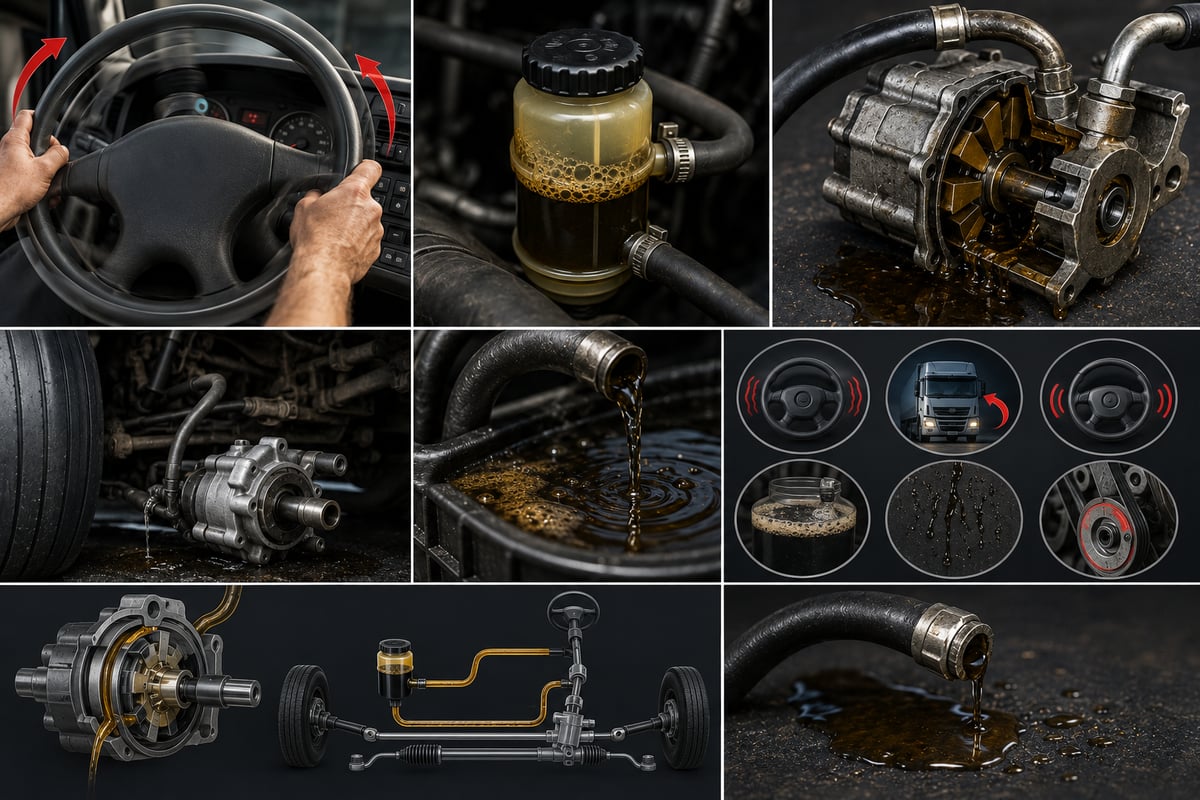
A driver backing a loaded tractor out of a job site is often the first one to notice it: the wheel feels heavier than usual, the engine seems to labor for a moment at full lock, and once the truck straightens out the wheel doesn't self-center. The same unit is fine on the highway. Back in the shop, the reservoir cap comes off to reveal foamy fluid, the pump pulley shows a bright glazed ring, and the drag-link ball joint has play you can feel by hand; what looks like one failed part is really three separate weak links acting together. This guide treats steering not as a single part but as the full mechanical-and-hydraulic chain running from the wheel to the tire.
What is a steering gear, and what does power steering actually mean?
The steering gear (steering box) is the mechanical-hydraulic gearset that takes the rotary motion of the steering wheel, reduces it through a large ratio while multiplying the driver's input force by that same ratio, and turns the wheels — and on heavy commercial vehicles the power-assist hydraulics are usually built into the same housing. Its job isn't only to pass motion along; it has to scale up the force from a driver's arm into something large enough to turn a steer axle carrying tons of load.
Power steering is the system that supplies part of that force multiplication from hydraulic pressure generated using engine power — "power-assisted steering" describes the same principle. When the driver turns the wheel, a valve inside the gear opens, pressurized fluid from the pump is routed to one face of the piston, and the piston adds its force to the driver's own effort to rotate the output shaft.
This assist isn't a comfort feature. A loaded steer-axle tire being turned while the truck is stationary generates a very large friction torque; without assist, the steering ratio needed to overcome that torque would mean turning the wheel dozens of times lock to lock.
If assist is lost, does the steering lock up?
No. Heavy-duty steering gears are built on the principle that the mechanical path stays intact even when hydraulic assist is lost. If the engine stalls, the belt snaps, or the pump fails, the gear train connecting the wheel to the tires stays in place — the wheel can still be turned, just with far more effort. This is a fallback left in so the truck can be brought to a safe stop; it is not permission to keep driving.
How does steering work on a heavy truck? The mechanical path and the hydraulic assist
Two paths work together in the system: the mechanical path carries the command to the wheel, and the hydraulic path generates the force that executes it. Faults are usually noticed at the exact moment the two paths come apart: the command still gets through, but the force doesn't follow.
The mechanical path starts at the steering wheel. The steering column carries motion through universal joints — which absorb the movement between cab and chassis — to the gear's input shaft. Inside the gear the motion is reduced and passed to the pitman arm on the output shaft. The pitman arm connects to the drag link running down to the knuckle arm, which pushes or pulls the left steer knuckle. The tie rod then keeps the two steer wheels turning in parallel, and at the end of the chain the wheels pivot around the kingpins at the axle ends.
The hydraulic path starts at the reservoir. A pump, driven off the engine by belt or gear, sends fluid to the gear through a high-pressure line. As long as the wheel isn't being turned, fluid simply passes through the gear and returns to the reservoir via the return line. The instant the wheel is turned, the valve assembly in the input shaft directs fluid to the relevant face of the piston, the opposite face is opened to the return line, and the piston adds its force to the driver's.
The key feature is that assist is proportional to the force the driver applies. The valve assembly is typically built around a torsion bar: the harder the driver forces the wheel, the further the valve opens. Almost no assist is given on the highway, which is what lets the driver feel the road, while the valve opens fully during a maneuver — a truck that "feels fine on the highway but heavy while maneuvering" is not a coincidence.
How a recirculating-ball gear actually works
At the heart of a heavy-duty steering gear is the recirculating ball chain between the worm shaft and the ball nut. A helical groove on the input shaft lines up with a matching groove inside the nut, and the spiral gap between them is filled with steel balls. As the shaft turns, the balls roll along the groove and push the nut along the shaft's axis, converting rotary motion into linear motion; balls reaching the end of the groove are picked up by an external return tube and carried back to the start. The balls' job isn't to carry load — it's to turn sliding friction into rolling friction.
The outside of the nut is machined like a gear rack and meshes with the sector gear on the output shaft. The nut also doubles as the hydraulic piston: the gear housing acts as the cylinder, and pressurized fluid from the valve pushes the nut. Because the mechanical gearing and the piston are combined in a single part, this design is called an integral power steering gear.
How this differs from a passenger-car rack-and-pinion system
In a passenger-car rack-and-pinion setup, a small pinion at the end of the steering shaft slides a toothed rack straight left and right; the entire load passes through one small gear mesh. On a heavy truck, the load that same mesh would have to carry would push gear dimensions to an impractical size. A recirculating-ball gear instead spreads the load across the ball chain and a wide sector-gear mesh, absorbs road shock, and carries an adjustable sector-gear lash. The practical consequence: on a heavy truck, play at the wheel doesn't always come from a tie-rod end — it can also come from the gear's own internal adjustment. A diagnosis carried out with passenger-car habits, going straight to the tie rods, can miss the sector adjustment entirely.
What components make up a steering system?
Reading the system as functional groups speeds up diagnosis: the mechanical chain, the hydraulic circuit, and geometry.
| Component | Function | Typical symptom when faulty |
|---|---|---|
| Steering column and universal joints | Carries the command from cab to chassis, absorbs the angle | Clunk at a specific angle, play, a tight spot |
| Steering gear | Reduces and multiplies motion, manages the assist | Center play, leakage, heavier in one direction |
| Power steering pump | Pressurizes fluid and feeds the circuit | Heavy steering when maneuvering, whine, speed-dependent noise |
| Reservoir and filter | Stores and filters fluid, lets air separate out | Foamy fluid, dropping level, clogged filter |
| Pressure and return lines | Carry fluid between pump, gear and reservoir | Leakage, sudden loss of assist, air ingestion, foaming |
| Pitman arm | Links the gear's output to the tie-rod chain | Loose taper joint, clunk when changing direction |
| Drag link | Carries force from the pitman arm to the knuckle arm | Play, clunking, wander on a straight road |
| Tie rod and its ends | Keeps the two steer wheels parallel | Alignment drift, uneven tire wear |
| Kingpins and bushings | Carry the wheel's steering axis | Heavy steering, creaking in turns, loss of caster |
| Second pitman arm, auxiliary cylinder | Steers the second axle on tandem-steer trucks | Uneven effort while maneuvering, wear on one axle |
| Drive belt and tensioner | Drives the pump off the engine | Squeal when maneuvering, assist fading with throttle |
The most misleading row in the table is the belt: when it's loose, the symptom is almost identical to a pump failure — assist is weak while maneuvering and briefly improves when you blip the throttle. Checking belt tension and pulley-face condition before pulling the pump is the single step that prevents the most unnecessary parts changes in the field.
Steering gear: function, failure symptoms and where repair stops
The gear is both the most expensive part in the system and the one most often blamed unfairly. The cases where the blame is justified are clear: fluid seeping from a shaft seal, play at center that doesn't disappear, noticeably heavier steering in one direction, and a hard clunk from inside when turning. What these share is that they can all be observed at the gear's own input, independent of the wheels.
Center play deserves its own note. The mesh between the sector gear and the ball nut is designed to be tightest at center, and because a truck spends most of its life running straight, wear also concentrates there. The result is a few degrees of free rotation felt at the wheel around center. Most gears have a sector adjustment screw to compensate; over-tightening it, though, creates a tight spot at center and stops the truck from self-centering on a straight road. The adjustment procedure and torque are manufacturer-specific.
Two mistakes are common in the field: assuming any leaking gear can be fixed with a seal replacement (a seal leak is usually the result of shaft-surface wear, not a bad seal on its own), and assuming a leak can be managed by topping up fluid (as the level drops, the running system draws in air). For the gear's detailed fault map, teardown discipline and step-by-step replacement procedure, see the Truck Steering Gear Box: Faults, Replacement & Maintenance guide.
Hydraulic circuit: pump, reservoir, filter and pressure lines
The hydraulic circuit is a closed loop made up of the reservoir, the pump, the high-pressure line and the return line. Its health can be read from a single indicator: the look of the fluid in the reservoir. Clear fluid means a healthy circuit, foamy fluid points to air getting into the system, dark and burnt-smelling fluid points to overheating, and fluid carrying a metallic sheen points to advanced wear.
Pumps are mostly gear-type, and the flow they produce depends on engine speed. That's exactly why maneuvering is the hardest operating point: the moment the truck needs the most assist is the moment the engine is closest to idle. The first sign that the system is becoming marginal is assist that's weak at idle and recovers as soon as you blip the throttle.
The pump body carries two protective devices. The pressure relief valve stops system pressure from exceeding the manufacturer's limit — it's the one that kicks in when the steering is held at full lock. The flow control valve caps the volume of fluid sent to the gear at higher engine speeds. Together, these two valves are the main source of fluid heating.
The reservoir isn't just a tank: it provides the settling volume needed for air bubbles in the returning fluid to separate out, and in most applications it also carries a strainer or cartridge filter. When the filter clogs, foaming increases. A loose clamp on the return line, meanwhile, may not leak fluid at all but can still draw air into the system. Telling line leaks apart, fitting and hose selection, and the replacement procedure are covered in the Power Steering Hydraulic Line Guide.
Tie rods, pitman arm and axle linkages: where the play really comes from
Most of the play felt at the steering wheel comes not from the gear but from the mechanical chain underneath it. Force is carried through ball joints: each joint is a tapered pin seated in a socket, with a plastic or metal bearing between them. Once that bearing wears, a fraction of a millimeter of movement in a single joint shows up at the wheel as several degrees of play.
The joints don't carry equal loads. The drag link carries the gear's entire output force on its own, so it's the most heavily stressed joint and usually the first to develop play. The tie rod carries less force but sets the front-end geometry, so play there tends to show up as tire wear instead. The pitman arm's tapered joint, meanwhile, doesn't so much develop play as it loosens — the tell is a hard clunk when changing direction.
Two mistakes are common when checking. The first is checking in the wrong direction: a joint loaded in its working direction may show no play at all, so a joint should always be checked against the direction it doesn't normally carry. The second is treating play as the only criterion; a torn dust boot means a joint's service life is over even if it hasn't developed noticeable play yet. Inspection methods, teardown discipline and post-adjustment verification are detailed in the Steering Drag Link & Tie Rod guide.
Further reading
For a plain-language technical overview of this subject, see the reference article on Wikipedia. Always confirm specific figures and procedures against the vehicle manufacturer service data.
Steering fault symptoms: what points to which cause?
Diagnosis speeds up by looking at the condition under which a symptom appears. Symptoms seen only while maneuvering point to the hydraulic side; symptoms seen only at higher speed point to geometry and balance; symptoms present regardless of speed point to mechanical play.
| Symptom | Likely mechanism | First check |
|---|---|---|
| Steering gets heavy while maneuvering | Insufficient assist: level, belt, pump or valve | Check reservoir level and belt tension |
| Whine or groan when turning | Air ingestion, low level, clogged filter | Check whether the reservoir fluid is foamy |
| Play at center that doesn't disappear | Worn gear sector mesh or worn tie-rod ends | Check play at the gear input and the linkage separately |
| Hard clunk when changing direction | Loose pitman-arm taper or column universal joint | Check joint torque and taper seating |
| Pulling to one side on a straight road | Caster imbalance, tire pressure, brake drag | Equalize pressures and retest on a straight road |
| Fluid level keeps dropping | A hidden leak; the circuit shouldn't consume fluid | Inspect the circuit section by section under load |
| One-sided, saw-tooth tire wear | Front-end (toe) drift | Remove play first, then measure alignment |
| Wandering on the highway, constant correction | Accumulated total play, geometry has shifted | Check every joint in the chain one by one |
There are two traps here. First, not every heavy feel is hydraulic in origin: low tire pressure, a seized kingpin or an unlubricated bushing can produce the same complaint. Second, looking for a single culprit in a play complaint is a mistake — three joints, each within limits on their own, can add up at the wheel to an unacceptable total.
Field diagnosis flow: what order should you check things in?
The right sequence goes from cheap to expensive and from the outside in; the steps below are meant to gather what the system is already telling you before any parts are replaced.
- Park the truck on level ground, set the parking brake, and chock the wheels. Get the complaint straight from the driver: does it show up cold or hot, while maneuvering or at speed?
- Check the reservoir level under the condition the manufacturer specifies; look at the fluid's color, smell and whether it's foamy. Foamy fluid points to an air leak on the suction side.
- Check the drive belt and tensioner; if the pulley is glazed, the belt is cracked, or the tensioner is weak, fix these before moving on to the hydraulic side.
- With the engine off, turn the steering wheel in both directions and measure the free play: the angle the wheel travels before the tires start to move is the system's total play.
- If the play exceeds the limit, isolate its source: with a helper rocking the wheel in small movements, watch the gear's input shaft, output shaft, pitman-arm taper, drag link and tie-rod ends one by one. The first link that doesn't move is where the play is coming from.
- Start the engine and slowly turn the steering at idle: is assist present, is it equal in both directions, does the noise change? Repeat at a fast idle and note the difference.
- Measure system pressure with a gauge connected at the point the manufacturer specifies: both the free-flow pressure at idle and the maximum pressure at which the relief valve opens. Keep dwell time at full lock short. If pressure is low, don't blame the pump outright — internal bypass inside the gear produces the same result.
- Clean the lines and observe again under load; look for leaks with a clean piece of cardboard, not your hand. If mechanical play and pressure both check out, move on to geometry: equalize tire pressures, read the wear patterns, and measure the alignment.
- Log everything you did and every value you measured in the vehicle file; because these complaints develop gradually, comparing against a previous reading tells you more than any single measurement.
The step that saves the most time is the fifth one: ten minutes of careful, deliberate observation will almost always show which link is moving.
Power steering fluid: selection, level checks and changing it
In a power steering circuit, fluid isn't a consumable — it's a working machine element that transmits force and lubricates surfaces. Heavy-duty circuits use two families of fluid: ATF-type automatic transmission fluid and central hydraulic fluid or mineral-based hydraulic oil. Which one to use is set by the manufacturer's specification. The two families should never be mixed; different additive packages can neutralize each other, seal swell behavior changes, and the system starts leaking within a short time.
Checking the level is a precise job, because reservoir level shifts with fluid temperature and steering position. Manufacturers generally call for the check to be done at a specific temperature, with the wheels straight and the engine off. A level that keeps dropping, on the other hand, is always a loss — a closed loop doesn't consume fluid.
The goal when changing fluid is to remove as much of the old fluid as possible; draining the reservoir alone only renews a small fraction of it. The usual method is to disconnect the return line from the reservoir and let the fluid pump out into a container while slowly turning the steering wheel; the reservoir should never be allowed to run dry during the process.
Bleeding the system: why it matters and how it's done
Air is a compressible intruder in a hydraulic system. Fluid transmits force practically instantly because it doesn't compress; air bubbles mixed into it, on the other hand, compress first and then expand. The result is delayed assist, a spongy steering feel, whining, and in severe cases cavitation damage inside the pump. That's why a bleed procedure needs to be run every time the circuit is opened, whenever the fluid is changed, and any time the level has dropped below the suction port.
Bleeding simply gives bubbles the chance to separate from the fluid and escape the reservoir to atmosphere. The most common mistake is rushing it; fast, hard steering movements break the bubbles up and mix them more finely into the fluid, which only draws the process out.
- Park on level ground, set the parking brake, and chock the wheels; if the manufacturer calls for the steer axle to be raised, support the load on stands.
- Fill the reservoir to maximum with the fluid the manufacturer specifies, and give it a few minutes to work its way down into the gear.
- With the engine off, turn the steering slowly from lock to lock a few times, topping up the level after each cycle.
- Start the engine and let it idle; some foaming and a drop in level are normal at this stage — don't let the suction port run dry.
- Turn the steering slowly in both directions, stopping just short of full lock; holding at full lock brings the relief valve into play and heats the fluid unnecessarily.
- Wait for the noise to settle and the foam to clear; if the noise persists, stop and check the clamps, hoses and fittings on the suction side.
- Shut off the engine, wait a few minutes, and top up the level one last time under the manufacturer's specified condition.
- After a short test drive, recheck the connections and the level cold; a drop in level shows that trapped air has been replaced by fluid, and the level should be topped up again.
Wheel alignment and toe: the link to tire wear
Wheel alignment is the full set of angles at which the wheels sit relative to the road and the chassis. The steering system doesn't set these angles — it carries them — but when they drift out of spec, the complaint almost always comes in through the steering.
Toe is the angle between the two steer wheels as seen from the front or back: if the fronts of the tires point toward each other it's "toe-in," and if they point apart it's "toe-out." Because axle components flex under load while the truck is moving, the wheels open up slightly, and manufacturers specify a static setting that compensates for that flex. Toe is the angle with the most direct effect on tire wear; even a deviation of a millimeter or two produces measurable wear.
Camber is the angle a wheel makes with vertical when viewed from the front; caster is the tilt of the steering axis viewed from the side, and it's what gives the steering its tendency to return to center on its own. Kingpin inclination works together with caster to pull the wheel back toward straight-ahead. On heavy trucks, caster and kingpin inclination are generally not adjustable; a deviation there means damage, overload, or deterioration in the suspension components.
| Wear pattern | Likely cause | Where to look |
|---|---|---|
| Saw-tooth wear (feathering) at the tread edges | Toe deviation | Alignment check, tie-rod adjustment |
| Rapid wear on one shoulder | Camber deviation or a bent axle | Axle straightness, hub bearing play, spring group |
| Wear on both shoulders or down the center of the tread | Consistently low or consistently high pressure | Compare pressure against the load chart |
| Localized, cupped wear spots | Vibration that isn't being damped out | Steering damper, wheel balance, hub bearing play |
| Wear returning shortly after an alignment | Alignment set before play was removed | Tie-rod ends, kingpin bushings, hub adjustment |
The last row is the most important rule: measuring and adjusting alignment only means something once play has been removed. The order matters: tire pressure and condition first, then joint and bushing play, then hub adjustment, and alignment last. A toe deviation also increases rolling resistance and creates a measurable fuel-consumption penalty.
Steering load and the second pitman arm on tandem-steer trucks
On trucks where both front axles steer — some four-axle tippers and mixers, for example — the load the system has to carry doesn't just double; it becomes more than double. Both axles' tire friction has to be overcome at the same time, and the second axle needs a different turning angle, which calls for extra force and an extra linkage.
Three solutions are common. The first fits a second pitman arm to the gear output and extends a separate drag link to the second axle. The second draws on a separate auxiliary hydraulic cylinder, fed from the main circuit, to take on part of the load. The third transmits motion mechanically through an intermediate arm linkage mounted on the chassis.
The key to diagnosis is separating which axle a symptom belongs to. Heaviness while maneuvering can just as easily come from binding in the second axle's linkage. When the turning-angle relationship between the two axles is off, tire wear shows up on only one axle — which is why alignment has to be measured on both axles separately. A fault on the suspension side can also load one axle more than the other and wear its components out fast.
Technical values and general reference ranges
The table below collects the figures most often needed in the field, as order-of-magnitude reference. These values aren't for making a decision — they're for sanity-checking whether a measured result is in a reasonable range.
| Value | General reference range or criterion | Interpretation |
|---|---|---|
| Maximum hydraulic system pressure | Roughly in the 130-180 bar range on heavy trucks | Set by the relief valve, varies by vehicle |
| Fluid and filter change interval | Mileage or time, whichever comes first | Shortened under severe duty cycles |
| Steering wheel free play | The manufacturer's angle limit governs | One of the checks in periodic vehicle inspection |
| Power steering fluid type | ATF or mineral hydraulic fluid, per spec | Families aren't mixed; seal behavior changes |
| Maximum dwell time at full lock | Should not exceed a few seconds | Extended dwell heats the fluid quickly |
| Toe setting | A small positive value, vehicle-specific | Only adjusted after play has been removed |
| Caster and kingpin inclination | Generally not adjustable | Deviation points to damage or a worn spring |
| Tie-rod end dust boot | A torn boot is reason for replacement even without play | Service life drops sharply once torn |
| Tie-rod and pitman-arm fastening torque | Per the OE manual's value and tightening sequence | Taper-joint torque is a safety item |
| Drive belt and pressure hose | Tension per manufacturer's method, hose life by condition | A loose belt mimics a pump failure |
The table's real rule is this: no numerical value for steering can be used independent of the chassis code. Two trucks from the same manufacturer with the same cab can call for very different values because of different axle loads or a different steering gear.
Maintenance, service life and steering's place in the safety chain
The steering system doesn't have a fixed overhaul interval; its service life is set by duty cycle and maintenance discipline, not mileage. In dusty, maneuver-heavy environments like construction sites, tie-rod ends wear several times faster than on a truck that runs mostly highway miles; hydraulic fluid ages faster too.
- Level and fluid appearance: Reservoir level goes on the periodic inspection checklist; fluid color, smell and foaming are assessed at every check.
- Leak inspection: Gear seals, pump shaft, fittings and hoses are inspected over cleaned surfaces.
- Joint and boot inspection: Joints are checked for play in the direction they don't normally carry load; boots are checked for tears and moisture ingress.
- Lubrication and belt: Joints, kingpins and bushings fitted with grease points are lubricated with the correct grease type; belt tension, cracking and pulley-face condition are checked periodically.
- Free-play measurement: Total play at the wheel is measured periodically with the same method and logged; a trend tells you more than a single reading.
- Tire and geometry tracking: Pressures and wear patterns are read regularly; a change in wear pattern is the earliest warning of a geometry shift.
- Fluid renewal and records: Hydraulic fluid and any reservoir filter are renewed on schedule; parts changed, torque applied and pressure measured are all logged in the vehicle file.
Steering, along with the brakes, is one of a truck's two fundamental safety systems, and there's one difference between them: a brake fault usually announces itself, while a steering fault creeps up quietly. Play in one joint grows over a period of weeks, and the driver adapts to it. That adaptation is the real risk, because the moment the system is truly needed isn't routine driving — it's a sudden evasive maneuver.
Steering also can't be evaluated as an isolated group: geometry won't hold on a truck with sagged springs, an alignment measurement is meaningless with a bad hub adjustment, and assist always feels inadequate when tire pressure is low. The right order is: tires and pressure first, then axle and suspension, then mechanical play, then the hydraulic circuit, and geometry last. The steering gear, the most expensive link in the chain, should always be the last one questioned — everything feeding into it should be confirmed correct first. In every case, the vehicle's current OE service documentation for its engine and chassis code is the authoritative source.
Shop this part: Steering pump
In-depth technical guide: For fault diagnosis, step-by-step replacement and service intervals: Hydraulic Steering Pump: Failure, Replacement & Care Guide
All our technical guides on this topic
- Steering Drag Link & Tie Rod: Faults, Replacement, Care
- Power Steering Hydraulic Line Guide: Leaks & Replacement
- Truck Steering Gear Box: Faults, Replacement & Maintenance
- Hydraulic Steering Pump: Failure, Replacement & Care Guide
VADEN ORIGINAL products
- Steering — 101 products
- Steering Pumps — 98 products
- Actuating Lever — 52 products
- Steering (Engine) — 27 products
Tags
Frequently Asked Questions
- What does a steering gear do?
- The steering gear takes the rotary motion of the steering wheel, reduces it through a large ratio and multiplies the driver's force by that same ratio to turn the wheels. On heavy commercial vehicles the power-assist hydraulics are usually built into the same housing; the piston inside adds pressurized fluid from the pump to the driver's own effort. That's what makes it possible to turn a steer axle carrying tons of load without excessive effort.
- What are the symptoms of a bad steering gear (steering box)?
- The most common ones are fluid seeping from the input or output shaft seal, play at center that doesn't disappear, noticeably heavier steering in one direction, and a hard clunk from inside when turning. What these have in common is that they can be observed at the gear's own input, independent of the wheels. Center play can often be compensated with the sector adjustment screw most gears have, but the adjustment procedure and torque are manufacturer-specific.
- Why does the steering feel heavy on a truck?
- Heaviness while maneuvering usually comes from insufficient hydraulic assist: low fluid level, a loose or slipping drive belt, a worn pump, or internal bypass inside the gear. But not every heavy feel is hydraulic in origin; low tire pressure, a seized kingpin, or an unlubricated bushing can produce the same complaint. Level, belt tension and tire pressure should always be checked before the pump is pulled.
- How does power steering work on a heavy truck?
- A pump driven off the engine draws fluid from the reservoir and sends it to the gear through a high-pressure line. As long as the wheel isn't being turned, fluid simply passes through the gear and returns to the reservoir. The instant the wheel is turned, the valve assembly in the input shaft directs fluid to the relevant face of the piston, and the piston adds its force to the driver's effort. Assist increases in proportion to how hard the driver forces the wheel, thanks to the valve acting on a torsion bar.
- What causes play in the steering, and is it dangerous?
- Most of the play comes from the mechanical chain underneath the gear — wear in the drag-link and tie-rod ball joints; the gear's own sector mesh can add play as well. A fraction of a millimeter of movement in a single joint shows up at the wheel as several degrees of play, and the play from three joints adds up to an unacceptable total. Steering wheel free play is one of the checks in periodic vehicle inspection; if it's above the limit, the truck should not be put back into service unrepaired.
- What type of fluid does power steering use?
- Heavy-duty power steering circuits use one of two fluid families: ATF-type automatic transmission fluid, or central hydraulic fluid and mineral-based hydraulic oil. Which one applies is set by the vehicle manufacturer's specification. The two families should never be mixed — different additive packages can neutralize each other, seal swell behavior changes, and the system starts leaking within a short time.
- Why does a power steering system need to be bled?
- Fluid transmits force almost instantly because it doesn't compress; air bubbles mixed into it compress and then expand, causing delayed assist, a spongy feel, whining, and in severe cases cavitation damage inside the pump. Bleeding is required every time the circuit is opened, whenever the fluid is changed, and any time the level has dropped below the suction port; the procedure should be done slowly, since fast steering movements only break bubbles up further.
- What causes a whining noise when turning the steering wheel?
- A whine or groan when turning is most often a sign of air ingestion on the suction side, a low fluid level, or a clogged reservoir filter. Foamy or milky-looking fluid under the reservoir cap supports this diagnosis. The source of the air should be found before the fluid is changed — otherwise the new fluid ends up in the same condition within a short time.
- What is toe (front-end alignment), and when should it be adjusted?
- Toe is the angle between the two steer wheels seen from the front or back, and it's the angle with the most direct effect on tire wear; the setting used in practice is popularly called the alignment or tracking adjustment. Measuring and adjusting it only means something once play has been removed, since a loose joint won't hold the angle the gauge shows. The correct order is tire pressure and condition first, then joint and bushing play, then hub adjustment, and alignment last.
- Can you keep driving if power steering assist is lost?
- No. Heavy-duty steering gears are built so the mechanical path stays intact even if hydraulic assist is lost — if the engine stalls or the belt snaps, the wheel can still be turned, just with much more effort. This is a fallback built in so the truck can be brought to a safe stop, not permission to keep driving; a truck running on lost assist won't have enough steering response left for a sudden evasive maneuver.
Related Articles
Power Steering Hydraulic Line Guide: Leaks & Replacement
Power steering hydraulic lines on trucks and tractor units: pressure, return and suction line symptoms, fitting types, replacement and bleeding.
Hydraulic Steering Pump: Failure, Replacement & Care Guide
Whining at the wheel and heavy steering at manoeuvring speed in a truck usually trace to the hydraulic steering pump: diagnosis, replacement, fluid care.


