Thermostat Failure Symptoms: Why Does the Engine Warm Up Slowly or Overheat?
Thermostat failure in heavy-duty trucks: stuck open delays warm-up and wastes fuel, stuck closed causes rapid overheating. Symptoms, diagnosis, and testing guide.
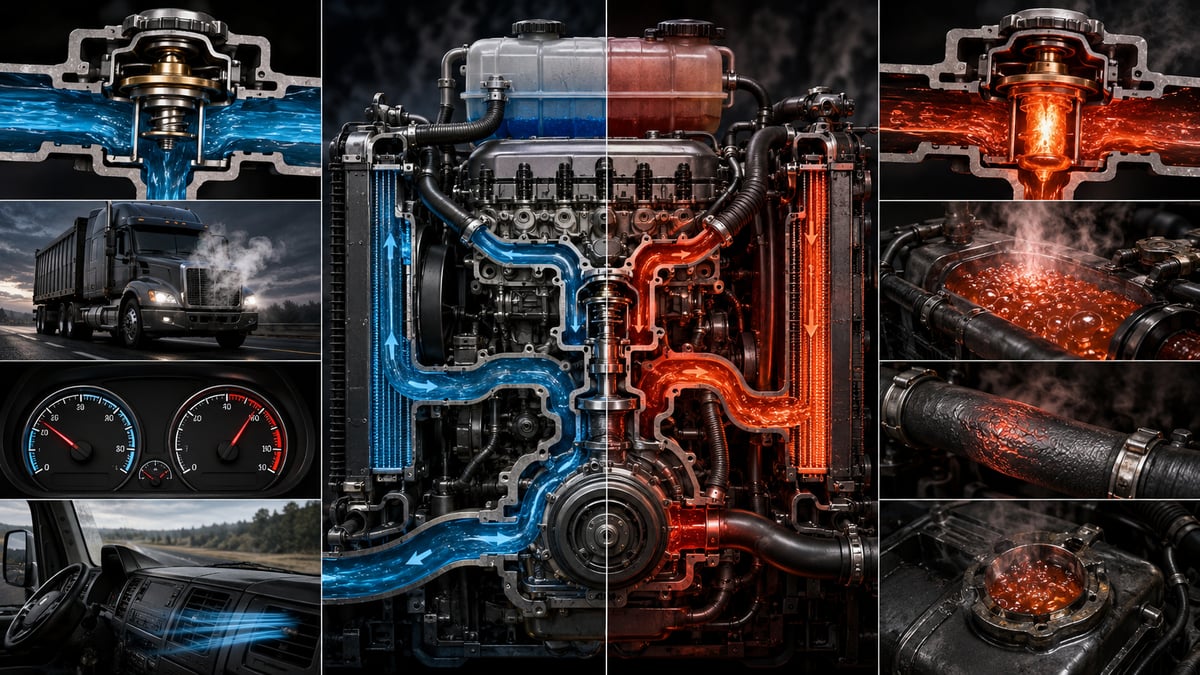
On a winter morning, a tractor unit pulls away and forty kilometres later the coolant gauge still sits in the first quarter, the cab won't warm up, and the windscreen barely clears; the driver blames "cold weather" and moves on. Another vehicle from the same fleet, loaded and climbing a grade, sends the needle into the red within a few minutes and steam out of the expansion tank. Both trucks describe one and the same component: the engine thermostat. One has stuck open; the other has closed and never opened again. This is the hardest part of thermostat failure — its symptoms arrive as two exactly opposite pictures, and correct diagnosis begins with telling which picture is in front of you.
Why Is Engine Operating Temperature a Target, Not Just a Number?
Contrary to popular belief, a diesel engine is not designed on the principle that "the cooler it runs, the better." Engine efficiency, wear rate, emissions, and the ability of the aftertreatment system to function all depend on staying within a narrow temperature band. An engine that runs below this band wastes fuel and wears itself out; one that runs above it can produce expensive damage within minutes. The thermostat is the automatic flow regulator that keeps the cooling circuit inside this narrow window between the two extremes.
The thermostat has two jobs that are often confused with each other. The first is to bring a cold-started engine up to operating temperature quickly: it does this by keeping coolant away from the radiator, temporarily blocking heat rejection. The second is to hold the engine in that band once it gets there, regardless of load, road speed, or ambient temperature. It is this second job that lets the same engine run at the same coolant temperature at minus ten degrees in winter and at forty degrees in summer.
The thermostat is not a safety valve; cooling capacity itself is set by the radiator, the fan, the water pump, and the coolant, and the thermostat only decides how much of that capacity gets used. This distinction matters for diagnosis: not every overheating truck has a faulty thermostat, but when a thermostat sticks closed, heat cannot be rejected no matter how sound the rest of the system is.
How Does a Thermostat Open? The Wax Element's Operating Logic
A conventional thermostat contains a special wax (paraffin) compound that expands markedly with heat. As temperature rises, the wax inside the sealed capsule softens and increases in volume; that growing volume pushes a piston, which opens the valve against spring force. When temperature drops, the wax solidifies and the spring pulls the valve back onto its seat. There is no electricity or sensor involved; the motion comes directly from temperature itself.
This has two consequences. First, a thermostat is not an on/off switch: it starts opening at the rated temperature stamped on its body, is fully open a few degrees higher, and sits partially open in between, continuously modulating flow. Second, the wax element is a wear item: after thousands of heating-cooling cycles its response speed drops, the spring fatigues, and scale builds up on the sealing face. A thermostat usually fails gradually, growing sluggish and letting temperature swing, rather than failing all at once.
This guide follows the diagnostic path from symptom to cause. Removal and installation sequence, housing torque, gasket selection, and a post-replacement checklist are covered separately; for the step-by-step replacement procedure, see the engine coolant thermostat faults, replacement, and care guide. The question this article answers is different: which failure does the symptom in front of you point to, and is the thermostat really the guilty part?
Mapping the Cooling Circuit: Small Loop, Large Loop, and Bypass
Understanding thermostat behaviour means separating the two paths coolant can take. The water pump circulates coolant continuously for as long as the engine runs; the thermostat decides where that flow goes.
The small loop (bypass) is the short path used while the engine is cold. Coolant circulates through the block and head galleries, in most designs also feeding the heater core and the oil cooler, then returns to the pump inlet without passing through the radiator. The bypass exists not only for fast warm-up but also to keep flow moving through the pump and to spread heat evenly: if flow stopped entirely, localised boiling would start at the hottest points of the cylinder head.
The large loop comes into play once the thermostat opens. Coolant leaves the cylinder head outlet, travels to the radiator, is cooled by airflow and the fan, and returns to the pump through the lower hose. Most heavy-duty thermostats are dual-valve: a main valve on the same spindle opens the radiator path while a second valve throttles the bypass, so as opening progresses a growing share of flow is directed to the radiator. This explains why the "just remove the thermostat" fix, covered later, does not work the way people expect.
Thermostat location varies by make: in the traditional layout the part sits at the cylinder head outlet, on the hot side; in some engines it sits on the radiator return, on the cold side, regulating what enters the engine. The second layout calls for a different reading of hose temperatures and should be confirmed against the service documentation.
The Two Opposite Faces of Thermostat Failure: Stuck Open and Stuck Closed
A thermostat fails in two basic ways, and each produces the opposite symptoms of the other. With stuck-open failure, the valve never fully closes; coolant keeps circulating through the radiator even while the engine is cold, so the heat being generated is rejected as fast as it forms and the engine reaches its target temperature late, or never. With stuck-closed failure, the valve never opens; because heat cannot reach the radiator, temperature climbs quickly under load and the engine overheats.
A third, more insidious form is partial sticking, or delayed opening: the valve does open, but late and erratically. The truck looks normal in most respects, except that temperature oscillates, the fan cycles more often than usual, and temperature climbs higher than expected on a grade.
| Symptom | Which fault | Why it occurs |
|---|---|---|
| Engine does not warm up for a long time; the gauge stays at the first quarter | Stuck open | Coolant is always circulating through the radiator, so heat is rejected as fast as it is generated |
| Heater blows lukewarm air, the cab does not warm up, windscreen mist clears slowly | Stuck open | Coolant reaching the heater core stays below the target temperature |
| Fuel consumption rises in winter and on short trips | Stuck open | Friction is high in a cold engine, combustion efficiency is low, and the warm-up fuel map stays active |
| Aftertreatment warnings, regeneration not completing | Stuck open | Engine and exhaust temperature stay low, so the system cannot reach operating temperature |
| Gauge needle hits the red zone within minutes | Stuck closed | The large loop is closed, so the heat generated never reaches the radiator |
| Overflow at the expansion tank, steam and coolant loss from the cap | Stuck closed | Temperature and pressure in the circuit rise, and the cap releases pressure |
| Heater still blows hot while the engine is overheating | Stuck closed | The bypass and heater circuit are still flowing; only the radiator path is blocked |
| Upper radiator hose stays cold while coolant temperature keeps climbing | Stuck closed | Because the valve does not open, heat-carrying coolant cannot pass into the radiator |
| Temperature rises and falls at regular intervals, never settling | Partial sticking, delayed opening | A fatigued wax element responds late, then overshoots open and overshoots closed |
| Temperature rises on a grade and returns to normal on flat road | Partial sticking or failure of one thermostat | The open flow area is not enough for high load |
Two traps are worth watching for when reading this table. First, on many heavy-duty vehicles the gauge needle is held in the middle across a wide band; it will not move even if the actual temperature changes. Reliable diagnosis relies on live coolant temperature read from a diagnostic tool, not the gauge. Second, none of these symptoms is unique to the thermostat: a faulty temperature sensor, a low coolant level, a fouled radiator, or a fan that fails to engage can all produce the same picture.
What Happens When the Engine Warms Up Slowly? The Consumption and Wear Chain
A thermostat stuck open will not leave a truck stranded. Precisely for that reason, it can run unnoticed for months while quietly running up a bill. In an engine that warms up slowly, several mechanisms feed off each other at the same time.
The lubrication side. Cold oil is thick; the pump works against high resistance, oil reaches bearing surfaces late, and a full oil film cannot form in the first few minutes. A significant share of the wear an engine accumulates over its life happens during these warm-up minutes; when the thermostat sticks open, those minutes multiply several times over.
The combustion side. Fuel struggles to vaporise against cold cylinder walls, the mixture loses homogeneity, and soot formation increases. Part of the unburned fuel is scraped down the cylinder wall into the sump oil, thinning it and reducing its protective ability. Under the same conditions, condensation water collecting in the sump forms acidic compounds that corrode internal surfaces.
The aftertreatment side. In a modern heavy-duty vehicle, low engine temperature is not just a mechanical issue. Passive regeneration of the particulate filter and efficient operation of the SCR system both need a certain exhaust temperature. An engine that consistently runs cold needs more frequent forced regenerations to clean the filter; every forced regeneration burns extra fuel and increases oil dilution. In this way, a single wax element stuck open drives up consumption both directly and indirectly.
The driver and safety side. The cab will not warm up, and the windows clear of mist slowly; a misted windscreen is a visibility problem, not just a comfort issue. In a number of vehicles where drivers complain about weak heater performance in winter, the fault lies not in the heater core but in the thermostat.
If the Thermostat Sticks Closed: The Chain Reaction of Sudden Overheating
Unlike stuck-open failure, stuck-closed failure shows itself within minutes, and its consequences can be irreversible. Here is how the chain unfolds.
Because the valve does not open, the heat generated stays trapped inside the block and cylinder head. As temperature rises, local boiling begins at the hottest points, typically around the exhaust valve seats. The resulting vapour bubbles cannot carry heat away; steam is a far poorer heat conductor than liquid. Once vapour reaches the water pump inlet, the pump goes into cavitation and loses most of its output; the moment flow collapses, the temperature rise accelerates.
As pressure rises, the expansion tank cap releases some of the coolant; every unit that escapes is replaced by air, and the circuit's heat-carrying capacity drops further still. From there, the order of damage is predictable: the cylinder head gasket fails, the head warps or cracks, the oil film on the cylinder wall breaks down, and oil cooks in the turbo bearing. In a loaded tractor unit, this sequence often plays out within a few minutes.
The right response in the field is to back off the load the moment temperature starts climbing, pull over somewhere safe, shut the engine down the way the manufacturer specifies, and let it cool; the cap must never be opened on a hot system. Causes of overheating other than the thermostat, and the correct roadside response sequence, are covered in detail in the engine overheating in heavy-duty trucks guide; the thermostat is only one of several possible causes behind that picture.
What Does Heater Behavior Tell You During Diagnosis?
In most designs, the heater core is fed from the small loop, that is, from the bypass branch. This detail gives you a powerful clue that needs no diagnostic tool at all: whether the heater blows hot tells you whether flow exists; engine temperature tells you whether heat is being rejected.
| Engine temperature | Heater output | Leading possibility and how to confirm it |
|---|---|---|
| Rising, heading toward overheating | Blows hot | Flow is present; the radiator path is blocked. Check for a thermostat stuck closed, a clogged radiator, or a fan that fails to engage |
| Rising, heading toward overheating | Blows cold or lukewarm | Flow itself has collapsed. Check for a low coolant level, an airlock, or a failed water pump impeller |
| Not reaching the target, staying low | Blows lukewarm | A thermostat stuck open is the leading suspect. Record the warm-up curve with live data |
| Oscillating, rising and falling | Blown air temperature also oscillates | A partially sticking thermostat or air in the circuit. Verify coolant level and the bleeding procedure first |
The second row matters most: a heater blowing cold while the engine overheats points to the flow itself rather than the thermostat. Corrosion-thinned or loose impellers on the water pump are among the most common causes; pump failure symptoms such as weep-hole leakage and bearing noise are covered in the water pump faults, replacement, and maintenance guide. Evaluating both together also avoids opening the same job twice.
Further reading
For a plain-language technical overview of this subject, see the reference article on Wikipedia. Always confirm specific figures and procedures against the vehicle manufacturer service data.
How to Read the Gauge, Live Data, and Fault Codes
The single biggest time-waster in thermostat diagnosis is trusting the dashboard gauge too much. On many trucks the gauge is not linear: the needle is held in the middle for every value inside a certain band and only moves quickly once that band is exceeded. This design protects the driver's peace of mind, and misleads the diagnostician.
The warm-up curve is the single most valuable piece of data. Start logging from a cold engine and track temperature against time. In a healthy system, temperature climbs steadily, then the rate of rise slows noticeably near the rated value (the thermostat has opened), after which it settles into a narrow band. Stuck open, the curve is flat from the start and often never settles at all, rising under load and falling when load comes off. Stuck closed, the curve keeps climbing without ever slowing down.
The second data point is the temperature difference between engine outlet and radiator return: while the thermostat is closed this gap is very large, and it shrinks quickly once it opens. This is measured with an infrared thermometer, not by touch.
Fault codes help, but they need interpretation. A code along the lines of "coolant temperature did not reach the regulation value within the expected time" points strongly to a stuck-open thermostat; over-temperature codes, on the other hand, only report the outcome, not the cause. The sensor itself can also fail: one that reports a low reading while actual temperature is normal produces the same code. For this reason, the sensor value should be cross-checked against an infrared reading taken on the housing.
Testing the Thermostat by Warming the Engine: Step-by-Step Verification
Whether a thermostat is opening can largely be determined without removing the part, simply by observing the engine as it warms up. The goal is to catch the moment the upper radiator hose starts to heat up as temperature rises.
- Start with the engine completely cold. Check coolant level, colour, and whether there is oil or bubbles in the expansion tank; no measurement is reliable in a circuit that is low on coolant.
- Secure the vehicle, apply the parking brake, and put the transmission in neutral. Stay clear of the rotating fan and belt area; on many trucks the fan can engage unexpectedly.
- Connect a diagnostic tool and open the live coolant temperature parameter; at the same time, point an infrared thermometer at the end of the upper radiator hose nearest the engine.
- Run the engine at idle and log temperature against time. At this stage it is normal for the upper hose to stay cold for a while; the thermostat is closed and coolant is circulating through the small loop.
- Keep watching the hose as coolant temperature approaches its rated value. In a healthy system, hose temperature rises noticeably within a short time; that is the moment the valve opens.
- If coolant temperature clearly exceeds its rated value while the upper hose stays cold, a stuck-closed diagnosis is strongly supported. Shut the engine down at this point; continuing to run it up increases the risk of damage.
- If the upper hose warms up from the first few minutes and coolant temperature takes a long time to reach target, a stuck-open diagnosis is strongly supported. Confirm the same behaviour on the road under load.
- Set the heater control to its hottest position and compare the blown-air temperature against the table in the previous section; this is a second, independent observation confirming whether flow is present.
- If doubt remains, remove the part and bench-test it: heat coolant slowly in a container fitted with a thermometer, observe the temperature at which the valve moves, and compare it against the rated value stamped on the housing. Know the limits of this test: a thermostat that opens correctly in an unpressurised, no-flow container can still open late on the vehicle, so passing the bench test does not clear the part outright.
Dual-Thermostat and Electronically Controlled (Map-Controlled) Systems
In large-displacement heavy-duty engines, the flow a single thermostat can pass is not enough; these engines house two thermostats working in parallel within the same housing. This creates an insidious picture: if only one fails, the system does not collapse outright, but the open flow area is no longer enough for high load, so the truck looks normal on flat ground yet edges toward overheating on a grade. For this reason, on dual-thermostat engines the parts are always replaced as a pair.
Many thermostat housings include a small air bleed hole or a free-moving pin that lets air trapped above the valve escape during filling. If the hole is blocked or the part is fitted in the wrong orientation, air remains around the wax element; sensing air instead of liquid, it opens late and the truck overheats even with a brand-new part. A good share of "we replaced the thermostat and it's still boiling" complaints trace back not to a defective part but to wrong orientation or an incomplete bleed.
An electronically controlled (map-controlled) thermostat, by contrast, houses a heating element built into the wax capsule itself. When the control unit judges it necessary, it energises this element to pre-heat the wax and makes the valve open earlier than coolant temperature alone would require — letting the engine run hotter under light load for efficiency, while early opening under high load keeps the safety margin. Failure here has two layers: the mechanical side can stick like a conventional thermostat, while the electrical side can develop an open circuit, a short, or a driver-stage fault. When power is lost, the part usually reverts to purely mechanical behaviour; the engine keeps running, but temperature settles in an unexpected band and a fault code is set.
Diagnosis on mapped systems cannot rely on a bench test alone; the control signal itself has to be verified with live data. Fitting a conventional mechanical thermostat into such a system is not a fix either: the control unit no longer finds the element it is supposed to command, and the fault code becomes permanent.
Consequences of Choosing the Wrong Opening Temperature
The rated opening temperature stamped on the housing is the joint result of the engine manufacturer's lubrication, combustion, emissions, and durability calculations; it is not an arbitrary preference to be chosen at will. One of the most common mistakes made in the field is fitting a lower-rated thermostat with the idea of "keeping it from overheating in summer"; the outcome is usually the opposite of what was intended.
| Practice | Resulting condition | Why it causes problems |
|---|---|---|
| Fitting a thermostat that opens below the rated value | The engine runs permanently below its target band | Consumption, oil dilution, and wear all increase; the aftertreatment system cannot reach temperature |
| Fitting a thermostat that opens above the rated value | Operating temperature rises and the overheating margin shrinks | No safety margin is left in summer conditions or on a long grade |
| Not fitting a thermostat at all, leaving the housing empty | The engine never warms up, and on most engines overheating risk does not fall — it rises | With the bypass leg never closing, flow keeps taking the short path and does not pass through the radiator enough |
| Fitting a similarly-sized part from a different engine code | Open flow area and flow characteristics stay mismatched | Flow falls short under high load, and over-cooling occurs under light load |
| Fitting the part reversed, or with the air bleed pin misaligned | Overheating and unstable temperature after replacement | Air remains around the wax element, and the valve opens with a delay |
The third row deserves particular emphasis. Removing the thermostat is usually done on the logic of "let the water flow freely," and on dual-valve designs it backfires: with no main valve present, the bypass leg never closes either, so coolant keeps taking the lowest-resistance short path and does not pass through the radiator enough. A number of these vehicles overheat more easily once the thermostat is removed; and because the engine never reaches its target temperature, the consumption and wear chain kicks in as well.
Thermostat, Water Pump, or Radiator? Telling Similar Symptoms Apart
Before replacing any part on a truck that comes in with an overheating or low-temperature complaint, the other causes capable of producing the same symptom need to be ruled out.
- Level and air: No measurement is reliable if the level is low or the circuit contains air. Look for leaks first, then fill and bleed the system following the manufacturer's procedure.
- Water pump: If flow has collapsed, the heater blows cold while the engine overheats. Weep-hole leakage, pulley play, and bearing noise are confirming signs.
- Radiator: A core clogged with insects, mud, or an oil film causes overheating especially at low speed and on construction-site duty. Internal blockage becomes obvious under high load; cold spots on the core can be located with an infrared reading.
- Fan and fan clutch: On a truck that overheats in traffic and recovers on the open road, the fan side is the first suspect. With a thermostat fault, temperature tracks load far more than it tracks airflow.
- Cylinder head gasket: Persistent bubbling in the expansion tank, a rising level, and the system building pressure even when cold all point this way; replacing the thermostat here is a waste of time.
The practical rule is this: the thermostat decides where temperature settles; capacity problems prevent it from settling at all. If temperature sits at the wrong value but does so steadily, suspicion lies with the thermostat. If temperature never settles and keeps climbing along with load and airflow, look at the capacity side — the radiator, the fan, the water pump, and the coolant level.
Bleeding and Verification After Replacement
The step that causes the most trouble in a thermostat replacement is not the part itself but filling and bleeding the system. The cooling circuit traps air at the highest points of the engine; air neither carries heat nor lets the wax element sense the correct temperature. A truck that overheats right after a thermostat replacement is, more often than not, suffering from the procedure rather than the part.
Filling should always be done from the highest fill point and slowly; fast filling traps air pockets inside. Where bleed screws are fitted, open them in the sequence the manufacturer specifies and wait until the air-coolant mixture stops. Set the heater control to its hottest position so the heater core fills too, since a closed valve there leaves that branch full of air. Many vehicles call for a dedicated procedure involving a vacuum fill kit or a specific engine speed; that procedure should not be skipped.
Coolant type and mixture ratio also affect the outcome directly. Use the coolant technology specified by the engine manufacturer, never mix different technologies, and never add plain water to the circuit. The mixture ratio determines not only freeze protection but also the boiling point and the pump's cavitation behaviour: too low a ratio brings boiling on earlier, and too high a ratio reduces heat-carrying capacity.
Verification happens in two stages. First, warm the engine at idle, log the warm-up curve, watch for the moment the upper hose heats up, and check around the housing for leaks. Then take the vehicle on a short loaded test drive and watch temperature settle into its band. Once the system has cooled after the drive, recheck the level; in a circuit that has not been fully bled, level drops after the first few cycles.
Technical Values and General Reference Ranges
The table below gathers, as order-of-magnitude figures, the quantities most often needed in thermostat diagnosis. The purpose is not to make a decision but to weigh whether a measured result looks reasonable.
| Quantity | General reference or benchmark | Interpretation |
|---|---|---|
| Rated opening temperature | Value stamped on the housing; roughly in the 80-90°C range for heavy-duty diesel engines | Varies by engine code; the value on the part itself is authoritative |
| Full opening point | A few degrees above the rated value | Opening is progressive, not a sudden on/off event |
| Stable operating band | A narrow band above the rated value | Read from live sensor data, not from the gauge |
| Fan engagement behaviour | Above the operating band and infrequent | Frequent, early engagement points to a late-opening valve or a dirty core |
| System pressure | Value printed on the expansion tank cap | Pressure raises the boiling point; a weak cap causes premature boiling |
| Gasket, O-ring, and seal | Renewed at every removal | Reusing them leads to leaks and level loss |
| Air bleed pin orientation | The orientation specified in the OE manual | Wrong orientation causes an airlock and false overheating |
| Replacement on dual-thermostat engines | Always as a pair | Replacing only one part leaves overheating under load unresolved |
The real rule behind this table is that no thermostat-related temperature value can be used independently of the engine code. Two engines of the same displacement from the same manufacturer can call for entirely different rated values simply because they meet different emissions levels.
Maintenance, Service Life, and a Fleet Checklist
There is no fixed replacement interval for a thermostat; its life is set not by mileage but by the number of heat cycles it sees and the quality of the coolant. Coolant with a depleted additive package, or coolant mixed across different technologies, leaves deposits on the sealing face that will eventually stiffen up even a sound part. Maintaining the thermostat is, in effect, maintaining the cooling circuit.
- Warm-up time tracking: A vehicle that fails to reach target temperature in winter should not be accepted as normal; the warm-up curve is logged with live data and recorded in the vehicle file.
- Coolant service: Renew coolant at whichever comes first of the manufacturer's mileage or time interval; never mix technologies and never top up with plain water.
- Leak and cap inspection: Check the housing area, clamps, and expansion tank for dryness; test the cap for pressure retention, since a weak cap can cause overheating even with a perfectly sound thermostat.
- Core cleaning and combined replacement: Clean the front faces of the radiator, charge air cooler, and oil cooler without crushing the fins; whenever the water pump, belt, or hose set is opened up, evaluate the thermostat and its gasket at the same time.
- Record keeping and trend monitoring: Record the rated temperature, date, and coolant type of the thermostat fitted in the vehicle file; track fan frequency, coolant temperature band, and consumption trend together over time.
In the end, the thermostat is the cheapest yet most decisive part in the cooling circuit. Stuck open, it will not leave a truck stranded, but it quietly eats away at fuel and engine life; stuck closed, it can set off a chain of damage reaching the cylinder head gasket within minutes. Diagnosis should not start by glancing at the gauge and calling it a day — it starts by placing the symptom into the correct failure category: engine can't reach target, suspect stuck open; reaches and overshoots it, suspect stuck closed; never settles at all, question the capacity side instead. In every case, the current OE service documentation for the vehicle's engine and chassis code is authoritative.
Shop this part: Thermostat
In-depth technical guide: For fault diagnosis, step-by-step replacement and service intervals: Engine Coolant Thermostat: Faults, Replacement & Care
Main guide: Water Pump: Faults, Replacement & Maintenance Guide
Tags
Frequently Asked Questions
- What are the symptoms of a thermostat failure?
- Thermostat failure shows up as two opposite pictures. Stuck open, the engine warms up slowly or never reaches temperature, the heater blows lukewarm, winter fuel consumption rises, and the aftertreatment system can't reach its operating temperature. Stuck closed, temperature climbs within minutes under load, with overflow and steam from the expansion tank. The third, more insidious form is partial sticking: temperature oscillates and the fan cycles more often than usual.
- What happens if the thermostat sticks open?
- Because the valve never fully closes, coolant keeps circulating through the radiator even while the engine is cold, so the heat generated is rejected right away. The engine reaches its target temperature late, or never. It won't leave the truck stranded, so the fault can go unnoticed for months — while fuel consumption, oil dilution, regeneration frequency, and engine wear all quietly increase.
- How quickly does the engine overheat if the thermostat sticks closed?
- Because heat can never reach the radiator, temperature under load climbs very fast — in a loaded tractor unit the whole chain often plays out within minutes. Local boiling starts first at the hottest points; once the resulting vapour reaches the water pump inlet, the pump cavitates and flow collapses. The moment temperature starts climbing, back off the load, pull over somewhere safe, and shut the engine down the way the manufacturer specifies.
- Why is my engine slow to warm up?
- In heavy-duty vehicles, the most common cause is a thermostat stuck open, letting heat escape through the radiator as fast as it's produced. A coolant temperature sensor reporting a falsely low reading can create the same picture, so cross-check the sensor value against an infrared reading taken on the housing. A truck that never reaches its target temperature in winter shouldn't be treated as normal — record the warm-up curve with live data.
- If the heater still blows hot while the engine is overheating, what's wrong?
- In most designs the heater core is fed from the bypass branch, so hot air means flow is present. If the engine is still overheating, heat simply isn't reaching the radiator: check for a thermostat stuck closed, a clogged radiator core, or a fan that isn't engaging. A heater blowing cold says the opposite — flow itself has collapsed, so check coolant level, airlocks, and the water pump impeller.
- Does removing the thermostat fix an overheating problem?
- No, on most engines it backfires. Heavy-duty thermostats are usually dual-valve: with no main valve in place, the bypass leg never closes either, so coolant takes the lowest-resistance short path and doesn't pass through the radiator enough. Some of these vehicles overheat more easily once the thermostat is removed, and since the engine never reaches its target temperature, consumption and wear rise too.
- How do you tell a thermostat fault from a water pump fault?
- Read heater output together with engine temperature. If the engine is overheating and the heater still blows hot, flow is present, so suspect a thermostat stuck closed, the radiator, or the fan. If the heater blows cold while the engine overheats, flow itself has collapsed — a corrosion-thinned water pump impeller, weep-hole leakage, and bearing noise confirm that direction.
- How can you test a thermostat without removing it?
- With the engine cold, watch live coolant temperature on a diagnostic tool while measuring the upper radiator hose with an infrared thermometer. It's normal for the hose to stay cold for a while; as coolant temperature nears its rated value, the hose should heat up noticeably. If temperature exceeds the rated value while the hose stays cold, that points to stuck closed; if the hose warms up within the first few minutes and temperature never reaches target, that points to stuck open.
- Is it a good idea to fit a lower-opening-temperature thermostat?
- No. The rated opening temperature stamped on the housing is the combined result of the manufacturer's lubrication, combustion, emissions, and durability calculations. A lower-rated part keeps the engine permanently below its target band; consumption, oil dilution, and wear all increase, and the aftertreatment system can't reach operating temperature. Always match the replacement part to the engine code and specification level.
- Why does the truck still overheat after the thermostat has been replaced?
- Most often it's not the part but the procedure: the system hasn't been fully bled. If air remains around the wax element, it senses the temperature of air rather than liquid and opens late. A misaligned air bleed hole or pin on the housing produces the same result. On dual-thermostat engines, leaving the second, worn unit in place lets overheating continue under load.
Related Articles

Engine Overheating in Heavy-Duty Trucks: Causes & Fixes
Learn why heavy-duty truck engines overheat, how to read the gauge, step-by-step diagnosis, and how coolant, water pump, thermostat, and fan clutch fail.
Fan Belt Tensioner: Failure, Replacement & Maintenance
What a truck fan belt tensioner does, why it squeals or vibrates, how to measure belt tension and how to replace a worn tensioner pulley bearing.
Water Pump: Faults, Replacement & Maintenance Guide
How the heavy-duty water pump keeps engine temperature in check, what fluid colour at the weep hole reveals about a failing seal, and safe replacement.


