EURO7 Timeline and Fleet Impact: Brake Dust Rules
What does EURO7 bring? Non-exhaust brake dust enters scope for the first time. Phased timeline, vehicle classes, pad and disc impact, and a fleet roadmap.
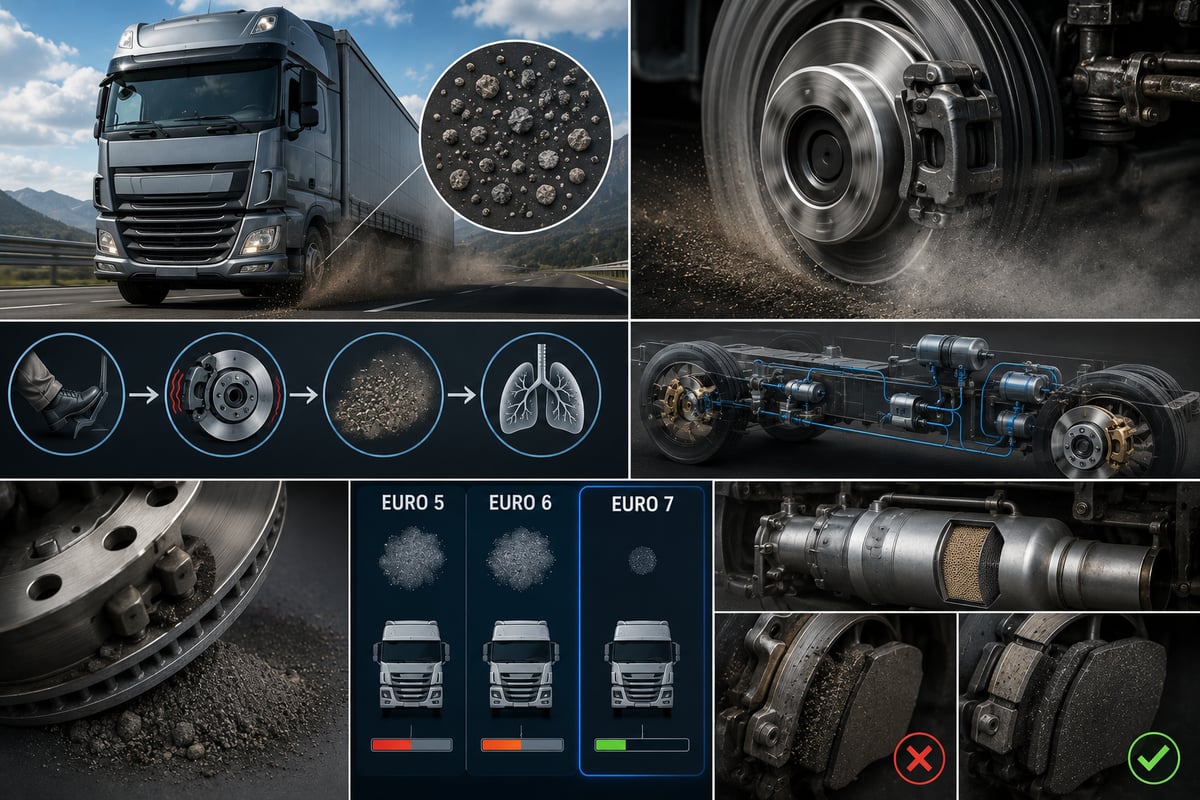
There's a new line buried in the emissions clause of nearly every tender specification landing on a fleet manager's desk today: the vehicle must meet whatever type-approval standard is in force on the delivery date. For thirty years that sentence was really about what came out of the engine's exhaust pipe. Today it also covers the dust that forms where the brake pad meets the disc, at the wheel hub. With EURO7, European emissions law steps outside the exhaust pipe for the first time — particles from brake wear and tyre wear are becoming measured, regulated line items in their own right. This guide isn't a technical breakdown of how brakes work; it's about what the regulation actually introduces, how the timeline plays out, and what a fleet should be doing today in procurement, replacement planning and maintenance policy.
What counts as an emission is changing: particles that never leave the tailpipe now count too
Every step in emissions law up to now has measured the same single thing: gas and particulate leaving the tailpipe. From Euro I through Euro VI, limits on nitrogen oxides, particulate matter, hydrocarbons and carbon monoxide tightened in stages, and manufacturers answered with particulate filters, SCR systems, exhaust gas recirculation and high-pressure injection. Measured against its own goal, the approach worked.
As the tailpipe got cleaner, the make-up of traffic-related particulate shifted with it. In city air, the dominant share of vehicle-linked particulate no longer comes from combustion — it comes from friction and wear. The technical name for this group is non-exhaust emissions: brake pad and disc wear, tyre wear, road-surface wear, and dust that has already settled being kicked back into the air as wheels pass over it. What all of these sources share is that they keep happening no matter how clean the engine is. Even a fully electric vehicle wears its brakes and its tyres every time it slows down or turns a corner.
That is exactly where the regulator's thinking shifted. Gains made at the tailpipe weren't translating fully into air-quality outcomes, because non-exhaust sources were never addressed at all. EURO7 was built to close that gap, redefining an emission as something that comes from using the vehicle, not just from what the engine burns. For heavy-duty fleets, that means emissions law is, for the first time, talking directly to the brake system and to consumable parts — not only to the engine supplier.
How is EURO7 actually different from earlier emissions steps?
The most common mistake is reading EURO7 as simply "Euro VI, a bit stricter." Most previous transitions tightened limits within the same measurement logic. This one widens the scope itself. The Euro 6 framework used for light vehicles and the Euro VI framework used for heavy vehicles are being brought under one regulatory roof, the list of what gets measured is growing, and the way conformity gets proven is changing too.
The new items entering scope fall into three groups. First, non-exhaust emissions: brake particulate and tyre wear. Second, battery durability for electric and hybrid vehicles is brought into type approval. Third, monitoring and documentation: on-board emissions monitoring systems, plus an environmental vehicle passport that travels with each vehicle. On top of that, the list of regulated pollutants grows and durability periods are extended.
| Topic | Position under Euro VI | Approach under EURO7 |
|---|---|---|
| Emission source measured | Exhaust gas and particulate only | Brake and tyre wear added alongside exhaust |
| Regulatory architecture | Separate rules for light and heavy vehicles | Brought under one single regulation |
| Powertrain distinction | Focused on internal combustion | Electric vehicles also covered, via brake dust and battery |
| Definition of durability | Shorter mileage and year definitions | Markedly extended service life in the heavy class |
| Conformity monitoring | Type approval and on-board diagnostics | On-board emissions monitoring plus lifetime conformity |
| Documentation | Type-approval certificate | Environmental vehicle passport, per vehicle |
| Where the spare part sits | Brake consumables outside emissions law | Friction material is part of emissions performance |
That last row is the one that matters most for heavy-duty fleets. Until now, a brake pad had nothing to do with emissions — it had performance, noise and part-approval requirements. Under EURO7 logic, the friction material becomes a component of the vehicle's approved emissions behaviour.
Why did EURO7 brake dust regulation become necessary?
There is one reason behind bringing EURO7 brake dust rules into the regulation: the source mix of fine particulate in city air has changed, and brake wear now accounts for a share too large to ignore at the places where it's measured. Particulate matter, once inhaled, is one of the best-documented pollutants in terms of health effects — and that effect doesn't care whether the source was an engine or a brake. What matters is particle size and composition.
The second reason brake dust caught the regulator's attention is what it's made of. A large share of heavy-duty brake pads carry metallic content for high-temperature resistance. The particles released during wear contain iron oxides, copper, zinc, barium and various filler materials. State-level rules in North America started phasing down copper content years ago, on the grounds that brake dust washed off by rainwater ends up in waterways. In Europe, the issue has been approached directly through respirable particulate and air quality.
The third reason has to do with traffic and mass themselves. Braking frequency is very high in urban distribution, municipal service vehicles and city bus routes — and these are exactly the vehicles operating where people are most concentrated. Brake dust is one of the rare emission types where the place it's produced and the place it's breathed coincide. Because the energy that has to be converted into heat during braking scales directly with mass, heavy-duty vehicles sit at the top end of that equation. In effect, the regulator accepted that friction-related emissions wouldn't shrink on their own just because a fleet's tailpipes got cleaner, and legislated accordingly.
How does brake dust actually form, and why is it such a fine particle?
Braking is a controlled wearing process that converts kinetic energy into heat. When the pad presses against the disc or drum surface, contact points reach very high local temperatures; the material is both mechanically scraped away and chemically broken down at that temperature. The result reaches the air by two routes: solid particles that break off directly, and material that vaporises on the hot surface and re-condenses into extremely fine particles as it cools. That second mechanism is why brake dust isn't a visible, coarse powder — a significant share of it is an aerosol in the respirable size range.
In heavy-duty vehicles, braking force is generated with compressed air; the force transmitted to the pads through the chamber, slack adjuster and camshaft directly determines how much dust is produced. How the whole system works, which component does what, and what maintenance should check is covered in detail in our guide to air brake systems. The emissions takeaway is simple: the more often and the harder the friction brake engages, the more wear — and dust — follows.
Brake architecture matters too. On disc brakes, the friction surface is exposed, so most of the particulate generated goes straight into the surrounding air. On drum brakes, friction happens inside an enclosed volume, and some of the dust stays trapped inside the drum. That doesn't mean drum brakes wear less — it means their release behaviour is different. How the two architectures compare in heavy-duty use, including cooling behaviour, maintenance cost and field preference, is covered in our disc brake vs. drum brake comparison; the EURO7 discussion simply adds an emissions dimension to that comparison.
How is brake dust emission actually measured? The logic behind the method
Measuring exhaust emissions is relatively straightforward, because there is a single outlet and the flow passes through it. Brake dust has no such chimney — particulate is released from the wheels into an open volume, in variable airflow. That's why the measurement method was developed over years of international work, anchored to a laboratory-based, repeatable rig. In short: the brake assembly is mounted on a brake dynamometer that reproduces the vehicle's real inertia. The friction zone is enclosed in a housing, and a controlled, filtered airflow is drawn through it. Particulate generated by wear is carried by that airflow into a sampling duct, where both mass-based measurement and particle-count measurement take place. The result is divided by distance travelled to produce a comparable unit.
For the measurement to mean anything, the brake cycle used has to be realistic. So the cycle isn't an arbitrary list of decelerations drawn up at a desk — it's derived from real driving data and includes a range of speeds and deceleration intensities: frequent urban stops, gentle intercity slow-downs, motorway driving and downhill gradients are all represented in the same cycle. The pad and disc surfaces are also bedded in before testing, because a fresh friction pair's wear behaviour in its first few kilometres doesn't represent how it behaves afterwards.
For a fleet, the practical meaning of this method is that a pad or disc can now be characterised not just by its friction coefficient and durability, but by the particulate it produces. That's a new data field entering the supply chain — information that isn't on product documentation today is expected to become part of technical documentation in future.
The phased timeline: which vehicle class is covered, and when?
EURO7 doesn't take effect on a single date; it's a class-by-class, stage-by-stage timeline. There are two distinct thresholds built into how the regulation operates, and confusing them is a common source of serious errors in fleet planning. The first is the new type-approval date: from that date, new vehicle types brought to market are approved under the new rule. The second is the new registration date: after that date, every new vehicle being registered can no longer be sold, even if its type carries an older approval.
The gap between the two thresholds is the transition window manufacturers get to convert their production lines and stock. For a fleet, the second date is the one that actually drives the purchasing decision. Heavy-duty vehicle classes are tied to a later timeline than light vehicles, for a technical reason: the approval process for heavy vehicles is considerably more extensive.
| Vehicle class | Scope | New type approval | New registration |
|---|---|---|---|
| M1 passenger car | Exhaust, brake dust, tyre wear, battery | End of 2026 | End of 2027 |
| N1 light commercial vehicle | Exhaust, brake dust, tyre wear, battery | End of 2026 | End of 2027 |
| M2 and M3 bus | Exhaust, brake dust, tyre wear, battery | Mid-2028 | Mid-2029 |
| N2 and N3 truck and tractor unit | Exhaust, brake dust, tyre wear, battery | Mid-2028 | Mid-2029 |
| O3 and O4 trailer and semi-trailer | Mainly the tyre-wear item | Aligned with the heavy-vehicle timeline | Aligned with the heavy-vehicle timeline |
| Small-volume manufacturers | Same scope, extended transition | Later stage | Later stage |
The second layer of the timeline concerns numerical thresholds. Brake dust limits don't apply to every class at the same time or the same level; mass-based thresholds per kilometre are defined earlier for light-vehicle classes, while for the heavy class, measurement and reporting come first and numerical tightening follows in later stages. The safe planning assumption for a fleet is that thresholds get tighter over time, not looser.
Standards and further reading
For the regulatory background on this subject, see Regulation (EC) No 595/2009 (Euro VI heavy-duty emissions). Always confirm specific figures and procedures against the current regulation and the vehicle manufacturer service data.
Durability life, in-service conformity and the environmental vehicle passport
The side of EURO7 that affects a fleet directly but gets talked about least is its durability definition. Emissions law requires a vehicle to hold its approved emissions performance across a defined mileage and age window. That window is called useful life, and the periods defined under Euro VI fell short of a heavy-duty vehicle's actual working life. The EURO7 framework extends these periods markedly, pushing both the mileage and the age figures upward for the heavy class.
The implication is simple but far-reaching. Manufacturers will need to keep emissions-related components compliant over a much longer service window. Carried across to the brake side, the same logic means friction material is expected to behave consistently across its full life; an inconsistent, cheap material stops being just a performance issue and becomes a conformity issue.
| Concept | What it means | Consequence for the fleet |
|---|---|---|
| Extended useful life | The period emissions conformity must be maintained is extended | Conformity expectations rise for second-hand and long-service use |
| On-board emissions monitoring | The system tracks and logs emissions-related deviation itself | Neglected maintenance and tampering get recorded |
| Environmental vehicle passport | A standard document of a vehicle's emissions information | Expected on tenders, leasing and resale |
| Real-driving verification | Conformity isn't proven in the lab alone | Usage profile and maintenance quality start to matter |
| Stability of friction material | Predictable wear behaviour across the vehicle's life | Consumable-parts choice becomes a technical decision |
What changes in brake pad and disc material?
Friction material design has always been a balancing act: enough stable friction coefficient, no fade at high temperature, low noise, minimal wear to the mating surface, and reasonable service life. EURO7 adds a sixth item to that list: low particulate emission. The problem is that these goals can pull against each other. A pad hardened to cut wear can wear the mating surface harder; a formulation that cuts dust output can lose performance under hard, hot braking.
The industry's response runs on two tracks. The first is pad formulation: low-dust formulations that reduce metallic content — copper in particular — and lean more heavily on organic and ceramic-based components. The second is on the disc side: coating the friction surface with a hard, wear-resistant layer. The coated-disc approach targets both wear and corrosion, aiming to cut the amount of particulate released overall.
| Material family | Typical trait | Dust behaviour | Note for heavy-duty use |
|---|---|---|---|
| High-metallic | High heat resistance, stable friction | Higher metallic particulate release | Common in heavy-load, high-temperature applications |
| Low-metallic | Balanced formulation, reduced metal content | Moderate emission, easier noise control | Common choice for mixed-use fleets |
| Organic (non-metallic) | Reduced copper and heavy-metal content | Lower emission, heat management is critical | Suitability depends on OE approval |
| Ceramic-based | Stable at high temperature, quiet running | Fine, less visible dust output | Limited application choice in the heavy class |
| Paired with a coated disc | Hard-coated mating surface | Wear- and corrosion-related emission drops | Pad-to-coating compatibility is manufacturer-defined |
The point to watch on the heavy-duty side is that these families can't be swapped as freely as in the passenger-car segment. A tractor unit's brake sizing — axle load, chamber size, slack adjuster, disc diameter and friction coefficient — is engineered as a set. Fit a pad from a different friction class and brake balance shifts: one axle starts doing another's job, and both wear and dust go up.
The coated-disc approach and wear management
The most visible innovation on the disc side is a hard coating applied to the friction surface. The goal is two-fold. First, cutting mechanical wear: a harder surface loses less material for the same braking energy. Second, blocking corrosion. In heavy-duty use, a disc surface rusts quickly while parked in damp conditions, and that rust layer gets scraped off during the first few brake applications. Repeated over a service life, that adds up to a non-trivial amount of material loss.
For a fleet, the upside is that reduced wear means not just lower emissions but longer maintenance intervals too. The catch is matching: a pad running against a coated disc has to be formulated so it doesn't wear the coating away. The second half of wear management is measurement discipline. Track pad thickness and disc thickness regularly and the wear rate becomes a curve — one that flags a brake-balance problem early. If one axle's pads wear out noticeably faster than the rest, there's an adjustment, chamber or valve issue behind it, and that axle is also producing more dust. How to read the warning signs, and what drives service life, is covered in our guide to when brake pads need replacing.
What changes on the spare-parts side? Approval, documentation and equivalent selection
There is already an established approval regime for aftermarket heavy-duty brake pads, discs and drums. Replacement friction parts carry an approval number proving equivalent performance to the original, and that number appears on the packaging and, most of the time, on the part itself. EURO7 doesn't remove that framework — it adds an emissions dimension on top of it.
The expected changes group into three items: friction material's emissions behaviour becomes part of how a product is characterised, technical documentation expands to cover wear and emission data, and which batch of material went on which vehicle gets recorded.
| Check item | Current practice | Expected under the new regime |
|---|---|---|
| Approval number | Checked on packaging and part | Same check, wider scope |
| Application list | Vehicle and axle match verified | Coated-disc compatibility checked too |
| Friction class | Matched to OE class | Same requirement, deviation upsets brake balance |
| Wear-behaviour data | Usually absent from documentation | Expected to become part of technical documents |
| Batch and traceability | Rarely kept in the fleet record | Recommended to keep in the vehicle file |
| Post-fit bedding-in | Carried out but rarely logged | Logging the procedure gains importance |
The bottom line for a fleet is about cost. A consumable with no documentation, an unclear application list or an unknown friction class was already a poor choice today; in the new regime it will carry a conformity risk on top of that.
Technologies that take load off the friction brake
The most direct way to cut brake dust is to use the friction brake less. Heavy-duty vehicles have an advantage over passenger cars here, because several systems share the job of slowing the vehicle down. Engine braking, exhaust braking and compression-release systems can handle a large share of extended deceleration without the friction brake engaging at all. A retarder provides continuous deceleration on long downhill grades in particular, cutting brake temperature and wear.
Regenerative braking, which kicks in on electric and hybrid drivetrains, achieves the same effect through a different mechanism: during deceleration the electric machine works like a generator, part of the kinetic energy goes back to the battery, and the friction brake only engages at the final stage or under high demand. That's the main reason brake dust on electric vehicles tends to come in lower than expected — though it works against the added vehicle weight, and when the friction brake does engage, more energy has to be dissipated.
There's a lesser-known side effect of this pattern: when the friction brake goes unused for long stretches, corrosion can build up on the disc surface and glazing can develop on the pad. On a vehicle that rarely brakes hard, checking the disc surface matters as much as checking pad thickness does on a vehicle that brakes often.
Practical consequences for fleets: purchasing criteria and a replacement plan
The EURO7 discussion reaches a fleet manager's desk as three concrete questions: when do I buy, what do I buy, and how long do I keep what I already have. The answer to all three depends on the two timeline thresholds and on the vehicle's usage profile. Because a vehicle with an old approval can no longer be registered once the new-registration threshold passes, demand piling up and lead times stretching out near that date is a predictable pattern — and previous emissions transitions have shown exactly that.
Purchasing criteria are widening too: alongside engine and gearbox choice, brake architecture, coated-disc fitment, retarder equipment and the consumable-parts supply chain now enter the decision. The route the vehicle will run matters: for urban distribution, brake equipment is a far more heavily weighted decision than it is for a long-haul tractor unit.
| Criterion | Question to ask | Why it matters |
|---|---|---|
| Emissions approval level | Under which approval will the vehicle be registered | Affects resale value and access to urban zones |
| Delivery timeline | Which side of the threshold date does delivery fall on | Lead times stretch as the threshold approaches |
| Brake architecture | Disc or drum, coated or not | Determines wear, dust and maintenance cost |
| Deceleration equipment | Engine brake and retarder capacity | Reduces load on the friction brake |
| Consumable supply chain | How accessible are approved pads and discs | Affects downtime and conformity risk |
| Telematics and monitoring | Can brake-usage data be captured | Supports driver training and predictive maintenance |
| Usage-profile fit | Which route will the vehicle run | Urban and long-haul loads differ completely |
A common mistake in replacement planning is trying to renew an entire fleet in one go around the threshold date; that squeezes both cash flow and the next replacement cycle. The threshold date should set the pace of a phased plan — it shouldn't define the plan itself.
Stock and maintenance policy during the transition
Where emissions transitions land most concretely on a fleet isn't purchasing — it's the parts store and the workshop. During the period when older- and newer-approved vehicles run side by side, it's entirely normal to find different friction materials and different disc treatments within the same brand and segment. The way to manage that period is to make the call as policy, not case by case.
- Group the fleet's vehicles by emissions approval level, and list each group's brake equipment, disc type and friction material class in one place.
- On the same list, flag each vehicle's usage profile: urban distribution, regional haulage, long-haul, construction site. Usage profile drives brake wear, not mileage.
- Split consumable stock by vehicle group; don't store pads for coated-disc vehicles on the same shelf as pads for uncoated applications.
- Don't stock friction material whose approval number and application list haven't been verified; the most expensive mistake during a transition period is a mismatched pad.
- Make pad and disc thickness measurement a mandatory item in periodic maintenance; log it by vehicle and axle, and track the trend rather than a one-off reading.
- Monitor brake balance through the wear difference between axles; when you see a clear gap, question the slack adjuster, chamber and valve before you question the pad.
- Record batch information and fitting date in the vehicle file at every replacement; traceability will carry documentary weight in the new period.
- When fitting new friction material, follow the manufacturer's recommended bedding-in procedure and log that it was done; an unbedded pair both produces more dust and wears out sooner.
- Pull driver brake-usage data from telematics regularly; put vehicles with a high count of hard-braking events on the training list.
- Plan disposal timing for older-approved vehicles now; build the schedule assuming resale value will diverge by emissions level.
- Put the policy in writing and post it in the workshop; most transition-period errors come not from a lack of information but from practice that varies by person.
None of these steps is specific to EURO7 — they're already part of good maintenance policy. What the new period changes is the cost of skipping them.
Common misunderstandings about EURO7
A few pieces of misinformation tend to spread quickly whenever a new emissions step is announced, and they can throw fleet decisions off. The most common one is the idea that vehicles already on the road will be banned. Emissions type-approval law doesn't work retroactively; the rule applies to newly approved types and newly registered vehicles. A vehicle already in service keeps running under the approval level it held on the date it was registered.
The second misunderstanding is that vehicles already in use will need some retrofit device fitted. The regulation does not require a brake-dust capture device on vehicles already in service. Low-emission zones set by individual cities are a separate matter entirely, and they're up to local authorities.
The third misunderstanding is that the rule only concerns diesel vehicles. Brake dust and tyre wear happen regardless of powertrain; an electric bus is just as much a subject of these rules. The fourth is the expectation that metallic pads will be banned outright. The regulation doesn't ban a material — it caps measured emissions. Which formulation gets used to meet that cap is the manufacturer's design choice.
The fifth misunderstanding is that a tighter rule inevitably means shorter pad life. Cutting wear is the most direct way to cut dust, so a low-emission target usually pulls in the same direction as a longer service life, not the opposite one.
Where things stand for international fleets, and a summary roadmap
EURO7 is European Union law, adopted through the EU's own regulatory process and published in the Official Journal of the European Union. Within the EU and the wider EEA, it applies directly to type approval and vehicle registration on the timeline set out above. Markets outside the EU handle it differently: some — the UK and EFTA states among them — tend to track EU vehicle standards closely and often adopt equivalent rules on their own schedule, while others don't. If a fleet runs routes into the EU, or exports into it, what matters in practice is the emissions standard the vehicles crossing that border have to meet, and that should be confirmed against the current rule of the country actually being served, rather than assumed from this guide.
There's plenty a fleet can do today without waiting for every detail of the regulation to settle.
- Take inventory: Group vehicles by emissions approval level and brake architecture; work out which group is affected by which threshold.
- Stage the replacement schedule: Build a plan that keeps the fleet's age distribution balanced, instead of renewing everything at once.
- Update purchasing specifications: Add brake equipment, deceleration capacity and consumable supply chain as line items in the tender specification.
- Make measurement mandatory: Turn pad and disc thickness measurement into a logged item of periodic maintenance, and track the wear gap between axles.
- Bring the driver in: Reinforce engine-brake and retarder use through training and telematics feedback.
- Track the regulation: Update the plan as implementing acts and national transposition measures are published.
In short, EURO7 turns from being an engine subject into an operating subject for heavy-duty fleets. Exhaust-side technology has largely matured; what's new this time is that emissions arising from how the vehicle is used — and that shift directly with fleet habits — are starting to be measured. That ties brake maintenance, consumable-parts choice and driver behaviour to the regulation more closely than they have ever been tied before. In every case, what's binding is the regulation text in force; for vehicle-specific technical values and procedures, the current OE service documentation for the engine and chassis code is authoritative.
Shop this part: Brake System
Tags
Frequently Asked Questions
- What is EURO7, and how is it different from earlier emissions steps?
- EURO7 is the new stage of European emissions law that brings the previously separate frameworks for light vehicles (Euro 6) and heavy vehicles (Euro VI) under one regulatory roof. Most earlier transitions simply tightened limits within the same measurement logic; EURO7 widens the scope itself. For the first time, emissions from outside the exhaust pipe — particles from brake wear and tyre wear — become measured, regulated line items. On top of that come battery durability requirements for electric and hybrid vehicles, on-board emissions monitoring, an extended durability period, and an environmental vehicle passport issued per vehicle. What is legally binding is the regulation text in force plus the national transposition measures that apply in each market.
- Why does EURO7 brake dust regulation exist?
- EURO7 brake dust rules exist because the source mix of fine particulate in city air has shifted. As particulate filters and SCR systems cleaned up the tailpipe, the dominant share of traffic-related particulate moved to friction and wear sources instead. Particles released by brake wear contain iron oxides, copper, zinc and various fillers, and a significant share falls in the respirable size range. Brake dust is also unusual in that the place it's produced and the place it's breathed tend to coincide: urban distribution vehicles and city buses brake often, and they operate exactly where people are most concentrated.
- Which vehicle class does EURO7 cover, and when?
- The timeline runs on two thresholds. The first is the new type-approval date, from which new vehicle types must be approved under the new rule. The second is the new registration date, after which no new vehicle — even one built to an older approval — can be registered. Passenger cars and light commercial vehicles are covered first; buses, trucks and tractor units follow roughly a year and a half later; trailers and semi-trailers are aligned with the heavy-vehicle timeline. For a fleet, the registration threshold is the one that actually drives the purchasing decision. Exact days and months are set by the regulation text in force and any national transposition measures.
- Will my Euro VI vehicles be banned once EURO7 takes effect?
- No. Emissions type-approval law is not retroactive: it applies to newly approved vehicle types and newly registered vehicles. A vehicle already on the road keeps operating under the approval level it held when it was registered, and there is no requirement to retrofit a brake-dust capture device onto vehicles already in service. Separately, individual cities can set their own low-emission zone rules based on emissions level — that is a local-authority matter, distinct from EURO7 type approval, and worth checking independently for any city a fleet regularly enters.
- How is brake dust emission actually measured?
- Unlike exhaust emissions, brake dust has no single outlet to sample, so the method relies on a laboratory-based, repeatable rig. The brake assembly is mounted on a dynamometer that reproduces the vehicle's real inertia, the friction zone is enclosed, and a controlled, filtered airflow carries wear particulate into a sampling duct, where both mass and particle count are measured. The result is divided by distance travelled to give a comparable figure. The brake cycle used is derived from real driving data — covering urban stops, gentle deceleration, motorway driving and downhill grades — and the pad and disc are bedded in before testing so early-life wear doesn't skew the result.
- What will EURO7 change in brake pad and disc material?
- Friction material design has always balanced friction stability, heat resistance, noise, wear to the mating surface and service life; EURO7 adds a sixth requirement — low particulate emission. The industry is answering on two fronts: low-dust pad formulations that cut metallic content, especially copper, in favour of organic and ceramic-based components, and hard coatings applied to the disc's friction surface to cut both wear and corrosion. The regulation doesn't ban any particular material family — it caps measured emissions, and manufacturers choose the formulation that meets it. In heavy-duty use, the friction class still has to match the vehicle's engineered brake balance; swapping classes freely upsets that balance and increases both wear and dust.
- How does EURO7 affect spare-parts selection for brakes?
- The existing approval regime for aftermarket brake pads, discs and drums — an approval number proving equivalent performance to the original — stays in place; EURO7 adds an emissions dimension on top of it. Expect friction material's emissions behaviour to become part of how a product is characterised, technical documentation to expand to cover wear and emission data, and batch information to be tracked against the vehicle it was fitted to. An unapproved, undocumented consumable was already a poor choice; going forward it will also carry a conformity risk.
- How should a fleet set stock and maintenance policy during the transition?
- Treat it as policy, not a case-by-case call. Group vehicles by emissions approval level and usage profile, and list each group's brake architecture and friction material class. Keep consumable stock separated by group — don't shelve pads for coated-disc vehicles next to pads for uncoated ones. Only stock friction material with a verified approval number and application list. Make pad and disc thickness measurement a mandatory, logged part of periodic maintenance, watch the wear difference between axles for brake-balance issues, record batch and fitting-date information in the vehicle file, and follow the manufacturer's bedding-in procedure on every replacement.
- What can a fleet do today to cut brake dust?
- The most direct lever is using the friction brake less: engine braking, exhaust braking and a properly used retarder can absorb much of a long deceleration without the friction brake engaging at all, and regenerative braking does the same job on electric and hybrid drivetrains. Driver behaviour matters as much as hardware — lifting off the throttle early, choosing the right gear on a downhill grade, and using the retarder correctly measurably reduce how often the friction brake is called on. Two identical vehicles on the same route can show very different pad life, and the gap is usually down to the driver, not the vehicle — so training paired with telematics-based brake-usage monitoring is one of the lowest-cost ways to cut dust.
- Will EURO7 affect a vehicle's resale value and tender eligibility?
- It's reasonable to expect so. EURO7 extends the useful-life period over which emissions conformity must be maintained, introduces on-board emissions monitoring, and adds a standard environmental vehicle passport for every vehicle. That document sits alongside registration papers, type-approval records and maintenance history, and is expected to be requested in tenders, leasing agreements and resale transactions. Maintenance history and consumable-parts traceability are likely to carry more weight in a vehicle's value going forward. For fleets running routes into the EU or exporting into it, the approval level of the vehicle fleet can also become a direct commercial constraint.
Related Articles
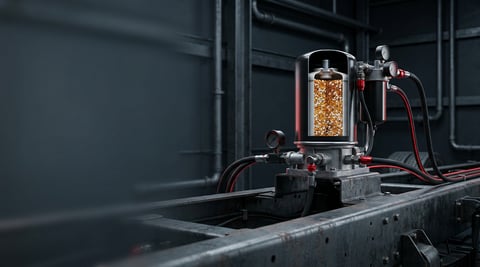
Air Dryer: Faults, Replacement & Maintenance Guide
How a truck air dryer's charge and purge cycle keeps moisture and oil out of the brake system, and what a hissing purge valve or water in the tanks means.
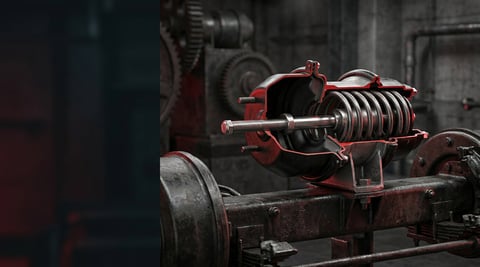
Brake Chamber: Faults, Replacement & Maintenance Guide
Service and spring brake chambers on trucks and trailers: diaphragm-leak and stroke diagnosis, why caging is mandatory before removal, and safe replacement.
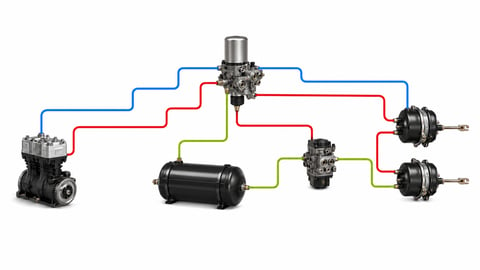
How to Read an Air Brake Diagram: Circuit Guide
How do you read an air brake system diagram? Symbol language, line colours, port codes, circuit split, trailer lines and fault-tracing, step by step.