Choosing Truck Brake Components
A practical guide to choosing the right aftermarket brake components for trucks, tractor units and trailers: verification, approvals, suppliers and cost.
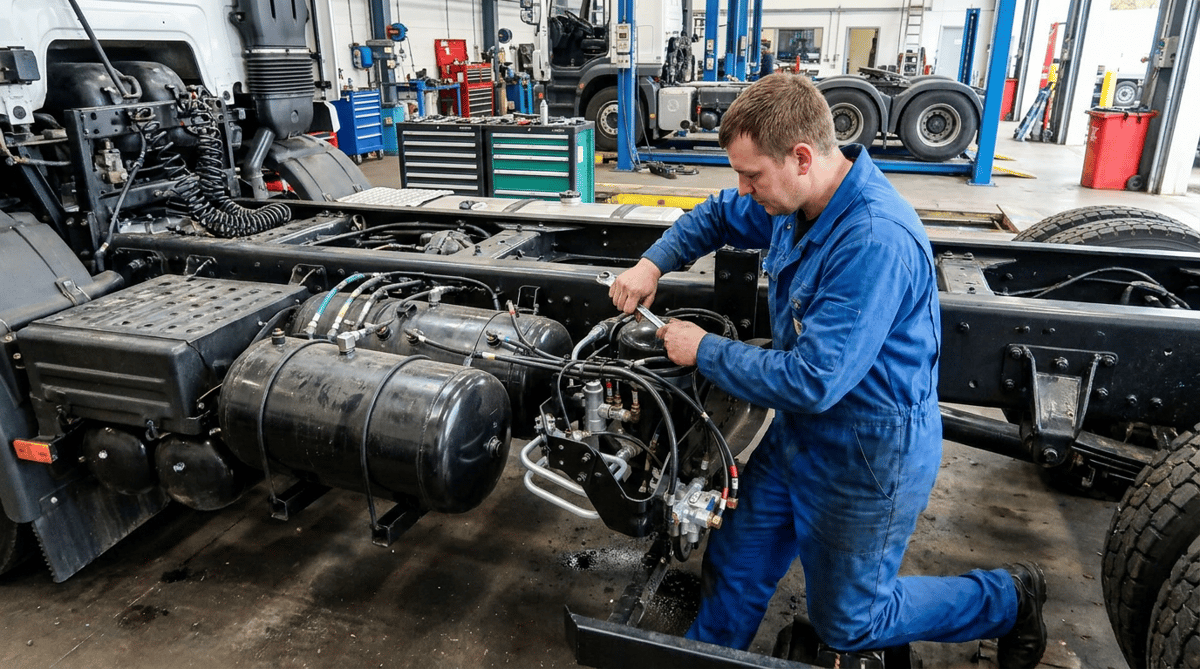
A brake parts order usually starts with a price question, and it usually ends there too: two quotes come in for the same line item, the cheaper one gets approved, and the part goes on the shelf. Nobody asked whether those two quotes were actually for the same thing. The real cost isn't paid on order day — it's paid the day the vehicle is up on the lift: the bolt spacing doesn't line up, the valve thread is right but the port faces the wrong way, the chamber stroke falls short. The vehicle is stopped and the crew is waiting.
This page deals with one question: how do you identify and source the correct aftermarket brake component for a truck, tractor unit, bus or trailer — defining the application accurately, verifying cross-references, understanding what interchangeability actually means, knowing what a certificate does and doesn't prove, evaluating suppliers, weighing lead time against stock depth, and calculating total cost of ownership. These are purchasing decisions, and they matter as much to a fleet manager as to a workshop foreman.
What physically makes a part durable — casting quality and heat treatment, surface coating, manufacturing tolerance, and how a worn part's wear pattern should be read — is not the subject of this page. That ground is covered in Heavy Duty Air Brake Parts That Hold Up. What this page discusses instead is how a claim about a part gets checked at the purchasing desk, before it ever reaches a bench.
Why choosing a brake component isn't just about comparing quotes
Price only means something when it's compared between two identical things. Most brake component quotes aren't directly comparable, because the same line item description can hide different scopes. In one quote a "brake chamber" is a bare unit; in another it arrives with the mounting bracket and gasket kit included. Two lines look the same on paper, but the difference is scope, not price. Before any comparison is meaningful, the first job is to reduce both quotes to the same scope: what actually comes out of the box, and what has to be bought separately to complete the installation.
The second issue is that a wrong brake part usually fails quietly. A wrong cab trim part is obvious on day one; a wrong brake part usually isn't. The vehicle leaves the yard, runs, covers kilometres. The difference shows up later — in uneven pad wear on one side of an axle, in a trailer that grabs late, or in a rejection note at the next roadworthiness inspection. That delay disconnects the cost of the wrong decision from the date it was made. The selection criterion should never be "which quote is cheapest" — it should be which part avoids a repeat job and a failed inspection.
Third, brake components don't work in isolation. A single axle's chamber, slack adjuster, valve and friction material all balance against each other. A change made to one line item on its own shifts that balance, and it shows up on the road as "we fitted the new part, but the rear axle is chewing through pads faster than before."
Define the application first: vehicle, axle, system and variant
The part of the selection process that gets skipped most often sits right at the beginning. Before searching for a part number, the application needs to be defined across four layers: vehicle, axle, system and variant. None of these layers substitutes for another — the same tractor model can carry a different axle supplier across two production years, and the front and rear axle on the same vehicle can run different foundation brake architectures.
The chassis plate is a starting point, not the whole answer
The vehicle layer starts with the chassis number, but it doesn't end there: a later body conversion, an axle swap, or a component upgrade carried out during a repair may never have made it into the paperwork. For the axle layer, the axle's own tag is what matters more — the axle manufacturer is often a separate company from the vehicle manufacturer, and most of the brake hardware fitted is determined by whichever company built the axle, not the badge on the bonnet.
The system layer covers whether the vehicle is fitted with disc or drum brakes and which generation of electronic control it runs; how disc and drum architectures actually differ is covered separately in Disc Brakes vs. Drum Brakes: A Heavy-Duty Vehicle Comparison. The variant layer covers distinctions such as left-right, heated or unheated, single-outlet or twin-outlet — and this is where most wrong orders genuinely originate. The problem is especially visible on the valve side: valves from the same housing family look almost identical, and the real difference sits in which way the ports face, how many ports there are, and the setting characteristic. Which valve does which job is the subject of Truck Air Brake Valves Explained: Types, Functions and Failure Symptoms; for selection purposes, the rule that matters here is to identify a valve by port layout and function, not by appearance.
| Data point | Where to read it | How it narrows the choice |
|---|---|---|
| Chassis number and build year | Chassis plate, registration document, VIN tag | Separates the model generation and mid-cycle production changes |
| Axle manufacturer and axle type | Tag or embossed marking on the axle housing | Determines the brake hardware family — most line items resolve here |
| Brake type (disc or drum) | Visual check, axle tag | Separates friction group and caliper or drum family |
| Axle position, side and trailer control | Position on the vehicle, coupling head markings | Separates left-right, front-rear and tractor-specific hardware |
| Markings on the removed part | Housing casting, manufacturer tag, casting number | The most reliable starting point for a catalog search |
None of this requires removing the part, and most of it can be gathered on a fifteen-minute walk around the vehicle:
- Record the chassis number and registration details. Identify the vehicle by its identity, not its model name.
- Go to the axle and read the axle tag. Where a tag is worn away, clean the embossed lettering and photograph it.
- Confirm the brake type by eye. Telling disc and drum apart takes one glance; don't work from a catalog assumption.
- Photograph the part to be removed from at least three angles. The mounting face, the port orientation, and the label face.
- Note every marking on the part. Manufacturer reference, casting number, and any date or approval mark present.
- Measure the mounting interface. Bolt spacing, flange diameter, thread size and, where relevant, stroke.
- Record the vehicle's duty profile. Urban delivery, long-haul, construction site, trailer-towing — this shapes the stock decision.
- Log the odometer reading and the reason for removal. This links the record to the vehicle's own maintenance history.
Catalog accuracy: how do you verify a cross-reference?
A cross-reference links the different numbers that identify one part: the vehicle manufacturer's, the axle manufacturer's, the original equipment supplier's, and the aftermarket manufacturer's. Every one of these links was built by a person at some point, and every one of them carries a margin for error.
Three error patterns show up most often. The first is revision drift: a number gets updated and the old number is redirected to the new one, but a physical change happened somewhere in between — the catalog records the redirect, not the change. The second is one-directional interchangeability: the new part can replace the old one, but not the other way around, and the catalog often displays this as a two-way match when it isn't. The third is mixing within a family: parts that share the same housing but differ only in their setting characteristic get cross-referenced to each other by mistake. Because of this, a cross-reference is never closed out on a single source — verification happens in stages, and each stage catches a different error pattern.
| Stage | What to do | Error it catches |
|---|---|---|
| Source count | Search the number in at least two independent catalogs | Data-entry mistakes specific to a single catalog |
| Direction check | Query the match in the reverse direction as well | One-directional interchangeability mistaken for a two-way match |
| Visual and dimensional comparison | Compare a photo and the mounting measurements of the removed part | Mixing within a family, port orientation and interface differences |
| Function comparison | Confirm the part's job in the circuit and its setting characteristic | Parts that fit physically but behave differently |
| Scope check | Ask what's actually included in the box and the installation kit | Missing gaskets, fasteners and consumable surprises |
The last stage is the one most often skipped, and it's also the one that saves the most rework: whether a gasket is in the box is a single line of information at order time, and a full extra day off the road at installation time.
Standards and further reading
This subject is governed by the equipment rules for air-braked commercial vehicles. In the United States the federal air brake standard, FMVSS 121 (49 CFR 571.121) defines the reservoirs, protection and timing a compliant system must provide, and Europe applies the equivalent limits of UNECE Regulation No. 13. For further detail, see the illustrated reference guide at airbrakecompressor.com. Always confirm specific figures against the current regulation and the vehicle manufacturer service data.
Outside the United States the equivalent duties sit in national law. In the United Kingdom, regulation 18 of the Road Vehicles (Construction and Use) Regulations 1986 requires every part of the braking system to be maintained in good working order. In Canada, air brake systems fall under the Motor Vehicle Safety Regulations, which contain CMVSS 121.
Interchangeability versus "it went on and looks right"
The most common mistake in the field is treating the fact that a part fits as proof that it's the right one. Physical fit only shows that the interface matches; it says nothing about whether the part will do the same job once it's in the circuit. This distinction is critical in air brake components because the interface itself is largely standardised: thread sizes, flange bolt patterns and coupling types are shared across a wide range of parts. In other words, the sentence "it went on" tells you almost nothing about whether the selection was correct.
What "functionally equivalent" actually depends on
What counts as functional equivalence changes with the part family. In a valve, the opening and closing thresholds, the number of ports and the flow characteristic decide it; two valves sharing the same housing can operate on different thresholds. In a brake chamber, effective area and stroke are decisive; a chamber with insufficient stroke works fine on day one and runs out of margin as the lining wears. In a slack adjuster, arm length and the adjustment mechanism decide it. The electrical interface is a separate matter and usually the last thing anyone checks: a connector fitting physically doesn't mean the pin layout and expected signal match. On electronically controlled components this doesn't always surface as a fault code — sometimes the system just quietly falls back to a safe state, and the vehicle runs without delivering the performance expected of it.
The most practical field check for functional equivalence is watching brake balance after the change. Asymmetric behaviour appearing between neighbouring axles is the first sign that the selection needs to be questioned, and logging it prevents the same mistake being repeated across the rest of the fleet.
Approvals and documentation: what to ask, and what a certificate actually proves
Asking for documentation is the right habit; asking for the wrong document just creates a false sense of security without proving anything. Three separate families of certification get confused on the brake side: product approval, whole-vehicle or system type-approval, and a quality management system certificate. None of these stands in for another.
Product approval shows that a specific spare parts group has been approved under a regulatory framework. In Europe, that is the regime governing replacement friction materials — UN Regulation No. 90 (UNECE R90) — and its scope has widened over time, but not every brake component falls under it. Asking a supplier for a friction-material approval number on an air brake valve or an air dryer is the wrong question; not getting an answer isn't a gap on the supplier's side. For those components, conformity is discussed through the vehicle's system type-approval and the manufacturer's own verification records instead.
A quality management system certificate documents the producing organisation's processes, not the product itself. It shows that production is traceable and repeatable; it does not show that the part in that particular box fits your particular vehicle. Treating the two as interchangeable is the single most common mistake in a purchasing file.
| Document or record | What it proves | What it does not prove |
|---|---|---|
| Replacement friction material product approval | That the covered product is approved under the regulatory framework | Valve, chamber and dryer line items sit outside that scope |
| Vehicle or system type-approval | That the vehicle as a whole is type-approved | That one individual replacement part is separately approved |
| Quality management system certificate | That production processes are documented | That the part in the box matches your specific application |
| Batch and traceability record | Which production batch a part came from | The part's performance level |
| Technical data sheet | The declared interface and characteristic values | That the declared values have been independently verified |
The most useful question to ask about a document isn't whether it exists — it's what it covers: which product group, which date range, which production site does this document apply to, and does the item in front of you actually fall within that scope.
Supplier evaluation: which questions actually separate suppliers?
Supplier evaluation is usually done on price list and payment terms alone. Both matter, but neither is genuinely decisive — under competitive pressure they converge toward each other. What actually separates suppliers is how they behave when something goes wrong: who answers a technical question and how quickly; whether a reported catalog error gets corrected and fed back to you; and on a warranty claim, whether the returned part is actually inspected and the result shared with you. That last question is particularly valuable — a supplier who inspects a return and reports back why it failed will, over time, also help bring down your own error rate.
The traceability question fleets tend to skip
A second group of questions concerns traceability: is there batch information on the box, does it carry through to the delivery note, and is a record kept that would let the supplier find you again if a systemic issue turns up in the same batch. For a fleet, this is the difference between tracing which vehicles received parts from the same batch, and having a single failure turn into uncertainty across the whole fleet. A third group concerns range and continuity: does the supplier stock the whole product family or only the fast-moving lines, and will the same line item still be available a year from now. These questions are invisible on the first order and become decisive on the second and third.
Lead time and stock depth: why they matter as much as part quality
In heavy commercial vehicles, downtime cost is a multiple of part cost. A day off the road for a tractor unit means lost trip revenue, cargo shifted onto another vehicle, a driver waiting idle, and the knock-on commercial consequences of the delay. The price gap on a single line item is usually small next to a single day's difference in lead time.
Lead time on its own is not a sufficient measure — stock depth is the real one. A supplier delivering quickly holds that particular item in stock; it doesn't mean they hold the slower-moving variants from the same family. The most common variant arrives the next day, the rare one waits two weeks. Evaluation should therefore be done not per line item, but per part family matched to your fleet's needs.
On the fleet side, this is where a critical-spares list comes in, built from fleet composition, duty profile and past failure records, separating out which items actually stop a vehicle. How to keep maintenance records and plan periodic checks is covered in Fleet Brake Maintenance Schedule and Recordkeeping; the cleaner your historical records, the more accurate the stock decision.
Total cost of ownership: where does the cheap part become expensive?
Total cost of ownership is not the sticker price of a part — it's the sum of everything that part generates for as long as it stays on the vehicle. On the brake side, part cost is usually the smallest line in the table; labour, downtime, repeat work, inspection failure and secondary damage together decide the real figure.
Repeat work is a particularly quiet cost: when a part fails early, what gets paid isn't just the price of the second part — the same labour, a second vehicle stoppage, and disrupted planning are all paid for again. Doing the same job twice, in most scenarios, ends up costing more than paying for the right part the first time. Secondary damage is the hardest line to see: one component behaving differently loads its neighbour harder, and the cost of the cheap part gets booked against something else entirely.
| Cost item | Where it shows up | Why it gets missed |
|---|---|---|
| Part price | Purchase invoice | Doesn't get missed — it's the only visible line, so its weight is overstated |
| Installation labour | Workshop job card | Sits on a separate line from the part, so it doesn't factor into the decision |
| Vehicle downtime | Trip schedule and lost revenue | Booked against operations, not against the maintenance budget |
| Repeat work | Second job card | Recorded as a new failure, not linked back to the original decision |
| Secondary damage and tied-up stock | Early replacement of a neighbouring component, wrong part sitting in the store | Booked against a different line item, or shows up as inventory instead of cost |
Filling in this table once changes every decision that follows: the question stops being "which quote is cheaper" and becomes "which option stops this vehicle the fewest number of times."
A decision checklist for fleet purchasing
The list below works equally well for a single-vehicle repair order and for a fleet-wide framework agreement. Its purpose is to tie the decision to a process rather than to one person's judgement.
- Write the application down across four layers. Vehicle, axle, system and variant — if any layer is blank, the order doesn't go out.
- Photograph the removed part and record its markings. This is the basis for every verification step that follows.
- Verify the cross-reference against at least two sources. Query the match in reverse too.
- Carry out the visual and dimensional comparison. No approval until mounting face, port orientation and, where relevant, stroke are checked.
- Get the box contents in writing. Confirm whether gaskets, fasteners and the mounting kit are included.
- Ask what the document covers. What matters isn't whether a certificate exists, but whether it covers the item in front of you.
- Log lead time and stock depth. Ask about the part family, not a single line item.
- Calculate total cost of ownership. Add labour, downtime and repeat-work risk to the part price.
- Score the supplier across six headings. Technical response, catalog correction, warranty inspection, traceability, range depth, delivery performance.
- Record the decision and the reasoning behind it. A year later, the decision is read from the record, not re-argued.
The point of the list isn't to generate paperwork — every step on it heads off an hour that would otherwise be spent later. Once it's in place, the "wrong part turned up" argument mostly disappears, because what was verified at which step is on record.
Related technical guides: Brake Caliper Overhaul Kit: Guide Pins, Boots & Adjuster · Brake Chamber: Fault Diagnosis, Replacement and Maintenance Guide · Brake Chamber, Diaphragm & Hose: Faults, Replacement, Care · Four-Circuit Protection Valve: Faults, Diagnosis & Replacement
Frequently Asked Questions
- Do two parts sharing the same OE number always interchange with each other?
- Not always. The same number can point to different revisions; manufacturers update a number over the years, and a physical change can happen between the old number being redirected and the new one taking over. Some matches are also one-directional: the new part replaces the old, but not the reverse. A number match is the start of verification, not the result of it.
- How many sources are needed to verify a cross-reference?
- At least two independent sources are recommended. A search against a single source can't catch data-entry errors specific to it. If two sources confirm each other, confidence goes up; if they disagree, that's a warning sign. On safety-related parts, the final stage is always comparing a photo and measurement of the removed part, regardless of how many sources agree.
- Is the chassis number enough on its own to select a part?
- In most cases, no. It gives the model generation and production period, but hardware changes made later — an axle upgrade, or a body-related modification — may never have been logged. The axle manufacturer's tag, a visual confirmation of brake type, and variant information all need to be collected alongside it.
- Is it reasonable to ask for a replacement friction material approval number on an air brake valve?
- No, that's the wrong question. The approval regime for replacement friction materials covers a specific product group; air brake valves, chambers and dryers fall outside that scope. Not receiving such a number from a supplier isn't a gap on their part. Conformity for these components is discussed through the vehicle's system type-approval and the manufacturer's own technical data and verification records.
- Does a quality management system certificate prove a part is suitable?
- It doesn't. A quality management system certificate shows that the producing organisation's processes are documented, traceable and repeatable. It does not show that the item in the box matches your vehicle, axle and variant. These are two different questions — one about the manufacturer, the other about the application. Treating them as the same question is the most common mistake in a purchasing file.
- When does a cheap part actually turn out to be expensive?
- When the same job has to be done a second time. It isn't only the price of the part that gets paid again — the same labour, a second vehicle stoppage, and disrupted planning are too. Add a failed roadworthiness inspection and any secondary damage to a neighbouring component, and the first order's price difference becomes irrelevant in most scenarios. The decision criterion is how many times the vehicle stops, not the sticker price.
- Which brake items should a fleet keep in stock?
- Priority goes to items that stop a vehicle and have a long lead time. Build the list from your own maintenance and failure records, not guesswork: which item has been replaced how many times, how long it took to source, and how many days the vehicle sat idle while waiting. Without recordkeeping discipline, this list is usually built on assumption and turns out wrong.
- What's the single most telling question in a supplier evaluation?
- Whether a returned part is actually inspected on a warranty claim, and whether the result is shared with you. Price and payment terms converge under competitive pressure; behaviour at the point of failure is what genuinely separates suppliers. A supplier who inspects a return and reports back why it failed will, over time, also lower your own error rate. The second most telling question is whether a reported catalog error actually gets corrected.
- The part came out of the box and it fit — does that prove it's the right one?
- It doesn't. Thread sizes, flange bolt patterns and coupling types are shared across a wide range of air brake components, so physical fit is common rather than proof of anything. Suitability also requires functional equivalence: threshold and flow in a valve, effective area and stroke in a chamber, arm length in a slack adjuster, pin layout and expected signal in an electronic component.
- How do you make two quotes for the same part genuinely comparable?
- By reducing them to the same scope. For each line, write down the box contents, any extra items needed for installation, and the lead time — only then does the price become comparable. One quote might include gaskets and fasteners while the other excludes them; one might be a complete unit while the other is missing hardware. Comparing price before equalising scope is comparing two different things.
Related Articles
What Makes an Air Brake Part Durable?
What actually makes a heavy-duty truck air brake part durable? Material, heat treatment, coatings, tolerances and wear patterns explained from the shop floor.