Engine Overheating on the Road: Emergency Guide
Truck engine overheating on the road? What to do in the first 60 seconds, when it's safe to keep driving, how to top up coolant, and when to call a tow.
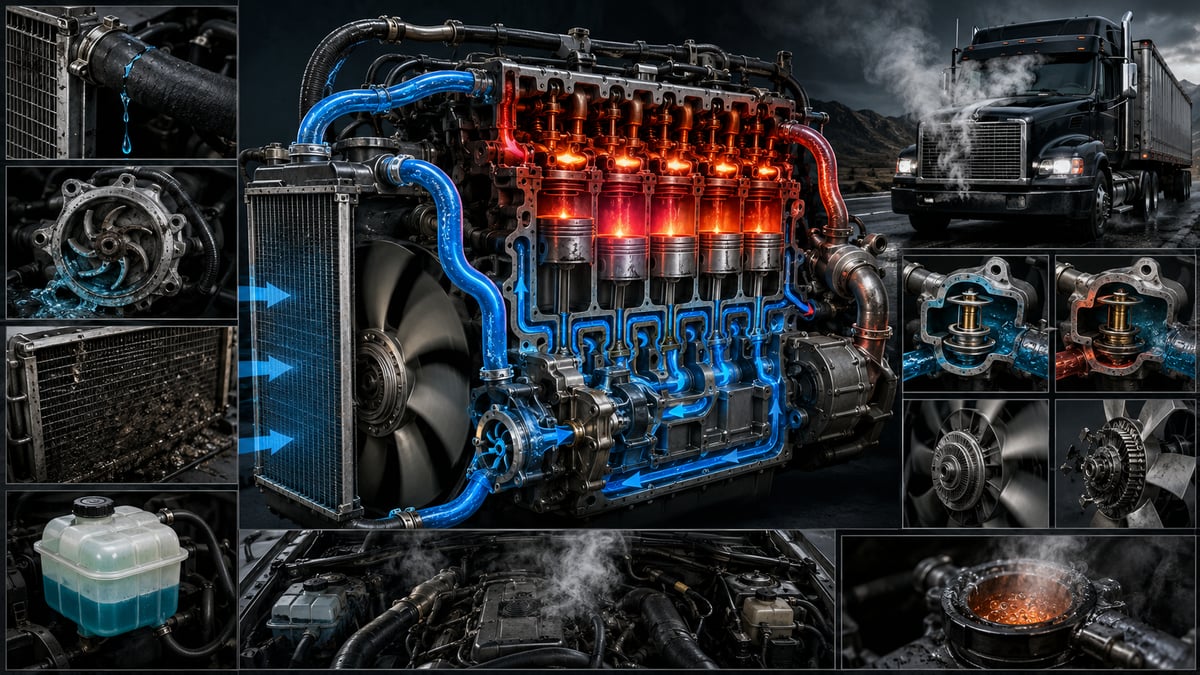
A loaded tractor unit is two-thirds of the way up a long grade when the temperature needle drifts off its usual mark. The driver barely notices at first glance; on the second, the needle is closing on the red band, there's a faint sweet smell in the cab, and a warning light comes on the dash. What happens in the next few minutes decides whether the truck drives itself into a workshop or the engine needs a full rebuild. Two correct moves halfway up the grade usually prevent the most expensive kind of damage; one wrong move — opening a hot expansion tank cap, or pouring cold water on a boiling engine — can cause a serious injury and irreversible mechanical damage within seconds.
This guide is not a general overview of the cooling system. For how the system works, the root causes of overheating, and a detailed look at the radiator, thermostat, water pump and fan assembly, the main reference is our pillar guide, Engine Overheating in Heavy-Duty Trucks. What follows here is narrower and more urgent: which decisions to make, and in what order, when a vehicle overheats on the road, far from a workshop.
The First 60 Seconds of Engine Overheating
Everything you do in the first minute of overheating is aimed at fixing one equation: the engine is producing more heat than the system can shed. In the first 60 seconds, the goal is to move either side of that balance. Cutting the heat you're generating is entirely in the driver's hands and pays off within seconds; raising the heat the system sheds takes only a few small moves. Get both right and the needle usually stops climbing, letting the truck reach a safe spot under its own power.
Here's the order. Ease off the throttle first and drop the engine load — backing off on a grade directly cuts the heat being produced. Shift into a gear that won't lug the engine but won't push the revs either. Switch off the air conditioning: the compressor adds load to the engine, and its condenser sits in front of the radiator, feeding it hot air. Then comes the move that looks backwards but is technically correct: turn the cabin heater all the way up and the fan speed to maximum. The heater core is effectively a second, small radiator wired into the cooling circuit; opening it up really does pull heat out of the system. The cab turns unbearable, but the engine comes out ahead.
- Ease off the throttle, cut the load: holding the same climbing pace on a grade keeps piling on heat.
- Switch off the AC: it cuts both the engine load and the hot air blowing across the radiator face.
- Turn the heater up full: it brings a second, heat-pulling radiator online.
- Avoid stop-and-go traffic: once the truck stops, airflow through the radiator depends entirely on the fan — this is where temperature climbs fastest.
- Look for somewhere safe: a hard shoulder, a pull-off, a rest area. Stopping in the middle of the grade is the worst option, both for traffic safety and for cooling.
- Watch the other warning lights: a charge or oil pressure warning coming on together with the temperature light changes the decision entirely.
By the end of that first minute, there are only two outcomes. The needle stabilises or drops back, and you can bring the truck under control to the first safe spot. Or it keeps climbing, in which case there's no point trying to cover more ground — pull over at the nearest safe point instead.
Should You Shut the Engine Off Right Away? The Logic of Controlled Cooling
The most common reflex on the road is to kill the ignition the moment the truck stops. That reflex is right in some situations and makes the damage worse in others — knowing the difference matters.
While the engine is running, the water pump keeps coolant circulating, carrying heat away from the hottest parts of the cylinder head to the radiator. The instant you kill the ignition, the water pump and fan both stop and flow ends. But the heat stored in the metal doesn't disappear — the head, the exhaust ports and the area around the turbo keep dumping heat into coolant that is no longer moving. The result is that temperature keeps rising for a while after the engine stops, and the stagnant coolant can boil locally.
So as long as coolant is still in the system and there's no major leak, it's generally better to pull over somewhere safe and leave the engine idling for a short while, with the heater still running so the circulating flow can carry the heat away. Don't let it idle for long — shut it down once the gauge starts dropping, or once it's clear nothing is improving.
In other situations, though, you need to shut the engine down immediately. What these cases have in common is that letting the engine keep running multiplies the damage:
- The drive belt has snapped: neither the water pump nor the fan is being driven, so running the engine only makes more heat.
- The coolant is gone: an engine run dry heads for head and cylinder damage in short order.
- Heavy steam is coming from under the hood: the system is already venting itself.
- The oil pressure warning is on: lubrication is now compromised too.
- There's a metallic knock or abnormal noise from the engine: mechanical damage has already started.
Five Things You Should Never Do on the Road
Most of the injuries and engine damage that come out of overheating incidents don't come from the fault itself — they come from well-meaning attempts to fix it on the spot. The five moves below are off the table, no matter the circumstances.
Opening the cap on a hot system. The cooling circuit is pressurised on purpose: as pressure rises, so does the boiling point of the coolant, which is what lets the engine run hot without actually boiling. Open the cap while it's still hot and the pressure drops to atmospheric in an instant, the boiling point drops right along with it, and the coolant flashes to boil. What comes out is a jet of boiling liquid and steam — enough to cause severe burns to the face, neck and arms. Throwing a rag over the cap doesn't remove that risk, it only reduces it.
Pouring cold water into a hot engine. The block and the head are cast from metals that expand at different rates, and both are fully expanded while hot. Hit that metal with cold water and the surfaces contract suddenly and unevenly. The resulting thermal shock can warp the head, damage the head gasket, and crack cast components. The same logic applies to the coolant itself: don't top up until the engine has cooled down.
Continuing to drive. Overheating doesn't progress in a straight line. Once coolant starts being pushed out of the system, what's left keeps dropping, and as it drops the temperature climbs faster — the process feeds itself. The last few kilometres you think you can squeeze out to reach a workshop are usually the exact kilometres that use up your last chance of saving the engine.
Reaching under the hood while the engine is running. On heavy commercial vehicles the fan is large, the belts are wide, and a viscous fan clutch can lock up and engage on its own once the engine is hot. Belt checks, squeezing hoses and hunting for leaks are all done with the engine off.
Clearing the warning and driving on. Resetting the dash warning does nothing to bring the temperature down. The logged fault is the only objective record of what happened, and clearing it makes diagnosis harder — the truck usually comes back with a second event before the real cause is ever found.
How Much Time Do You Have, Based on the Symptom?
How good a roadside decision is comes down to correctly judging how much time you actually have. The table below isn't a diagnostic tool — it's a triage tool. Its job is to show you which symptoms leave room to think, and which don't.
| Symptom | How much time you have | Can you keep driving | What to do |
|---|---|---|---|
| Needle just above the normal band, no warning light | On the order of minutes | Yes, under control | Switch off AC, turn the heater up full, cut load and speed, watch the needle |
| Rises on climbs, drops back on the flat | Repeats through the trip | Yes, conditionally | Take grades at a lower load, check the radiator face and fan at the first stop |
| Needle in the red band, warning light on continuously | Seconds to a few minutes | No | Stop at the first safe point, idle briefly with the heater on, then shut down |
| Cabin heater isn't blowing hot, needle fluctuates | Limited, short distance | Conditional | Suspect low coolant or an air lock; head to the nearest workshop under light load |
| Steam from the hood or front grille | None | No | Stop immediately, shut off the engine, step away, don't touch the cap |
| Overheating plus a charge warning and heavy steering | None | No | Shut the engine off immediately, assume the drive belt has failed |
| Overheating plus power loss, knocking, or an oil pressure warning | None | No | Shut off the engine, don't try to restart it, call for a tow |
| Heavy white exhaust smoke with a sweet smell | None | No | Suspect coolant leaking into a cylinder; shut off the engine, arrange a tow |
How you read this table matters. A high gauge reading on its own still leaves you time to think. The moment a second symptom joins it — a charge warning, steam, an unusual noise, loss of power — your room to manoeuvre drops to zero.
A Five-Minute Roadside Diagnosis
Once the truck is parked somewhere safe, hazards on, the parking brake set and wheel chocks in if needed, hi-vis vest on and the warning triangle placed, it's time for a quick diagnosis. The goal isn't to fix the fault — it's to decide whether you can keep driving and whether you need a tow. All of the checks below are done with the engine off and once any steam has stopped venting.
| Check point | What you see | What it likely means | Roadside decision |
|---|---|---|---|
| Drive belt and tensioner | Belt snapped, shredded, loose, or a glazed back | Water pump, fan and alternator aren't being driven | No driving, call a tow |
| Fan and fan clutch | Fan spins freely and easily even with the engine hot | Clutch isn't locking up, weak fan drive | Light load only, avoid stop-and-go, head to a workshop |
| Radiator and intercooler face | Layer of bugs, mud, straw, snow, plastic, leaves | Airflow is physically blocked | Cleaning it can bring a clear improvement |
| Underneath the truck and the ground it's parked on | Coloured, sweet-smelling wetness, dripping | External leak: hose, radiator, water pump seal, clamp | Decision depends on where the leak is and how bad it is |
| Upper and lower radiator hoses | Upper hose hot, lower hose noticeably cold | No flow through the radiator, thermostat may not be opening | No driving |
| Expansion tank (once it's cooled) | Continuous bubbling, level rising toward overflow, an oily film on the surface | Combustion gas leaking into the cooling circuit, suspect a head gasket | No driving, call a tow |
| Engine oil dipstick | Brown, frothy emulsion, unexplained rise in level | Oil and coolant have mixed | Don't start the engine, call a tow |
| Cabin heater behaviour | Heater blows cold with the engine hot | Coolant is low or there's an air lock in the circuit | Check the level, don't drive on until it's confirmed |
All of these checks take less than five minutes and need no special tools. The two points most often skipped on the road are the temperature of the lower radiator hose and the behaviour of the expansion tank — yet these two give the strongest signal of whether you can keep driving.
Belt Snapped? The Water Pump, Fan and Alternator All Go Down Together
On most heavy commercial vehicles, a single multi-rib drive belt turns several accessories at once: the water pump, the fan drive, the alternator and, depending on the truck, the hydraulic power steering pump and the AC compressor. When the belt snaps or is thrown, all of them drop out together. That's why a broken belt never shows up as one symptom — it shows up as a cluster: the gauge climbs fast, the charge warning lights up, the steering goes heavy and the fan noise from the cab disappears.
The meaning of that cluster is unambiguous. If the water pump isn't turning, coolant isn't circulating. Even with a full system, there's no flow to carry heat away, so the engine banks the heat it's making right where it's made. Every kilometre covered in that state does direct damage to the cylinder head and gasket. There's no decision to weigh once the belt has gone: shut the engine down and get the truck towed.
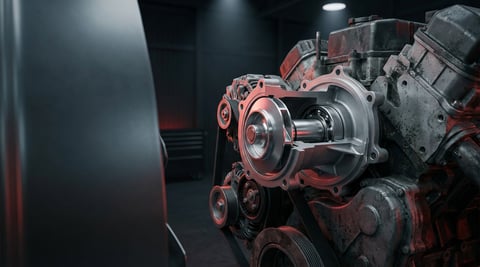
Why the belt broke matters too, because a belt rarely fails on its own. A seized pulley bearing, a failing tensioner, or a water pump shaft that's binding up will cut a belt in short order. That's why replacing the belt alone is rarely a complete repair — every accessory it drives needs to be checked for free rotation, play and alignment. The water pump's own failure signs, from seizing to seal leaks to bearing play, along with replacement details, are covered in our water pump guide.
Is the Fan Kicking In? Reading Clutch Behaviour
On heavy commercial vehicles, the fan matters most not at speed but at low speed and standstill. At road speed, most of the airflow through the radiator comes from the truck's own forward motion; in city traffic, a border queue, on a site, or crawling up a grade, that airflow disappears and the fan has to do the whole job. That's why "fine at speed, overheats in stop-and-go" almost always points to the fan side of the system.
How the fan is driven varies by vehicle. On viscous-clutch fans, the clutch locks up in response to temperature and brings the fan closer to engine speed; on electronically controlled clutches, the engine management decides when it engages. On either design, the check that matters is done hot, not cold: a fan that spins freely on a cold engine is normal and not a fault. What matters is whether the fan engages audibly once the engine is hot and the gauge is high. If a hot engine produces no fan noise at all and the fan still spins freely by hand, the clutch is the problem.
The second thing that affects fan effectiveness is the fan shroud; once it's cracked or missing, the fan only pulls air through part of the radiator and capacity drops noticeably.
Further reading
For a plain-language technical overview of this subject, see the reference article on Wikipedia. Always confirm specific figures and procedures against the vehicle manufacturer service data.
What Hose Stiffness, Softness and Leak Marks Tell You
The hoses in the cooling circuit give you the fastest hands-on read of pressure and flow inside the system. The one rule for this check is that the engine has to be cold — squeezing a hose on a hot system risks a burn and doesn't give you reliable information anyway.
The most telling comparison is between the upper and lower radiator hoses. If the engine has reached operating temperature, the gauge is climbing, and the lower hose is still noticeably cold, there's no flow going through the radiator. The most common cause is a thermostat that isn't opening: coolant just circulates in the short loop inside the engine, never reaches the radiator, and temperature climbs fast. How a thermostat behaves when it fails to open, opens late, or stays stuck open — and what each of those feels like on the road — is covered in detail in our thermostat failure guide.
How a hose feels in your hand carries information too. An aged hose either turns mushy and soft or hardens up glass-brittle — both point to a hose that's close to failing on the road. Fine cracking across the surface, swelling near the clamps, or bulging at the ends all mean a hose has reached the end of its life. If a hose on the suction side is collapsing inward while the engine runs, suspect that its internal reinforcement has broken down or that there's a restriction somewhere in the circuit.
The most reliable way to hunt for leaks is to read the trail. Coolant that has evaporated away leaves a coloured, crusty residue behind, tracking downward from wherever it escaped. Clamps, the ends of the radiator core, the water pump's weep hole and the expansion tank's seams are the points worth checking first.
Bubbles in the Expansion Tank and Emulsion in the Oil
The worst news you can see at the roadside is continuous bubbling in the expansion tank. The cooling circuit is a closed loop; under normal conditions, nothing inside it should keep producing air bubbles. If the tank shows a steady stream of rising bubbles with the engine idling, suspect that pressurised combustion gas is getting into the cooling jacket. The usual cause is a failed head gasket, a warped head deck, or a crack in the casting.
This picture rarely shows up alone. A few extra symptoms strengthen the case: coolant that keeps disappearing with no visible outside leak, the tank overflowing once the engine is shut off, heavy, sweet-smelling white smoke from the exhaust, a cabin heater that just won't warm up, and a brown, frothy emulsion in the engine oil. If you see that emulsion on the dipstick or on the inside of the oil filler cap, don't start the engine under any circumstances — bearings can't survive on oil that's been cut with water.
There's an important distinction here. A blown head gasket can be the cause of overheating, or it can be the result of an engine that's already run hot for too long. You can't tell which at the roadside, and you don't need to — the decision is the same either way. Shut the engine down, get the truck towed, and let the diagnosis be confirmed in a workshop with a combustion-gas test and a pressure test. Roadside sealant additives are not a lasting fix for this picture; they can clog the radiator core and narrow passages, making the eventual repair harder.
How Do You Safely Top Up Coolant After Overheating on the Road?
Topping up is the stage of an overheating incident that causes the most injuries. The rule fits in one sentence: don't open the cap until the system is cool enough to hold comfortably by hand. A rushed top-up both risks scalding the driver and risks cracking hot metal with cold liquid.
The top-up itself is also a diagnostic opportunity. If the system swallows a large volume, there's a serious leak, and whatever you pour in will most likely be back out again soon. If the system won't take any liquid at all despite a low level in the tank, suspect an air lock in the circuit.
- Wait. Once the engine is off, wait for the system to cool down. Don't count this in minutes — wait until you can comfortably grip the upper hose by hand.
- Secure the truck. Parking brake set, chocks in place, hazards on, hi-vis vest on, warning triangle out, and the ignition off.
- Open the cap in two stages. Wearing protective gloves, turn the cap to its first stop, wait for any remaining pressure to vent, then remove it once the hissing stops. Keep your face away from the cap the whole time.
- Check for the source of a leak. Look for anything visible before you fill — if there's a leak, whatever you pour in will simply be wasted.
- Choose the right fluid. Pre-mixed coolant of the type your manufacturer specifies is always the first choice; if you don't have it, follow the order in the table below.
- Fill slowly, a little at a time. Don't pour it all in at once — add it gradually. This cuts down both thermal shock and trapped air.
- Bleed the air and seat the cap properly. Follow the vehicle's bleeding procedure; if you don't know it, run the engine at idle with the heater on full and watch the level. A cap that isn't fully seated won't hold pressure, and the truck will overheat again before long.
- Check again after a short distance. At the first suitable stop once you're back on the road, recheck the level and the gauge — an air lock often only reveals itself after a few heat-up cycles.
| Option | When it's appropriate | Risk and limitation |
|---|---|---|
| Pre-mixed coolant matching the OEM type | First choice in every situation | No risk; confirm the correct type in the vehicle's manual |
| Concentrated antifreeze of the same type mixed with demineralised water | If no pre-mix is on hand | Don't guess the ratio by eye; use the exact ratio your manufacturer specifies |
| Demineralised or distilled water only | Emergency use only, for a short distance | Loses the boiling-point protection, corrosion inhibition and pump lubrication the mix normally provides |
| Clean tap water | Only if nothing else is available, temporary | Minerals leave scale and sediment; the system must be flushed and refilled with the correct fluid at the next service |
| Adding antifreeze of a different chemistry to what's already in the system | Not recommended | Additive packages can clash, risking gelling and blockages |
The logic behind the mix ratio is often misunderstood. Antifreeze isn't just there to stop freezing in winter; the mix also raises the boiling point, carries corrosion-inhibiting additives, and lubricates the water pump seal. That's why running the system on plain water in summer removes both the boiling-point margin and the corrosion protection. Going too far the other way isn't right either — push the concentrate ratio too high and heat-carrying capacity drops. Get the exact ratio from your vehicle's OEM service manual.
The Call to Tow: When You Should Never Keep Driving
Calling a tow is expensive and slow, which is why it tends to get put off in the field. But with overheating, the cost of a tow is small next to the alternative. A severely overheated engine can end up with a warped head deck, a blown head gasket, seizing on the liner and piston side, loss of oil film, cooked oil around the turbo, and heat damage to emissions hardware. None of that shows itself at the roadside — it only surfaces later, once the engine is opened up.
- The coolant level isn't visible, or the system empties out again as soon as you fill it.
- The drive belt has snapped, shredded, or started slipping.
- There's continuous bubbling in the expansion tank, an oily film on the tank, or emulsion on the dipstick.
- Heavy, sweet-smelling white smoke is coming from the exhaust.
- The oil pressure warning has come on alongside the temperature warning.
- There's a metallic knock, tick, or scraping noise from the engine.
- The engine has gone into protection mode, with torque limitation or an rpm ceiling engaged.
- The engine overheats again within a short time of being shut down and restarted.
There's a simple question that helps with the call: what does it cost if I'm wrong? Get the decision to keep driving wrong, and the cost is the engine itself. Get the decision to call a tow wrong, and the cost is a tow bill and a few hours' delay. That asymmetry makes the decision almost make itself.
What Must Be Checked After an Overheating Event
Once the truck reaches a workshop, the job isn't just to fix whatever leak is visible. An overheating event calls for questioning the whole system from end to end, because you need to find both what caused it and what damage it left behind.
- Coolant level and condition: check colour, clarity, any oily film on the surface, and sediment at the bottom. Cloudy or oily coolant is the first sign of an internal leak.
- Engine oil level and condition: look for emulsion and any unexplained rise in level. If water has mixed in, an oil and filter change is unavoidable.
- Pressure cap and expansion tank: check the cap seal, spring behaviour and the tank's seams. A cap that won't hold pressure can cause repeat overheating all by itself.
- System pressure test: pressurise the circuit and watch whether pressure holds; this is the most reliable way to catch small leaks.
- Combustion-gas leak test: confirm with the appropriate test kit whether the gas in the tank is combustion gas. A suspected head gasket is only confirmed here.
- Thermostat behaviour: check its opening behaviour and the circuit's warm-up curve; this is where the roadside lower-hose finding gets confirmed.
- Water pump: check for leak marks at the weep hole, shaft play, bearing noise and impeller condition.
- Belt, tensioner and pulleys: check the belt's back and ribs, tensioner movement, pulley alignment and bearing play.
- Fan and fan clutch: check engagement behaviour on a hot engine, blade condition and whether the shroud is properly in place.
- Radiator and intercooler: clean the face and check the fins for crushing and the core for internal blockage. A radiator that looks clean on the surface can still be blocked inside.
- Hoses and clamps: look for hardening, swelling and cracking on hoses that have been through the heat cycle; replace any suspect hose before it causes a repeat event.
- Cylinder head and sealing: if there's any doubt, run a compression and leak-down test, and check the head deck if needed.
- Fault codes and data: read out permanent and pending codes; where possible, pull the peak temperature along with the rpm, load and speed data from the moment of the event, and record it before clearing anything.
Items four and five on this list are the ones most often skipped. A "just a burst hose" diagnosis handed down without a pressure test or a combustion-gas test usually ends with the same truck back in the shop, same complaint, a few weeks later.
Logging Repeat Overheating Across a Fleet
One overheating event can be a one-off. The same truck overheating a second time — especially on the same route — isn't an accident anymore, it's a pattern, and a pattern only becomes visible through records. The most expensive version of overheating in a fleet is the one that gets patched over each time with a splash of water and no real cause ever chased down; a truck slowly losing coolant can be nursed along for months before it finally breaks down.
| Field | Why it matters |
|---|---|
| Date, time and outside temperature | Shows whether the event is tied to season or ambient heat |
| Vehicle, engine code and mileage | Reveals whether a pattern is repeating across the same engine family |
| Load state and the route's grade profile | An event that repeats on a specific climb points to a cooling-capacity problem |
| Driving style: stop-and-go or long haul | Overheating in stop-and-go points to the fan side, overheating on long runs points to the flow side |
| Gauge behaviour and timing | Did it spike suddenly, how many minutes did it take to climb, did it drop back |
| Warning lights and fault codes | Distinguishes a single fault from a chain of problems |
| Cabin heater behaviour | A cold-blowing heater goes on record as a low-level or air-lock suspicion |
| Type and amount of fluid added | A top-up amount that grows over time is the strongest evidence of a hidden leak |
| Action taken and whether the truck continued the trip | Determines how long the engine ran hot for later damage assessment |
Once enough records pile up, the patterns start reading themselves. Overheating that only shows up in summer and only at full load points to the radiator face or the airflow side. Overheating that only shows up in stop-and-go traffic points to the fan drive. Overheating that starts right after a specific repair is usually air that got into the system during that job and was never fully bled out. And a truck that loses a little coolant every month with no visible outside leak needs to be tested for an internal leak.
Pre-Trip Checks and Driving Habits That Keep You Off the Shoulder
A large share of roadside overheating events give warning through signs that a five-minute pre-trip check would have caught. In the morning walk-around, the most practical checks are: the expansion tank level on a cold engine, confirming the cap is seated properly, scanning the radiator and intercooler face by eye, checking the belt's back and its tension, and looking for coloured stains on the ground where the truck was parked overnight.
Seasonal factors matter too. During heavy insect season the radiator face clogs up fast and airflow drops noticeably; harvest season produces the same result with straw and dust. Winter grille covers that don't come off once the weather warms up become the silent cause of repeat overheating come summer. Clean the face without damaging the fins, and in the direction the manufacturer allows.
A handful of driving habits make a real difference too. On long grades, keeping the engine in its working band with the right gear, rather than lugging it at low revs under high load, cuts the heat it produces. On extreme-heat days with a long, fully loaded climb, checking the gauge regularly catches trouble at the earliest stage. And rather than shutting an engine off the instant you park after a long stretch under heavy load, leaving it idling briefly helps heat even out, especially around the turbo.
Finally, knowing your gauge's normal behaviour is the cheapest early-warning system there is. Every vehicle settles into its own habitual working band, and an experienced driver knows exactly where the needle is supposed to sit. A needle running one notch higher than usual gives warning before any light comes on at all. Paying attention to that early signal is what keeps you from ever needing the emergency-response sections of this guide. In every case, for exact temperature thresholds, the correct top-up fluid, the bleeding procedure and the limits of what to attempt yourself, the current OEM service documentation for your engine and chassis code is the final authority.
The air-facing end of that chain is the radiator; how the core works, how blockage is noticed and how cleaning is approached are covered separately in the radiator function and core blockage guide.
Another heat exchanger tied into the same coolant circuit is the oil cooler; because an internal leak can let oil and coolant mix, oil cooler failure and rupture is examined under a separate heading.
Shop this part: Cooling System
Main guide: Water Pump: Faults, Replacement & Maintenance Guide
Tags
Frequently Asked Questions
- What do I do in the first 60 seconds of engine overheating on the road?
- The goal is to cut the heat you're producing and increase the heat the system can shed. Ease off the throttle first and drop the engine load, and shift into a gear that won't lug the engine. Switch off the air conditioning; the compressor adds load to the engine and its condenser sits in front of the radiator, feeding it hot air. Then turn the cabin heater all the way up with the fan on maximum; the heater core acts like a second small radiator wired into the cooling circuit and genuinely pulls heat out of the system. Avoid stop-and-go traffic, put the hazards on, and look for a safe place to stop, such as a hard shoulder or rest area. If a charge or oil pressure warning comes on alongside the temperature light, the decision changes completely and you stop right away.
- Should I shut off an overheating engine right away?
- It depends. The instant you kill the ignition, the water pump and fan both stop and flow ends, but the heat stored in the metal keeps dumping into coolant that's no longer moving, so temperature can keep rising for a while after the engine stops. If coolant is still in the system and there's no major leak, it's generally better to pull over somewhere safe and leave the engine idling briefly with the heater on. On the other hand, if the drive belt has snapped, the coolant is gone, heavy steam is coming from under the hood, the oil pressure warning is on, or there's a metallic knock, shut the engine down immediately — running it any longer only multiplies the damage in these cases.
- Why is it dangerous to open a hot radiator or expansion tank cap?
- The cooling circuit is pressurised on purpose, because pressure raises the coolant's boiling point and lets the engine run hot without actually boiling. Open the cap while it's still hot and the pressure drops to atmospheric instantly, the boiling point drops with it, and the coolant inside flashes to boil. A jet of boiling liquid and steam sprays out of the opening, which can cause severe burns to the face, neck and arms. Throwing a rag over the cap doesn't remove that risk. Only open the cap once the system is cool enough to hold comfortably by hand, wearing gloves, and turn it to the first stop to let the remaining pressure vent before removing it fully.
- Can I pour cold water into a hot engine?
- No. The block and head are cast from metals that expand at different rates and are fully expanded while hot. Hitting that metal with cold water makes the surfaces contract suddenly and unevenly, and the resulting thermal shock can warp the head, damage the head gasket, and crack cast components. The correct approach is to let the engine cool first, then add fluid gradually rather than all at once. For the same reason, any top-up attempt before the engine has cooled down risks both injury and damage.
- Does turning on the cabin heater actually help when the engine overheats?
- Yes, and it's one of the most effective moves in that first minute. The cabin heater core is essentially a second, small radiator wired into the engine's cooling circuit. With the heater turned all the way up and the fan on maximum, the air passing through that core genuinely pulls heat out of the system, adding to the engine's total cooling capacity. The cab becomes unbearably hot, but the engine benefits. A heater that won't blow hot at all is itself a warning sign, pointing to low coolant or an air lock in the circuit.
- Can I keep driving an overheating truck to the nearest workshop?
- If the gauge is just above the normal band, no warning light is on, and the needle drops back once you cut the load, you can continue cautiously for a short distance. In almost every other case, you shouldn't. Overheating doesn't progress in a straight line: once coolant starts being pushed out of the system, the remaining volume drops, and as it drops temperature climbs faster still — the process feeds itself. The last few kilometres you think you can squeeze out to reach a workshop are usually the exact kilometres that cost you the engine. A steady warning light in the red band, steam, power loss, knocking, or an oil pressure warning all mean you stop, full stop.
- Can I keep driving if the drive belt has snapped?
- No. On most heavy commercial vehicles, a single drive belt turns the water pump, the fan drive, the alternator and, depending on the truck, the power steering pump and AC compressor all at once. When the belt snaps, everything it drives drops out together, and the symptoms appear as a cluster: the gauge climbs fast, the charge warning lights up, and the steering goes heavy. If the water pump isn't turning, coolant isn't circulating — even with a full system there's no flow to carry heat away, and every kilometre covered in that state damages the cylinder head and gasket directly. Shut the engine down and get the truck towed.
- I see bubbles in the expansion tank — what does that mean?
- The cooling circuit is a closed loop, and under normal conditions nothing inside it should keep producing air bubbles. A steady stream of rising bubbles while the engine idles suggests pressurised combustion gas is getting into the cooling jacket, typically from a failed head gasket, a warped head deck, or a crack in the casting. Signs that strengthen this picture include coolant that keeps disappearing with no visible outside leak, heavy sweet-smelling white smoke from the exhaust, a cabin heater that won't warm up, and a brown, frothy emulsion in the engine oil. Don't start the engine in that case — get the truck towed and have the diagnosis confirmed with a combustion-gas test.
- Can I use tap water instead of coolant?
- Only as a last resort and only temporarily. The first choice is always pre-mixed coolant of the type your manufacturer specifies; the second is concentrated antifreeze of the same type mixed with demineralised water at the ratio your manufacturer gives. Using plain water loses the boiling-point protection, corrosion inhibition and water pump seal lubrication the proper mix provides. Tap water also leaves scale and sediment from its minerals, so the system should be flushed and refilled with the correct fluid at the next service. Mixing in antifreeze of a different chemistry than what's already in the system isn't recommended either, as the additive packages can clash and cause gelling or blockages.
- What checks are essential after an overheating event?
- Fixing the visible leak isn't enough; both the cause and the resulting damage need to be tracked down. Check the coolant's colour and any oily film on the surface, look for emulsion in the engine oil, and inspect the pressure cap and expansion tank. Then run a system pressure test and a combustion-gas leak test, since a suspected head gasket is only confirmed there. Thermostat behaviour, the water pump's weep hole and bearing play, the belt and tensioner, the fan clutch's engagement when hot, the radiator and intercooler for internal blockage, and hoses and clamps should all be inspected individually. If there's any doubt, run a compression and leak-down test. Read out the fault codes and record the peak temperature and load data before clearing anything.
Related Articles

Engine Overheating in Heavy-Duty Trucks: Causes & Fixes
Learn why heavy-duty truck engines overheat, how to read the gauge, step-by-step diagnosis, and how coolant, water pump, thermostat, and fan clutch fail.
Fan Belt Tensioner: Failure, Replacement & Maintenance
What a truck fan belt tensioner does, why it squeals or vibrates, how to measure belt tension and how to replace a worn tensioner pulley bearing.
Water Pump: Faults, Replacement & Maintenance Guide
How the heavy-duty water pump keeps engine temperature in check, what fluid colour at the weep hole reveals about a failing seal, and safe replacement.