Fuel Filter & Water Separator: Faults, Change and Care Guide
Power loss under load on a truck, or water reaching common-rail injectors, starts at the fuel filter and water separator: diagnosis, bleeding, replacement.
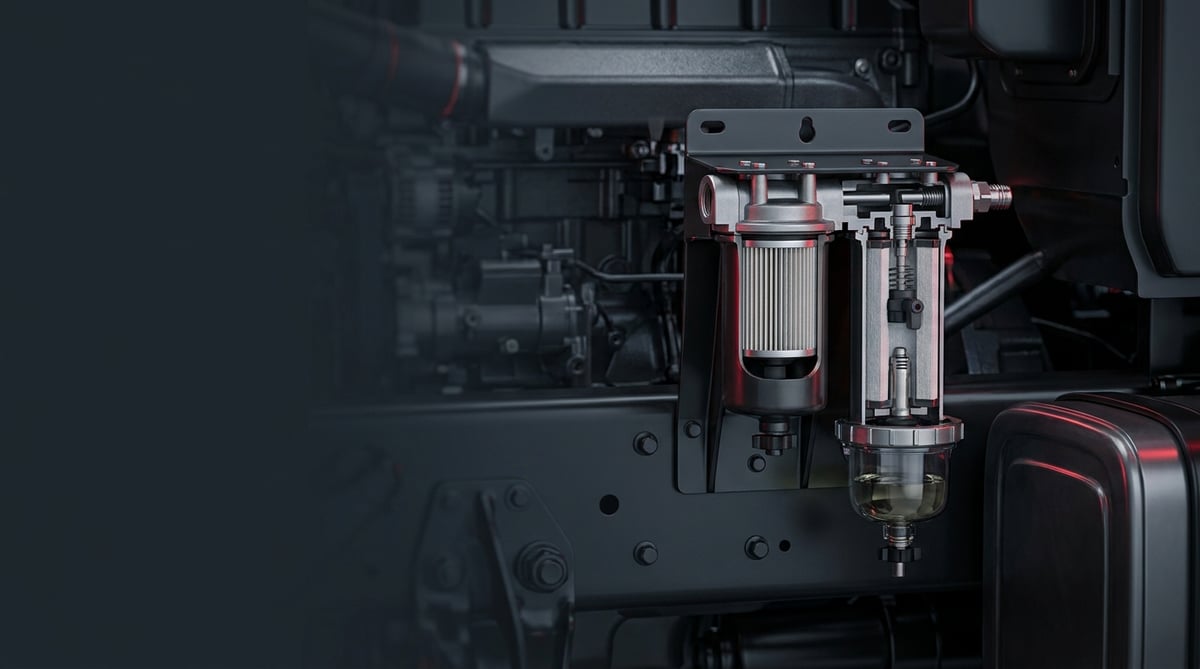
The cheapest part protecting the most expensive components on a heavy-duty commercial diesel is often overlooked: the fuel filter and water separator. In a tractor unit or a bus, the injection pump and common-rail injectors work to micron tolerances; the life of these units depends directly on how clean and water-free the fuel reaching them is. When the filter clogs, the result is power loss and hard starting; when the water separator is neglected, injection equipment worth thousands of euros is put at risk. This guide brings together, in field language, the working logic of the fuel filter and water separator for heavy diesel vehicles, the diagnosis of clogging and water symptoms, correct replacement and bleeding practice, and safe technical values.
What Is a Fuel Filter and Water Separator? Its Job and Working Principle
A fuel filter and water separator is a protective fuel-preparation unit that strains solid contaminants (dust, rust, sludge, fibres) out of diesel fuel, separates the water mixed into the fuel by exploiting the gravity/density difference and collects it at the base, and delivers clean, water-free fuel to the feed pump and the high-pressure system. On its way from the tank to the injector, diesel fuel carries both the dirt picked up during transport and storage, and water arising from condensation and low-quality fuel. Water and dirt wear away the micron-level tolerances of common-rail injectors and the high-pressure pump; that is why fuel must be strained and de-watered before it enters the system. On heavy commercial vehicles this task is usually carried out in two stages, as a pre-filter (a coarse filter with a water separator) and a fine (main) filter.
A fuel filter/water separator unit is not a single element but a sub-system working together. The main components are:
- Filter element (paper/synthetic media): Pleated filter paper or synthetic media that strains solid contaminants down to a specified micron value.
- Water separator (separator) bowl: A mostly transparent or sensor-equipped bowl where water collects at the base, exploiting the density difference between fuel and water.
- Water drain screw/tap: A lower drain plug through which the water accumulated at the base is emptied.
- Water level sensor (WIF - Water in Fuel): A warning sensor that illuminates the indicator lamp at a certain water level.
- Hand (priming) pump: A manual feed pump used to bleed the system and fill it with fuel after a filter change.
- Fuel heater (optional): An electric/fuel-return heater that warms the filter to prevent paraffin crystallisation (gelling) in cold weather.
Why does water separation work by gravity?
Water is denser than diesel fuel and does not mix permanently with it. In the water separator bowl the flow speed of the fuel is deliberately reduced; during this slowing, heavy water droplets coalesce and grow, then sink to the bottom of the bowl by gravity. The special water-repellent (hydrophobic) filter surface of the media prevents water from passing through the filter and helps it accumulate as droplets. The water collected at the base is drained regularly through the lower drain screw. Thanks to this simple but critical principle, water is expelled from the vehicle without ever reaching the sensitive injection system.
Heated filter and the cold-weather (gelling) problem
Diesel fuel forms paraffin crystals in the cold; when the temperature drops below the cloud point, these crystals clog the filter pores, cut off the fuel flow and the engine stalls or does not start at all. Winter-grade fuel and additives are the first line of defence; the second is the heated fuel filter. Filter heads heated by an electric resistance element or by engine coolant/fuel return keep the filter media above the gelling threshold, safeguarding cold-morning starts. If the heater is faulty, persistent hard starting and clogging symptoms in the cold can be confused with physical clogging of the filter.
OE-equivalent types and vehicle–engine matching
The deciding factors in choosing the correct filter are: the engine family, the system type (cartridge/spin-on or inner element), the filtration fineness (micron), whether a water separator is present, and the heater/sensor equipment. The table below is a guiding match for common heavy commercial platforms.
| Vehicle family (example) | Engine family | Typical filter configuration | Tendency |
|---|---|---|---|
| Mercedes-Benz Actros / Antos | OM 470 / OM 471 | Pre-filter (with water separator) + fine cartridge element | Two-stage, sensor/heater common |
| Volvo FH / FM, Renault T | D11 / D13 | Pre-filter with water separator + main filter | WIF sensor + optional heater |
| Scania R / S | DC13 / DC16 | Cartridge (element) type fine filter + water separator | High fineness (common-rail/XPI) |
| MAN TGX / TGS | D26 (D2676) | Module-type filter + integrated water separator | Integrated head, priming pump |
| Older-generation truck / off-highway machine | Mechanical diesel | Spin-on (screw-on) + glass-jar water separator | Coarser fineness, mechanical |
| Bus / midibus | Various | Pre-filter with water separator + fine filter | Heater common (cold starting) |
Fault Symptoms and Diagnosis
Fuel filter and water separator faults fall into three main groups: flow restriction due to clogging (power loss, hard starting), water/dirt breakthrough (injection equipment damage) and air ingress / sealing failure (stalling, rough running). The critical point is this: the power loss caused by a clogged filter also overlaps with the symptoms of a weak injection pump or a faulty injector. That is why the filter, being a cheap and easily replaced part, is the first component to be ruled out in diagnosis.
| Symptom | Possible Cause | Check / Verification |
|---|---|---|
| Noticeable power loss under load / on climbs, unable to pull | Clogged fuel filter, restricted flow, dirty/algae-fouled fuel | Check the filter change history; read the pressure difference before/after the filter (if available); try a new filter |
| Engine is hard to start or starts and stalls immediately | Air in the fuel line, drained water separator, loose filter head/O-ring | Bleed with the hand pump (priming); check the tightness of the head and drain screw; inspect the O-ring |
| Constant/rapid water build-up in the separator, WIF lamp on | Water condensation in the tank, low-quality fuel, condensate | Drain the water; monitor the build-up rate again; question tank hygiene and the fuel source |
| No starting in cold weather / persistent hard starting | Fuel gelling (paraffin), faulty filter heater, no winter fuel used | Check the heater supply/operation; verify winter fuel and additive status |
| Smoke from the exhaust, rough idle, power fluctuation | Insufficient/fluctuating fuel flow (partially clogged filter), air bubble | Renew the filter; watch for air bubbles in the return line/transparent bowl |
| Fuel leak / wetness around the filter head | Worn gasket/O-ring, cracked bowl, over- or under-tightening | Locate the leak point on a clean surface; renew the gasket and drain screw |
| Filter that clogs again in a short time | Dirty tank, microbial sludge (diesel bug), rust, low-quality fuel | Cut open and inspect the spent filter element; inspect the tank and fuel source |
Distinguishing the clogging (flow restriction) symptom
The classic signature of a clogged fuel filter is power loss that appears under load: the vehicle copes on level roads but on a climb or at full throttle, when fuel demand rises, the filter cannot pass enough flow and the engine "chokes". The symptom usually comes on gradually and worsens over time. The quickest confirmation is to renew the filter; if the problem clears with a new filter, that was the cause. On systems that can read the pressure difference before and after the filter, this difference grows as the filter clogs. Always rule out the filter before blaming the expensive injection pump or the injectors.
Distinguishing the danger of water in fuel
Water is the most destructive enemy of the diesel injection system. By breaking down the fuel's lubricating film, it causes corrosion and wear on the working surfaces of the high-pressure pump and injectors, and in common-rail, needle and nozzle damage. The symptoms are rapid water build-up in the separator, illumination of the WIF (water in fuel) warning lamp, difficulty starting in the cold, and power loss increasing over time. If the water builds up again quickly after draining the separator, this shows that the problem is not in the filter but in the tank/fuel source; in that case, changing only the filter is a temporary fix.
Distinguishing the air-ingress (air in the fuel line) symptom
The diesel feed system does not tolerate air; a loose O-ring at the filter head, an incompletely tightened drain screw or a cracked connection draws air in on the suction side. The result is hard starting, stalling while running, and irregular idle. The most common scenario is that the system is not fully bled right after a filter change. Seeing bubbles in fuel circulating in a transparent bowl or a section of line is clear proof. After completing priming with the hand pump, check all connections and the drain screw for leaks/air.
Once water has passed through, the nozzle side also comes into the picture; how those signs are told apart is explained in the fuel injector failure symptoms guide.
For faults found on the bowl, drain cock and water sensor hardware checked during an air leak inspection, our fuel water separator filter housing guide treats the housing equipment as a subject of its own.
Further reading
For a plain-language technical overview of this subject, see the reference article on Wikipedia. Always confirm specific figures and procedures against the vehicle manufacturer service data.
Replacement / Installation Steps
The steps below are a general sequence for heavy diesel (truck/tractor/bus); always rely on the replacement interval, torque and procedure values in the vehicle's and filter's service manual. Simple as the job may look, cleanliness and correct bleeding are the key to success.
- Secure the vehicle: Stop on level ground, chock the wheels, turn off the ignition. Let the engine and its surroundings cool; if necessary, observe the waiting time specified by the manufacturer.
- Drain the water separator: Open the lower drain screw and empty the water and sediment in the bowl into a proper container. This both keeps the environment clean and reduces spillage during removal.
- Disconnect the electrical/sensor connections: Mark and carefully remove the WIF water sensor and, if present, the heater connector; do not force the clips.
- Remove the old filter/element: On the spin-on type, unscrew anti-clockwise with a filter wrench; on the cartridge (element) type, open the head cap and take out the inner element. Keep a cloth/container ready for spilled fuel.
- Clean the seat and sealing surface: Wipe old gasket residue, dirt and sediment off the head and seating surface with a clean cloth. Do not let dirt fall into the seat; briefly cover the open inlet.
- Prepare the new gasket/O-rings: Use the new O-rings and gaskets supplied in the box; apply a thin layer of clean diesel fuel to the seating surface to ease assembly and ensure a correct seal. Prefer clean fuel over engine oil.
- Fit the filter with pre-fill (if possible): On accessible types, filling the new filter with clean fuel eases the first bleed. However, never fill with dirty fuel or by contaminating it with dirt during assembly — a dirty pre-fill means bypassing the filter; if in doubt, fit it dry and fill by priming.
- Seat the new filter/element: On the spin-on type, hand-turn until the gasket touches the surface, then tighten as specified by the manufacturer (typically ~3/4 turn); on the cartridge type, bring the cap to the manufacturer's torque. Do not over-tighten.
- Fit the water separator bowl and drain screw: Fit the bowl and lower drain screw with a new O-ring and hand-tighten to a seal; do not crack the plastic by over-tightening.
- Reconnect the sensor and heater connections: Seat the WIF sensor and heater connectors; make sure they are locked.
- Bleed (priming) and start: With the hand pump, prime until the pump goes firm and clean, bubble-free fuel comes from the bleed screw/bowl. Start the engine; if it runs for a few seconds and stalls, repeat priming. Check all connections and the drain screw for fuel leaks; watch the idle and check that the WIF lamp goes out.
Points to Watch (Common Mistakes)
- The "power loss = pump/injector is finished" fallacy: The same symptom often comes simply from a clogged filter. Renew the cheap and easy filter before moving to expensive diagnosis.
- Starting without fully bleeding the air: Air left in the system leads to hard starting and stalling; complete the priming and make sure no bubbles remain. Do not crank at length and burn out the starter motor.
- Pre-filling the filter with dirty fuel: Filling with unstrained fuel bypasses the filter and delivers dirt straight into the system. If in doubt, fit it dry and fill by priming.
- Missing the replacement interval / poor-quality filter: When the interval is exceeded or a filter of unsuitable fineness is fitted, either flow is restricted or straining is inadequate; both put the injection equipment at risk.
- Refitting an old water drain screw/O-ring: A worn O-ring leads to air leaks and seepage; renew the gaskets/O-rings at every change.
- Ignoring the water source: If water keeps building up, the problem is in the tank/fuel; changing only the filter is a temporary fix, tank hygiene and the fuel source must be inspected.
Technical Values and Check Points
The values below are general/safe references for common heavy commercial vehicle diesel fuel systems. Values such as filtration fineness, replacement interval and torque vary by vehicle, engine and filter model; for exact figures, always rely on the relevant service manual.
| Parameter | Typical / Safe Reference | Note |
|---|---|---|
| Pre-filter (water separator) fineness | ~10–30 micron range | Coarse straining + water separation; varies by model |
| Fine (main) filter fineness | ~2–7 micron range | Usually very fine straining for common-rail |
| Water separation efficiency | High (manufacturer's declaration governs) | Depends on media and flow rate; model-specific |
| Replacement interval (main filter) | ~ at periodic service / general reference | Shortens with fuel quality and operating conditions |
| Water draining | At WIF warning or periodic check | More frequent with condensate and fuel quality |
| Heater activation temperature | At low temperature (manufacturer's threshold) | To keep above the gelling threshold |
| Pressure difference before/after filter (ΔP) | Should be low; rise = clogging | Clogging indicator on sensor-equipped systems |
The fineness and interval values above are only meant to give an idea of magnitude; the real values differ significantly by engine family and emission class. Diesel fuel quality is defined in the EU by the EN 590 standard, and emission requirements within the EURO 5/6 framework (e.g. (EU) 595/2009 and the related implementing regulations); the filter fineness and water separation efficiency are set by the manufacturer to comply with these requirements. Regional regulations and vehicle manufacturer values always take priority.
Typical installation torque and tightening values
The torque of the filter head, bowl and drain screw varies with design and material (metal/plastic). The values below are only a general reference; for exact torque, always use the vehicle/filter manual. On plastic bowls, over-tightening leads to cracking and under-tightening to air leaks.
| Connection | Typical tightening reference | Note |
|---|---|---|
| Spin-on (screw-on) filter | Hand + ~3/4 turn once the gasket touches | Do not over-tighten with a wrench; hand feel governs |
| Cartridge (element) head cap | ~20–35 Nm (general reference) | Model-specific; a torque wrench is recommended |
| Water separator bowl (plastic) | Hand-tight to a seal + light (guide value) | Over-tightening cracks the plastic |
| Lower drain screw | Hand-tight to a seal | With a new O-ring; do not force |
| Bleed / priming screw | Low torque (guide) | Close to a seal after priming |
Quick field check points
- Drain the water separator regularly and observe water/sediment build-up in the fluid that comes out — chronic water means an early death for the injection equipment.
- Heed the WIF (water in fuel) warning lamp; when it comes on, drain the water at the first opportunity and monitor the re-accumulation rate.
- If power loss under load has begun, rule out the filter first; check the change history and (if available) the pressure difference.
- In cold seasons use winter fuel/additive and verify that the heater works; in persistent cold-starting difficulty, check for gelling and the heater supply.
- Scan the filter head and bowl connections for leaks on a clean surface; even the slightest wetness is a sign of an advancing seep or air leak.
Maintenance and Service Life
The fuel filter and water separator are themselves consumable (wear) parts; what really matters is how well they look after the expensive injection system behind them. Three things determine their service life: fuel quality, adherence to the replacement interval, and regular water draining. If these three are in place, the filter does its job fully and markedly extends the life of the injectors and the high-pressure pump. A routine that keeps preventive maintenance simple is one of the cheapest yet highest-return maintenance items.
- Daily / pre-trip: Inspect the water separator, watch the WIF lamp, drain the water if needed; do a visual fuel-leak check and use quality, clean fuel.
- At periodic services: Renew the main and pre-filter at the manufacturer's interval; change the water separator O-ring and drain gasket; verify that the heater and sensor work.
- At seasonal transitions: Use winter fuel/additive going into winter and check the heater circuit; in summer, watch for water condensation in the tank during long standstills.
- Fuel quality and tank hygiene: Avoid non-standard, watery or dirty fuel; during long standstills, water and microbial sludge (diesel bug) can form in the tank — pay attention to tank hygiene.
- Tracking early clogging: If the filter clogs earlier than expected, that is a warning; investigate the source — dirty tank, rust or sludge — and do not just keep changing the filter.
If constant water build-up, recurring early clogging and the resulting power loss are seen together, the problem is often not in the filter itself but in the fuel source or the tank; every change made without curing the root cause is temporary. The filter and water separator are the protective link between the tank/line in front and the feed pump and injectors behind; for a sound outcome, evaluate this chain as a whole. A filter of the correct fineness, water-free and renewed on time, is the cheapest insurance for the common-rail system.
After correct diagnosis, clean fuel and a meticulous installation, what is decisive is that the filter you fit meets the OE-type fineness, water separation efficiency and flow capacity. The VADEN Fuel Filter and Water Separator product family — together with the pre-filter with water separator, the fine (main) filter element, the filter head/module, and the water drain and O-ring/gasket kits — has been developed as an equivalent to Bosch and Mann-Filter type filters on heavy diesel trucks, tractor units and buses, to meet the safe technical values and field expectations set out in this guide; you need only select the model suited to your needs, together with the vehicle and engine match, evaluating it as a whole within the VADEN Fuel System product group.
Shop this part: Fuel Filter
Related categories: Fuel Filter
Related technical guides: Diesel Injection Pump: Faults, Replacement & Maintenance · Feed Pump & Hand Primer: Faults, Replacement, Maintenance · Diesel Injection Line & Fuel Pipe: Faults, Repair, Maintenance
Application and compatibility: Vehicle compatibility catalogue · Engine compatibility catalogue
Vehicles and engines mentioned in this guide: MAN D2676 · Volvo D13 · Volvo D11 · Volvo FM · Volvo FH · Mercedes-Benz Antos · Mercedes-Benz OM471 · MAN TGS I (2007-2020)
Tags
Frequently Asked Questions
- What happens when a fuel filter clogs, and what are the symptoms?
- The most typical symptom of a clogged filter is power loss under load: the vehicle copes on level roads but "chokes" on a climb or at full throttle. Hard starting, rough idle and power that fades over time are also seen. The symptom usually comes on gradually. The quickest confirmation is to renew the filter; if the problem clears with a new filter, that was the cause.
- When should the fuel filter be changed?
- The replacement interval varies by vehicle, engine and fuel quality; for the exact value, rely on the service manual. The general rule is to keep to the interval together with periodic maintenance. With poor fuel, a dusty environment and water/sludge, the interval shortens. If early clogging occurs, this is a warning related more to the fuel source than to the interval.
- How often should I drain the water in the separator?
- Immediately when the water-level warning (WIF) lamp comes on; also drain it regularly at periodic checks. If the water builds up again quickly, there is water in the tank/fuel. Neglecting to drain causes the water at the base to exceed the drain outlet and reach the sensitive injection system, leading to expensive damage.
- Does water in the fuel damage the engine?
- Yes, and it is the most destructive factor. By breaking down the fuel's lubricating film, water causes corrosion and wear on the working surfaces of the high-pressure pump and injectors, and nozzle/needle damage in common-rail. The job of the water separator is exactly this: to catch the water before it reaches the system and collect it at the base. That is why regular draining is critically important.
- Why is the engine hard to start after a filter change?
- The most common cause is that the system's air has not been fully bled. With the hand pump (priming), you must bleed the air until the pump goes firm and the bubbles stop. A loose filter head, an incompletely tightened drain screw or a worn O-ring can also draw air and cause the same problem. Repeat priming and check all connections for leaks/air.
- How do I bleed (prime) the fuel filter?
- Pump the hand (priming) pump on the filter head until it goes firm and, if there is a bleed screw, clean bubble-free fuel comes from it. Then close the bleed screw to a seal and start the engine. If it stalls within a few seconds, repeat priming; do not strain the starter motor by cranking for a long time.
- What is a heated fuel filter for?
- Diesel fuel forms paraffin crystals and gels in the cold, clogging the filter and stalling the engine. A heated filter keeps the filter media above the gelling threshold, safeguarding cold-morning starts. If the heater is faulty, persistent hard starting in the cold is seen; this can be confused with physical clogging. Winter fuel and additive are the first line of defence, the heater the second.
- What is the difference between the pre-filter and the fine (main) filter?
- The pre-filter (usually with a water separator) strains coarse dirt and separates water; it works at a larger micron value. The fine (main) filter holds much smaller particles, delivering fuel to the injection system at a cleanliness suited to common-rail tolerances. Together they provide two-stage protection; to choose the correct equivalent, it is essential to know which stage your system belongs to.
- Should I pre-fill the new filter with fuel before fitting it?
- On accessible types, yes: filling the new filter with clean fuel makes the first bleed easier. But the fuel must genuinely be clean and no dirt may enter the seat during assembly. A pre-fill with unstrained fuel bypasses the filter and sends dirt straight to the high-pressure pump and the injectors. If in doubt, fit the filter dry and fill it by priming with the hand pump.
- What should I do if the filter clogs much earlier than expected?
- Treat early clogging as a warning and do not simply keep changing the filter. Investigate the source: a dirty tank, rust, sludge, or microbial sludge formed during long standstills. Check fuel quality and tank hygiene. If constant water build-up and recurring early clogging appear together, the problem lies in the tank or the fuel source, and every change made without curing the root cause is temporary.
Related Articles

Fuel Water Separator Filter: Symptoms, Replacement & Care
Truck fuel water separator filter and housing: how it works, water sensor, drain valve, heater, fault symptoms, replacement, bleeding and maintenance.
Solenoid Coil: Faults, Testing, Replacement and Maintenance
Understand how a solenoid coil works, spot open or shorted windings with a multimeter, replace it correctly and extend its service life on trucks.
Diesel Injection Line & Fuel Pipe: Faults, Repair, Maintenance
Heavy truck injection line and fuel pipe guide: high-pressure vs supply line, leak and air ingress diagnosis, torque sequence, replacement and maintenance.