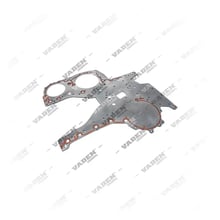
Positioned between the block face and the camshaft, this plate is usually made from hardened steel or a bronze alloy, designed as a wear surface subjected to continuous friction and axial load. In some engine families, thrust plates of different thicknesses are available, allowing axial clearance to be adjusted by selecting plate thickness alone, without replacing the shaft or block.
What are the functions of a camshaft thrust plate?
The plate's functions inside the engine are aimed at keeping the camshaft in the correct position and running in sync.
- Axial fixing: Prevents the camshaft from moving along its length, maintaining stable contact at the bearing surfaces.
- Timing preservation: Prevents axial drift of the shaft, keeping the gear/chain assembly within its set timing.
- Load distribution: Spreads axial forces at the shaft end across a wide contact surface, reducing localized wear.
- Lubrication support: In most designs, grooves or holes on the plate direct oil flow to the bearing area.
- Assembly reference: Provides a fixed reference surface for installing the camshaft at the correct axial position.
- Vibration damping: The tight contact surface limits the propagation of axial vibration generated while the engine runs.
What are the symptoms of a camshaft thrust plate failure?
Wear or breakage of the plate shows up in the engine's timing and running behavior.
- Irregular engine running: As axial play increases, valve timing can drift and the engine may run unevenly.
- Abnormal noise: Metallic knocking or ticking from the camshaft area can indicate a worn plate or increased clearance.
- Power loss: As timing deviation progresses, a drop in engine performance and torque output can appear.
- Excessive axial play: Detecting above-normal axial movement at the shaft end during inspection.
- Irregular oil pressure: If the plate positioned over the oil channel is damaged, the corresponding bearing area may be under-lubricated.
- Progressive wear marks: Deep grooving or discoloration (a sign of overheating) on the plate surface found during disassembly.
How is a camshaft thrust plate checked?
Inspection is carried out after the engine is disassembled and the camshaft is accessible.
- Visual inspection: Check the plate surface for scoring, pitting, discoloration, or cracks.
- Axial clearance measurement: Use a dial gauge to measure the camshaft's axial play and compare it to the manufacturer's tolerance range.
- Surface flatness check: Check the flatness of the plate surface against a straightedge or flat reference; replace if deformed.
- Bolt/fastener check: Verify the retaining bolts are at the correct torque and undamaged.
- Bearing surface check: Inspect the bearing surface in contact with the plate for wear or scoring.
What should be considered during replacement?
Correct installation directly affects camshaft service life and timing accuracy.
- Cleanliness: Fully clean metal shavings and old gasket residue from the plate and contact surfaces before installation.
- Correct torque: Tighten retaining bolts to the manufacturer's specified torque, following a staged sequence where required.
- Axial clearance check: Remeasure axial play after installation to confirm it is within tolerance.
- Lubrication: Pre-lubricate the bearing and plate surfaces with clean engine oil during assembly.
- Timing check: After plate replacement, re-verify the camshaft's timing marks.
How should a camshaft thrust plate be selected?
Selection requires an exact match to the engine code and camshaft type.
Camshaft thrust plate selection criteria| Criterion | Description |
|---|
| Engine code match | Plate geometry and hole positions vary by engine code and must match exactly |
| Material and hardness | Must have wear resistance compatible with the bearing surface |
| Thickness tolerance | Directly affects axial clearance value; must match manufacturer specification |
| Oil channel alignment | Lubrication holes, if present, must align exactly with bearing channels |
| Bolt hole pattern | Retaining bolt positions must match the original exactly |
Maintenance and service life
Under normal conditions, the camshaft thrust plate is designed to last until the engine's general overhaul interval; however, factors such as inadequate lubrication, contaminated oil, or excessive engine speed can accelerate wear. Following oil change intervals and replacing the oil filter regularly directly extends the service life of the plate and bearing surfaces. During engine overhaul, the plate's axial clearance value must always be checked and renewed if outside tolerance. Engines run for long periods on low-quality oil can show premature wear on the plate surface, so oil quality also indirectly affects the part's lifespan. For exact tolerance and torque values, the vehicle's current OE service manual is authoritative.
VADEN Camshaft Thrust Plate
VADEN offers OE-compatible camshaft thrust plates for heavy commercial vehicle engines. Manufactured with correct thickness tolerance and hole alignment, the part is designed to preserve camshaft timing accuracy and axial stability.
Frequently Asked Questions (FAQ)
What does a camshaft thrust plate do?
It prevents the camshaft from moving axially within the engine block, keeping the shaft in its correct position and maintaining stable timing.
What happens if a camshaft thrust plate wears out?
The shaft's axial play increases, which can lead to timing drift, abnormal noise and vibration, and in advanced cases serious engine damage including valve-to-piston contact.
At what mileage should a camshaft thrust plate be checked?
There is no fixed mileage figure; it is typically checked during engine overhaul or whenever the camshaft is removed. Early inspection is recommended if abnormal noise or timing complaints occur.
Can the plate be replaced without disassembling the engine?
No, accessing the camshaft thrust plate generally requires removing the front cover and timing assembly; this work should be done in a qualified service environment.
What happens if a plate of the wrong thickness is used?
Axial clearance falls outside tolerance; a plate that is too thin causes excessive play, while one that is too thick causes excessive bearing pressure and premature wear.