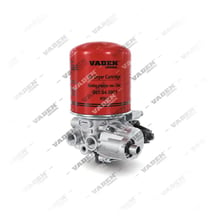
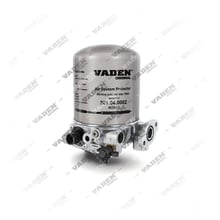
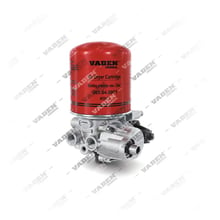
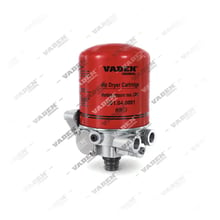
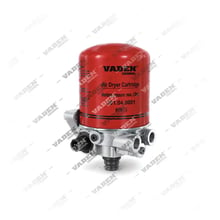
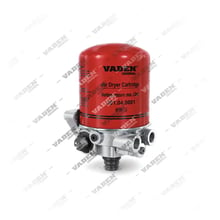
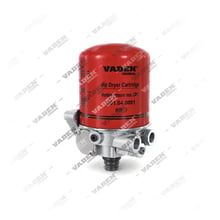
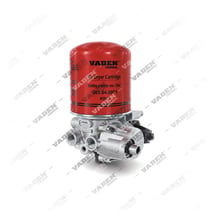
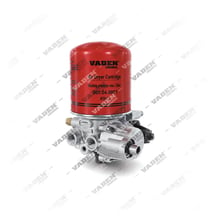
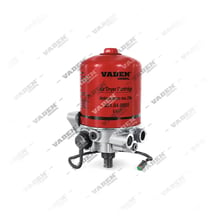
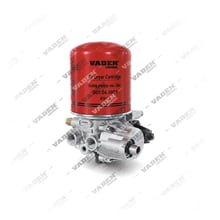
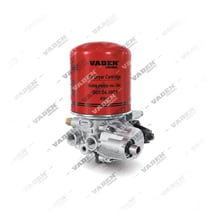
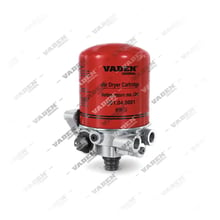
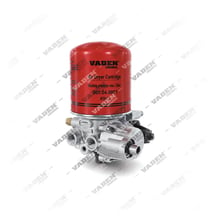
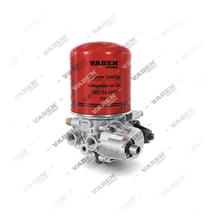
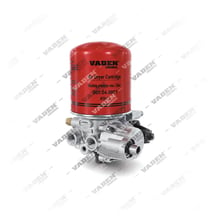
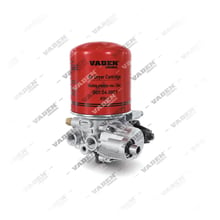
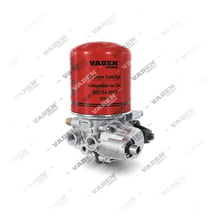
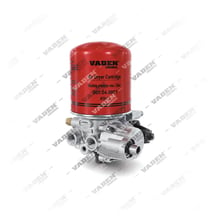
What is a complete air dryer with purge valve?
The word "complete" in this category means exactly this: rather than renewing individual internal parts, the entire unit is replaced. The complete air dryer with purge valve is different from individual spares such as the cartridge, repair kit, heater element, or regulator; instead of renewing parts on a unit with a cracked housing, worn seats, constant air leakage, or an oil-filled interior, complete replacement is preferred.
The compressor raises air above 100 degrees Celsius during compression, and this air carries all of the ambient humidity within it. As the air cools, the moisture condenses and turns into water in the air tanks, valves, and bellows. The complete air dryer with purge valve captures this water before it enters the system; thus valve freezing, internal corrosion, gasket swelling, and brake performance loss are prevented. The most common cause of ice plugs forming in air lines in winter is a dryer unit that is not doing its job.
What are the functions of the complete air dryer with purge valve?
The unit's function is not just "removing moisture"; it carries out several interconnected jobs simultaneously:
- Moisture retention (adsorption): The desiccant granules inside the cartridge hold the water vapor of the passing air on their surface and send dry air to the tanks.
- Oil and particle separation: Oil particles and carbon particles carried from the compressor are separated in the pre-filter section of the cartridge.
- Regeneration: When the system reaches cutoff pressure, the purge valve opens, and dry air from the regeneration tank is passed through the cartridge in the reverse direction, expelling the retained moisture and oil. This is the short, sharp discharge sound heard from the purge port.
- Pressure regulation: In integrated-regulator types, the unit determines the compressor's load and unload pressure, protecting the compressor from running continuously.
- Preventing backflow: The check valve prevents pressurized air in the tanks from leaking back into the compressor.
- Freeze protection: The heater element prevents the purge valve area from freezing at low outside temperatures.
When any of these functions is disrupted, the impact does not remain limited to the dryer alone; the air processing unit, four-circuit protection valve, relay valves, ABS/EBS modulators, and brake chambers are affected in sequence. For this reason, the complete air dryer with purge valve is a safety part whose maintenance should not be postponed.
What are the symptoms of a complete air dryer with purge valve failure?
The most common field symptoms are:
- Water in the tanks: Water or a milk-consistency oil-water emulsion coming from the tank drain cock is the clearest indication that the cartridge is saturated.
- Continuous air leakage: Uninterrupted air coming from the purge port shows that the purge valve sealing surface has worn or become contaminated.
- No purge sound at all: If there is no discharge sound at cutoff pressure, regeneration is not working; the cartridge will saturate quickly.
- Compressor running continuously: If pressure never reaches the cutoff value and the compressor is not resting, there is a leak or a regulator failure.
- Low pressure warning: The gauge or audible warning, particularly informs that system pressure cannot be maintained at idle.
- Air lines freezing in winter: A disabled heater element or supply cable is a typical cause.
- Blocking and corrosion in valves: Relay valves and modulators exposed to moisture responding late, releasing the brake late.
- Excessive oil carryover: Dark oil coming from the purge port most often indicates compressor ring wear; in this case replacing only the dryer will not be a permanent solution.
How is the complete air dryer with purge valve checked?
The check begins with simple steps that can be performed without disassembling the system. The vehicle should be on level ground, parking brake applied, wheels chocked:
- Tank drainage: Drain water from all tanks while the engine is cold. If water comes out, drying efficiency has dropped.
- Regeneration listening: Start the engine and fill the system. At cutoff pressure, a short, sharp discharge sound should come from the purge port.
- Leak test: With the system full and the engine off, apply foam to the purge port and connection fittings; no bubbles should form.
- Pressure measurement: Read the load and cutoff pressures by connecting a manometer to the tank test point; the values should be within the range in the vehicle's current OE service manual.
- Heater check: Measure the supply voltage and heater resistance with the ignition on; check for corrosion in the cable socket.
- Visual inspection: Look for cracks in the housing, rust on the cartridge seating surface, blockage at the muffler port, and dents or breaks in the regeneration line.
- Compressor side: Excessive oiliness on the dryer intake hose indicates that the source of the problem is the compressor.
Pressure, torque, and time values vary by vehicle manufacturer; general ranges are guiding, but the vehicle's current OE service manual is authoritative.
What should be watched for during replacement?
Although the complete air dryer with purge valve replacement seems simple, work is done on a pressurized circuit. The following sequence must not be neglected:
- Fully drain the system: Zero out the pressure of all tanks. Removing under pressure can cause the fitting and valve to fly out.
- Label the lines: Label air lines and the electrical connector before disassembly; port mix-up causes the system to malfunction.
- Cleanliness: Cap open connections so dust and moisture do not enter. Clean old gasket residue from seating surfaces without scratching the surface.
- New sealing elements: Always renew gaskets and O-rings; do not reuse the old part.
- Correct tightening: Tighten the cartridge and connection fittings with a torque wrench to the value specified by the manufacturer. Over-tightening damages the housing thread and gasket; loose installation leaks.
- Regeneration line: Ensure the regeneration tank and line are not blocked; a blocked line will fatigue the new unit quickly too.
- Electrical connection: Seat the heater socket properly, keep the cable routing away from hot surfaces and moving parts.
- Post-installation test: Fill the system, verify cutoff pressure and purge sound, perform a foam test on all connections, then drain the tanks.
- Address the root cause: If the compressor is carrying excessive oil, the new unit will clog quickly; compressor condition should be evaluated together.
How is the complete air dryer with purge valve selected?
The correct product is selected based on OE number and technical matching, not brand name. The original number of the vehicle manufacturer or system manufacturer (Wabco, Knorr-Bremse, Bendix, Mercedes-Benz, Volvo, MAN, DAF, Scania, Iveco) should be used as reference and confirmed with the chassis number. Even within the same vehicle family, different units may be used depending on production year and brake system equipment.
Decisive criteria in selection: whether it has an integrated regulator, heater supply voltage (12V or 24V), the number of ports and thread sizes on the housing, cartridge connection thread, mounting foot hole spacing, single or twin dryer structure, and operating pressure class. Our product group includes different housing and connection options, including the AD9 type; it is recommended to search by OE number to find the appropriate reference.
Complete air dryer with purge valve: selection and inspection points| Inspection point | Method | Expected condition | Action |
|---|
| OE reference match | Number on the old unit and chassis confirmation | Number exactly overlaps | If not, verify from the application list |
| Regulator type | Visual comparison | Integrated or external, same as vehicle | If different, pressure setting won't hold, replace |
| Heater voltage | Label and vehicle network | Same as vehicle voltage | If mismatched, the resistance will burn out |
| Port count and threads | Measurement and counting | All lines connect with no port left unused | Do not force with an adapter, choose the correct housing |
| Cutoff pressure | Manometer at test point | Range in the OE service manual | If outside range, check regulator/unit |
| Regeneration discharge | Listen at cutoff moment | Short, sharp discharge sound | If no sound, check purge valve and line |
| Tank water | Drain from drain cock | Dry or very little condensation | Renew the cartridge or unit if water/emulsion present |
| Sealing | Foam test | No bubbles | If leaking, check gasket and torque |
| Compressor oil carryover | Inlet hose inspection | No noticeable oil buildup | If oil present, evaluate the compressor together |
Maintenance and service life
The life of the complete air dryer with purge valve unit directly depends on usage conditions. Tractors and dump trucks operating in humid climates, stopping frequently over short distances, and with high air consumption saturate the cartridge much faster. The basis of maintenance is periodic renewal of the cartridge and regular drainage of the tanks; cartridge renewal is generally planned at annual or specific mileage intervals, but the exact period is determined per the vehicle manufacturer's current OE service manual.
The main factors shortening life are: excessive oil from the compressor, a blocked regeneration line, freezing due to a faulty heater, mud and salt blocking the muffler port, and deformed seating surfaces resulting from over-tightening. Conversely, regular tank drainage, a clean intake filter, and a healthy compressor allow the unit to reach its expected life.
In maintenance, cartridge replacement is often sufficient; however, if there is a crack in the housing, thread damage, permanent leakage in the purge valve, or regulator failure, replacing as a complete air dryer with purge valve is both safer and more rational in terms of total cost.
VADEN complete air dryer with purge valve
VADEN is a manufacturer producing in the heavy commercial vehicle air brake systems and compressor group. In the complete air dryer with purge valve product group, different housing, port, and regulator configurations are available for truck, tractor, bus, and trailer applications. The references in our product group are listed matched with vehicle and system manufacturer OE numbers; to find the correct part, it is recommended to search with the OE number you have and to compare port and thread dimensions before installation. You can review the complete air dryer with purge valve options suitable for your vehicle from this category page using the filters.
Frequently Asked Questions (FAQ)
What does the complete air dryer with purge valve do?
It dries the hot, humid, and oil-vapor-carrying air coming from the air brake compressor, separates oil and particles, and expels the moisture it retains during regeneration. In integrated-regulator types, it also determines the compressor's load and cutoff pressure. This prevents water accumulation, corrosion, and freezing in winter in tanks and valves.
How is it understood that the complete air dryer with purge valve unit is faulty?
The clearest indicator is water or a milk-consistency oil-water emulsion coming from the tank drain cock. Continuous air leakage from the purge port, no discharge sound at all at cutoff pressure, the compressor running continuously, a low pressure warning, and air lines freezing in winter are other typical symptoms.
Is it sufficient to replace just the cartridge, or is a complete unit needed?
If the problem is only in drying efficiency, renewing the cartridge is usually sufficient. However, if there is a crack in the housing, thread damage, permanent leakage in the purge valve, regulator failure, or internal wear, replacing it as a complete air dryer with purge valve unit is required; in this case, renewing a part alone does not provide a permanent solution.
How is the correct complete air dryer with purge valve unit selected?
Selection should be based on the OE number, not the brand name. The original number of the vehicle or system manufacturer should be confirmed with the chassis number; whether it has an integrated regulator, heater voltage (12V or 24V), port count and thread sizes, cartridge connection thread, and mounting foot spacing should be compared.
What checks should be done after replacement?
The system should be filled and cutoff pressure read with a manometer, a short, sharp discharge sound should be heard from the purge port at cutoff, all connections should be tested for leaks with foam, the heater socket connection should be confirmed, and the tanks should be drained to confirm no water comes out. The vehicle's current OE service manual is authoritative for torque and pressure values.
Related technical guide: Air Dryer Purge Valve: Faults, Replacement and Maintenance