Engine Overheating in Heavy-Duty Trucks: Causes & Fixes
Learn why heavy-duty truck engines overheat, how to read the gauge, step-by-step diagnosis, and how coolant, water pump, thermostat, and fan clutch fail.

Halfway up a grade, the temperature needle starts climbing into the red. The driver lifts off the throttle, turns the heater to full blast, and pulls onto the shoulder. Popping the hood reveals either a gurgling sound from the expansion tank or steam escaping from under the radiator cap. On heavy commercial vehicles, overheating turns into damage far faster than on a passenger car: the engine is bigger, the load is heavier, and the cooling system already runs closer to its limit. This guide walks through why heavy-duty engines overheat, what the gauge is really telling you, which component to suspect, and how to diagnose the problem step by step in the field.
What Is Engine Overheating? Defining Excess Heat in the Engine
Engine overheating is the condition where coolant temperature rises above the normal operating range set by the manufacturer. In heavy commercial diesel engines, coolant typically runs between eighty and ninety-five degrees Celsius; permanently exceeding that range is defined as overheating. Overheating is not a fault but a symptom: the cooling system cannot shed the heat being produced, or coolant circulation through the circuit has broken down.
The engine converts only part of the energy it draws from fuel into motion; the rest turns into heat. The cooling system pulls that heat out of the cylinder block and head and releases it to the air through the radiator. Whenever any link in that chain weakens, heat starts to build up. In a heavy commercial vehicle this chain is long: the water pump, thermostat, radiator, expansion tank, fan and fan clutch, coolant hoses, heater core, and oil cooler are all part of the same circuit.
How Do You Read the Temperature Gauge?
The temperature gauge reads coolant temperature through a sensor mounted on the block or the cylinder head. During normal driving the needle sits steady in the middle of the scale. What matters as much as the needle's position is how it behaves: a needle that creeps up on a grade and drops back on the flat points to a system running near its limit, a needle that rises at idle and falls at road speed points to an airflow problem, and a needle that fluctuates points to air in the circuit or a thermostat fault. A needle that never moves at all is not necessarily reassuring either; in some failures the sensor or the gauge circuit fails and the needle stays put while the actual temperature keeps rising.
When a fluctuating needle or a slow warm-up comes up, the thermostat is among the components considered; how the two opposite failure modes are told apart is examined in the thermostat failure symptoms guide.
Why Does a Heavy-Duty Engine Overheat?
The causes of engine overheating fall into two main groups: coolant not circulating adequately through the circuit, and heat not transferring from the radiator into the air. The table below summarizes the causes most often found in the field, along with their distinguishing symptoms.
| Cause | Distinguishing symptom | Check / verification |
|---|---|---|
| Low coolant level | Expansion tank empty or below minimum; temperature climbs gradually | Check level on a cold engine; look for signs of a leak |
| Thermostat not opening | Engine heats up quickly, upper radiator hose stays cold | Feel the upper hose by hand during warm-up to check when it heats |
| Water pump impeller worn or belt slipping | Overheats at idle, partially recovers under throttle; leakage or noise from the pump | Check belt tension, pump shaft play, and the weep hole |
| Fan clutch (viscous coupling) not engaging | Overheats at idle and low speed, recovers on the road; no fan noise heard | Watch and listen for the fan locking up on a hot engine |
| Radiator core blocked from outside | Overheating worsens on slow, dusty, or bug-heavy routes | Hold the core up to light and visually check airflow |
| Radiator scaled or silted internally | One zone of the radiator is cold, another is hot | Measure the temperature difference across the core on a hot engine |
| Air lock in the circuit | Heater blows cold, needle fluctuates, gurgling from the tank | Follow the correct bleeding procedure and monitor the result |
| Cylinder head gasket leaking | Tank keeps losing coolant with no visible leak; bubbles rise in the tank | Run a combustion leak (exhaust gas) test, check for oil/coolant mixing |
| Pressure cap not holding | Boiling and overflow even at normal temperature | Check the cap seal and spring, run a pressure test |
| Oil cooler blocked or leaking | Oil temperature is also high; oil traces in coolant, coolant traces in oil | Inspect oil and coolant color, pressure-test the heat exchanger |
Coolant Is Dropping but There's No Overheating — What Does That Mean?
Coolant loss does not always come with overheating, and it is an early warning that should not be ignored. If coolant is dropping but the gauge stays normal, three possibilities stand out. The first is an external leak: a hose clamp, coolant pipe, radiator core, or water pump seal may be weeping at a drip rate; on a hot engine the coolant evaporates before it pools, leaving a dried white-to-green antifreeze residue instead of visible wetness. The second is an early-opening pressure cap; if the cap cannot hold the rated pressure, coolant is pushed into the overflow bottle and gradually lost. The third, and the most serious, is an internal leak: if the cylinder head gasket or the head itself is cracked, coolant passes into the combustion chamber or the oil circuit. In that case the expansion tank shows constant bubbling, the exhaust shows white smoke, and the dipstick shows a milky, coffee-with-cream-colored mixture.
Temperature Is Rising and the Heater Isn't Blowing Warm Either
When the temperature is climbing and the heater is blowing cold air, that combination usually points to coolant circulation having stopped in the circuit. The heater core sits at one of the highest points in the engine, so it is the first spot to go dry when an air lock forms or the coolant level drops. The same symptom also shows up when the water pump impeller has worn down and lost its ability to push coolant. If the heater is blowing warm but the engine is still overheating, circulation is present and the problem lies in the heat not being shed to the outside air; this distinction quickly splits the fault in two in the field.
What Happens If the Engine Overheats?
When the engine overheats, damage progresses in stages, and each stage is more expensive than the last. In the first stage, coolant boils, pressure rises, and the weakest point in the system — usually a hose or a cap — gives way. In the second stage, the temperature difference between the cylinder head and the block breaks the seal of the head gasket, and coolant begins entering the combustion chamber. In the third stage, thermal stress warps or cracks the aluminum cylinder head. In the final stage, the oil film between the piston and the liner breaks down, the piston seizes, and the engine locks up.
The time between these stages is measured in minutes. The correct response to an overheating warning is therefore not to keep driving but to pull over to a safe spot and shut the engine down. Because coolant circulation also stops once the engine is off, letting it idle briefly can in some cases dissipate heat faster during cooldown; but if the needle is in the red and steam is escaping, the engine must be shut down immediately.
Further reading
For a plain-language technical overview of this subject, see the reference article on Wikipedia. Always confirm specific figures and procedures against the vehicle manufacturer service data.
What Is the Coolant Temperature Sensor and How Do You Check It?
The coolant temperature sensor measures coolant temperature and sends the reading to the gauge or the engine control unit. Known in the field simply as the "temp sender," this part is usually threaded into the cylinder head, the thermostat housing, or the coolant outlet pipe. Some vehicles carry two separate sensors — one for the gauge, one for engine management — in which case a fault in one does not affect the other, and the gauge can read normal while the engine is actually running at a different temperature.
Checking the sensor means measuring how its resistance changes with temperature. Most sensors in use are negative-temperature-coefficient types, so resistance falls as temperature rises. The resistance measured on a cold engine is compared against the reading once the engine has warmed up, and both are checked against the vehicle's service table values. If resistance does not change with temperature at all, or reads infinite (open circuit) or close to zero (short circuit), the sensor needs replacing. If the sensor itself is sound, the wiring harness and connector are checked next; a corroded connector produces a faulty reading even with a brand-new sensor.
How Do You Diagnose an Overheating Fault? Step by Step
- Pull the vehicle over to a safe spot, park it on level ground, and apply the parking brake. If the needle is in the red, shut the engine off.
- Let the engine cool down. Do not open the expansion tank or radiator cap until the system has cooled to a temperature you can touch by hand.
- Check the coolant level on a cold engine. If the level is low, look for a leak first; topping up coolant masks the fault, it does not fix it.
- Inspect the coolant's color and consistency. Oily, brown and foamy, or rust-colored coolant points to an internal leak or a contaminated circuit.
- Inspect the radiator core from the outside. A buildup of bugs, dust, leaves, or mud blocks airflow; the core should let light through when held up to it.
- Start the engine and watch it warm up. Feel the upper radiator hose by hand to track when it heats up; if it never heats up, the thermostat is not opening.
- Watch the fan. As temperature rises, confirm whether the fan clutch engages by listening for the fan noise and watching its speed.
- Check belt tension and the tensioner pulley. A slipping belt weakens both the water pump and the fan at the same time.
- Watch the expansion tank for continuous bubbling. Constant bubbles rising from the tank while the engine runs suggest combustion gas is leaking into the coolant circuit.
- Run a pressure test. Apply the pressure the manufacturer specifies to the circuit and watch for a drop; a falling pressure means there is a leak. Take the test pressure and duration from the vehicle's service manual.
- Replace the suspect component, refill and bleed the circuit using the correct procedure, and take a test drive. Confirm the needle's behavior under load and at idle separately.
Things to Watch: Common Mistakes
- Opening the cap on a hot engine: The pressurized circuit sprays scalding coolant the moment the cap comes off; this is the most common and most serious cause of injury.
- Topping up with plain water only: Water without antifreeze lowers the boiling point, gives no freeze protection, and sets the stage for corrosion. The circuit should be filled with the mixture the manufacturer specifies.
- Mixing different types of antifreeze: Coolants with different chemistries can gel together and narrow the cross-section of the core and hoses.
- Running the engine with the thermostat removed: Without a thermostat, the engine cannot reach its operating temperature, fuel consumption and wear increase, and this usually does not even solve the overheating problem.
- Skipping the bleeding procedure: An air lock left in the circuit keeps causing overheating even if every component is brand new.
- Washing the radiator with high pressure straight-on: The core fins bend over and airflow is permanently reduced; washing should be done at low pressure, in the direction of airflow.
- Assuming the fan clutch is fine by eye: A clutch that fails to engage only causes overheating at low speed and goes unnoticed because it clears up once on the road.
- Selecting parts by brand name: The correct part is chosen by the vehicle's engine and chassis code and its OE reference number, not by brand name.
Technical Values and Check Points
The table below summarizes the main check points examined in a field inspection of the cooling system, along with general reference ranges. Values vary by engine family and vehicle manufacturer; the exact value must always be taken from the vehicle's current OE service manual.
| Check point | General reference | What a deviation indicates |
|---|---|---|
| Normal operating temperature | Approximately 80-95 °C (OE value is authoritative) | Consistently above: overheating; consistently below: thermostat stuck open |
| Thermostat opening temperature | Varies by engine family, stamped on the thermostat body | If it doesn't open, the upper hose stays cold |
| System pressure (cap rating) | The value stamped on the cap is authoritative | If it doesn't hold, boiling occurs even at normal temperature |
| Antifreeze mixture ratio | The ratio the manufacturer specifies (commonly close to half) | If too low, boiling and freeze protection are inadequate |
| Coolant appearance | Clear, its normal color, no sediment | Oily or foamy: internal leak; rust-colored: corrosion |
| Belt tension | Deflection or tensioner indicator value from the service manual | If loose, both the pump and fan lose effectiveness together |
| Water pump weep hole | Should be dry | If dripping, the seal has reached the end of its life |
| Fan clutch behavior | Should lock up at temperature and increase fan speed | If it doesn't lock up, overheating occurs at low speed |
| Radiator core surface | Lets light through, fins upright | Blocked or bent-over fins: insufficient airflow |
Cooling System Maintenance and Service Life
The strongest factor determining the cooling system's service life is coolant quality and timely renewal. Antifreeze does not only prevent freezing; the corrosion inhibitors it contains protect the surfaces of the block, head, radiator, and water pump. These inhibitors deplete over time, and once depleted, the coolant no longer protects even if it still looks colored. Following the manufacturer's specified change interval is the cheapest safeguard against radiator clogging and water pump wear.
The second factor is on the air side. Regularly cleaning the radiator core at low pressure and in the direction of airflow removes the single most common cause of overheating, especially on vehicles working dusty construction sites or agricultural routes. If the AC condenser or a charge-air cooler sits in front of the radiator, the gap between them also needs to be kept clean; mud trapped between the two cores is not visible from outside.
The third factor is the mechanical drive chain: the belt, tensioner pulley, and fan clutch. A slipping belt lowers water pump speed and reduces fan efficiency at the same time; when the two effects stack up, the vehicle overheats only when loaded and climbing, and looks normal on the flat. Adding belt tension, tensioner pulley play, and fan clutch response to a fleet's periodic maintenance plan prevents a significant share of roadside breakdowns.
The pump also has failures of its own, independent of the belt; symptoms such as seal leakage, bearing play and impeller wear are examined in our water pump faults, replacement and maintenance guide.
VADEN Cooling System Components
VADEN ORIGINAL manufactures water pumps, thermostats and thermostat housings, radiator pipes and hoses, expansion tanks, fan blades, viscous fan clutches, belt tensioners and tensioner pulleys, and oil coolers with their gaskets for heavy commercial vehicle cooling systems, all built to OE dimensions. The product range covers the connection and dimension families commonly used in truck, tractor unit, bus, and off-road machinery applications.
Overheating is not the failure of a single part but the symptom of a weak link in a chain. This is why diagnosis needs to review the entire circuit rather than focusing only on the most obvious component. The VADEN technical guide library includes separate fault, replacement, and maintenance guides for the radiator, thermostat, water pump, temperature sensor, belt tensioner, and oil cooler. Using your engine and chassis code together with the OE reference number stamped on the existing part — instead of your vehicle's brand and model — eliminates the risk of a mismatched part.
Related categories: Cooling System · Radiator · Water Pump · Water Pump · Thermostat · Fan
All our technical guides on this topic
- Engine Overheating: Causes and Cooling System Failures
- Engine Coolant Thermostat: Faults, Replacement & Care
- Thermostat Failure Symptoms: Why Does the Engine Warm Up Slowly or Overheat?
- What Is a Radiator? Function, Core Blockage and Maintenance
- Truck Radiator & Expansion Tank: Faults, Replacement & Care
- Fan Belt Tensioner: Failure, Replacement & Maintenance
- Viscous Fan Clutch: Fault, Replacement & Maintenance Guide
- What Is Antifreeze/Coolant? Red vs Green Coolant Difference, and When to Change It
- What Is a V-Belt? Its Function, Noise, and Tensioner Pulley Failure
VADEN ORIGINAL products
- Cooling System — 952 products
- Fan — 534 products
- Radiator — 87 products
- Radiator Expansion Tank — 52 products
Tags
Frequently Asked Questions
- Why does a vehicle overheat?
- Overheating happens because coolant is not circulating adequately through the circuit, or heat is not transferring from the radiator into the air. The most common causes are a low coolant level, a thermostat that won't open, a worn water pump impeller, a fan clutch that fails to engage, a radiator core blocked from outside, and an air lock in the circuit. On heavy commercial vehicles, a leaking cylinder head gasket is also a frequent — and the most serious — cause.
- What happens if the engine overheats?
- Damage progresses in stages: first the coolant boils and the weakest point in the system gives way, then the cylinder head gasket loses its seal, then the cylinder head warps or cracks, and finally the piston seizes and the engine locks up. The time between stages is measured in minutes, which is why an overheating warning should never be met with continued driving — pull over to a safe spot and shut the engine down.
- Can you add coolant to an overheated engine?
- Only after the engine has cooled down. Pouring cold water onto a scorching-hot cylinder head causes thermal shock and can crack the cast component. The cap must also stay closed while the system is hot, since the pressurized circuit will spray scalding coolant. Top-ups should use the antifreeze mixture the manufacturer specifies rather than plain water whenever possible.
- Coolant is dropping but there's no overheating — what's wrong?
- There are three possibilities. An external leak: a hose clamp, coolant pipe, radiator core, or water pump seal may be weeping at a drip rate, leaving a dried white-to-green antifreeze residue. An early-opening pressure cap: if the cap cannot hold its rated pressure, coolant gets pushed into the overflow bottle. An internal leak: a cracked head gasket or cylinder head lets coolant pass into the combustion chamber or the oil circuit, showing up as constant bubbling in the tank and a milky, coffee-with-cream mixture in the oil.
- The heater isn't blowing warm but the engine is overheating — why?
- This combination usually means coolant circulation has stopped in the circuit. The heater core sits at one of the highest points in the circuit, so it is the first spot to go dry when an air lock forms or the coolant level drops. The same symptom also appears when the water pump impeller has worn down. If the heater blows warm but the engine is still overheating, circulation is present and the problem is that heat cannot be shed to the outside air.
- What is the coolant temperature sensor, and how do you spot a fault in it?
- The coolant temperature sensor measures coolant temperature and sends the reading to the gauge or the engine control unit. A fault shows up as the gauge needle jumping suddenly, staying pinned at zero, or not moving while the actual temperature is rising. Checking it means measuring how its resistance changes with temperature and comparing that against the vehicle's service table values. If the sensor itself checks out, the connector and wiring harness should be inspected next.
- Can you run the engine with the thermostat removed?
- It is not recommended. Without a thermostat, the engine cannot reach its operating temperature; fuel consumption rises, oil becomes diluted, and wear accelerates. The thermostat also regulates heat transfer by keeping coolant in the radiator long enough; removing it usually does not solve an overheating problem, it just adds a different one.
- Can different types of antifreeze be mixed?
- They should not be mixed. Combining coolants with different chemistries can cause gelling, and the resulting sediment narrows the fine sections of the radiator and heater core. If you need to switch coolant types, the circuit should be fully drained, flushed, and refilled with a single fluid type as specified by the manufacturer.
- How do you check the fan clutch (viscous coupling)?
- Whether the fan is engaging on a hot engine can be told from its noise and speed. When the clutch is working, the fan noticeably speeds up and produces an audible rush of air. A clutch that fails to engage only causes overheating at idle and low speed, and clears up on the road once airflow is sufficient — which is why it often goes unnoticed. Leakage from the clutch housing and a loss of resistance in free rotation are also signs of a fault.
- How do you clean a radiator?
- The core surface should be washed at low pressure, against the direction of airflow, moving parallel to the fins rather than straight into them. Washing at high pressure straight-on bends the fins over and permanently reduces airflow. If a charge-air cooler or AC condenser sits in front of the radiator, the gap between them needs cleaning too; mud trapped between the two cores is not visible from outside.
Related Articles
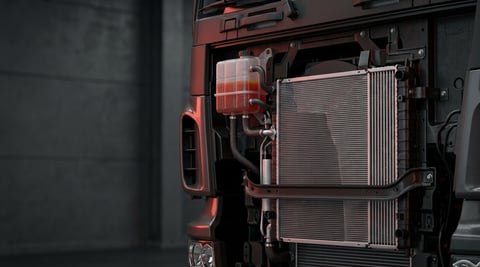
Truck Radiator & Expansion Tank: Faults, Replacement & Care
Diagnose radiator and expansion tank faults on heavy trucks: overheating, coolant loss, pressure caps, correct replacement steps and safe technical values.
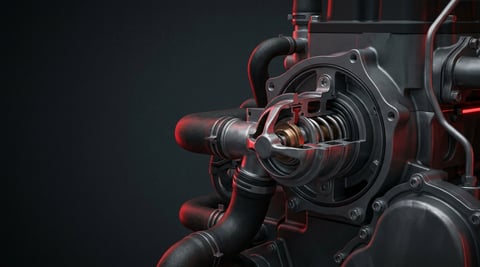
Engine Coolant Thermostat: Faults, Replacement & Care
Heavy truck engine coolant thermostat guide: stuck-open vs stuck-closed faults, diagnosis, correct replacement, torque values and maintenance tips.
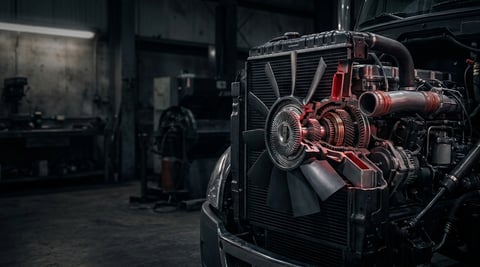
Viscous Fan Clutch: Fault, Replacement & Maintenance Guide
Heavy-duty viscous fan clutch guide: how it works, fault symptoms, diagnosis, correct replacement steps and safe technical values for trucks and buses.


