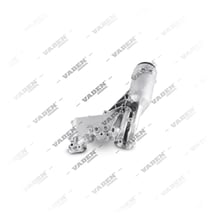
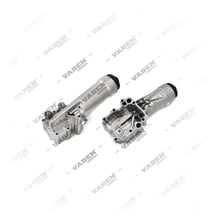
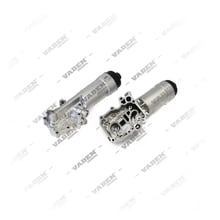
What Is an Oil Cooler Cover?
An oil cooler cover is a cast iron or aluminum cover fitted on heavy commercial vehicle engines that encloses the oil cooler (oil radiator) housing and holds the cooling core bundle sealed in its seat on the block. In the field it is also known as the oil cooler housing cover or oil radiator cover; in the catalog chain it sits under Engine > Oil Cooler > Cover. This part is far more than a simple cap — it carries the sealing surfaces that keep oil and coolant in separate circuits, the oil transfer channels, and the bolt load. It is used on the oil cooler assemblies mounted to the engine block of Mercedes-Benz, MAN, Scania, Volvo, DAF, Iveco, and Renault Trucks heavy-duty vehicles.
How Does an Oil Cooler Cover Work?
As engine oil circulates through the bearings, the turbo shaft, and the piston cooling jets, it picks up a significant amount of heat. The oil cooler transfers this heat into the coolant, while the cover encloses the volume where the heat exchange takes place and keeps the two fluids from mixing. The channels machined into the cover set the oil's inlet and outlet direction, and the gasket surface carries the pressure differential.
- Sealing: Together with the gasket and O-rings, the cover forms a lasting barrier between the oil side and the water jacket, keeping oil from entering the coolant and coolant from entering the oil.
- Oil routing: The channels inside the cover direct hot oil into the cooling core bundle and return the cooled oil to the main gallery.
- Component carrier: In many applications the cover also carries the mounting point for the oil filter housing, thermostat, bypass valve, or oil pressure sensor.
Oil Cooler Cover Technical Specifications
Oil cooler covers are most commonly manufactured from grey cast iron or a cast aluminum alloy; the choice depends on the engine's thermal load and the additional components mounted on the cover. The values below are general ranges only — for installation torque and gasket type, the vehicle manufacturer's current service manual is authoritative.
- Material: Grey cast iron or aluminum alloy, chosen so its thermal expansion is compatible with the block.
- Surface finish: The gasket seating surface is machined to a tight flatness tolerance; scoring compromises the seal.
- Sealing element: Elastomer gasket, metal-reinforced gasket, or O-ring depending on the application; renewing it together with the cover is recommended.
- Bolt pattern: Hole count, hole diameter, and center-to-center spacing must match the OE pattern exactly.
- Operating temperature: Typically in the 90-130 °C range on the oil side, with brief higher peaks under heavy load.
Oil Cooler Cover Types and Subgroups
Covers in this category differ according to the oil cooler housing they mount to and the additional components they carry. Even within the same vehicle model, a different cover may be used depending on the engine variant.
- Plain covers: Simple designs that only close off the cooling core bundle, with no additional connections.
- Covers with a filter seat: Carry the oil filter connection, combining the filter head and the cooler housing into a single part.
- Covers with thermostat and bypass seats: Include a seat for the thermostat or bypass valve that brings the cooler online according to oil temperature.
- Covers with sensor ports: Feature a machined threaded port for an oil pressure or temperature sensor; thread size and port location must match the OE part.
- Aluminum and cast iron covers: Aluminum offers a weight advantage and fast heat transfer; cast iron is preferred in heavy-duty applications where higher mechanical strength is required.
How to Choose the Right Oil Cooler Cover
The safest way to reach the correct part is to read the OE number stamped on the removed cover and cross-match it. If the number cannot be read, work from the engine code and chassis number instead. The table below summarizes the criteria that should be verified before ordering.
Oil Cooler Cover Selection and Compatibility Criteria| Criterion | What to Check | Why It Matters |
|---|
| OE part number | The cast or label number on the old cover | The most reliable way to confirm compatibility |
| Engine code | The engine code on the block and the chassis number | The same model can use a different cover with a different engine |
| Bolt pattern | Hole count, diameter, and center spacing | A single hole mismatch makes installation impossible |
| Material | Cast iron or aluminum | Differences in thermal expansion affect gasket life |
| Additional connections | Filter seat, thermostat, sensor port | A missing port leaves the assembly incomplete |
| Gasket and O-ring | The sealing kit matched to the cover | Reusing the old gasket makes a leak unavoidable |
| Block surface | Flatness of the seating surface on the block | A warped surface will leak even with a new cover |
Oil Cooler Cover Maintenance and What to Watch For
The cover itself is not a wear part; its service life is determined by installation quality and coolant condition. Mistakes made during removal and refitting cause leaks far sooner than the part's actual lifespan would suggest.
- Clean the gasket surface correctly: Remove old gasket residue using methods that will not damage the surface rather than a metal scraper; a scored flange leaks permanently.
- Always renew the gasket: Once the cover has been removed, the gasket and O-rings are single-use items and must not be reused.
- Apply torque in sequence: Tighten the bolts progressively from the center outward; for the torque value and tightening sequence, the vehicle manufacturer's current service manual is authoritative.
- Check the coolant: Degraded antifreeze causes corrosion on the cover and core surfaces; follow the specified replacement interval.
Common Faults and Solutions
Problems traced to the oil cooler cover usually show up as a loss of sealing, and when caught early they can be resolved economically. Reading the symptom correctly also prevents unnecessary engine disassembly.
- Oil leaking around the cover: A fatigued gasket or a loosened bolt; renew the gasket and tighten the bolts in the specified sequence and torque.
- Oil film in the expansion tank: Indicates oil crossing into the coolant circuit; pressure-test the assembly and replace the sealing elements.
- Water found in the sump: A cracked cover or a degraded O-ring; check the cover for cracks and replace it without hesitation if in doubt.
- Recurring gasket failure: Loss of flatness on the block or cover flange; measure the surfaces and renew the deformed part.
Why VADEN ORIGINAL?
VADEN ORIGINAL oil cooler covers are manufactured based on the dimensional and tolerance logic of the original part. The goal is for the workshop to fit the part without any additional machining.
- Manufactured to OE dimensions: The bolt pattern, flange thickness, and gasket seating surface are machined to match the original part.
- Broad OEM coverage: Offers wide reference coverage for the oil cooler housings commonly used on heavy commercial vehicle engines.
- Material consistency: Casting quality and surface finishing standards are kept consistent across batches.
- Exported to 100+ countries: The product range has proven itself in the field with fleets and service operations across different markets.
Conclusion
The oil cooler cover may look like a minor part, but it directly determines whether engine oil and coolant stay in separate circuits. Choosing the right one starts with verifying the OE number, engine code, bolt pattern, and additional connections; correct installation is completed with a new gasket, a clean surface, and the tightening sequence specified in the manual.
Frequently Asked Questions (FAQ)
What does an oil cooler cover do?
The oil cooler cover encloses the volume that houses the oil cooler's cooling core bundle on the engine block and keeps engine oil and coolant in separate circuits. The channels inside it direct oil into the cooling core bundle, while the gasket surface carries the pressure difference between the two circuits. If the cover leaks, oil can escape or mix into the coolant circuit.
How can you tell an oil cooler cover has failed?
The clearest signs are oil leaking around the cover, an oil film appearing in the expansion tank, and water found in the sump. Oil running hotter than normal can also point to sediment buildup in the cover's channels. If any of these symptoms appear, the assembly should be pressure-tested.
Can the gasket be reused when replacing the cover?
No. Once the cover has been removed, the gasket and O-rings are considered single-use and must always be renewed. A reused sealing element will leak again on the very first heat cycle, so a matching gasket kit should be sourced along with the cover.
How do I choose the right oil cooler cover?
The most reliable method is to read the OE number stamped on the removed cover and cross-match it. If the number is not legible, work from the engine code and chassis number instead, and also confirm that the bolt hole count and center spacing, along with additional connections such as the filter seat, thermostat, and sensor port, match exactly.
What torque should the cover bolts be tightened to?
The torque value depends on the engine family and the cover material; aluminum covers generally use lower values than cast iron ones. Bolts should be tightened progressively from the center outward. For the exact torque value and tightening sequence, the vehicle manufacturer's current service manual is authoritative.
Related technical guide: Oil Cooler: Failure Symptoms, Replacement & Maintenance Guide