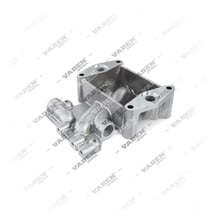
What is the Engine Oil Cooler Bracket?
Although the engine oil cooler bracket is not directly a lubrication system element, it makes an indirect but important contribution to system integrity by keeping the connected oil cooler in place.
What are the functions of the Engine Oil Cooler Bracket?
The main functions of the bracket within the engine lubrication system are as follows.
- Fixed mounting: Securely fixes the oil cooler unit to the engine block or chassis.
- Vibration resistance: Limits the effect of vibration generated during engine operation on the oil cooler, reducing fatigue at the connection points.
- Line protection: Prevents unnecessary movement of the pipes and hoses connected to the oil cooler, avoiding early fatigue cracks in these lines.
- Correct alignment: Keeps the oil cooler correctly aligned with the engine or cooling system connection points.
What are the symptoms of an Engine Oil Cooler Bracket failure?
A crack or deformation in the bracket produces noticeable symptoms in the engine bay.
- Visible vibration: The oil cooler unit may be noticed moving or vibrating more than normal.
- Pipe and hose damage: When the bracket weakens, early cracking or leakage may occur in the lines connected to the oil cooler.
- Abnormal noise: A metallic ticking or squeaking sound may be heard from the bracket area while the engine is running.
- Visible crack: Crack marks may be observed on the bracket, especially at welded or bent points.
How is the Engine Oil Cooler Bracket checked?
Inspection should be carried out with the engine cold and after gaining access to the area around the oil cooler.
- Visual inspection: The bracket surface is examined for cracks, corrosion, or deformation.
- Tightness check: The bolts connecting the bracket to the engine block or chassis are checked for looseness.
- Movement test: The oil cooler is gently pushed by hand to observe whether there is abnormal play at the bracket connection.
- Line condition: The pipes and hoses around the bracket are examined for signs of excessive tension or friction.
What should be considered during replacement?
The following points should be observed during bracket replacement.
- Correct installation sequence: The pressure in the relevant oil lines may need to be released before separating the oil cooler from the bracket.
- Correct torque: Bracket bolts must be tightened to the torque value specified in the vehicle's current OE service manual; over-tightening can damage the bracket or block.
- Corrosion prevention: It is recommended to apply appropriate anti-corrosion protection to contact surfaces before installing the new bracket.
- Alignment check: After installation, it must be verified that the oil cooler is correctly aligned with the connection points on the new bracket.
How to choose an Engine Oil Cooler Bracket?
The following technical references should be considered for correct bracket selection.
Engine Oil Cooler Bracket technical reference values| Property | Typical value / description |
|---|
| Application area | Heavy commercial vehicle engine oil cooler connection point |
| Material | Forged or cast steel, corrosion-resistant coating |
| Connection type | Bolted mounting, referenced to the engine block or chassis |
| Vibration resistance | Range suited to general engine bay operating conditions |
| Torque value | General range; the vehicle's current OE service manual is authoritative |
In the VADEN catalog, this bracket is matched via OEM reference codes to the engine families of European brands such as Mercedes-Benz and MAN; for exact torque and dimensional compatibility, the vehicle's service manual should be consulted.
Maintenance and service life
The service life of the engine oil cooler bracket varies depending on the moisture and vibration conditions in the engine bay. Checking bolt tightness and visually inspecting for corrosion during periodic maintenance allows a progressing deformation to be noticed early. On brackets that carry the weight of the oil cooler and connected lines over long periods, regular inspection of weld points is recommended.
VADEN Engine Oil Cooler Bracket
VADEN bases the oil cooler brackets it produces for heavy commercial vehicle engines on OE-compatible material and dimensional standards. The product is designed to offer a reliable mounting solution at service points, together with the other components in the Engine > Oil Cooler chain.
Frequently Asked Questions (FAQ)
What does the engine oil cooler bracket do?
It fixes the oil cooler unit to the engine block or chassis, reduces the effect of engine vibration on the unit, and prevents early fatigue in connected lines.
What happens when the bracket cracks?
Visible vibration in the oil cooler, early cracking or leakage in connected pipes and hoses, and abnormal noise while the engine is running may occur.
How is a bracket fault diagnosed?
Diagnosis involves visual inspection for cracks and corrosion, verifying bolt tightness, and pushing the oil cooler by hand to observe play at the connection.
What is the most critical point during replacement?
Tightening the bracket bolts to the OE torque value and correctly aligning the oil cooler on the new bracket.
Should the bracket be replaced periodically?
Not necessarily; but visual inspection during periodic maintenance is recommended, and replacement should follow if cracks or corrosion are detected.