Exhaust / Engine Brake: Faults, Replacement & Maintenance Guide
Diagnose, replace and maintain the heavy truck exhaust/engine brake (cylinder, flap, valve). Symptoms, torque values, back-pressure and step-by-step fixes.
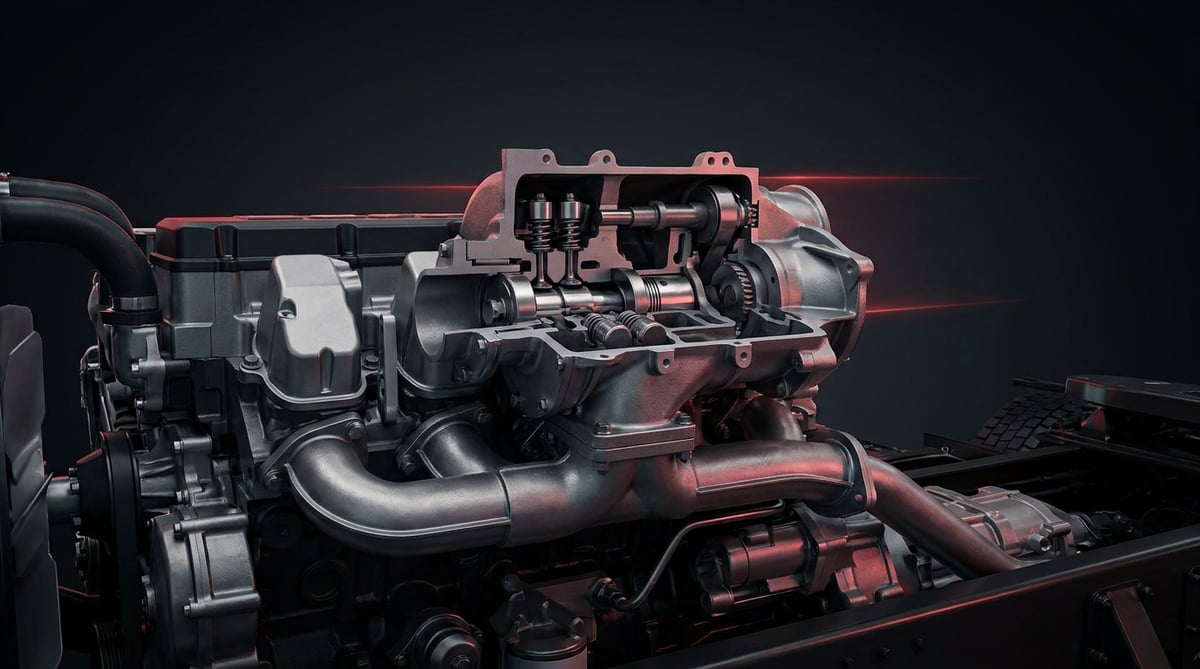
Every driver who wants to avoid leaning on the service brakes during long downhill descents is, in reality, relying on the engine brake. On a heavy commercial vehicle, trying to slow a 40-tonne combination with discs and pads alone overheats the pads and invites the risk of brake fade. This is exactly where the exhaust/engine brake steps in: it temporarily turns the engine into an air compressor and slows the vehicle without applying the wheel brakes. In the field, complaints such as "the exhaust brake isn't holding", "the flap won't close", or "the engine brake has weakened" are common; in most cases the root cause is a pressure leak, a seized flap shaft, or a fatigued valve. This guide introduces the exhaust brake assembly (cylinder + flap + valve) and explains, in plain workshop language, how to diagnose the fault, replace the unit, and carry out its maintenance.
This document was prepared by the VADEN technical team, drawing on field and workshop experience with heavy commercial vehicle exhaust/engine brake systems. The values given here are typical reference ranges; for exact figures such as torque, pressure, and clearance, always refer to the vehicle's/engine's OE service manual. Last updated: September 2026.
Heavy commercial vehicle air brake systems are designed within the framework of ECE R13 (UN/EU braking regulation) and ISO 611.What Is the Exhaust / Engine Brake (Cylinder+Flap+Valve)? Function and Operating Principle
The exhaust/engine brake is a pneumatically controlled auxiliary braking system that closes a butterfly (flap) valve in the exhaust line to build back-pressure inside the engine, thereby turning the engine into a retarding (retarder) element without burning any additional fuel.
The operating principle is simple but effective: when the driver presses the exhaust brake pedal/lever, the solenoid (electrovalve) is energised and directs compressed air from the vehicle's air system to the brake cylinder. The cylinder's piston rotates and closes the flap in the exhaust line through a linkage arm. As the exhaust gas outlet is restricted, the engine is forced to do extra work to push gas out of the cylinders; this "work" is covered by the energy taken from the wheels, and the vehicle slows down. At the same time, in many systems the fuel is cut, so the engine behaves entirely like an air pump.
Because the exhaust brake operates independently of the wheel brakes, it protects the service brake, extends pad and disc life, and prevents brake overheating (fade) on long descents. On modern Euro 5/Euro 6 vehicles this assembly usually works integrated with the EBS and the engine control unit; on some heavy tractor units, an additional engine brake (decompression type) or a hydraulic/electromagnetic retarder is added alongside the exhaust brake.
Main Components That Make Up the System
- Brake cylinder (actuator): A pneumatic cylinder that converts compressed air into linear motion; it produces the pushing force that opens and closes the flap.
- Flap (throttle) and body: A disc-shaped valve that rotates within the exhaust flow; when closed, it creates the back-pressure.
- Flap shaft and bushings: The shaft that carries the flap and operates at high temperature; carbon build-up in the bushings leads to seizure.
- Linkage arm / fork: The mechanical connection that transfers cylinder motion to the flap shaft.
- Solenoid (electrovalve): The control valve that opens and closes the air path on the ECU signal.
- Return spring and seals: The spring that returns the flap to the open position when the brake is released, and the sealing elements.
Exhaust Brake or Compression (Engine) Brake?
The terminology gets mixed up in the field. The "exhaust brake" is a flap-type throttling system; it is cheap, durable, and delivers some torque even at low rpm. The "compression/decompression engine brake" (Jake-type equivalent), on the other hand, intervenes in the valve timing to release compressed air at top dead centre and produces far greater braking power; however, it is more complex and expensive. On many heavy tractor units the two are used together in stages.
Type Comparison and Application
| Feature | Exhaust (Flap) Brake | Compression Engine Brake |
|---|---|---|
| Operating method | Throttling the exhaust line / back-pressure | Releasing compressed air via the valve |
| Braking power | Low–medium | High |
| Rpm dependency | Somewhat effective even at low rpm | Very effective at high rpm |
| Complexity / cost | Low | High |
| Typical application | Distribution, medium tonnage, urban | Heavy tractor, long haul, mountain roads |
Part number verification: The exhaust brake cylinder, flap diameter, and flange bolt pattern vary according to the engine and the exhaust manifold/turbo outlet. Before ordering, always verify the OE part number, flap diameter, and connection flange from the vehicle chassis/engine number. A "similar-looking" flap delivers back-pressure at a different diameter and degrades braking performance.
How does a compression release engine brake work?
In a four-stroke diesel, the piston compresses the air on every compression stroke, and that takes work from the crankshaft. On an engine with the fuel cut and no engine brake engaged, most of that work comes back: past top dead centre the compressed air pushes the piston down again and turns the crankshaft on the expansion stroke, like a spring unwinding. A compression release engine brake cuts that return. With the brake engaged, fuel is cut, and near the end of the compression stroke a valve on the exhaust side opens briefly and vents the compressed charge into the exhaust manifold. With no pressure left to push the piston down on the expansion stroke, the energy spent compressing the air isn't recovered; it comes out of the vehicle's momentum instead, and the vehicle slows.
How that release valve is opened varies by engine. Some designs add a mechanism on the camshaft or rocker side so that the normal exhaust valve opens an extra time while the engine brake is on; others use a small, separate valve built into the cylinder head that bleeds part of the compressed charge into the exhaust port. Braking effort rises with engine speed, because more compression strokes are vented per minute at higher rpm - which is why staying in a suitable lower gear on a long descent matters. Many systems also brake in stages: the first position of the stalk or switch brings in one group of cylinders, later positions add more, and the driver matches braking force to the grade and the load.
That is also where the difference from the flap-type exhaust brake described above comes from. A flap throttles the exhaust line, so on the exhaust stroke the piston has to push the gas out through a narrowed passage, and the braking comes from that back-pressure. A compression release brake takes the energy earlier, on the compression stroke, and doesn't give it back on the expansion stroke, so it produces more braking power at the same rpm. A retarder can be added on the same vehicle as well: for how it works, see the truck retarder guide, and for the order in which to use the engine brake, the retarder and the service brake on a long descent, see the brake fade and long-descent guide.
What are Jake brakes? (United States)
"Jake Brake" is a trademark of Jacobs Vehicle Systems, and in North America the name is commonly used for any compression release engine brake, not only for that company's product; the working principle is the one described above. Some towns and residential areas post "No Engine Brake" or "No Jake Brake" signs. The concern behind them is noise: releasing compressed air into the exhaust produces a sharp, loud bark, and it is at its loudest on a truck without an effective muffler. What a particular sign covers is set by the local rule behind it, so check that rule rather than assuming it applies to only one type of engine brake.
Fault Symptoms and Diagnosis
Exhaust brake faults usually creep in gradually: the driver says "it isn't holding like it used to" but no clear warning light may come on. The table below summarises the most common symptoms, their likely causes, and the verification method.
| Symptom | Likely Cause | Check / Verification |
|---|---|---|
| Exhaust brake does not engage at all | Solenoid failure, blown fuse/broken wiring, no air supply | Measure the control voltage at the solenoid, check the air line pressure, read the ECU fault code |
| Brake is weak, doesn't slow the vehicle enough | Flap not closing fully, air leak, linkage adjustment off | Watch the flap position visually, measure the cylinder stroke, look for leaks with soapy water |
| Flap stays open / opens late | Return spring fatigued, shaft seizing in the bushing, carbon build-up | Test the spring and shaft freedom by hand, check the bushing clearance |
| Stays permanently engaged, engine chokes | Solenoid stuck, cylinder not rotating, flap seized closed | Test the solenoid electrically, listen to the cylinder exhaust, release the flap and test |
| Rattle / metallic noise when engaging | Linkage arm play, worn bushing, loose flange | Torque the fasteners, check for play, inspect the flange gasket |
| Exhaust/air leak at the connection, soot marks | Flange gasket burnt, cylinder seal leaking | Look for the leak trace while hot, inspect the gasket and seal visually |
| Brake responds late (delay) | Bottleneck in the air line, moisture/water freezing, slow solenoid | Check the air dryer and line drainage, measure the response time |
Visual and Audible Preliminary Check
Always start diagnosis with the cheapest method: with the engine at idle, engage the exhaust brake and watch the movement of the flap/linkage visually. The flap should close with a distinct "click" and open quickly when released. Slow, hesitant, or half movement points to a spring, bushing, or air pressure problem. When engaged, the sound from the exhaust should become noticeably muffled.
Pneumatic and Electrical Verification
Check the air line feeding the cylinder with a pressure gauge; if the system pressure has dropped, the flap will not close fully. If no supply voltage reaches the solenoid at the moment of command, the fault is on the electrical side: measure the fuse, relay, wiring, and ECU output in sequence. Reading the fault codes for the exhaust brake actuator with a diagnostic device points you in the right direction before any mechanical disassembly.
Carbon- and Temperature-Related Seizure
The exhaust brake operates continuously in gas of around 400–600 °C. Over time, carbon/soot builds up on the shaft and bushing; the flap "sticks" half open. In this case, even if the pneumatic and electrical sides are sound, the brake weakens. The shaft being unable to turn by hand, or turning with difficulty, is the clearest sign that carbon cleaning or replacement of the assembly is required.
Further reading
For a plain-language technical overview of this subject, see the reference article on Wikipedia. Always confirm specific figures and procedures against the vehicle manufacturer service data.
Replacement / Installation Steps
PPE and safety: Immediately after the engine has run, the exhaust brake assembly is extremely hot — to avoid the risk of burns, wait for the system to cool down completely. Use heat-resistant gloves and safety glasses. Before starting work, bleed off the vehicle's air pressure, disconnect the negative terminal of the battery, and secure the vehicle with chocks/parking brake. Work carefully around hot engine surfaces and the turbo area.
- Preparation and safety: Move the vehicle onto level ground, apply the parking brake, chock the wheels. Bleed the air tank pressure, disconnect the battery, and wait for the system to cool down.
- Mark the connections: Before disassembly, photograph or mark the solenoid electrical connector, the air hose, and the linkage adjustment position; it serves as a reference during assembly.
- Disconnect air and electrics: Carefully remove the air hose feeding the cylinder and the solenoid connector; cap the hose ends to keep dirt out.
- Release the linkage: Remove the linkage arm/fork connecting the cylinder to the flap shaft. If worn, renew the pin and fork.
- Remove the cylinder: Undo the brake cylinder's mounting bolts and take out the actuator. Inspect the condition of the gaskets and seals.
- Remove the flap assembly: Loosen the exhaust line flange bolts and take the flap body off its seat. Clean the flange surface of old gasket residue.
- Clean and inspect the surfaces: Check the flange surface, shaft bearing, and bushings; look for carbon build-up and cracks. A deformed flange will leak.
- Fit the new assembly: Install the new flap body with a new gasket. Start the bolts by hand and tighten them in a cross pattern, gradually, to the OE torque.
- Connect the cylinder and linkage: Fit the cylinder, connect the linkage arm by adjusting it to the position you marked. Make sure the flap opens fully and closes fully.
- Connect air and electrics: Refit the air hose and the solenoid connector. Verify that the connections seat leak-tight.
- Test and leak check: Connect the battery, build up the air pressure, engage the exhaust brake a few times and check the flap movement and any possible leaks. Confirm the braking effect with a short road test.
Points to Watch (Common Mistakes)
Do not reuse the old gasket. The exhaust flange gasket fatigues at high temperature; a removed gasket will almost always leak. Use a new gasket at every installation and leave the flange surface smooth and clean.
Do not set the linkage adjustment "by eye". Setting the arm too short causes the flap not to close fully (weak brake), while setting it too long prevents it from returning to the open position (engine choking, excessive back-pressure). Take the OE position you marked as your reference.
- Do not tighten the bolts to full torque in one go; tighten in a cross pattern and gradually, otherwise the flange will warp.
- Do not leave the air hose kinked/crushed; a bottleneck delays the brake response.
- Protect the solenoid connector from dirt and moisture; a poor contact causes intermittent faults and complicates diagnosis.
- Do not force the flap shaft to turn; if there is seizure, carry out carbon cleaning, and do not risk breaking the shaft.
- Do not leave the turbo and exhaust manifold connections loose; secondary leaks reduce performance.
- Do not fit a "similar" flap of a different diameter/type; the back-pressure changes and the engine and brake balance is disrupted.
Technical Values and Checkpoints
The values below are typical/general references for heavy commercial vehicle exhaust brake systems; they vary by engine and manufacturer. For an exact value, the OE service manual is always the authority.
| Parameter | Typical Reference Range | Note |
|---|---|---|
| System air pressure | ~7–9 bar (100–130 psi) | Shared with the vehicle pneumatic system |
| Exhaust brake back-pressure | ~2.5–5 bar (35–72 psi) | Depends on the engine and flap diameter |
| Exhaust gas operating temperature | ~400–600 °C | Varies with load and rpm |
| Flap closing angle | Fully closed ≈ perpendicular to the line | A small by-pass clearance may exist |
| Solenoid control voltage | 24 V DC nominal | Heavy commercial standard |
| Brake response time | Short (~under a second) | A noticeable delay is a fault sign |
Typical torque ranges for the fasteners (general reference only; the OE manual is the authority):
| Connection Point | Typical Torque Range |
|---|---|
| Exhaust flange bolts (M8) | ~20–30 Nm |
| Exhaust flange bolts (M10) | ~40–55 Nm |
| Cylinder mounting bolts | ~20–35 Nm |
| Linkage arm lock nut | ~15–25 Nm |
When applying the torque values, take into account the bolt class (8.8 / 10.9) and the high-temperature environment. For bolts in the hot zone, use high-temperature assembly paste/thread lock if the manufacturer approves, and follow the cross-tightening sequence.
Field checklist:
- Does the flap reach the fully open and fully closed positions freely?
- Is there a noticeable slowdown and a muffling of the exhaust sound on engagement?
- Is there any air/exhaust leak or soot mark at the flange and cylinder connection?
- Are the solenoid connector and the air hose sound and leak-tight?
- Is any linkage play, rattle, or looseness felt?
Maintenance and Service Life
The exhaust/engine brake is a low-maintenance system when used correctly; but if neglected due to constant high temperature and soot, it will seize and weaken over time. Visually inspecting the assembly at periodic services, testing the shaft freedom, and looking for leaks noticeably extends its life.
- At periodic service, check that the flap shaft turns freely and that the return spring is lively.
- If carbon build-up has started, clean it early; waiting on a "stuck" flap accelerates shaft and bushing wear.
- Do not neglect the air system dryer and line drainage during maintenance; moisture causes corrosion/freezing in the solenoid and cylinder.
- Renew the part at the slightest leak from the flange gasket or cylinder seal; a small leak grows quickly.
- Monitor the play in the linkage pin and fork; as the play increases, the adjustment drifts and the braking effect drops.
- Keep the solenoid connector connection clean and dry; corrosion is the number one cause of intermittent faults.
General rule: Although the exhaust brake is not thought of as a "wear part", because of the harsh environment in which it operates, the bushing, gasket, spring, and solenoid fatigue over time. Early diagnosis and the use of original-quality spare parts protect both braking safety and the service life of the service brake system (pads/discs).
The VADEN ORIGINAL exhaust/engine brake product family covers the exhaust brake cylinders, exhaust gas flaps, and exhaust brake valves (together with their repair kits) of heavy commercial vehicles to an OE-compatible quality standard. Manufactured with the correct diameter, the correct flange, and durable sealing, VADEN Exhaust / Engine Brake (cylinder+flap+valve) parts are designed to provide safe braking on long descents and a long service life. To verify the part number suitable for your vehicle and to see the full product range, browse the VADEN product catalogue.
Related categories: Exhaust Brake · Cylinder · Exhaust Gas Flap · Exhaust Gas Flap · Exhaust Brake Valve · Exhaust Brake Valve
Related technical guides: Exhaust Manifold: Cracks, Leaks, Replacement & Torque Guide · Engine Cylinder Head Group: Faults, Replacement & Maintenance · Oil Cooler: Failure Symptoms, Replacement & Maintenance Guide · Truck Oil Pan Group: Faults, Replacement & Maintenance Guide · Engine Valve Train & Adjustment Shim: Faults, Replacement, Care
Application and compatibility: Vehicle compatibility catalogue · Engine compatibility catalogue
Main guide: What Is an EGR Valve? Failure Symptoms and Cleaning (Heavy Commercial Vehicles)
Tags
Frequently Asked Questions
- Are the exhaust brake and the engine brake the same thing?
- Not exactly. The exhaust brake is a simple system that creates back-pressure by closing the flap in the exhaust line. The "compression engine brake", on the other hand, intervenes in the valve timing to deliver far greater braking power. In the field both are referred to as the "engine brake", but technically they are different; on many heavy tractor units they are used together.
- If the exhaust brake isn't holding, what should I check first?
- First do the cheapest check: with the engine at idle, engage the brake and watch visually whether the flap closes fully. If the flap moves only halfway, look at the spring, bushing, or air pressure; if it does not move at all, look at the solenoid, fuse, and electrical line.
- Does the exhaust brake increase fuel consumption?
- No, on the contrary. When engaged, most systems cut the fuel and the engine runs like an air pump. Because it protects the service brake and extends pad/disc life, it lowers the total operating cost.
- What happens if the flap seizes?
- If the flap seizes half open, the brake weakens; if it seizes fully closed, the engine cannot expel the exhaust gas, it chokes and may be damaged by the excessive back-pressure. In either case, the shaft freedom should be checked, the carbon cleaned, or the assembly renewed.
- Is the exhaust brake effective at every speed?
- The zone where it is most effective is the medium-to-high rpm range; as the engine rpm rises, the back-pressure and therefore the braking effect increase. At very low rpm its effect diminishes, which is why staying in the appropriate gear on long descents is important.
- Can the vehicle be driven if the exhaust brake is faulty?
- The vehicle moves mechanically because the service brake is independent. However, on long descents and mountain roads an excessive load falls on the service brake and the risk of fade increases. This is a safety matter; an exhaust brake fault should not be neglected and should be remedied as soon as possible.
- How often is the exhaust brake cylinder replaced?
- There is no fixed mileage life; it depends on the operating conditions. It is replaced when an air leak, a seal leak, or a weak cylinder that cannot move the flap fully is detected. Periodic inspection is the best way to catch the fault before being stranded on the road.
- How do I choose the correct spare part?
- Verify the OE part number, the flap diameter, and the connection flange from the vehicle's engine and chassis number. A flap of a different diameter that looks similar in appearance changes the back-pressure and disrupts the braking balance. Confirm compatibility and prefer an original-quality part.
- What happens if the linkage arm is adjusted incorrectly?
- Set too short, the arm keeps the flap from closing fully and the brake stays weak; set too long, the flap cannot return to the open position, the engine chokes and excessive back-pressure builds. Never adjust it by eye: use the OE position you marked before removal, then confirm by hand that the flap opens fully and closes fully.
- What should be checked on the exhaust brake at a periodic service?
- At service, test that the flap shaft turns freely and that the return spring is still lively; if carbon build-up has started, clean it without waiting, because a stuck flap accelerates shaft and bushing wear. Do not skip the air dryer and line drainage either: moisture causes corrosion or freezing in the solenoid and cylinder. Keep the solenoid connector clean and dry.
Related Articles

Oil Filter Cap and Housing: Leaks, Cracks and Seal Replacement
Truck engine oil filter cap and housing: why plastic caps crack, O-ring leak causes, bypass valve faults, and correct torque and seal replacement steps.
Piston Rings: Oil Consumption, Compression Loss and Replacement
Ring-related oil consumption and compression loss in truck diesel engines: how rings seal, blow-by and leak-down tests, ring gap and replacement.
Intake Manifold and Intake Pipe: Faults, Diagnosis, Repair
How the intake manifold and charge air pipe work on truck diesel engines, how to spot boost leaks, run a pressure test and fit them leak free.