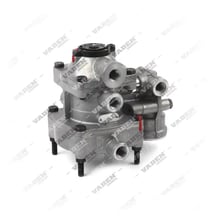
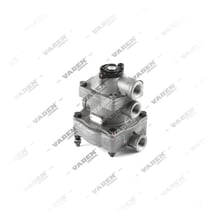
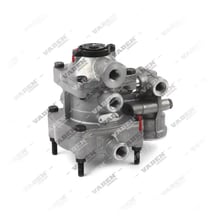
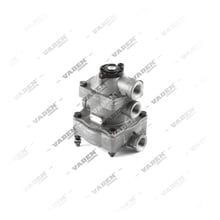
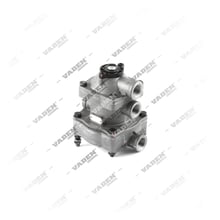
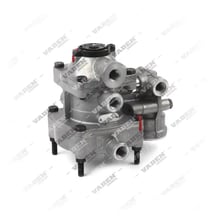
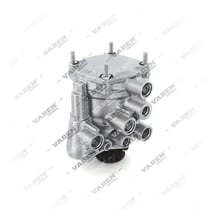
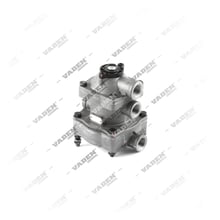
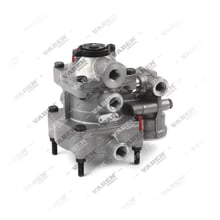
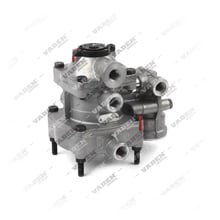
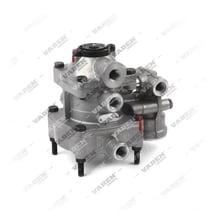
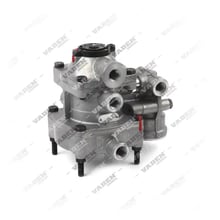
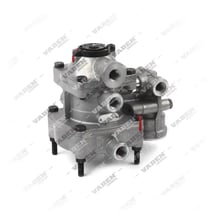
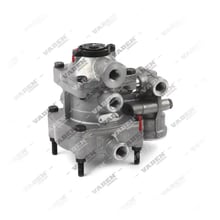
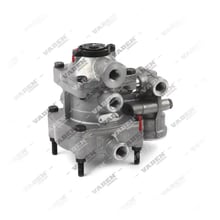
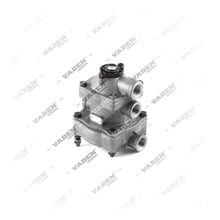
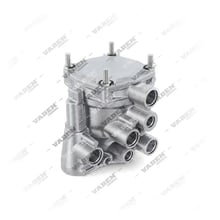
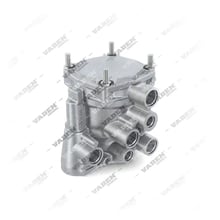
What Is a Trailer Control Valve?
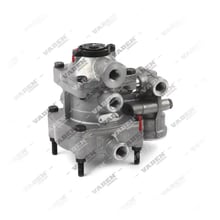
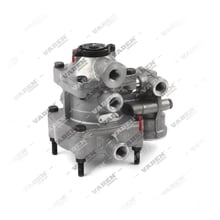
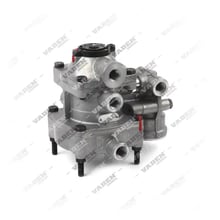
The trailer control valve is a complete unit that governs the pneumatic brake circuit between the tractor and the trailer or semi-trailer; it regulates compressed air from the tractor's air reservoir and delivers it to the trailer's brake system. In the field it is also known as the "trailer brake valve," "trailer relay valve," or "relay emergency valve." This category covers the valve's complete body-piston-spring assembly; replacement of individual worn seals or small internal parts belongs to a separate repair kit group. When the driver presses the brake pedal or applies the parking brake, the valve senses this command and adjusts pressure in the trailer brake line accordingly. This valve is the fundamental guarantee of synchronized braking in a tractor-trailer combination and of automatic trailer braking in the event of a sudden pressure loss.
How Does a Trailer Control Valve Work?
The valve operates by comparing the constant air pressure arriving from the tractor's supply line against a control line signal. When the driver applies the brakes, pressure in the control line drops or rises; the piston inside the valve senses this difference and sends proportional pressure to the trailer brake line. If the supply line breaks or pressure drops completely, the safety function engages and the trailer brakes apply automatically; this prevents the vehicle from becoming uncontrollable in critical situations such as the trailer separating from the tractor. The same mechanism engages the trailer brakes when the parking brake is applied.
Trailer Control Valve Technical Specifications
Trailer control valves are manufactured with different connection sizes, port counts, and pressure stages depending on the tractor's make and trailer type. The body material is typically pressure die-cast aluminum, giving both light weight and resistance to internal pressure. Operating pressure range and trigger sensitivity vary by model; for exact values, refer to the vehicle's current service manual or the original part number.
- Connection Ports: M16/M22 standard threaded or push-in quick-connect type, with port count and position varying by manufacturer.
- Body Structure: One-piece pressure die-cast body housing the internal piston-spring assembly.
- Compatibility Criteria: Vehicle make, brake system type (single-line/dual-line), and chassis mounting location must be evaluated together.
Trailer Control Valve Technical Summary Table| Feature | Description |
|---|
| Product Type | Complete trailer/semi-trailer control valve unit |
| Body Material | Pressure die-cast aluminum with internal steel piston and spring assembly |
| Connection Lines | Supply line, control line, trailer brake outlet line |
| Safety Function | Automatic trailer brake engagement on supply loss |
| Compatible Systems | Wabco- and Knorr-Bremse-based pneumatic brake circuits |
| Quality Standard | VADEN ORIGINAL manufacturing to OEM dimensions and tolerances |
Trailer Control Valve Types and Subgroups
- Standard Trailer Control Valve: The basic type operating on a single supply/single control line, used in classic dual-line brake systems.
- Valve with Integrated Safety Function: Automatically engages the trailer brake on supply loss; standard on modern vehicles.
- Valve with Parking Brake Integration: Directly linked to the tractor's parking brake lever, also locking the trailer when parked.
- Slow Release Valve: Reduces pressure gradually when the brakes release, to minimize sudden jolting.
- Electronically Signaled (EBS-Compatible) Valve: A modern variant integrated with the electronic braking system, supported by an electrical signal.
How to Choose the Right Trailer Control Valve
The first step is to reference the original part number on the removed component or the vehicle's chassis number; visual similarity alone is not enough, since port layout can vary by mere millimeters. The second criterion is brake system type: single-line, older-generation systems and dual-line, modern systems call for different valve architectures. Third, check whether the vehicle has EBS (electronic braking system); an electronically signaled valve should not be confused with a standard pneumatic valve. The choice between replacing the complete unit and reviving it with an internal repair kit should be based on whether the body shows cracking, excessive corrosion, or scoring in the piston bore; if the body is sound and only the seal or piston is worn, a repair kit is the more economical option.
Trailer Control Valve Maintenance and Key Considerations
- Check Connection Lines Periodically: Regularly verify supply and control line connections for air leaks using a soap-bubble test.
- Follow Installation Torque: Over-tightening cracks the body, while a loose installation causes leaks; follow the torque value in the vehicle's current service manual.
- Don't Neglect Filter and Dryer Maintenance: Moisture and contamination in the air dryer cause premature wear on the valve piston.
- Test the Parking Brake Regularly: Verify that the emergency brake function engages when the trailer separates.
- Use Original-Dimension Parts: An incorrectly sized valve causes the trailer to brake late or early, leading to unbalanced braking between tractor and trailer.
Common Faults and Solutions
- Trailer Brakes Engage Late: Pressure loss in the control line or a worn piston seal; check the line connections and replace the valve or repair kit if needed.
- Trailer Brakes Stay Engaged Continuously: Mechanical sticking of the valve piston or a blocked control line; clean the line and inspect the internal assembly.
- Air Leak at Connection Points: A worn O-ring or a loose connection; renew the seals and verify installation torque.
- Trailer Doesn't Lock in Park: A fault in the parking brake signal line or internal spring fatigue; test the signal circuit and replace the valve if necessary.
- Sudden Brake Jolt: The slow-release function has become inactive; check whether the valve supports it and replace it with a suitable model.
Why VADEN ORIGINAL?
- Manufactured to OE Dimensions: Body, piston, and port dimensions match original part tolerances, requiring no extra fitting work.
- Broad OEM Cross-Reference: Extensive cross-reference support for Wabco- and Knorr-Bremse-based systems shortens the time needed to find the correct part.
- Consistent Safety Performance: Every unit is tested to ensure the safety function performs reliably in a supply-loss scenario.
- Global Service Network Experience: Exported to more than 100 countries, field-proven across different fleets and trailer types.
Conclusion
The trailer control valve sits at the heart of brake synchronization and emergency safety in the tractor-trailer combination. When the right choice is made based on part number verification, brake system type, and EBS compatibility, both installation and long-term performance proceed without issue. VADEN ORIGINAL trailer control valves, built to OE dimensional and tolerance standards, deliver a reliable, long-lasting solution for fleet operators.
Frequently Asked Questions (FAQ)
How are trailer brakes affected when the trailer control valve fails?
When the valve fails, the trailer brakes may engage late, stay permanently applied, or fail to engage at all. This disrupts the braking synchronization between tractor and trailer and can lengthen stopping distance or cause unbalanced stopping, so the issue should be checked as soon as symptoms appear.
Is a trailer control valve the same part as a trailer brake valve?
Yes, in the field the same unit is referred to as both a "trailer control valve" and a "trailer brake valve." Both terms describe the same complete assembly that relays the tractor's brake command to the trailer's brake line and provides automatic emergency braking on supply loss.
Should I replace the complete valve or is a repair kit enough?
If the valve body shows no cracking, corrosion, or scoring in the piston bore, and the issue is limited to a worn seal or piston, revision with a repair kit is usually sufficient. If there is structural damage to the body or the safety function isn't operating reliably, replacing the complete unit is the better choice.
Which vehicles is the trailer control valve compatible with?
VADEN ORIGINAL trailer control valves are used on heavy trucks, tractor units, and semi-trailer combinations equipped with Wabco- or Knorr-Bremse-based pneumatic brake systems. Before ordering, compatibility should be verified using the vehicle's chassis number or the original code of the removed part.
Do the brakes engage automatically when the trailer separates?
Yes, thanks to the trailer control valve's safety function, the trailer brakes apply automatically when the supply line breaks or pressure drops completely. This is a mandatory safety mechanism designed to prevent uncontrolled movement in situations such as the trailer unintentionally separating from the tractor.
Related technical guide: Trailer Control Valve: Faults, Replacement & Maintenance Guide