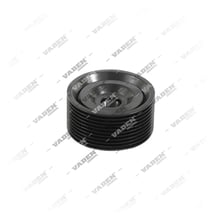
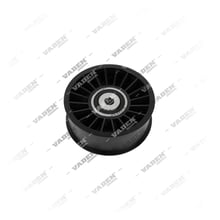
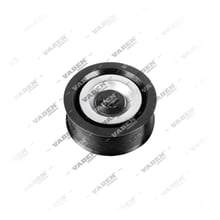
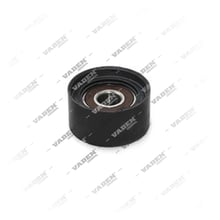
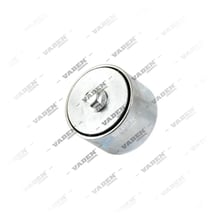
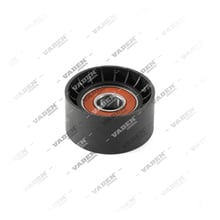
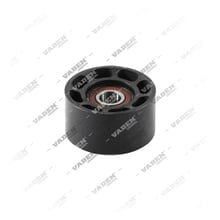
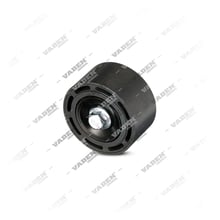
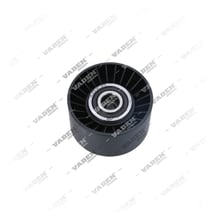
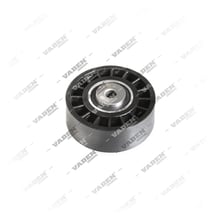
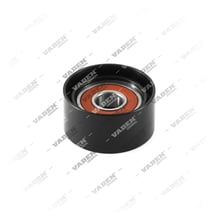
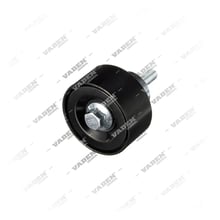
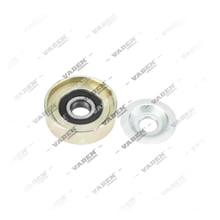
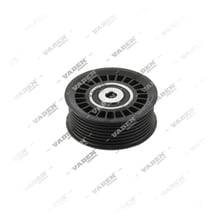
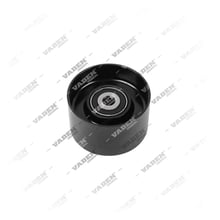
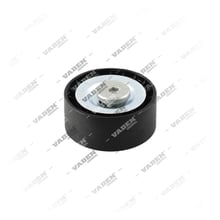
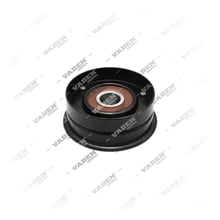
What Is a Fan Tensioner Roller?
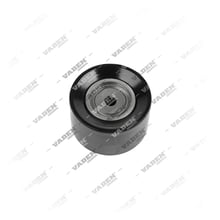
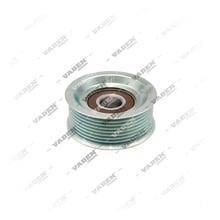
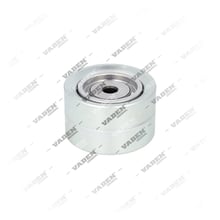
A fan tensioner roller is a spring-loaded or fixed-body drive component that keeps constant tension on the belt driving the fan pulley in a heavy-duty commercial vehicle's cooling system. It sits at the front of the engine, on the belt run between the crankshaft pulley and the fan pulley, pressing the belt firmly against the pulley surfaces. In the field it is also known as the fan belt tensioner roller, fan tensioner bearing, or fan belt idler pulley. Belonging to the Fan group under the Cooling System, it is distinct from the tensioner rollers on the alternator or air conditioning belt lines.
In trucks, tractor units, buses, and trailer-towing heavy vehicles, the fan drive is the primary way engine heat is dissipated through the radiator. Because the roller keeps this belt run under steady tension, it directly affects engine operating temperature. Once the bearing wears out, belt slip, noise, and overheating follow in a chain reaction.
How Does a Fan Tensioner Roller Work?
The roller maintains belt wrap angle and tension by applying force perpendicular to the belt run. In spring-loaded types, a torsion spring pushes the roller outward as the belt stretches, automatically offsetting the tension loss. In fixed types, tension is set during assembly using an adjustment bolt or eccentric bearing and requires periodic checking.
- Tension compensation: Offsets belt elongation caused by heat and time, reducing the risk of slip.
- Vibration damping: Balances belt oscillation from engine speed changes via the spring.
- Alignment protection: The pulley surface keeps the belt running true, preventing lateral drift and edge wear.
Fan Tensioner Roller Technical Specifications
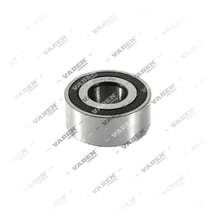
Fan tensioner rollers are manufactured from materials that withstand the heat and vibration of the engine bay. The body is aluminum alloy or cast steel, the pulley surface is reinforced polyamide or steel, and inside sits a sealed ball bearing with lifetime grease fill. Because pulley diameter, width, and profile vary by application, always check catalog dimensions against the removed part.
- Pulley profile: Multi-ribbed pulleys are used for poly-V belts, flat-surface pulleys for flat belts.
- Operating temperature: Bearing and grease are selected for high-temperature resistance; for exact figures, refer to the vehicle manufacturer's current service manual.
- Mounting type: Center-bolt, flanged, or pin mounting; bolt diameter and thread pitch must match the original exactly.
- Balance and runout: The pulley must be balanced and machined to tight tolerances to avoid vibration.
Fan Tensioner Roller Types and Subgroups
Tensioner components in the fan drive line differ according to engine architecture and belt layout. Even within the same vehicle family, roller types can differ by engine option and viscous fan use. Base selection on the engine code and OE reference number, not just the vehicle model.
- Spring-loaded automatic tensioner roller: Contains a torsion spring, continuously compensates for belt elongation, and requires no adjustment.
- Fixed-adjustment tensioner roller: Tension is set during assembly and requires periodic checking.
- Guide pulley: Applies no tension, only guides the belt run.
- Complete assembly with tensioner arm: Roller, arm, and spring are replaced together, preferred for spring fatigue issues.
- Bearing and repair kit: An economical renewal option when only the bearing has worn out.
How to Choose the Right Fan Tensioner Roller
The right choice comes from verifying compatibility criteria in order, starting with the OE number on the removed part and then physically comparing dimensions. The table below summarizes the criteria to check.
Fan tensioner roller selection and compatibility criteria| Criterion | What to check | Point of attention |
|---|
| OE reference number | The number stamped on the roller or tensioner arm | The most reliable matching method; confirm against the engine code |
| Pulley diameter and width | Outer diameter and belt contact width | A narrow pulley wears the belt edge, an oversized one can rub |
| Profile type | Ribbed, flat, or V profile | Must match the belt type exactly |
| Mounting dimensions | Center bolt diameter, thread pitch, bearing bore | A different diameter causes a centering error |
| Tensioning type | Spring-loaded automatic or fixed-adjustment | The original system architecture must be preserved |
| Vehicle and engine application | Make, model, engine code, trim | Even the same model can require a different roller across Mercedes-Benz, MAN, Scania, Volvo, DAF, Iveco, and Renault Trucks applications |
| Mounting torque | Manufacturer's tightening value | Apply the figure from the current service manual, not an estimate |
Fan Tensioner Roller Maintenance and Key Points
The roller should be evaluated as one system together with the belt and pulleys. Running a new roller against an old, cracked belt makes the same fault return quickly. Inspections should be carried out with the engine cold.
- Replace together with the belt: Renewing the belt at the same time as the roller preserves tension balance.
- Check alignment: Verify that the roller, crankshaft pulley, and fan pulley sit on the same plane.
- Perform a hand-spin test: The pulley should turn freely and quietly with no play; rattling or stiffness indicates a worn bearing.
- Follow the tightening value: Center bolt torque must be applied according to the manufacturer's current service manual.
- Check the spring arm: If the tensioner arm's travel or return force is weak, replace the complete assembly.
Common Faults and Solutions
Faults usually announce themselves through noise first, then progress into rising engine temperature. Reading the symptom correctly prevents unnecessary parts replacement. The list below gives the symptom, likely cause, and recommended action in order.
- Humming at idle or under revs: Dried-out grease or ball wear; remove and hand-check the roller, replace if there is play.
- Belt squeal on cold start: Tension loss, a fatigued spring, or an oiled belt surface; fix the leak and renew the belt and roller together.
- Engine running hot: Reduced fan speed caused by belt slip; assess belt tension and the fan clutch together.
- Vibration and runout at the housing: An impact-damaged pulley or a loose center bolt; check the torque and replace a damaged roller.
Why VADEN ORIGINAL?
VADEN ORIGINAL fan tensioner rollers are manufactured to match the real operating conditions of heavy commercial vehicle cooling systems and are cross-referenced to OE dimensions. The product range covers the pulley diameter, profile, and mounting variants across different engine families.
- Built to OE dimensions: Pulley diameter, width, mounting bore, and profile geometry match the original part.
- Broad OEM cross-reference: Catalog structure cross-matched to reference numbers from common heavy-duty engine families.
- Durable bearing: Sealed, high-temperature grease construction delivers a long service interval.
- Export network spanning over 100 countries: Parts and technical support are accessible across a wide range of markets.
Conclusion
Although the fan tensioner roller is a small component, it is decisive for the continuity of engine cooling. As it wears, noise and vibration appear first, followed by belt slip and rising temperature. The right choice comes from verifying the OE reference, pulley dimensions, profile type, and tensioning architecture together. Checking belt and pulley alignment at replacement delivers a lasting result; for torque and service intervals, follow the vehicle manufacturer's current service manual.
Frequently Asked Questions (FAQ)
What does a fan tensioner roller do?
A fan tensioner roller keeps constant tension on the belt that drives the engine's fan and ensures the belt runs on the pulleys without slipping. This keeps fan speed steady so cooling efficiency through the radiator does not drop. If tension is lost, engine temperature can rise quickly.
What are the symptoms of a faulty fan tensioner roller?
The most common symptoms are a humming noise at idle or as engine speed rises, and belt squeal during cold running. Edge wear on the belt, vibration at the roller housing, and the engine running hotter than expected are also signs of a fault. If you remove the belt and feel play or stiffness when turning the pulley by hand, the bearing has worn out.
Should the fan tensioner roller be replaced together with the belt?
Yes, it is recommended to renew the belt at the same time as the roller. An old, stretched belt disrupts the tension balance of the new roller and causes the same fault to recur within a short time. The tensioner arm and pulley alignment should also be checked during the same service.
How do I choose the right fan tensioner roller for my vehicle?
The most reliable method is to start with the OE reference number stamped on the removed part. Next, verify that the pulley diameter, width, profile type, and center bolt size exactly match the original part. Because the same vehicle model can use a different roller depending on the engine code, engine information is also required.
What is the difference between a spring-loaded tensioner roller and a fixed tensioner roller?
A spring-loaded automatic roller continuously compensates for belt elongation through its internal torsion spring and requires no adjustment. In a fixed-type roller, tension is set during assembly and needs periodic checking. The system type should not be changed - always fit a roller that matches the vehicle's original architecture.
Related technical guide: Belt Tensioner: Failure, Replacement & Maintenance Guide
Related technical guide: Fan Belt Tensioner: Failure, Replacement & Maintenance