Fan Belt Tensioner: Failure, Replacement & Maintenance
What a truck fan belt tensioner does, why it squeals or vibrates, how to measure belt tension and how to replace a worn tensioner pulley bearing.

On a cold morning, when the engine first starts, a sharp squeal rises from under the hood for a few seconds and fades — or disappears entirely — as the engine warms up. Most drivers ignore it. The next day the noise comes back, this time audible at idle as well. A few weeks later the alternator stops charging, or the air conditioning compressor fails to engage. In the field, most of this pattern traces back to a single small component: the fan belt tensioner. This guide covers the belt tensioning system in heavy commercial vehicles — the tensioner and the tensioner pulley — from end to end: its function, the real causes of squealing and vibration, how tension is measured, and how to replace a tensioner with a worn bearing.
What Is a Fan Belt Tensioner? Function and Working Principle
Fan belt tensioner is the component that keeps the multi-groove (poly-V) belt — which carries power from the crankshaft pulley to accessories such as the alternator, water pump, air conditioning compressor and fan — at constant tension, automatically compensating for belt elongation through a spring or hydraulic damper mechanism. The tensioner applies continuous preload to the belt through its tensioner pulley and keeps the belt from slipping on the pulleys.
In heavy commercial vehicles, most engine accessories are no longer driven by separate belts. Instead, a single multi-groove belt (poly-V, DIN 7867 PK profile) starts at the crankshaft pulley and runs in sequence through the alternator, water pump, air conditioning compressor, power steering pump (where fitted) and fan pulley. In this layout the belt must stay at a constant tension along its entire run: a loose belt slips on the pulleys, while an overly tight belt increases bearing and shaft loads. The fan belt tensioner establishes this balance automatically and keeps the preload constant even as the belt gradually lengthens from heat and wear.
On a classic manual tensioner, tension is set by hand: the bolt securing the tensioner arm is loosened, the required torque is applied to the belt, and the bolt is retightened. On an automatic tensioner, a coil spring continuously pushes the tensioner arm toward the belt; as the belt lengthens over time, the arm advances on its own under spring force and tension stays constant. Most automatic tensioners also include a friction or hydraulic damper to keep the spring from pushing the belt back too quickly and to prevent belt flutter during sudden engine-speed changes; once the damper fails, the tensioner arm starts to vibrate and the belt develops an irregular flutter.
What Is the Difference Between an Automatic and a Manual Belt Tensioner?
A manual belt tensioner is a simple, fixed-position mechanism — typically a sliding mounting plate or an eccentric bolt — that requires tension to be checked and adjusted by hand during periodic maintenance. An automatic belt tensioner, by contrast, continuously adjusts tension itself through a spring-and-damper mechanism, needs no operator input, and has become standard on most modern heavy commercial vehicles. On an automatic tensioner, tension is not held at a single fixed force but within a range determined by the spring's characteristic; this is why the min-max marks on the arm are checked visually during periodic inspection.
What Is the Tensioner Pulley (Tensioner Roller)?
The tensioner pulley is a rotating roller bolted to the end of the tensioner arm, riding against the belt's ribbed face, with a sealed bearing inside. It spins continuously for as long as the engine runs and constantly carries the radial force generated by belt preload; because of its small diameter it turns at a high rotational speed compared with the crankshaft pulley, which makes its bearing one of the most heavily fatigued elements in the system. On some belt routings there is also a separate idler pulley — smooth, not grooved, and used only to redirect the belt — that contacts the belt's flat back; this pulley does not tension the belt, it only guides the routing, and it is a separate, independent part from the tensioner.
- Tensioner arm: pinned to the housing, carries the tensioner pulley at its tip, and moves toward the belt under spring force.
- Tensioner spring: a coil or torsion spring that continuously pushes the arm toward the belt, generating the required preload.
- Damper: friction- or hydraulic-type; slows sudden movements of the tensioner arm to prevent vibration and flutter.
- Tensioner pulley and bearing: the rotating roller in contact with the belt, containing a sealed, pre-lubricated bearing.
- Mounting bolt and pin: the fasteners that attach the tensioner housing to the engine block or bracket and must be tightened to a specified torque.
- Tension indicator: on some tensioners, a mark or scale on the housing used to compare the arm's position against the min-max range.
Why Does a Fan Belt Tensioner Cause Squealing and Vibration?
Squealing and vibration coming from the fan belt tensioner area are the shared symptom of two different fault groups that are most often confused in the field: the belt slipping on a pulley, and mechanical deterioration of the tensioner/pulley mechanism. Both sound similar, but their causes and their fixes are completely different.
The most common cause of squealing is brief slipping of the belt on a pulley surface. This slipping comes from a tensioner spring that has lost force, a belt surface that has glazed and lost its coefficient of friction, oil or grease contamination in a pulley groove, or a belt fitted in the wrong length. When engine load rises suddenly — for example when the air conditioning compressor engages — a slipping belt typically produces a short, sharp squeal.
Vibration and irregular belt movement (flutter), on the other hand, mostly originate from the tensioner mechanism itself. Once the damper fails, the tensioner arm overreacts to every change in belt tension and swings back and forth; this oscillation makes the belt ripple between pulleys and produces an irregular hum or ticking noise. When the tensioner pulley bearing wears, axial or radial play develops in the roller's axis, the belt can no longer track a straight line, and it begins to wear prematurely along its edges.
Why Does a Tensioner Pulley Bearing Wear Out?
The life of the sealed bearing is set by three factors acting together: the chemical life of the grease inside it, the operating temperature in the engine bay, and the fatigue cycling produced by changes in engine speed and load; the higher the temperature, the faster the grease oxidises, and with every start-stop cycle the fatigue accumulated on the contact surfaces between the balls and the races advances a little further. A bearing whose lubricant dries out over time, or whose seal is damaged and lets in dust and moisture, wears first silently, then with an audible whine or squeak. In advanced wear, play develops in the roller's axis that can be felt by hand; at that point the tensioner pulley must be replaced as a complete unit — it cannot be repaired by relubrication alone, because the bearing is a sealed, non-lubricatable type.
Further reading
For a plain-language technical overview of this subject, see the reference article on Wikipedia. Always confirm specific figures and procedures against the vehicle manufacturer service data.
How Is a Fan Belt Tensioner Failure Diagnosed? Symptoms and Diagnosis
A fan belt tensioner failure most often announces itself through noise, though visual and functional symptoms are added in advanced cases. The table below summarizes the symptoms most commonly encountered in the field, their likely causes, and how to check for them.
| Symptom | Likely cause | Check / verification |
|---|---|---|
| Brief sharp squeal on cold start | Belt surface hardened or tensioner spring has lost force | Start the engine and compare the tensioner arm's position against the indicator mark |
| Squealing increases under load (A/C, incline) | Belt is slipping; tension is insufficient | Manually check the tensioner arm's travel range and spring response |
| Irregular hum or ticking at idle | Tensioner pulley bearing worn | With the engine off, turn the bearing by hand and feel for stiffness/roughness |
| Visible flutter at the tensioner arm | Damper has failed | Watch the arm's movement with the engine running and check for excessive oscillation |
| Belt edges worn early and unevenly | Play in the roller axis; pulley misalignment | Align the pulleys with a straightedge or laser and check the roller axis |
| Tensioner arm has traveled to its limit, indicator at maximum | Belt has reached the end of its service life; spring reserve is exhausted | Replace the belt and tensioner together |
| Belt suddenly breaks, alternator/charge warning lights up | Tensioner pulley bearing has seized, or the belt is completely worn | Remove the belt and tensioner pulley and check whether the roller spins freely |
How Is Belt Tension Measured and Adjusted?
Belt tension can be measured with three different methods, and the OE service manual specifies which one applies for a given vehicle type. On systems with an automatic tensioner, tension is not measured separately — the position of the tensioner arm is monitored instead: there is an indicator or notch on the housing between two marks (minimum and maximum), and tension is adequate as long as the arm stays within that range. If the arm moves outside the marks, either the belt has reached the end of its life or the spring has weakened.
On systems with a manual tensioner, tension is verified with two methods: the deflection method and the tension-gauge (tensiometer) method. In the deflection method, a specified force is applied to the midpoint of the belt's longest free span between two pulleys and the amount of deflection is measured with a ruler; in the tensiometer method, the instrument is placed against the belt and reads the tension value directly from the vibration frequency. In both methods, the accepted value range varies with the engine family, belt profile and number of driven accessories; the exact value is given in the vehicle's current OE service manual, an estimated field adjustment is not a permanent fix.
Why Should a Newly Fitted Belt Be Checked Again After a While?
A new poly-V belt mechanically beds in during its first hours of operation, and a small, permanent elongation occurs in its length. On manual-tensioner systems, tension should therefore be rechecked — and adjusted if needed — after a specified time or distance following belt replacement. On automatic-tensioner systems, the spring compensates for this bedding-in allowance on its own, and no separate check is required.
How Is a Fan Belt Tensioner Replaced? Step by Step
- Park the vehicle on level ground, apply the parking brake, stop the engine and let it cool down. The belt and tensioner pulley carry a burn risk while hot.
- Disconnect the battery terminal. This step must not be skipped, to prevent an electric fan or other accessory from engaging unexpectedly.
- Note or photograph the belt's routing and its direction across the pulleys; if a belt routing label is present in the engine bay, use it as a reference.
- Using the appropriate wrench point on the housing (square or hex socket), rotate the tensioner arm against spring force and slacken the belt off the pulleys.
- Remove the belt from the pulleys in sequence. Do not apply excessive bending or folding to any part of the belt during removal.
- Release the tensioner arm slowly; keep your hand clear of the arm's travel path, as spring force can release suddenly.
- Turn the tensioner pulley bearing by hand and check for stiffness, roughness or axial play; if in doubt, replace the pulley as a complete unit — do not attempt to fix it by relubrication alone.
- Remove the bolt securing the tensioner arm and separate the tensioner from the bracket. Fit the new tensioner and tighten the bolt in stages to the torque value given in the vehicle's OE service manual.
- Fit the new belt onto the pulleys in sequence, following the routing you noted, and route it over the tensioner pulley last; visually verify that the belt's ribs align exactly with the pulley grooves.
- Rotate the tensioner arm against spring force again so that the belt seats fully in the pulley grooves, then release the arm slowly and let the spring apply the preload; check that the arm settles within the indicator range.
- Reconnect the battery, start the engine and listen at idle for a few minutes, then turn the steering to full lock and engage the air conditioning to verify whether any squealing or vibration remains under load.
Things to Watch For (common mistakes)
- Replacing only the belt and skipping the tensioner: a new belt fitted with a tensioner whose spring reserve is depleted starts slipping again within a short time; a tensioner that has reached the end of its service life should be replaced along with the belt.
- Releasing the tensioner arm suddenly: uncontrolled release of spring force can strike the hand or face and cause injury; the arm must always be released slowly.
- Mixing up the belt routing: on systems with a complex path, a belt fitted in the wrong sequence wears from the edge or jumps off a pulley within a short time.
- Trying to silence bearing noise by "lubricating" it: the tensioner pulley bearing is a sealed, non-lubricatable type; oil or grease applied from outside only masks the noise temporarily while the failure continues to progress.
- Refitting the old belt on the assumption it "still has some life left": once a belt with a cracked or glazed surface is refitted, its tendency to slip returns quickly.
- Fitting new parts without checking pulley alignment: a bent bracket or a loose alternator mounting causes recurring wear even with the best tensioner and belt.
- Selecting parts by brand name: the correct tensioner and pulley are identified not by brand name but by the vehicle's engine and chassis code together with the OE reference number stamped on the existing part.
Technical Values and Inspection Points
The table below summarizes the main points checked in the field on the fan belt tensioner and tensioner pulley system, along with general reference ranges. Values vary with engine family, belt profile and number of accessories; the exact value should always be taken from the vehicle's current OE service manual.
| Inspection point | General reference | What a deviation indicates |
|---|---|---|
| Tensioner arm indicator | Between the min-max marks (OE value is authoritative) | At or beyond maximum: belt/spring has reached end of life |
| Tensioner pulley bearing | Quiet rotation, no axial play | Whining, squeaking or play: pulley must be replaced |
| Belt surface | Matte, flexible, ribs sharply defined | Glazed, cracked or scuffed: belt must be replaced |
| Belt edge wear | Symmetric, light and even | Heavy wear on one edge: pulley misalignment |
| Damper resistance | Arm movement smooth and damped | Hard binding or free oscillation: damper faulty |
| Mounting bolt torque | Value per OE service manual | If loose, vibration and premature wear increase |
| Pulley-to-roller alignment | All pulleys in the same plane | If misaligned, belt wears rapidly from the edge |
Maintenance and Service Life of the Tensioner System
The two most important factors determining a fan belt tensioner's service life are thermal cycling and exposure to dust and moisture. The engine bay heats up with every start and cools down when it stops running; this cycle fatigues the spring steel and the damper elements over time. Dirt and moisture, especially once they reach the tensioner pulley bearing's seal, break down the lubricant and accelerate wear. During periodic maintenance, the tensioner arm's indicator position, the pulley's noise and play, and the appearance of the belt surface should be assessed together; even if each looks normal on its own, evaluating them together can give an early warning.
The belt and the tensioner pulley are generally designed to be replaced together, because their wear curves progress over a similar timeframe. Replacing only the belt and continuing with a worn pulley or a weakened spring cuts a significant portion off the new belt's expected life. Adding a visual check of the tensioner arm indicator to the periodic maintenance plan lets fleet operators catch most breakdown-causing failures before they happen.
VADEN ORIGINAL Belt Tensioning System Product Range
VADEN ORIGINAL manufactures fan belt tensioners and tensioner pulleys to OE dimensions for the fan drive assembly of heavy commercial vehicle cooling systems; the same fan group also includes fan brackets and fan repair kits. The product range covers the spring forces, pulley diameters and mounting geometries commonly used in truck, tractor unit and bus applications. To find the correct part, using the engine and chassis code together with the OE reference number on the existing part — rather than your vehicle's make and model — removes the risk of selecting the wrong spring force or pulley diameter.
The belt tensioning system does not operate in isolation within the engine's accessory drive chain; the water pump's cooling performance, the alternator's charging capacity and how reliably the air conditioning compressor engages all depend on the belt staying at a constant, correct tension. The VADEN technical guide library includes separate failure, replacement and maintenance guides for the water pump, the viscous fan clutch, the thermostat and the radiator.
Related categories: Belt Tensioner · Tension Roller
Main guide: Water Pump: Faults, Replacement & Maintenance Guide
Tags
Frequently Asked Questions
- What does a fan belt tensioner do?
- A fan belt tensioner keeps the multi-groove belt — which carries power from the crankshaft pulley to accessories such as the alternator, water pump, air conditioning compressor and fan — at constant tension. Through a spring or hydraulic damper mechanism it automatically compensates for the belt's gradual elongation over time and prevents it from slipping on the pulleys.
- Why does a fan belt tensioner squeal?
- Squealing is usually caused by brief slipping of the belt on a pulley surface; this slipping can come from a weakened tensioner spring, a glazed belt surface, or oil or grease contamination in a pulley groove. When the noise comes from the tensioner mechanism itself, the cause is generally a failed damper or a worn pulley bearing.
- Are the tensioner pulley and the idler pulley the same thing?
- No, they are not. The tensioner pulley sits at the end of the tensioner arm and provides tension by applying spring-loaded preload to the belt. The idler pulley, in contrast, is fixed in position, does not tension the belt, and only redirects the routing or changes the direction of rotation by contacting the belt's flat back.
- How is belt tension checked?
- On systems with an automatic tensioner, tension is not measured; instead, the position of the tensioner arm between the min-max marks on the housing is monitored. On systems with a manual tensioner, measurement is done with the deflection method or a tensiometer; since the accepted value varies by engine family, the exact value should be taken from the vehicle's OE service manual.
- What happens when a tensioner pulley bearing fails?
- The bearing first announces itself with a whining or squeaking noise; in a later stage, play develops in the roller's axis that can be felt by hand. If it continues to be used without inspection, the bearing can seize; in that case the belt suddenly stops or breaks, and every accessory the belt drives goes out of service at the same time.
- Should the tensioner be replaced along with the belt?
- The general recommendation is to replace the belt together with the tensioner pulley, and the tensioner arm if needed, since their wear curves progress over a similar timeframe. Replacing only the belt and continuing with a worn tensioner significantly shortens the new belt's service life.
- Can a vehicle be driven with a faulty fan belt tensioner?
- It can be driven a short distance, but this is not recommended. If the belt keeps slipping, alternator charging drops, the water pump cannot cool sufficiently, and the air conditioning compressor runs erratically; if the belt breaks completely, all of these functions stop at once and the vehicle can be stranded. Once a failure is detected, inspection and replacement as soon as possible is advised.
- Can a tensioner pulley bearing be lubricated?
- No. The tensioner pulley bearing is a sealed type and is not designed for external lubrication. Oil or grease applied from outside only masks the noise temporarily, while seal and bearing wear continue to progress; the permanent fix is complete replacement of the pulley.
- Why should a newly fitted belt be checked again after a while?
- A new poly-V belt mechanically beds in during its first hours of operation and develops a small, permanent elongation in length. On manual-tensioner systems, rechecking tension after a specified time or distance is therefore recommended; on automatic-tensioner systems, the spring compensates for this allowance on its own.
- Why does the torque value matter when replacing a tensioner arm?
- If the bolt securing the tensioner arm is under-tightened, it can loosen under vibration; if over-tightened, it can crack the bracket or arm housing. Because the correct torque value varies by engine family, it should be taken from the vehicle's current OE service manual, and the bolt should be tightened in stages, in a crisscross sequence.
Related Articles

Engine Overheating in Heavy-Duty Trucks: Causes & Fixes
Learn why heavy-duty truck engines overheat, how to read the gauge, step-by-step diagnosis, and how coolant, water pump, thermostat, and fan clutch fail.
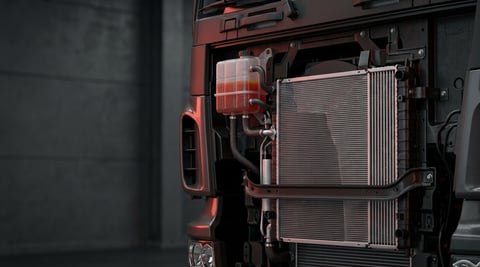
Truck Radiator & Expansion Tank: Faults, Replacement & Care
Diagnose radiator and expansion tank faults on heavy trucks: overheating, coolant loss, pressure caps, correct replacement steps and safe technical values.
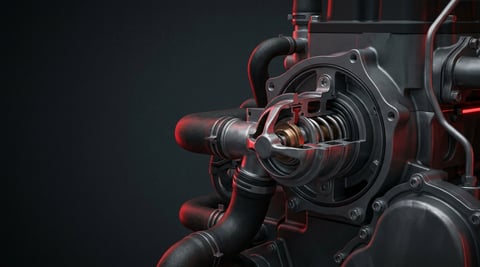
Engine Coolant Thermostat: Faults, Replacement & Care
Heavy truck engine coolant thermostat guide: stuck-open vs stuck-closed faults, diagnosis, correct replacement, torque values and maintenance tips.