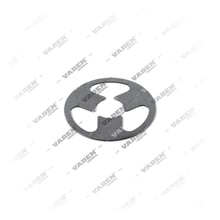
What are the functions of an Oil Pump Lock Washer?
This washer ensures the mechanical security of the oil pump connection.
- Loosening prevention: Physically prevents the bolt or nut from rotating loose under vibration.
- Torque retention: Helps maintain the tightening torque applied during installation over time.
- Position stability: Supports the oil pump staying correctly aligned with its drive gear.
- Surface protection: Balances pressure distribution between the bolt head and housing surface, reducing surface damage.
- Early failure warning: Deformation seen on bent tabs during disassembly indicates a history of previous loosening.
What are the symptoms of a failing Oil Pump Lock Washer?
Lock washer failure is not noticed directly, but produces indirect symptoms through connection loosening.
- Drop in oil pressure: A shift in pump position can disrupt gear contact, causing oil pressure to fluctuate.
- Metal friction noise: A loosening pump gear can contact adjacent parts, producing abnormal noise.
- Oil pressure warning light: The ECU or pressure switch may detect falling oil pressure and illuminate the warning light.
- Increased vibration in the oil system: Connection looseness increases pump vibration, adding extra vibration across the engine.
- Tab damage found on disassembly: Broken or flattened lock washer tabs found during maintenance are a sign of previous loosening risk.
How is an Oil Pump Lock Washer checked?
Inspection is performed during oil pump maintenance or disassembly.
- Visual inspection: Check the washer's tabs for breakage, flattening or wear.
- Bolt torque check: Verify the connection bolt's torque with a wrench to confirm no loosening has occurred.
- Pump gear alignment: Check whether the oil pump drive gear is correctly aligned with the mating gear.
- Oil pressure measurement: Measure oil pressure with a gauge while the engine is running to confirm it is within the normal range.
- Deformation check: A washer with cracks or excessive deformation must not be reused.
What should be considered during replacement?
The lock washer should be treated as a single-use safety element.
- Do not reuse: Bent tabs must not be flattened and reused; a new washer must be fitted at every disassembly.
- Correct installation orientation: The washer must be positioned so its tabs press against the correct surface.
- Torque sequence: Bolts must be tightened to the manufacturer's specified torque and, if applicable, sequence.
- Tab bending: After installation, tabs must be bent to make full contact with the bolt head or housing surface.
- Gear alignment check: After installation, confirm the pump gear is correctly aligned with the mating gear.
How to choose the right Oil Pump Lock Washer?
Selection should match bolt diameter, washer inner diameter and tab count/design specific to the engine type. An incompatible washer does not provide adequate locking.
Oil Pump Lock Washer selection criteria| Criterion | Description |
|---|
| Inner diameter | Must exactly match the connection bolt diameter |
| Tab design | Must have a compatible count and position matching the bolt head or housing surface |
| Material hardness | Must withstand engine vibration and oil temperature |
| Coating | Must have appropriate surface coating against corrosion |
| Reference verification | Confirm with OEM number and engine code |
Maintenance and service life
Since the oil pump lock washer is designed as a single-use safety element, it must be renewed at every disassembly-reassembly. Checking the washer during an engine oil change or pump maintenance helps catch potential loosening risk early. When correct torque and tab bending are applied, the washer maintains connection security for the life of the engine. The vehicle's current OE service manual is authoritative for the exact replacement and inspection interval.
VADEN Oil Pump Lock Washer
VADEN offers oil pump lock washers manufactured to OE tolerances for heavy commercial vehicle engines. Correct material hardness and tab design support reliable connection security.
Frequently Asked Questions (FAQ)
Why must the lock washer be replaced every time?
Once the tabs are bent, the material fatigues and bending them again does not provide full locking; a new washer must therefore be used at every disassembly-reassembly.
Is torque alone sufficient without a lock washer?
Torque alone may not be sufficient under engine vibration; the lock washer provides additional mechanical security against torque loss over time.
What should be done if a washer tab is broken?
A washer with a broken tab has lost its locking function and must always be replaced with a new one.
Is low oil pressure always caused by the lock washer?
No, oil pump wear, filter clogging or low oil level can produce the same symptom; the washer should be checked alongside these other possible causes.
What is the most common mistake when installing a lock washer?
The most common mistake is not fully bending the tabs or positioning them against the wrong surface, which weakens the locking effect.