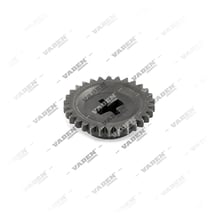
Because the gear is subjected to continuously high torque and repeated braking cycles, it is made of hardened steel, with the tooth profile machined to tight tolerances against wear. In the Vaden catalog, this category offers actuating lever gears matched to different caliper models, cross-referenced with OEM part numbers.
What is a Brake Caliper Actuating Lever Gear?
The brake caliper actuating lever gear is the gear element located inside the actuating lever housing of the caliper mechanism that transmits the force coming from the actuator to the pad thrust spindle. In modern disc calipers, the automatic clearance adjustment mechanism gradually advances the position of the thrust spindle as the pad wears, keeping brake clearance constant; in this adjustment process, the gear is responsible for transmitting rotary motion at the correct ratio without slipping. Gear wear or a broken tooth causes the clearance adjustment mechanism to malfunction.
What are the functions of the Brake Caliper Actuating Lever Gear?
- Force transmission: transmits rotary motion from the actuator to the thrust spindle.
- Clearance adjustment support: provides precise tooth engagement so the automatic adjustment mechanism functions correctly.
- Torque carrying: transmits the high torque generated during braking without slipping.
- Positional accuracy: supports consistent pad-to-disc clearance on every braking event.
- Mechanical durability: offers long service life against repeated braking cycles.
What are the symptoms of a Brake Caliper Actuating Lever Gear failure?
When the gear wears, the most obvious symptom is a stiffened or delayed response felt at the brake pedal along with brake clearance becoming irregular. When tooth slippage occurs, the automatic clearance adjustment does not function correctly, the pad can remain at excessive clearance, and braking response can weaken. In some cases, a metallic squeal or rattling sound may be heard from the gear mechanism, becoming more noticeable during braking. If the gear breaks completely, clearance adjustment stops working altogether, the pad can wear excessively, and stopping distance can increase significantly. If the vehicle tends to pull to one side, gear wear in the caliper on that side should also be considered as a possible cause.
How is the Brake Caliper Actuating Lever Gear inspected?
Inspection starts by measuring pad-to-disc clearance; if the clearance is outside the manufacturer's tolerance, the actuating lever mechanism should be removed and examined. The gear tooth profile should be checked visually and, if necessary, with magnification, looking for wear, breakage, or rounded tooth tips. The actuating lever should be turned by hand to assess whether the gear moves smoothly and without play. Engage the brake a few times to observe whether the clearance adjustment mechanism operates consistently.
What should be considered during replacement?
Before replacing the gear, the actuating lever mechanism should be fully disassembled and the grease inside completely cleaned out; metal particles in old grease can damage the new gear. When fitting the new gear, the tooth engagement sequence and orientation specified by the manufacturer should be maintained, since incorrect engagement causes the clearance adjustment to malfunction. After installation, the mechanism should be filled with the lubricating grease recommended by the manufacturer; the wrong grease type can cause premature wear. Test the brake system to confirm the clearance adjustment mechanism functions correctly.
How to choose the right Brake Caliper Actuating Lever Gear?
Selection should be based on the caliper's OE reference number, with tooth count, module, and shaft dimension matching the original part exactly.
Brake Caliper Actuating Lever Gear selection criteria| Criterion | Description |
|---|
| Caliper OE number | The reference specified in the vehicle's current OE service manual is authoritative |
| Tooth count and module | Must exactly match the original gear |
| Shaft/hub dimension | Inner diameter and keyway must fully match the original part |
| Material hardness | Hardened steel resistant to repeated torque loading |
| Lubrication compatibility | Must be suitable for use with the grease type specified by the manufacturer |
Maintenance and service life
Because the brake caliper actuating lever gear operates inside an enclosed mechanism, direct visual inspection can be difficult; measuring pad-to-disc clearance during periodic brake maintenance is an indirect indicator of gear health. The actuating lever mechanism's grease should be renewed at the interval recommended by the manufacturer; contaminated or dried-out grease accelerates gear wear. On vehicles that brake frequently under heavy load, the gear should be checked more often.
VADEN Brake Caliper Actuating Lever Gear
Vaden offers actuating lever gears matched to different caliper models in OE tolerances with broad OEM reference coverage. For correct clearance adjustment, the part should be selected according to the caliper's OE number.
Frequently Asked Questions (FAQ)
Why does brake clearance become irregular when the gear wears?
The automatic clearance adjustment mechanism relies on correct gear tooth engagement; a worn or slipping gear disrupts this adjustment and causes pad clearance to become irregular.
Can squealing during braking come from the gear?
It can be a metallic squeal or rattling sound caused by a worn or damaged gear; once the sound is noticed, the actuating lever mechanism should be inspected.
Why should old grease be cleaned out during gear replacement?
Metal particles accumulated in old grease can damage the new gear, so the mechanism should be fully cleaned and refilled with the grease recommended by the manufacturer.
How should gear wear be assessed if the vehicle pulls to one side?
Gear wear in the caliper on that side is a possible cause; clearance should be measured and the mechanism disassembled to inspect the tooth profile.
What happens if the gear breaks completely?
Clearance adjustment stops working altogether, the pad can wear excessively, and stopping distance can increase significantly; the part should be replaced immediately in this case.