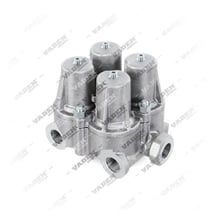
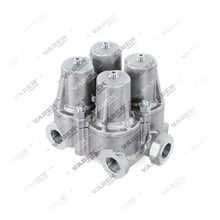
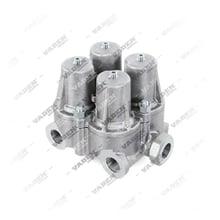
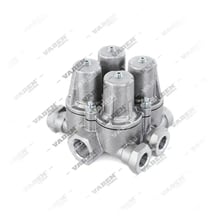
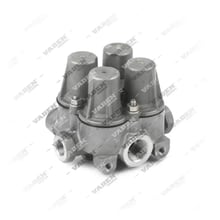
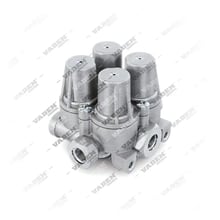
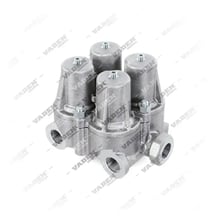
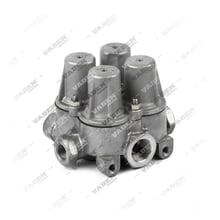
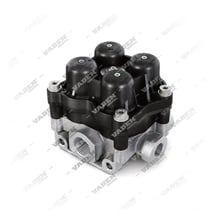
What Is a Four-Circuit Protection Valve?
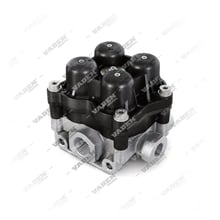
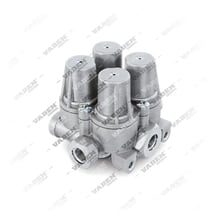
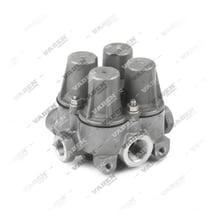
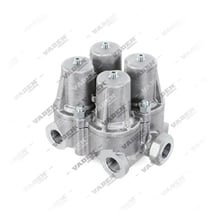
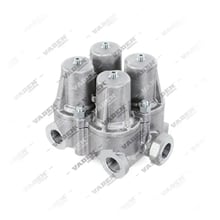
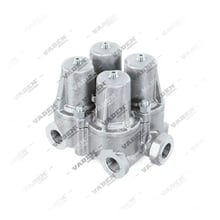
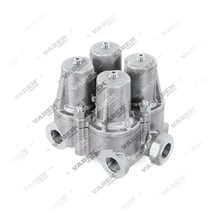
A four-circuit protection valve is a safety and distribution unit in the air brake system of heavy commercial vehicles that splits compressed air from the air dryer into four independent circuits within a single housing. In the field it is also called a quad protection valve, four-circuit relay valve, or four-circuit safety valve. It sits between the air dryer and the air tanks in the brake system chain, and its job is to stop a leak in one circuit from draining the others. This category covers not a single repair part but complete four-circuit protection valve units that bolt straight onto the vehicle - housing, internal valve assembly, springs, and sealing elements all arrive already fitted together.
How Does a Four-Circuit Protection Valve Work?
The unit takes air through a single inlet and routes it to four outlets via four pressure-limiting and non-return valve assemblies built into the housing. Each outlet stays closed until it reaches its own opening pressure, so during the initial fill-up the service brake circuits are supplied first. If a hose bursts or a leak develops in one circuit, the corresponding valve closes and the remaining circuits hold their working pressure.
- Circuit 1: Feeds the front-axle service brake circuit and is one of the priority circuits during fill-up.
- Circuit 2: Supplies air to the rear-axle service brake circuit, forming two independent braking paths with the front circuit.
- Circuit 3: Controls the parking brake and trailer supply line; release of the spring brake chambers depends on this pressure.
- Circuit 4: Feeds auxiliary consumers, cab suspension, air bellows, and body/superstructure functions.
- Backflow protection: The non-return valve on each outlet stops a depressurized circuit from drawing air back out of circuits that are still charged.
Four-Circuit Protection Valve Technical Specifications
The housing is mostly die-cast aluminium; internal valve seats, springs, and diaphragms use elastomers and stainless materials chosen to withstand oil, moisture, and heat. Circuit opening pressures are generally set below the system cut-out pressure. Port dimensions and inlet/outlet layout vary by manufacturer, so the vehicle manufacturer's current service manual is the authoritative source for exact opening/closing values and tightening torques. There are two operating characters, static and dynamic: a failed circuit causes a limited pressure drop in the others under the dynamic type, while under the static type the remaining circuits keep full pressure.
Four-Circuit Protection Valve Types and Subgroups
- Static four-circuit protection valve: Fully isolates the failed circuit, allowing no pressure loss in the remaining three; common on heavy tractors and buses.
- Dynamic four-circuit protection valve: Allows controlled pressure equalization between circuits; preferred where a short fill-up time is needed.
- Dryer-integrated units: On modules that combine dryer and distribution functions in one housing, the distribution section is replaced as a complete assembly.
- Separate-housing conventional units: The traditional type, mounted to the chassis on its own bracket with the four outlets piped separately; easy to access.
- Pressure-limiting variants: Feature a stage that keeps auxiliary circuit pressure below the brake circuits; required on vehicles with body superstructures.
How to Choose the Right Four-Circuit Protection Valve
The starting point is the OE number stamped on the housing of the removed unit. The same vehicle model can use units with different opening pressures depending on engine and chassis variant, so matching by model alone is risky. If the number can't be read, identify the equivalent by comparing outlet count, port threads, mounting hole spacing, and circuit markings. The other half of the decision is whether the valve can be repaired at all - a cracked or corroded housing rules out a repair kit.
- Complete unit replacement: Replace the whole unit for housing damage, a leak in more than one circuit, or an unknown service history.
- Repair with a repair kit: If the housing is sound and the leak is confined to one circuit and traceable to a sealing element, a kit is the economical option.
- OE-equivalent matching: Cross-check Wabco, Knorr-Bremse, and vehicle manufacturer references to confirm connection geometry.
- Circuit assignment: Which outlet feeds which circuit can vary by manufacturer, so tag every line before removal.
Four-circuit protection valve selection and compatibility criteria| Criterion | How to verify it |
|---|
| OE reference number | Read the number on the housing and cross-match it in the equivalent parts list |
| Number and layout of outlets | Compare outlet positions, angles, and circuit markings with the original |
| Port thread and pipe diameter | Thread size and fitting type must match the existing line hardware |
| Opening pressure character | Choose static or dynamic type according to the manufacturer's service data |
| Mounting interface | Bracket hole spacing, bolt size, and housing orientation must fit the mounting location |
| Vehicle application | Mercedes-Benz, MAN, Scania, Volvo, DAF, Iveco, Renault Trucks, BMC, Ford |
| Complete unit or repair kit | Determined by housing integrity and how many circuits are leaking |
Four-Circuit Protection Valve Installation, Maintenance, and What to Watch For
- Drain the system: Empty all air tanks before removal; a unit removed under pressure can damage the part and the operator.
- Tag the lines: Since the four outlets look similar, number the hoses; a misconnected circuit can disable the parking brake or trailer supply.
- Respect the torque values: Tighten bracket bolts and fittings to the manufacturer's value; overtightening strips threads in the aluminium housing.
- Check the dryer: If the cartridge is past its service life, the new unit will get contaminated from the inside in short order.
- Test after replacement: Charge the system and observe the fill-up sequence, pressure gauges, and parking brake release.
Common Faults and Their Solutions
- System pressure builds up slowly: There may be a blockage inside the unit or a valve stuck partly open; measure line pressures to locate the faulty outlet.
- Pressure drops while the vehicle is parked: The non-return valve is leaking or a sealing element has hardened; find the leak with a soapy-water test.
- Parking brake releases late: The opening pressure of circuit 3 may have drifted; compare it with a pressure gauge and replace the unit if out of range.
- One circuit never fills: The corresponding valve is stuck or the internal passage is contaminated; also check for oil and moisture carryover from the dryer.
- Continuous leak from the housing: If there is a crack or corrosion, don't attempt a repair - replace the unit complete.
Why VADEN ORIGINAL?
VADEN ORIGINAL four-circuit protection valves are manufactured to the connection geometry and functional values of the original part; port threads, mounting interface, and circuit layout bolt on without extra adaptation. A broad OEM cross-reference list covers Mercedes-Benz, MAN, Scania, Volvo, DAF, Iveco, Renault Trucks, BMC, and Ford applications. The products are exported to more than 100 countries, proven by field feedback across a wide range of climates and load conditions.
Conclusion
The four-circuit protection valve is a critical safety component that keeps the circuits of the air brake system independent and stops a single leak from leaving the vehicle without brakes. The complete units in this category offer a more lasting fix than a repair kit on vehicles with housing damage or a fault in more than one circuit. When selecting one, verify the OE number, outlet layout, port dimensions, and static/dynamic character, and pressure-test every circuit after installation.
Frequently Asked Questions (FAQ)
What does a four-circuit protection valve do?
It splits the compressed air coming from the air dryer into four independent circuits: front brake, rear brake, parking/trailer, and auxiliary. When a leak develops in one circuit, it isolates that circuit and keeps the pressure in the others intact. This means a partial failure never leaves the vehicle completely without brakes.
What are the symptoms of a failing four-circuit protection valve?
Typical symptoms include system pressure building up very slowly, pressure dropping while the vehicle is parked, the parking brake releasing late, or one circuit never filling at all. A continuous hiss of air around the housing also points directly to this unit. If any of these appear, measure each circuit's pressure individually with a gauge.
Should I replace the complete unit, or is a repair kit enough?
If the housing is sound and the leak is confined to one circuit and comes from a sealing element, a repair kit is the economical fix. A cracked housing, corrosion, stripped threads, or a fault in more than one circuit calls for a complete unit replacement. On high-mileage vehicles with an unknown service history, a full replacement is the safer choice.
How do I correctly match an equivalent four-circuit protection valve?
The most reliable approach is to work from the OE reference number on the housing of the removed unit. If the number is unreadable, compare outlet count and position, port thread size, mounting hole spacing, and static/dynamic character with the original part. Choosing by vehicle model alone is a mistake, since the same series can use units set to different pressures.
What checks should be done after replacement?
Charge the system to full pressure and observe the fill-up order and pressure values of each circuit, then check how the parking brake releases. Run a soapy-water leak test on every fitting and connection. For tightening torques and pressure values, the vehicle manufacturer's current service manual is the authoritative source.
Related technical guide: Four-Circuit Protection Valve: Faults, Diagnosis & Replacement