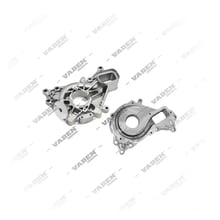
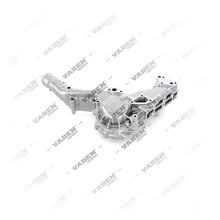
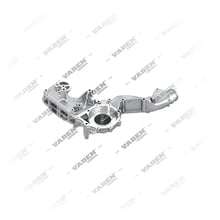
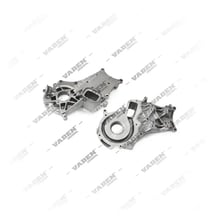
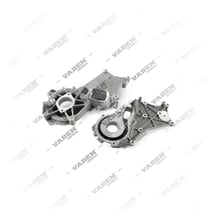
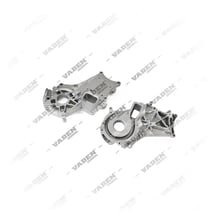
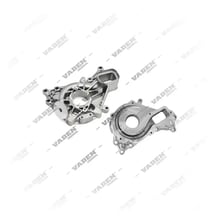
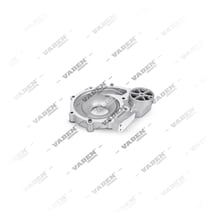
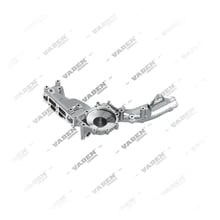
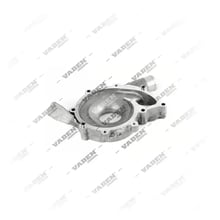
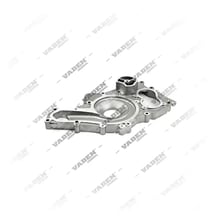
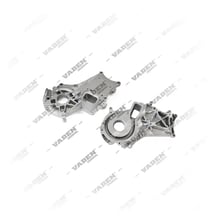
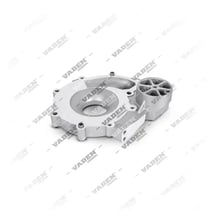
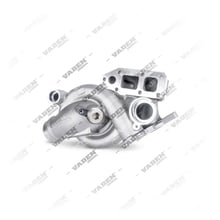
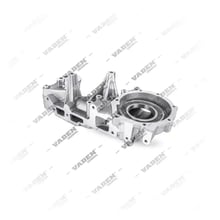
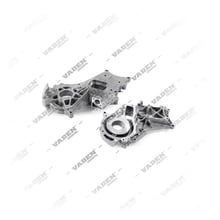
What is a Water Pump Housing?
A water pump housing is the main structural component that holds together all rotating and static internal parts of the coolant pump, and provides the inlet/outlet connection points to the engine cooling circuit. The bearing and shaft assembly is pressed into the housing, and the shaft seal maintains the fluid seal between the housing bore and the rotating shaft. Mounting flanges and bolt holes on the housing allow the part to be installed in correct alignment against the engine block with a sealed joint. Vaden's range in this category covers housing variants for multiple engine families, each cross-referenced to its own OEM part number.
What are the functions of the Water Pump Housing?
- Structural support: holds the pump shaft, bearing, and impeller in a fixed, aligned position.
- Flow routing: directs coolant flow correctly between the engine block, cylinder head, and radiator.
- Connection point: provides sealed mounting surfaces to the engine block, thermostat housing, and hose/pipe connections via gaskets.
- Seal support: maintains the precise bore tolerances needed for the shaft seal and o-rings to seat correctly.
- Heat transfer: wall thickness and internal geometry support efficient cooling of the circulating fluid.
What are the symptoms of a Water Pump Housing failure?
Cracking, casting porosity, or corrosion-driven perforation of the housing is the most common failure mode. This shows up as coolant seepage on or under the housing surface, a sweet antifreeze smell in the engine bay, and a steady drop in radiator/reservoir level. When the seal bore in the housing wears, leakage typically appears as dripping from the weep hole at the bottom of the pump housing. When internal passages accumulate rust or scale, restricted flow pushes engine temperature above normal, the cab heater underperforms, and a temperature warning may appear on the dash. If the flange mating surface is warped or the gasket seat is damaged, leaks persist even with correct bolt torque. In severe cases a growing housing crack can cause sudden, high-volume coolant loss and rapid engine overheating, which is why early diagnosis matters.
How is a Water Pump Housing checked?
Inspection should be done with the engine cold. Start with a visual check of the outer housing surface, flange edges, and weep hole for dried antifreeze residue or whitish crystallization, which confirms a leak. A pressurized cooling system tester, set to the pressure specified in the vehicle's current OE service manual, is used to check the housing and gasket line for pressure drop, which indicates a leak. Where visual inspection is inconclusive, dye penetrant testing can reveal hairline cracks. Shaft play is checked by hand; excessive radial or axial movement points to bearing or housing bore wear. Internal passages are checked for scale or blockage by removal or with a borescope. Flange flatness is verified with a straightedge and feeler gauge to detect warping.
What should be considered during replacement?
Before replacing the housing, the cooling system must be fully drained and the old coolant collected properly. All gasket and o-ring mating surfaces must be cleaned of residue, and new gaskets must match the original thickness and material. Bolts must be tightened to the torque and sequence specified in the vehicle's OE service manual, applied in a crossing pattern — over-tightening can crack the housing. Flange flatness should be verified before installation and cleaned lightly if needed. After refilling, the system must always be purged of air with the heater valve open and the engine running, and the vehicle should be monitored for a few minutes afterward for leaks and correct temperature.
How to choose the right Water Pump Housing?
Selection should be based on the vehicle's engine/chassis OE number rather than brand — the housing must be matched by OE reference. Material (cast iron or aluminum), flange hole count and diameter, and shaft/seal bore dimensions must match the original part exactly.
Water Pump Housing selection criteria| Criterion | Description |
|---|
| Engine/chassis OE number | Use the reference given in the vehicle's current OE service manual |
| Housing material | Cast iron or aluminum, must match the original |
| Flange dimensions | Hole count, diameter and spacing must match the engine block |
| Shaft/seal bore diameter | Must provide correct tolerance fit with bearing and seal |
| Port orientation | Hose/pipe inlet-outlet positions must match the original |
Maintenance and service life
Housing service life largely depends on coolant quality and change intervals. Coolant left in service too long loses its corrosion-inhibiting additives, which can start rust and porosity on the housing's internal surfaces. Coolant concentration and pH should be checked at regular intervals, with a full flush and refill performed per the manufacturer's schedule. Avoiding mixing different coolant brands and using a proper premixed antifreeze instead of hard water helps prevent scale build-up and extends housing life. The flange gasket should be visually inspected at each service and replaced preventively if hardening or cracking is observed.
VADEN Water Pump Housing
Vaden supplies water pump housings for heavy-duty vehicle cooling systems built to OE tolerances, across a wide OEM cross-reference range. Parts are verified for material and dimensional accuracy; for correct selection, match by OE part number rather than brand.
Frequently Asked Questions (FAQ)
Can a vehicle keep running if the water pump housing is cracked?
It may be possible for a very short distance, but it is not recommended; a crack widens quickly, coolant level drops, and the engine can overheat and suffer serious damage. Replace the part as soon as possible.
Is the housing the same part as the complete pump?
No. The housing is the outer carrier of the pump; the shaft, impeller, bearing and seal are separate internal components. Depending on the application, either the housing alone or a complete pump assembly is replaced — always follow the vehicle's OE manual.
Is there a difference between aluminum and cast iron housings?
Yes, weight and thermal conductivity differ. Always replace with a housing in the same material as the original, since a different material can affect mounting tolerances and thermal expansion.
Why is air purging needed after replacing the housing?
Trapped air pockets in the system block coolant circulation and cause localized overheating. After refilling, run the engine with the heater valve open and complete a full air-purge cycle.
Should the flange gasket always be renewed on every replacement?
Yes. Once the housing is removed, the old gasket should never be reused; fit a new gasket of the original thickness and material and torque the bolts to OE specification.
Related technical guide: Truck Water Pump Repair: Housing, Gasket and Water Pipe