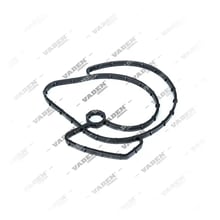
What are the functions of the Engine Crankcase Ventilation Gasket?
This gasket performs a task that directly affects the engine internal pressure balance and oil economy.
- Sealing: Makes the contact surface between the ventilation cover and the engine block gas- and oil-tight.
- Pressure balance: Allows controlled release of crankcase pressure while blocking unwanted air ingress.
- Oil loss prevention: Stops oil vapor from leaking through the gasket onto the outer engine surface or surrounding components.
- Emission compliance: Prevents uncontrolled crankcase gas escape into the atmosphere, supporting correct operation of the exhaust emission system.
- Vibration damping: Helps the cover-to-block joint stay stable under engine vibration.
What are the symptoms of Engine Crankcase Ventilation Gasket failure?
When the gasket hardens, cracks or shifts out of position, several typical symptoms appear.
- Oil leakage: Oil stains and residue appear around the ventilation cover and on the side of the engine block.
- Falling oil level: As the leak becomes more pronounced, periodic oil consumption accelerates.
- Burnt oil smell: A burning odor appears when leaking oil contacts hot engine surfaces or the exhaust manifold.
- Smoke in the engine bay: With heavy leaks, oil vapor smoking off a hot surface may be noticeable.
- Rising crankcase pressure: Once the seal is compromised, crankcase pressure becomes unstable, which can accelerate premature wear of other oil seals.
- Irregular idle: Rarely, an air leak affecting the combustion mixture can cause slight idle fluctuation.
How is the Engine Crankcase Ventilation Gasket checked?
Inspection starts with a clean visual check while the engine is cold.
- Visual inspection: Examine the area around the ventilation cover, its underside and the joint line with the engine block for oil traces.
- Post-cleaning check: Clean the suspect area, run the engine briefly and observe whether a new leak forms.
- Gasket surface check: Once removed, inspect the gasket by hand and eye for cracks, hardening, deformation or flattening.
- Cover flatness check: Assess the ventilation cover mating surface for warping or corrosion using a straightedge.
- Pressure reading: Where available, read crankcase ventilation line pressure sensor data from the service display to detect abnormal values.
What should be considered during replacement?
Carelessness during replacement can cause even a new gasket to start leaking within a short time.
- Surface cleanliness: Old gasket residue, oil and soot buildup must be fully removed from the cover and block surfaces.
- Correct gasket selection: Use a gasket that exactly matches the cover model and engine type in original dimensions; a different thickness compromises sealing.
- Tightening sequence and torque: Tighten the cover bolts progressively in the sequence and torque value specified in the vehicle's service manual; overtightening crushes the gasket and causes premature tearing.
- Oil line check: Inspect the oil separator and hoses connected to the ventilation system for blockages during the same procedure.
- Test run: Run the engine for a few minutes after replacement and recheck for leaks.
How to choose an Engine Crankcase Ventilation Gasket?
The correct choice should match the vehicle's engine code and ventilation cover variant; generic gaskets increase the risk of sealing failure.
Engine Crankcase Ventilation Gasket selection criteria| Criterion | Description |
|---|
| Material | Oil- and heat-resistant NBR or silicone-based rubber |
| Dimensional fit | Exact mold match to cover/housing geometry |
| Temperature range | Suited to engine crankcase temperature; for the general range, the vehicle's current OE service manual is authoritative |
| OE reference match | Cross-checked against OE part numbers from manufacturers such as Mercedes-Benz, Volvo, MAN, DAF, Scania, Iveco |
| Application | Confirmed via the vehicle manufacturer's compatibility table by engine code and chassis number |
Maintenance and service life
The engine crankcase ventilation gasket retains its sealing performance for a long period when correctly installed and when engine oil maintenance intervals are followed. Key factors affecting its service life include high engine temperature, low-quality or contaminated engine oil, blocked ventilation lines, and loose or improperly torqued cover bolts. Visually inspecting the area around the ventilation cover during routine oil changes helps catch a potential leak early and avoid larger repairs later. Following the maintenance intervals specified in the vehicle's current OE service manual is recommended.
VADEN Engine Crankcase Ventilation Gasket
Among the air brake compressors and engine-related components VADEN produces for heavy commercial vehicles, the engine crankcase ventilation gasket is also offered to OE dimensions and material specifications. The products are manufactured with an oil- and high-temperature-resistant compound aimed at long-lasting sealing performance and are designed for cross-compatibility with the OE reference numbers of relevant vehicle manufacturers. Produced to VADEN quality standards, this gasket offers a reliable replacement part alternative for fleet operators and service workshops.
Frequently Asked Questions (FAQ)
What does the engine crankcase ventilation gasket do?
It seals the connection between the engine block and the crankcase ventilation cover or housing against gas and oil, allowing controlled release of crankcase pressure.
What happens if the engine crankcase ventilation gasket fails?
Oil leakage around the cover, a falling oil level, a burnt oil smell and light smoke in the engine bay can occur; if unnoticed for long, oil loss increases.
When should the engine crankcase ventilation gasket be replaced?
It should be replaced with a new gasket when a visual check reveals cracking, hardening or leakage, or whenever the ventilation cover is removed.
How long does replacing the engine crankcase ventilation gasket take?
It is generally a quick procedure depending on accessibility and engine type; the cover is removed, the surface cleaned, and a new gasket fitted with progressive torque.
Can a different brand engine crankcase ventilation gasket be used?
It can be used as long as it exactly matches the cover geometry and OE dimensions; an incompatible thickness or material can compromise sealing, so the vehicle's OE service manual should be the reference.