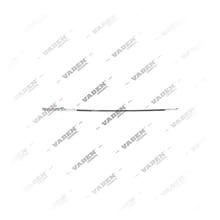
Working on the Bowden cable principle, a short movement at the column is transmitted through a steel wire inside an outer sheath to a mechanism some distance away; the flexibility of the sheath accommodates the tight geometry of the cabin layout. Despite their simple appearance, control cables of this type directly affect the driver's day-to-day control of the vehicle; smooth and consistent movement matters for driver comfort, especially for controls used frequently on long-haul trips.
What are the functions of a steering column control cable?
The cable's functions within the system are aimed at ensuring the driver's command reaches the relevant mechanism accurately and quickly.
- Motion transfer: Converts the control lever's angular movement into linear movement via the inner wire and carries it to the target mechanism.
- Precision: Transmits even small lever movements without loss, allowing the control to work in fine increments.
- Flexible routing: Correctly directs the motion through the tight, curved path between the cabin and engine compartment.
- Position holding: Supports the mechanism staying fixed at the position the lever is left in (or returning via spring, depending on design).
- Vibration isolation: The sheath structure limits the direct transfer of cabin vibration to the mechanism.
What are the symptoms of a steering column control cable failure?
A cable failure shows up in the response of the control and in driving comfort.
- Stiff or sticking movement: The control lever moving more stiffly than before or sticking at certain points can indicate the inner wire binding or sheath damage.
- Loose/slack feel: Excessive play felt at the lever can mean the mechanism is not receiving the full command.
- Loss of function: The control not responding at all indicates the inner wire may have broken.
- Visible damage: Cracking, wear on the cable sheath, or deformation at a connection end.
- Abnormal noise: A squeak or friction noise along the cable's path indicates the wire inside the sheath is moving irregularly.
How is a steering column control cable checked?
Inspection should be performed with the cabin interior and the relevant mechanism accessible.
- Motion test: Move the control lever end to end and observe its freedom of movement and response speed.
- Visual inspection: Check the sheath along the cable's path for cracking, crushing, or excessive bending.
- Connection end check: Verify the connection elements (joint, clip) at both ends are sound and correctly fitted.
- Tension check: Verify the cable is at the manufacturer's specified pre-tension value.
- Mechanism response: When the lever is moved, observe whether the target mechanism (valve, arm, etc.) reaches the expected position.
What should be considered during replacement?
Correct installation directly affects the precise and reliable operation of the control.
- Correct routing: Route the cable along its original path, avoiding sharp bends or contact with hot surfaces.
- Connection integrity: Fit the connection elements at both ends until fully seated, locking clips into place.
- Tension adjustment: Adjust the cable so the mechanism achieves its full range of motion; avoid over-tensioning or under-tensioning the installation.
- Function test: After installation, move the control lever end to end several times to confirm the mechanism follows without issue.
- Fastening points: Fit all retaining clips in the cabin and engine compartment completely, preventing free flapping of the cable.
How should a steering column control cable be selected?
Selection requires an exact match to the vehicle model and the type of mechanism controlled.
Steering column control cable selection criteria| Criterion | Description |
|---|
| Length and routing | Varies by vehicle model; incorrect length causes lost motion or excessive tension |
| Connection end type | Joint/clip geometry at the column and mechanism side must match the original |
| Sheath material | Must withstand cabin and engine compartment conditions and resist wear |
| Wire diameter and strength | Must have sufficient strength to transmit control force without loss |
| Application | Confirm against the vehicle manufacturer's compatibility list by chassis/model code |
Maintenance and service life
As a frequently used mechanical part, the steering column control cable can show wear in its inner wire and sheath over time. Checking that the cable moves freely and that connection points are sound during periodic maintenance helps prevent sudden loss of function. Sections of the cable route exposed to excessive heat or constant friction should be inspected more often. It is also worth remembering that the rubber grommets at the holes and guide points where the cable passes through the cabin can harden and crack over time, so these points should be checked separately during inspection. For exact adjustment values, the vehicle's current OE service manual is authoritative.
VADEN Steering Column Control Cable
VADEN offers OE-compatible steering column control cables for heavy commercial vehicles. Manufactured with correct length and connection geometry, the part supports precise, reliable transmission of control motion.
Frequently Asked Questions (FAQ)
What does a steering column control cable do?
It transmits the movement of the control lever on the steering column to the related mechanism outside the cabin, such as the hand throttle or engine brake control.
What happens if the cable breaks?
The lever's movement no longer reaches the mechanism and the function is completely disabled; the cable should be renewed as soon as possible.
Why does the cable stiffen over time?
Dirt buildup on the wire inside the sheath, corrosion, or lack of lubrication can increase friction, causing the cable to move stiffly.
Is adjustment needed when replacing the cable?
Yes, the cable's tension must be adjusted to the manufacturer's specified value so the mechanism achieves its full range of motion.
What happens if a cable of the wrong length is used?
A cable that is too short over-tensions the mechanism and causes premature failure; a cable that is too long can fail to fully transmit the command or operate loosely.