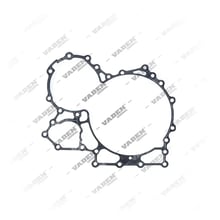
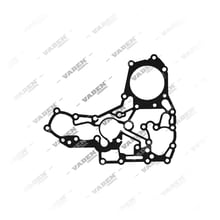
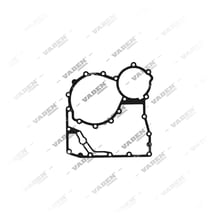
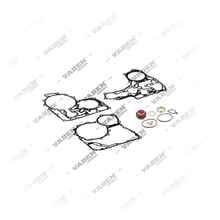
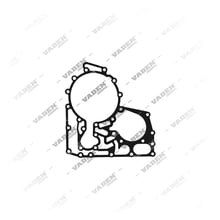
What Is a Retarder Gasket?
A retarder gasket is the sealing component used at the housing joint faces, rotor-stator cover, and oil channel connections of the hydraulic retarder unit integrated into or mounted on the transmission of heavy commercial vehicles. This parts family — the transmission-to-retarder housing joint, the cover gaskets, and the oil line O-rings — contains the high-pressure oil flow generated during retarder operation. In the field it is also called a "retarder housing gasket," "retarder cover gasket," or "transmission retarder sealing kit." Since the retarder is an auxiliary brake that supplements the wheel brakes, the integrity of the Retarder Gasket directly affects braking performance, transmission oil level, and therefore safety. VADEN ORIGINAL gaskets, compatible with the ZF and Voith retarder units commonly found in Mercedes-Benz, MAN, Scania, Volvo, DAF, Iveco, and Renault Trucks vehicles, are manufactured to original dimensions and material specifications.
How Does a Retarder Gasket Work?
When the retarder engages, the gap between the rotor blades and the stator fills rapidly with transmission oil, and the resulting turbulence converts rotational energy into heat, slowing the vehicle down. High pressure and temperature fluctuations occur within the system during this process; the retarder gasket's job is to keep the housing joint faces sealed under these conditions. The cover gasket isolates the rotor-stator chamber from the outside environment, while the O-rings prevent pressure loss at the connection points on the oil inlet and outlet lines. Gasket material is chosen to withstand the retarder's continuous heat-cooling cycle. When the seal weakens, oil pressure drops, braking force decreases, and the transmission oil level gradually falls.
Retarder Gasket Technical Specifications
Retarder gaskets are typically made from high-temperature-resistant NBR, FKM (Viton), or metal-reinforced composite materials; the material must suit the retarder's operating temperature and the transmission oil type used. Housing joint gaskets are usually multi-layer steel (MLS) or paper-composite construction, while cover gaskets are molded rubber profiles. O-ring dimensions are held to millimetric tolerances based on inner diameter and cross-section thickness; the wrong size leads to leakage after installation. Tightening torque and cover bolt sequence must follow the manufacturer's service manual; the vehicle's current service manual should always be the reference. Compatibility criteria include the retarder model, transmission housing type, and oil channel configuration.
Retarder Gasket Selection and Compatibility Guide| Criterion | Check Point |
|---|
| Retarder Make/Model | Verify the ZF or Voith unit type and serial number |
| Gasket Location | Distinguish between housing joint, cover gasket, or oil line O-ring |
| Material Compatibility | Check chemical compatibility with the transmission oil type in use |
| Temperature Class | Resistance level to the retarder's continuous operating temperature |
| Vehicle Application | Mercedes-Benz, MAN, Scania, Volvo, DAF, Iveco, Renault Trucks |
| OEM Reference | Confirm via chassis number or original part code |
Retarder Gasket Types and Subgroups
- Retarder Housing Joint Gasket: The main, large-surface seal connecting the retarder unit to the transmission housing.
- Rotor-Stator Cover Gasket: Isolates the rotor-stator chamber from the outside environment, keeping oil within the circuit.
- Oil Line O-Rings: Prevent pressure loss at the oil inlet/outlet connections between the retarder and the transmission.
- Heat Exchanger Gasket: Maintains sealing at the connection faces of the retarder oil cooler.
- Valve Block Gasket: Used at the housing joint of the hydraulic control valve that engages the retarder.
- Complete Gasket Set: Supplies all gaskets and O-rings needed for an overhaul in one package.
How to Choose the Right Retarder Gasket
To select the correct gasket, first identify the vehicle's retarder make and model precisely, since housing design and gasket dimensions differ between ZF and Voith units. Verifying via the chassis number or OEM part code, guided by the table above, eliminates the risk of leakage and repeat labor from installing the wrong part.
- Identify the Location: Clarify whether you need a housing joint, cover gasket, or oil line O-ring.
- Check Oil Compatibility: Confirm that the transmission/retarder oil in use is chemically compatible with the rubber component.
- Confirm the OEM Code: Verify dimensions using the chassis number or original part code.
Retarder Gasket Maintenance and Points to Watch
- Clean the Mounting Surface: Old gasket residue and oil traces stop the new gasket from seating properly; clean thoroughly without scratching the surface.
- Apply the Correct Tightening Torque: Tighten the cover bolts gradually, in the manufacturer's sequence and torque value; overtightening crushes the gasket and causes premature failure.
- Check the Oil Level: After replacing the gasket, top up the transmission/retarder oil to the manufacturer's specification.
- Perform a Leak Test: After installation, run the vehicle and visually check the housing joints and hose connections for leaks.
- Avoid Reusing a Gasket: Never refit a removed gasket; once compressed, the rubber loses its sealing properties.
Common Failures and Solutions
- Oil Leak from the Retarder Housing: Hardened or cracked housing gasket; inspect the gasket and contact surface, then replace the complete set.
- Weakening of Retarder Braking Force: Cover gasket or O-ring wear causing internal pressure loss; renew the sealing kit and check the oil level.
- Continuous Drop in Transmission Oil Level: A slow leak at the retarder-transmission joint; remove the joint face and renew the gasket.
- Moisture/Oil Traces at Oil Line Connections: Worn O-ring; replace it at the relevant connection point with the original size.
- Abnormal Noise When the Retarder Engages: Loose cover bolts or a crushed gasket; retighten to the specified torque and replace the gasket if necessary.
Why VADEN ORIGINAL?
- Manufactured to OE Dimensions: Retarder housing and cover gaskets are produced to original dimensions and tolerances, requiring no extra machining.
- Broad OEM Coverage: Covers Mercedes-Benz, MAN, Scania, Volvo, DAF, Iveco, and Renault Trucks applications with ZF and Voith retarder units.
- Heat- and Oil-Resistant Material: Formulated for the retarder's high-temperature cycling and the chemical makeup of transmission oil.
- Exported to Over 100 Countries: Passes the quality control trusted by global fleet operators.
Conclusion
Although it may seem like a small part, the retarder gasket directly affects the sealing of the hydraulic retarder, its braking force, and the transmission oil level. A gasket of the correct material and dimensions, installed to the manufacturer's torque values, safeguards both retarder performance and the transmission's long service life. VADEN ORIGINAL Retarder Gasket products, manufactured to OE dimensions with broad vehicle compatibility, offer a reliable solution.
Frequently Asked Questions (FAQ)
What does a retarder gasket do?
A retarder gasket seals the housing joint faces, cover gaskets, and oil line O-rings of the hydraulic retarder unit. It keeps the high-pressure oil flow generated when the retarder engages contained within the system, preserving both braking force and the transmission oil level.
What are the symptoms of a failed retarder gasket?
The most common symptoms are oil leaking from the retarder housing, weakened retarder braking force, a continuous drop in transmission oil level, and abnormal noise when the retarder engages. If any of these signs appear, the housing joint and cover gaskets should be inspected immediately.
What should be considered when replacing a retarder gasket?
The mounting surface must be completely cleaned of old gasket residue, the cover bolts must be tightened gradually in the manufacturer's sequence and torque value, and a gasket that has already been removed should never be reused. After installation, check the transmission/retarder oil level and perform a leak test.
Which vehicles are VADEN ORIGINAL retarder gaskets compatible with?
VADEN ORIGINAL Retarder Gasket products are compatible with the ZF and Voith retarder units found in Mercedes-Benz, MAN, Scania, Volvo, DAF, Iveco, and Renault Trucks heavy vehicles. We recommend verifying compatibility via the chassis number or OEM part code before ordering.
Does transmission oil decrease if the retarder gasket leaks?
Yes. Since the retarder housing is integrated into or directly connected to the transmission, a leak at the housing joint gradually lowers the transmission oil level. This negatively affects both retarder efficiency and the transmission's overall lubrication performance, which is why early intervention matters.
Related technical guide: Truck Retarder: Faults, Replacement & Maintenance Guide