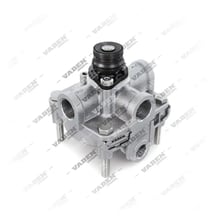
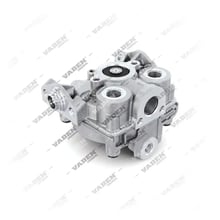
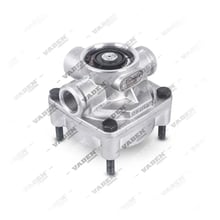
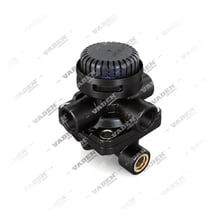
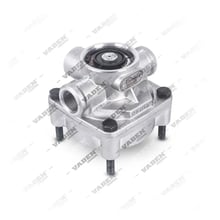
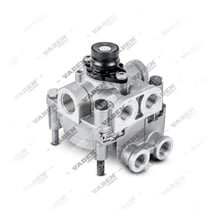
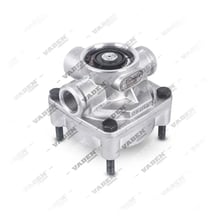
What Is a Relay Valve?
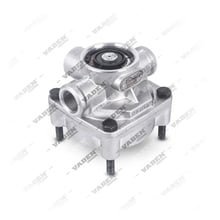
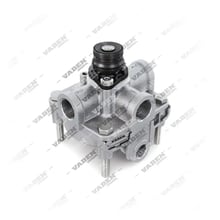
A relay valve is a complete pneumatic control unit in the air brake system of heavy commercial vehicles that receives the control signal from the brake pedal and feeds the rear axle or trailer brake chambers directly from the nearest air reservoir. Positioned within this branch of the Brake System chain, the relay valve eliminates the lag caused by long air lines: the control air arrives through a thin signal line, while the working air is delivered through a short, wide-bore line. In the field, this unit is also referred to as a relay valve, quick-action valve, or rear brake relay.
This category covers complete, bolt-on/bolt-off units; individual repair components are listed in separate groups. The relay valve is used in the rear axle circuit of tractor units and trucks, in the brake lines of buses, and in the main control block of trailers and semi-trailers.
How Does a Relay Valve Work?
The working principle of the relay valve is to control a large air flow using a small control pressure. When the pedal is pressed, control air reaches the valve's upper port and pushes the piston; the piston closes the exhaust passage and opens the supply passage, letting air from the reservoir fill the brake chambers. When the pedal is released, the piston returns, and the air in the chambers discharges through the exhaust port.
- Control signal: Pressure from the foot brake valve or the relay emergency valve initiates the process at the valve's control port.
- Supply path: The supply port, connected to the reservoir by a short line, opens and directs full-pressure air to the working ports.
- Quick exhaust: On brake release, air discharges through the wide exhaust port; this shortens brake release time and prevents lining drag.
- Crack pressure: Some versions have a threshold value; no output is generated until the control pressure exceeds this threshold, which sequences the axle circuits.
Relay Valve Types and Subgroups
- Standard relay valve: The classic single-control, dual working-port type; the most common complete unit in the rear axle circuit of trucks and tractor units.
- Crack-pressure type: Preferred for regulating the braking sequence between the front and rear axles through a defined threshold value.
- Load-sensing type: The port is regulated according to the signal from the load-sensing valve; used on tippers and curtain-sider vehicles with variable loads.
- Trailer relay valve: Serves in the main control block of trailers and semi-trailers; generally has a higher flow capacity.
- Combined quick-release type: Combines the relay function with quick release; shortens release time on vehicles with long lines.
Relay Valve Technical Specifications and How to Choose the Right Unit
The most reliable way to select a complete unit is to match the OE number cast or stamped on the removed valve's body against the cross-reference; if the number is illegible, proceed based on make, model, production year, and circuit diagram. The ranges below are general application values, and the vehicle manufacturer's current service manual takes precedence.
Complete relay valve selection and compatibility criteria| Criterion | What to check | Typical range |
|---|
| OE reference | Matching the cast or laser-etched number on the body against the cross-reference | Exact cross-reference match |
| Working pressure | The circuit's nominal line and the safety valve setting | Approximately 8-10 bar |
| Crack pressure | The threshold value that determines axle sequencing | 0 - 0.8 bar variants |
| Number and thread of ports | Control, supply, working, and exhaust ports | Metric or pipe thread |
| Mounting arrangement | Flange hole spacing, bolt diameter, body orientation | Two-hole flange is common |
| Flow capacity | Volume of chambers to be supplied and fill time | Depends on chamber size |
| Vehicle application | Make, model, axle configuration | Mercedes-Benz, MAN, Scania, Volvo, DAF, Iveco, Renault Trucks |
Complete Replacement or Repair Kit?
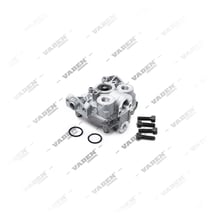
Since this category covers complete units, the decision workshops face most often is between replacement and repair. If the fault is limited to the sealing elements and the body and piston bore are sound, a repair kit is sufficient; if the body shows corrosion, scoring, or cracking, replacing the complete unit is the right call.
- Requires a complete unit: A cracked body, an oxidized piston bore, damaged threads, a broken flange ear, or a recurring internal leak.
- A repair kit is sufficient: Aged sealing elements, a light leak at the exhaust port, or sticking after a vehicle has sat unused for a long time.
- Fleet perspective: On high-mileage vehicles, complete replacement removes both the risk of a breakdown and the labor cost of a second removal.
- Axle matching: If one of the two valves on the same axle is being replaced, the condition of the other should also be checked to preserve brake balance.
Relay Valve Maintenance and Points to Watch
The service life of the relay valve depends largely on the cleanliness of the air entering the system. Moist and oily air causes the internal sealing elements to swell, making the piston stick in its bore. Forcing components during installation and over-tightening are the most common causes of body cracks.
- Protect air quality: Replace the dryer cartridge on schedule and drain condensation from the reservoirs regularly.
- Keep the exhaust port clear: A clogged muffler delays brake release; clean it at every service.
- Label lines before removal: Swapping the control and supply lines means the valve either won't function at all or will apply the brakes continuously.
- Follow the tightening torque: Tighten fittings and flange bolts to a controlled value; for exact figures, the vehicle manufacturer's current service manual takes precedence.
- Test after replacement: Charge the system to full pressure, check for leaks with soap solution, and verify response time with a road test.
Common Faults and Solutions
- Brakes engage late: There may be a blockage in the control line or a stuck piston; check the line, and replace the unit completely if it is sticking.
- Brakes release late and the linings drag: The exhaust port is blocked or the internal spring has weakened; clean the muffler, and renew the unit if the issue persists.
- Continuous leak from the exhaust: The sealing element has aged or the seating surface is damaged; repair if the body is sound, otherwise replace the complete unit.
- Vehicle pulls to one side under braking: The two valves on the same axle may have different crack pressures; compare and match the part numbers.
- Reservoir pressure drops: There is an external leak at the supply port or fitting; check the connections with soap solution and renew the sealing.
- Locking up in cold weather: Moisture has entered the system; check the dryer and the reservoir drain.
Why VADEN ORIGINAL?
- Manufactured to OE dimensions: Body, flange, and port geometry match the original unit; no adapters or line extensions required.
- Broad OEM matching: A cross-reference list covering applications for Mercedes-Benz, MAN, Scania, Volvo, DAF, Iveco, and Renault Trucks.
- Materials and coating: A corrosion-resistant body and sealing elements deliver a long service life.
- Both complete and repair options available: Workshops can choose between a complete unit or a repair kit depending on the extent of the fault.
- Supply at scale: Exports to more than 100 countries and deep stock availability keep fleet maintenance planning on schedule.
Conclusion
The relay valve is a critical control unit that determines the response time of a heavy commercial vehicle's brake system, and the choice of complete unit directly affects brake balance. The starting point for selection is the OE number; the verification points are the crack pressure, port arrangement, and mounting dimensions. A repair kit is economical when the body is sound, while complete replacement should be chosen when there is damage or a recurring internal leak. A leak and response test should always be performed after installation.
Frequently Asked Questions (FAQ)
What does a relay valve do?
A relay valve receives the control signal from the brake pedal and feeds the rear axle or trailer brake chambers directly from the nearest air reservoir. This eliminates the lag caused by long air lines, so the brakes engage faster and release faster.
How can you tell a relay valve has failed?
The most common signs are the brakes engaging late, releasing late, continuous air leaking from the exhaust port, and the vehicle pulling to one side under braking. A faster-than-expected drop in reservoir pressure also points to an external leak. When these symptoms appear, the valve's control and supply lines and its exhaust port should be checked first.
Should you replace the relay valve completely or use a repair kit?
If the body and piston bore are sound, a repair kit is an economical solution for aged sealing elements. If the body has a crack, corrosion, damaged threads, or a recurring internal leak, replacing the complete unit is the right decision. On high-mileage fleet vehicles, complete replacement also eliminates the labor of a second removal.
How do I choose the right relay valve?
The most reliable method is to match the OE number on the removed unit's body against the cross-reference. If the number is illegible, proceed based on make, model, production year, and circuit diagram; then be sure to verify the crack pressure, the number and thread size of the ports, and the flange mounting spacing.
Can the two relay valves on the same axle have different part numbers?
It's possible, but this is usually a sign of an earlier incorrect replacement. Two units with different crack pressures upset the brake balance on the same axle and cause the vehicle to pull to one side under braking. When replacing one side, the part numbers of both sides should be compared and matched.
Related technical guide: Relay Valve & ABS Relay Valve: Faults, Replacement & Care