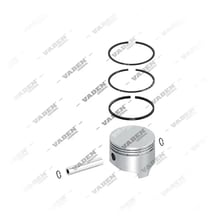
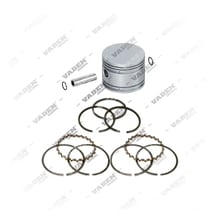
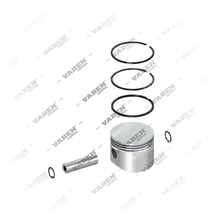
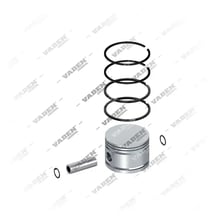
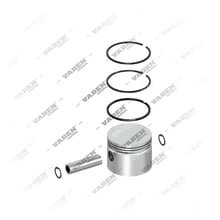
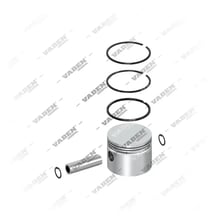
What Is Compressor Parts Piston & Rings?
The Compressor Parts Piston & Rings group covers the piston, piston pin, and ring sets (compression ring plus oil control ring) that work inside the compression chamber of an air brake compressor. Sitting under the Air Brake Compressors > Compressor Parts chain, this subgroup is the moving core that actually pressurizes the air. In the field it's referred to as the compressor piston, piston kit, ring set, or piston-and-ring kit. It is used on trucks, tractor units, buses, trailers, and heavy construction equipment; the condition of the piston and rings directly determines air delivery, oil consumption, and how quickly the reservoir fills.
How Does Compressor Parts Piston & Rings Work?
Rotation of the crankshaft is transmitted to the piston through the connecting rod, and the piston travels back and forth inside the cylinder liner to complete the intake and compression cycle. As the piston descends, the resulting pressure differential opens the intake valve and filtered air fills the chamber; as the piston rises, that air is compressed and pushed through the discharge valve to the dryer and on to the reservoirs. A worn ring set first extends the time it takes to build pressure, and then starts carrying oil into the brake circuit.
- Compression: The piston crown reduces the air volume; piston diameter and stroke set the compressor's delivery rate.
- Sealing: The compression rings spring outward against the liner wall, limiting air blow-by into the crankcase.
- Oil control: The oil control ring leaves behind a controlled oil film thickness, preventing oil from passing to the air side.
- Motion and heat transfer: The piston pin transmits the force coming from the connecting rod; heat that builds up at the crown passes through the rings into the liner.
Compressor Parts Piston & Rings Technical Specifications
Compressor pistons are typically made from aluminum alloy or cast iron; the rings are manufactured from cast iron or alloy steel and carry a chrome, molybdenum, or phosphate-based surface treatment for wear resistance. Piston diameters on heavy commercial vehicle compressors mostly fall within a 60 to 100 mm band, and the piston carries two or three ring grooves. End gap and groove clearances vary by model, so only general ranges are given here; for exact figures the vehicle manufacturer's current service manual is authoritative.
- Sizing logic: Alongside the standard size, oversize options are available for use once the liner has been machined.
- Ring arrangement: The upper grooves carry compression rings while the lower groove holds the oil control ring.
- Compatibility criteria: Piston diameter, pin diameter, OE number, and cylinder count are all evaluated together.
Compressor Parts Piston & Rings Types and Subgroups
This subgroup is offered in scopes ranging from single parts to complete kits. Which product to choose depends on the nature of the fault and the condition of the liner; if only the rings are leaking, a ring set may be enough, whereas scoring on the piston skirt calls for a kit that includes the piston.
- Ring set: Contains the compression and oil rings needed for one cylinder; it's the most commonly requested service item.
- Piston (single): A single piston body with verified dimensions, used when the liner and pin bore are still sound.
- Piston and ring kit: Includes the piston, rings, pin, and circlips together; preferred for overhauls.
- Oversize kits: Options with an above-standard diameter, used after the liner has been honed.
How to Choose the Right Compressor Parts Piston & Rings?
The most reliable starting point for selection is the OE part number stamped on the compressor housing. Because the same vehicle model can use different compressors depending on the engine variant, make and model information alone is not enough. If the number can't be read, matching should be done by measuring the piston diameter and ring thickness.
Criteria to check when selecting a piston and ring set| Criterion | What to check | Why it matters |
|---|
| OE part number | The printed reference on the housing | The most definitive way to rule out an application error |
| Piston diameter | Liner bore and the current piston size | Determines whether standard or oversize is needed |
| Ring thickness | Number and height of the grooves | The wrong thickness causes binding or excess clearance |
| Piston pin diameter | Pin bore and connecting rod bushing size | Pin clearance causes knocking and rapid wear |
| Vehicle application | Mercedes-Benz, MAN, Scania, Volvo, DAF, Iveco, BMC | Wabco and Knorr-Bremse type architectures differ |
| Liner condition | Scoring, out-of-round wear, honing marks | A damaged liner makes a new ring set leak prematurely |
Compressor Parts Piston & Rings Maintenance and What to Watch For
Replacing the piston and rings requires removing the compressor and working in a clean environment. Before assembly, the liner surface should be inspected; if the honing pattern is gone, the liner needs to be machined or replaced. Tightening torques and clearance values vary by model, so the vehicle manufacturer's current service manual is authoritative.
- Stagger the ring end gaps: Leaving the gaps aligned creates a leak path.
- Lubricate during assembly: Wet the piston, rings, and liner surface with suitable oil; dry assembly causes scoring.
- Use a ring compressor: Don't force the piston in; a broken ring is the most common assembly mistake.
- Renew the intake filter: A dirty filter is the most common cause of premature wear on new rings.
Common Faults and Their Solutions
Faults originating from the piston and rings are usually noticed first as a pressure problem in the brake system. Reading the symptom correctly prevents unnecessary parts replacement.
- Reservoir fills slowly: A worn compression ring or an out-of-round liner is likely; check the dimensions and renew the ring set.
- Oil accumulating in the lines and dryer: The oil control ring has stopped doing its job; renew the dryer cartridge along with the ring set.
- Metallic knocking noise: Could be pin clearance, connecting rod bushing wear, or a broken ring; remove the piston assembly and inspect it.
- Smoke from the crankcase breather: Compression is blowing past into the crankcase; measure the end gaps and evaluate the liner and piston together.
- New kit leaking prematurely: An unmachined liner, incorrect sizing, or contaminated intake air; repeat the dimension and filter checks.
Why VADEN ORIGINAL?
VADEN ORIGINAL piston and ring products are manufactured to the dimensional and material requirements of the original part. The goal is to restore compression performance without replacing the entire compressor.
- Manufactured to OE dimensions: Piston diameter, groove dimensions, and pin bores are machined to original tolerances.
- Broad OEM matching: A reference list cross-matched to the OE numbers of common compressor types is provided.
- Exported to more than 100 countries: The product group is used by fleets operating in a wide range of climate and load conditions.
Conclusion
The Compressor Parts Piston & Rings group is the service item that directly determines an air brake compressor's ability to generate pressure. A kit selected in the correct size and installed by the book restores air delivery without the cost of a full compressor replacement. Verifying the OE number, piston diameter, and liner condition together before ordering prevents short-lived repairs.
Frequently Asked Questions (FAQ)
When should compressor rings be replaced?
An air reservoir that fills slower than normal, oil accumulating in the air lines, and smoke from the crankcase breather are typical signs of ring wear. Once these symptoms appear, the compressor should be removed and the liner and ring dimensions checked. If they're out of tolerance, the ring set or the piston kit is renewed.
Is replacing just the rings enough, or should I renew the piston too?
If the piston skirt and ring grooves are undamaged and the groove side clearance is within tolerance, a ring set alone may be sufficient. But if a groove has widened, the piston skirt is scored, or there's play in the pin bore, the piston should be replaced as well. Otherwise the new rings will start leaking again in a short time.
When are oversize pistons and rings used?
If the cylinder liner has worn out of round or is scored and will be corrected by machining, an oversize piston and ring set matched to the new bore diameter is required. A standard size would leave excess clearance in that case and leak. The actual dimension of the machined liner should be verified with a measuring instrument.
What is the most common mistake when replacing pistons and rings?
The most common mistakes are assembling without a ring compressor, leaving the ring end gaps aligned, and fitting a new kit without checking the condition of the liner. Failing to renew a clogged intake filter also causes the new rings to wear out quickly.
Which compressors do these piston and ring kits fit?
The products are cross-matched by OE number to the Wabco and Knorr-Bremse type air brake compressors commonly used on heavy commercial vehicles, covering Mercedes-Benz, MAN, Scania, Volvo, DAF, Iveco, Renault Trucks, and BMC applications. Verify the OE number on the compressor housing and the piston diameter before ordering.
Related technical guide: Compressor Piston-Ring & Connecting Rod: Repair Guide