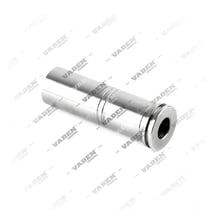
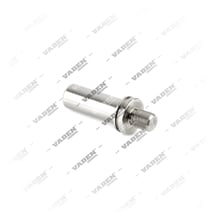
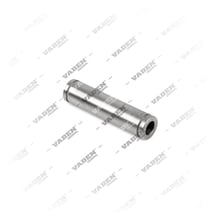
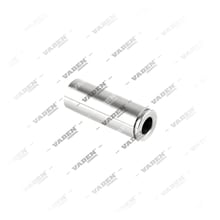
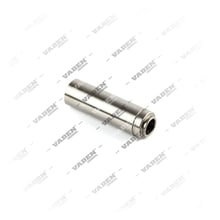
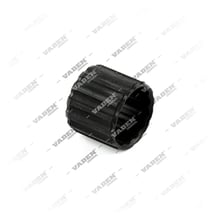
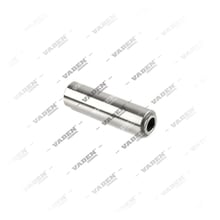
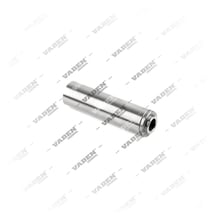
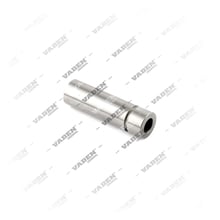
What Is a Caliper Guide Pin?
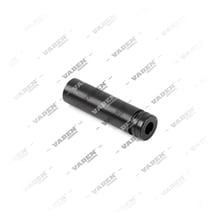
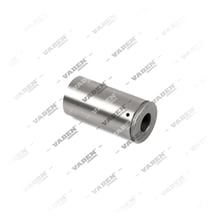
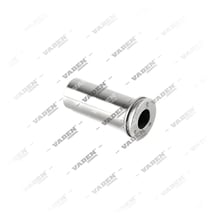
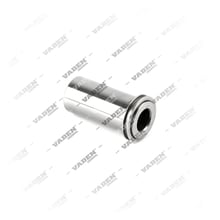
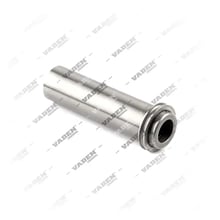
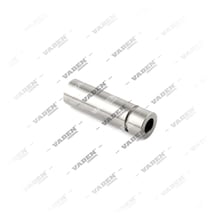
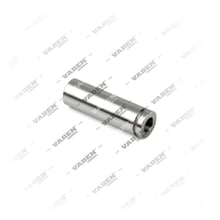
A caliper guide pin is the cylindrical guide shaft that lets a heavy commercial vehicle's disc brake caliper slide freely in the axial direction on the carrier bracket. In the field it is also known as the caliper slide pin, caliper pin, or simply the guide pin. In a floating caliper design, brake pressure comes from only one side, so the caliper body has to slide toward the disc to press the inner and outer pads evenly; the part that guides and centers this sliding motion is the caliper guide pin. Most pneumatic disc brake calipers on trucks, tractor units, buses, and trailers work on this principle, which is why the pin is not a simple fastener but a functional component that shapes braking geometry.
How Does a Caliper Guide Pin Work?
When the brake chamber pushes the adjuster mechanism inside the caliper, the inner pad contacts the disc. The reaction force slides the caliper body backward relative to the carrier bracket, and the outer pad then seats against the disc as well. The pin carries out this sliding motion with low friction and without angular deviation.
- Guidance: Keeps the caliper parallel to the disc so the pad surface presses evenly.
- Load carrying: Transfers part of the forces generated during braking to the carrier bracket.
- Free return: Lets the caliper re-center once the brake is released, so the pad does not drag on the disc.
- Sealing: Pin boots and caps keep out salt, mud, and water.
Caliper Guide Pin Technical Specifications
Caliper guide pins are generally machined from quenched-and-tempered steel, then surface-hardened and given a corrosion-resistant coating. Sliding-surface roughness and diameter tolerance are held tight. On heavy commercial vehicle calipers, pin diameters mostly fall in the 25-45 mm range, while length varies roughly between 80-200 mm depending on caliper type. These figures give a general idea; for exact dimensions, tightening torque, and grease type, the vehicle manufacturer's current service manual is authoritative.
- Material: High-strength quenched-and-tempered steel; surface-hardened or nitrided variants are common.
- Coating: Zinc-nickel, phosphate, or a dedicated corrosion barrier; this determines service life on salted roads.
- Compatibility criteria: Diameter, length, threaded-end size, head type, and boot channel must match the original part exactly.
- Kit contents: The long and short pin, bushings, boots, caps, and mounting bolts are supplied together in a single kit.
Caliper Guide Pin Types and Subgroups
A caliper usually contains two pins that perform different roles and cannot be swapped for one another. The pin set changes with caliper brand, disc diameter, and axle position. Choosing the correct subgroup is the first requirement for preserving the caliper's free sliding behavior.
- Long guide pin: The main load-bearing pin; it carries the caliper's weight and most of the sliding load.
- Short guide pin: The balancing pin; it keeps the caliper from rotating and allows for thermal expansion.
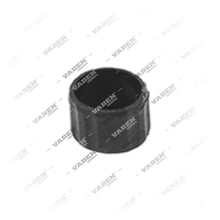
- Bushed pin sets: Supplied with a metal or composite bushing; bushing wear shows up before the pin itself wears.
- Boot and cap sets: Seal the pin bore off from the outside environment; a torn boot is the most common cause of pin damage.
- Pin repair kits: Complete service solutions that bring the pin, bushing, boot, clip, and bolts together.
How to Choose the Right Caliper Guide Pin
The most reliable way to select a pin is to work from the OE number stamped on the removed part. If the number can no longer be read, cross-matching is done using caliper type, axle position, and disc diameter. Because different caliper types can be fitted to the same vehicle model, brand-and-model information alone is not enough.
Caliper guide pin selection and compatibility criteria| Criterion | What to check | Why it matters |
|---|
| OE reference number | Original number on the pin or caliper | Shortest, most accurate matching path |
| Caliper type | Type label and manufacturer code on the body | Different variants can exist on the same vehicle |
| Pin position | Long (load-bearing) or short (balancing) | Wrong position binds the caliper |
| Diameter and length | Sliding-surface diameter and overall length | Deviation creates play or seizing |
| Axle position | Front or rear axle, disc diameter | Caliper size varies by axle |
| Kit contents | Bushing, boot, cap, and bolts | Sealing elements should be renewed together with the pin |
| Vehicle application | Mercedes-Benz, MAN, Scania, Volvo, DAF, Iveco, Renault Trucks, BMC, and trailer axles | Prevents installation errors |
Caliper Guide Pin Maintenance and Points to Watch
Pin maintenance should be carried out at the same service visit as pad replacement. With the pads removed, the caliper is moved back and forth by hand to check that it slides freely; if the movement feels stiff, the pin and bushings should be removed and inspected.
- Check the boots at every service: If a boot is torn or has come out of its seat, renew the kit.
- Use the correct grease: A rubber-compatible brake grease is essential; general-purpose grease swells the boot and locks the pin.
- Clean the bore: Old grease, rust, and dirt must be fully removed from the bore before installation.
- Follow the torque spec: Bolts must be tightened with a torque wrench; single-use bolts must not be reused.
- Replace as a set: Renew every pin, bushing, and boot belonging to the same caliper together.
Common Failures and Their Solutions
Caliper guide pin failures usually announce themselves first as uneven pad wear. If the symptom is caught early, the disc and caliper body can still be saved; if it is left too long, the repair bill grows.
- One-sided pad wear: The pin has seized or the boot has let in water; remove the pin and bushings and renew them as a set.
- Brake won't release, disc overheats: The pin is locked by corrosion; check sliding freedom and replace the kit.
- Clicking noise from the brake: Play caused by bushing wear; measure the pin-to-bushing clearance and replace the worn parts.
- Rust or scoring on the pin: A sign of moisture ingress through a torn boot or of excessive heat; renew the part along with the boots.
- Failure recurring within a short time: The wrong grease or an incomplete cleaning was used; repeat the job with the correct grease and a thorough clean.
Why VADEN ORIGINAL?
VADEN ORIGINAL caliper guide pin kits are manufactured to the original dimension and tolerance logic of heavy commercial vehicle brake calipers. The goal is to let the service renew the caliper economically instead of replacing it complete.
- OE-dimension manufacturing: Diameter, length, and surface quality are machined to the original part's tolerances.
- Broad OEM matching: Cross-referenced options are offered for widely used truck and trailer caliper types.
- Complete-kit approach: Pin, bushing, boot, and fasteners are supplied together, reducing the risk of an incomplete installation.
- Corrosion resistance: The coated surface lowers the risk of seizing in salted and humid road conditions.
- Exported to more than 100 countries: Developed using field feedback gathered across a wide range of climates and road conditions.
Conclusion
The caliper guide pin is the component that lets the disc brake caliper slide freely and linearly, and it directly determines braking balance. A seized or worn pin leads to one-sided pad wear, disc deformation, and longer stopping distances. For this reason, the pin, bushing, and boots should be checked together at every pad service and renewed as a set when needed. A correctly sized kit, installed with the proper grease, protects both braking safety and the vehicle's uptime.
Frequently Asked Questions (FAQ)
What does a caliper guide pin do?
A caliper guide pin is the guide shaft that lets the disc brake caliper slide axially on the carrier bracket. This sliding motion lets the inner and outer pads press evenly against the disc. If the pin seizes, the caliper can no longer center itself and braking becomes one-sided.
How can you tell a caliper guide pin has failed?
The clearest sign is that the two pads on the same caliper wear at different rates. Other symptoms include the brake failing to release, the disc overheating, a clicking noise from the brake, and a torn boot. If the caliper feels stiff when moved back and forth by hand, the pin and bushings should be removed and inspected.
Can the long and short caliper guide pins be used interchangeably?
No. The long pin carries the caliper's weight and most of the sliding load, while the short pin acts as the balancing pin and allows for thermal expansion. Swapping their positions makes the caliper bind and causes uneven pad wear.
What grease should be used on a caliper guide pin?
A dedicated brake grease that withstands high temperatures and is compatible with rubber boots should be used. General-purpose grease flows at high temperature, swells the boot, and can lock the pin. For grease type and quantity, the vehicle manufacturer's current service manual is authoritative.
Should the bushings and boots also be renewed when replacing the pin?
Yes, the recommended practice is to replace the pin, bushing, boot, and cap as a set. A worn boot quickly carries moisture and dirt into a new pin, and the failure recurs. That is why VADEN ORIGINAL pin kits are supplied together with the sealing elements.
Related technical guide: Caliper Guide Pin, Bushing & Bolt: Faults, Repair, Care