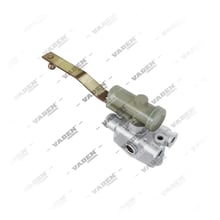
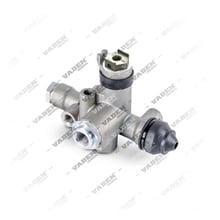
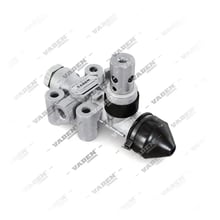
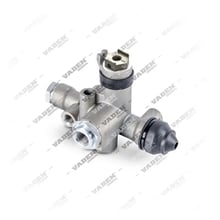
What Is a Level Valve?
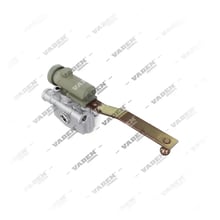
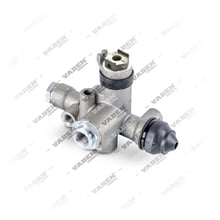
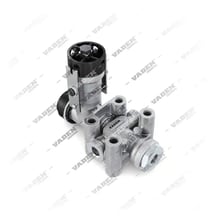
A level valve is the control component that measures the distance between chassis and axle on air-suspended heavy commercial vehicles and adjusts the air fed to the air springs accordingly. In the field it is also known as the height control valve or leveling valve. This category covers not individual repair parts but ready-to-fit complete level valve units; housing, shaft and internal valve assembly arrive as a single factory-set piece, used on truck, tractor, bus and trailer chassis.
How Does a Level Valve Work?
The valve body is fixed to the chassis, while the control arm is anchored to the axle housing via a connecting link. When the vehicle is loaded the chassis drops, the arm rotates and opens the supply port, filling the air spring; once design ride height is reached the valve returns to neutral and shuts off the flow. When the load is removed the arm rotates the opposite way and excess air is exhausted, letting the vehicle settle back to the same height, keeping ride height constant regardless of load and maintaining a balanced distribution of axle load.
- Height sensing: The arm and link transmit axle-to-chassis distance to the valve.
- Supply and exhaust: The air spring fills as the chassis drops and vents as it rises.
- Neutral zone: Prevents cycling on every small road vibration, cutting air consumption.
Level Valve Technical Specifications
Complete level valve units are manufactured with a machined aluminum or high-strength engineering polymer housing built for heavy-duty conditions. Internal sealing elements are elastomers resisting degradation across a wide temperature range in an oily-air environment. Exact thread size, arm length and neutral angle vary by model, so the vehicle manufacturer's current service manual is the governing reference.
- Housing: Corrosion-resistant aluminum alloy or reinforced engineering plastic.
- Ports: Supply, air spring and exhaust, in metric or pipe-thread options.
- Compatibility: OE number, port layout, arm rotation direction and neutral angle evaluated together.
Level Valve Types and Subgroups
This category includes complete units built on different operating logic. Selecting the correct type requires knowing how many air springs the axle uses, whether cab or chassis is controlled, and the response needed; the same vehicle may use different valves front/rear.
- Single-point control valve: One unit feeds both air springs on the axle; the most common configuration.
- Dual-point control valve: Separate valves for left and right; preferred on buses and lean-prone loads.
- Delayed (damped) type: Wide neutral zone; reduces air consumption in city driving and on rough roads.
- Fast-response type: Corrects ride height quickly during loading-dock and terminal work.
- Cab suspension valve: Compact-body types that maintain the height of an air-suspended cab.
How to Choose the Right Level Valve?
This is a category for buying a complete unit; selection relies less on matching a single part than matching the whole assembly. The most reliable method is reading the OE number stamped on the existing valve and matching it against the cross-reference list. If unreadable, measure port layout, arm rotation direction and mounting hole spacing instead. The choice between complete replacement and a repair kit depends on housing condition: a cracked housing, stripped thread seat, or increased shaft play calls for a complete unit.
Level valve selection and compatibility comparison| Selection criterion | How to determine it | Result of a wrong choice |
|---|
| OE number | Housing stamp matched against the cross-reference list | Different characteristics, incorrect ride height |
| Control type | Number of valves on the axle checked | Body lean, uneven air spring pressure |
| Arm rotation direction | Direction the link travels is determined | Reversed control, valve fails to hold level |
| Response character | Delayed or fast type, matched to the use case | Excess air consumption or slow leveling |
| Complete unit / repair kit | Housing and shaft play inspected | Repeat failure and a second labor job |
Level Valve Maintenance and Key Points
Before fitting a new unit, depressurize the air circuit and confirm the air dryer works properly. After installation, measure ride height unladen and fine-tune it via the connecting link length. Torques and target heights vary by model, so the manufacturer's current service manual should always be the reference.
- Don't overlook the connecting link: A worn joint or bent link throws off even a sound valve.
- Don't force the arm: Pushing it past its stop point permanently damages the internal mechanism.
- Keep the exhaust port clear: Mud, ice or a misrouted hose will stop leveling altogether.
- Run a leak test: After installation, check ports under pressure with a soap solution.
Common Level Valve Faults and Solutions
Level valve faults often reach the workshop disguised as a brake or tire complaint, since incorrect ride height shifts axle loading and brake force distribution. Reading the symptom correctly avoids unnecessary air spring and shock absorber swaps.
- Vehicle leans to one side: One-sided blockage or link misadjustment; measure arm position, replace if it does not correct.
- Suspension won't rise: Blocked supply line, frozen moisture or a stuck internal valve; check the line and the dryer.
- Continuously feeding air: Internal leakage at the exhaust port or a shifted neutral setting; renew the unit if adjustment won't hold.
- Chassis sags while parked: Hardened sealing elements or a cracked housing; a crack requires complete replacement.
- Compressor cycles too often: A micro-leak, or a fast-response type cycling constantly on rough roads; choose the right response character.
Why VADEN ORIGINAL?
As a manufacturer of pneumatic systems for heavy commercial vehicles, VADEN builds level valves to OE dimensions and mounting geometry. Port layout, arm rotation direction and neutral angle are set against the original unit, so no adapter or forced fit is needed. Thanks to an extensive OEM cross-reference list, the correct match for Wabco and Knorr-Bremse applications on Mercedes-Benz, MAN, Scania, Volvo, DAF, Iveco and Renault Trucks is found quickly.
- Built to OE dimensions: Housing, port and arm geometry machined against the original unit.
- Broad OEM matching: The cross-reference list brings brands and model periods into one catalog.
- Tested sealing: Units go through leak and function testing under pressure.
- Global supply: Exports to over 100 countries keep parts consistently available.
Conclusion
The level valve is a critical unit on air-suspended heavy commercial vehicles, determining ride height, axle load distribution and, indirectly, braking safety. The complete valves in this category deliver correct geometry and factory setting in a single step, without dealing with individual repair parts. Choosing the right product means weighing OE number, control type, arm rotation direction and port layout together; where housing or shaft wear is present, a complete replacement should be preferred.
Frequently Asked Questions (FAQ)
What does a level valve do?
A level valve measures the distance between the chassis and axle on an air-suspended vehicle and feeds or exhausts air to the air springs based on that measurement. This keeps the vehicle at the same ride height whether loaded or empty. A constant ride height means correct axle load distribution, even brake force, and balanced tire wear.
What are the symptoms of a faulty level valve?
The most common symptoms are the vehicle leaning to one side, the chassis sagging while parked, suspension failing to rise after loading, and continuous air venting. The compressor cycling more often than normal can also point to a valve-related leak. With these symptoms, check the control arm and connecting link first, then the valve itself.
Should I replace the level valve completely, or is a repair kit enough?
If the housing and shaft are sound and only sealing has been lost, a repair kit is an economical fix. But if the housing is cracked, the thread seat is stripped, or shaft play has increased, a repair kit will not give a lasting result. The complete units in this category arrive with factory-set geometry, making them the safer and faster solution in these cases.
How do I determine the correct level valve?
The most reliable method is to read the OE number on the vehicle's existing valve and match it against the cross-reference list. If the number cannot be read, proceed by measuring control type, arm rotation direction, port thread and mounting hole spacing. For mid-cycle differences within the same model, the chassis number and production year should also be checked.
Does the level valve need adjusting after replacement?
Yes, once the new unit is fitted, ride height should be measured with the vehicle unladen and fine-tuned via the connecting link length. Eyeballing the adjustment throws off axle load distribution. Because target height values and tightening torques vary by model, the vehicle manufacturer's current service manual should be the reference.
Related technical guide: Levelling Valve: Faults, Replacement & Maintenance Guide