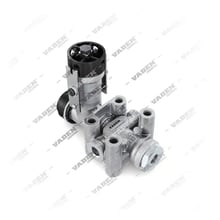
What Is a Lever Valve?
A lever valve (leveling valve) is a mechanical-pneumatic control component that automatically regulates chassis ride height and load balance on air-suspended heavy commercial vehicles. Fitted to trucks, tractor units, trailers and buses, it senses the distance between the axle and the chassis through a connecting lever and, in response, increases or bleeds off air pressure to the air bellows (air springs). This keeps the vehicle sitting at a consistent ride height whether it is empty or fully loaded. When a lever valve fails, problems such as suspension imbalance, chassis sag or excessive stiffness quickly follow, which is why it's considered one of the most safety-critical parts in an air suspension system.
What Does a Lever Valve Do?
- Ride-height sensing: Uses a connecting lever to track, in real time, any change in the distance between the chassis and the axle.
- Air pressure regulation: Feeds more compressed air into the air bags as load increases and vents excess air as load decreases.
- Consistent ride height: Holds the chassis at its designed reference height no matter how the vehicle is loaded.
- Load distribution balance: Balances air pressure across axles to help spread the load evenly.
- Braking and driving safety: A stable chassis height protects headlight alignment, brake balance and road-holding from being thrown off.
Lever Valve Technical Specifications
| Specification | Description |
|---|
| Part group | Suspension system / air bellows control component |
| Operating principle | Mechanical lever movement controlling pneumatic airflow |
| Application | Trucks, tractor units, trailers, buses (air-suspended chassis) |
| Connection type | Mounted between axle and chassis via connecting lever and ball joint |
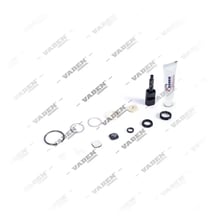
| Material | Durable housing material with gasket/seal kits |
| Manufacturing standard | OEM-equivalent, produced under VADEN ORIGINAL quality control |
Types of Lever Valves
- Mechanical leveling valve: Operates via a lever-and-ball-joint linkage; the standard type on conventional air suspension systems.
- Fast-acting (accelerator) leveling valve: Responds more quickly to sudden load changes, balancing the air bellows in less time.
- Single-axle and tandem-axle compatible valves: Produced in different mounting geometries to match the vehicle's axle count and chassis layout.
- Electronically supported valves: Used on modern vehicles that pair with the ECU to relay ride-height data electronically as well as mechanically.
Lever Valve Maintenance
- Check for air leaks: Inspect the valve housing and its connection points regularly for air leaks and seal integrity.
- Inspect lever and ball joint: Check periodically that the lever and ball-joint connection are neither loose nor worn.
- Functional test: Test that ride height is set correctly with the vehicle both loaded and unloaded.
- Fastener tightness: Check bolts and clamps periodically to make sure they haven't worked loose.
- Cleanliness: Keep air lines and the area around the valve free of dirt, dust and moisture.
Common Faults and Fixes
- Uneven ride height: If one side of the chassis sits lower or higher than the other, the valve or its connecting lever may be faulty; inspect and replace if needed.
- Air leak: A leak at the valve body or air line fittings causes pressure loss and reduced suspension performance.
- Excessive vibration and harshness: A valve that doesn't respond correctly lets more road shock through to the cab.
- Slow or delayed response: Wear or sticking in the lever mechanism causes a sluggish reaction to load changes.
- Dashboard warning light: On vehicles with electronic monitoring, the ECU can detect a valve fault and trigger a dashboard warning.
Why Choose VADEN ORIGINAL Lever Valves?
- OEM-standard manufacturing: Original-equipment quality production compatible with Mercedes-Benz, MAN, Scania, Volvo, DAF, Iveco, Renault, BMC and Ford heavy-duty vehicles.
- Broad vehicle coverage: Options in different connection types for trucks, tractor units, trailers and buses.
- Durable construction: Housing and seal materials built to withstand heavy-duty commercial use.
- Wabco and Knorr-Bremse equivalents: Reliable alternative parts compatible with the air suspension systems most widely used on the road.
- Technical support and warranty: Professional pre- and after-sales technical guidance backed by product warranty.
Frequently Asked Questions (FAQ)
What is a lever valve and what does it do?
A lever valve (leveling valve) is a spare part in a heavy-duty vehicle's air suspension system that automatically adjusts chassis ride height according to load by controlling air pressure to the air bags.
What are the symptoms of a failing lever valve?
Common symptoms include uneven ride height, air leaks, excessive vibration, slow suspension response, and on some vehicles a dashboard warning light.
Which vehicles use a lever valve?
Lever valves are used on air-suspended heavy commercial vehicles such as trucks, tractor units, trailers and buses.
How does a faulty lever valve affect vehicle safety?
Chassis imbalance can throw off braking performance, road-holding and load distribution, putting overall driving safety at risk.
How often should a lever valve be replaced?
There's no fixed mileage interval; it should be inspected and replaced as needed whenever air leaks, ride-height imbalance or other fault symptoms appear.
What sets VADEN ORIGINAL lever valves apart from other brands?
VADEN ORIGINAL lever valves are built to OEM standards, offer broad compatibility with Mercedes-Benz, MAN, Scania, Volvo, DAF, Iveco, Renault and BMC vehicles, and come with technical support and warranty coverage.
Conclusion
Lever valves are a vital spare part that keep a heavy-duty vehicle's air suspension system at the correct ride height and load balance, delivering comfort, safety and fuel efficiency. Choosing the right valve and keeping up with regular maintenance ensures the suspension system runs reliably for the long haul. VADEN ORIGINAL lever valves, built to OEM standards, give your heavy-duty fleet a dependable, long-lasting solution.