What is a Transmission Oil Cooler Repair Kit?
Because the cooler's connection points, which contact both the oil and coolant circuits, are continuously exposed to temperature differences and pressure, their gaskets and O-rings harden, crack, or leak over time. The repair kit supplies, in a single package, all the sealing elements needed when the cooler is removed and cleaned or replaced, preventing the reuse of old, fatigued gaskets. Since a long and trouble-free transmission life depends on keeping oil temperature under control, this repair kit is an important item in transmission maintenance and repair work despite its low stock level. In automatic and semi-automatic transmissions, oil temperature rising above a certain range shortens the chemical life of the oil and also causes premature wear of the clutch packs and valve body; for this reason, even the smallest leak in the cooler circuit can indirectly affect the overall life of the transmission.
What are the functions of a Transmission Oil Cooler Repair Kit?
- Sealing: Prevents oil and fluid leaks at the connection points between the cooler and the transmission housing/cooling circuit.
- Circuit separation: Prevents the oil circuit and coolant circuit from mixing with each other.
- Pressure resistance: Provides sealing elements resistant to the system's operating pressure.
- Thermal cycle compatibility: Maintains sealing by staying flexible under temperature fluctuations.
- Connection stability: Keeps the cooler in place despite vibration, using bolts and washers.
- Maintenance convenience: Supplies all consumables needed for cooler cleaning or replacement in a single package.
What are the symptoms of a failed Transmission Oil Cooler Repair Kit?
Symptoms indicating worn repair kit elements usually appear as leakage and oil/fluid mixing.
- Oil leakage: Visible transmission oil leak at the cooler connection points.
- Fluid level drop: Unexplained decrease in engine coolant level.
- Oil-fluid mixing: Traces of oil in the coolant (foaming, color change) or fluid mixed into the transmission oil.
- Transmission overheating: Abnormal rise in transmission oil temperature as cooling efficiency drops.
- Visible marks: Oil buildup, dried leak marks around the cooler.
How is a Transmission Oil Cooler Repair Kit checked?
Inspection is carried out through visual examination and periodic fluid level monitoring.
- Cooler connection points are inspected for leaks, wetness, or dried oil marks.
- Engine coolant color and consistency are checked for signs of oil mixing.
- A transmission oil sample is evaluated visually or with a lab test for water/fluid mixing.
- Connection bolts are checked with a torque wrench to identify any that are loose.
- The cooler is removed and its gaskets and O-rings are inspected for hardening, cracking, or crushing.
What should be considered when replacing it?
- All gaskets, O-rings, and bolts in the kit must exactly match the original dimensions and material.
- Contact surfaces must be cleaned before installation, with old gasket/sealant residue fully removed.
- Bolts must be tightened in a cross pattern, in stages, to the torque value stated in the vehicle's current service manual.
- If the oil and coolant circuits have mixed, both circuits must be fully drained and cleaned before installation.
- After installation, fill the system and run it to check for leaks and temperature.
How to choose a Transmission Oil Cooler Repair Kit?
Selection is determined by transmission model, cooler type (water-cooled/air-cooled), and connection pattern.
Transmission Oil Cooler Repair Kit selection criteria| Criterion | Description |
|---|
| Transmission model | The kit is specific to the transmission family and should be confirmed with the OE part number |
| Gasket material | Must be an elastomer or metal-composite gasket resistant to oil and coolant |
| O-ring size | Inner diameter, cross-section thickness, and material must exactly match the original |
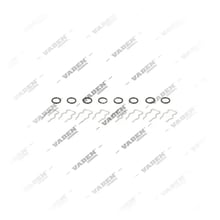
| Kit content | Gaskets, O-rings, bolts, and washers must be complete |
| Compatibility | Transmission/cooler fit must be confirmed via the OE cross-reference number |
Maintenance and lifespan
The transmission oil cooler repair kit is a consumable item; renewal is recommended every time the cooler is removed and reinstalled, or during periodic transmission maintenance. Gaskets/O-rings continuously exposed to thermal cycling and pressure lose their flexibility over time; early detection during periodic inspection protects both the transmission and the cooling system from potential damage.
VADEN Transmission Oil Cooler Repair Kit
VADEN offers the transmission oil cooler repair kit for heavy commercial vehicle transmissions with original dimensions and material specifications, manufactured to OE-referenced standards for correct sealing and long service life.
Frequently Asked Questions (FAQ)
When is a transmission oil cooler repair kit used
It is used when the cooler is removed and reinstalled, when a leak is detected, or when gaskets/O-rings need renewal during periodic transmission maintenance.
What should be done if oil and coolant mix
Both circuits must be fully drained and cleaned, sealing elements renewed, and the system refilled with the correct fluids.
Can old gaskets and O-rings be reused
Not recommended, sealing elements exposed to thermal cycling lose their flexibility over time and carry a leakage risk if reused.
How is a cooler leak noticed
Usually noticed through oil buildup at connection points, an unexplained drop in coolant level, or traces of oil in the fluid.
What should be considered when choosing a repair kit
Make sure the transmission model, cooler type, gasket material, and O-ring dimensions match the vehicle's original part.