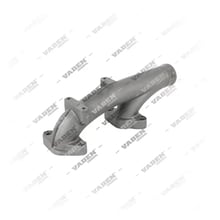
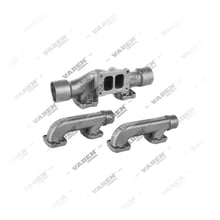
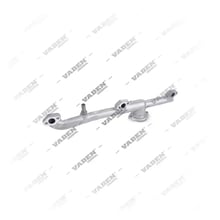
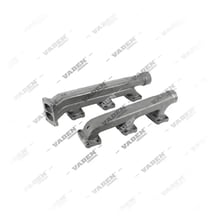
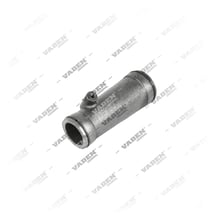
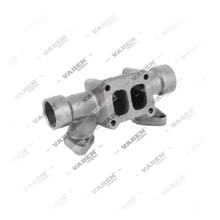
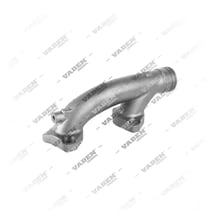
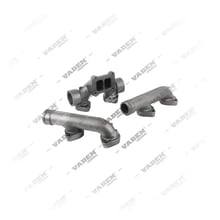
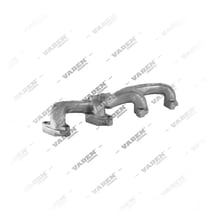
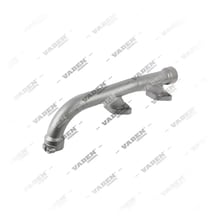
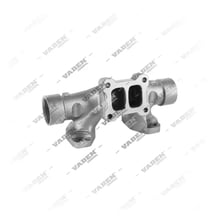
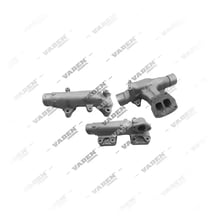
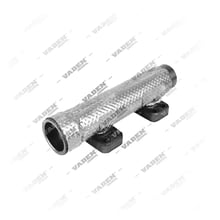
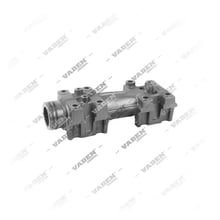
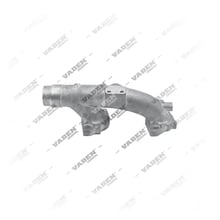
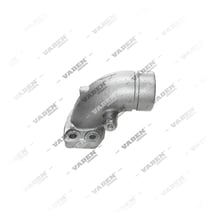
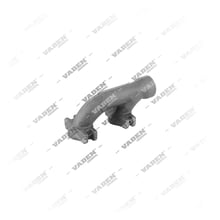
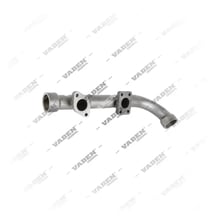
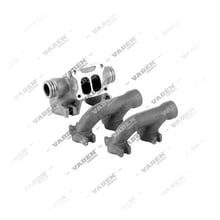
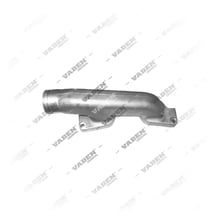
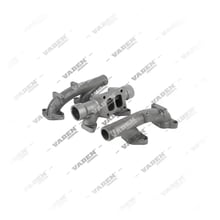
What Is an Exhaust Manifold?
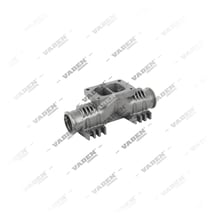
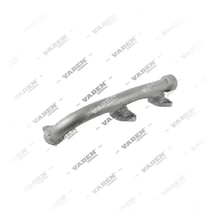
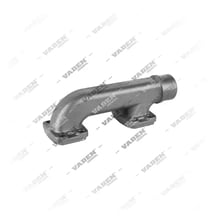
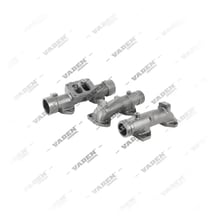
The Exhaust Manifold is a complete cast unit bolted to the cylinder head's exhaust ports on heavy-duty commercial vehicle diesel engines, collecting the burnt gases from each cylinder into a single outlet and directing them to the turbocharger inlet. This Engine subcategory holds ready-to-install complete products; it lists manifold housings and multi-segment sets, not individual sealing components. In the field it's also called the exhaust collector. On trucks, tractors, buses and heavy equipment it directly determines turbo feed.
What Does an Exhaust Manifold Do and How Does It Work?
The Exhaust Manifold takes the hot gas produced after combustion from the cylinder head and carries it to the turbo turbine inlet with the lowest possible pressure loss. The timing of pressure pulses affects turbo response and therefore low-rpm torque. Channel cross-sections are calculated in the OE design to match the engine's filling characteristics; a unit that looks similar outside but has different internal geometry creates turbo lag.
- Gas collection: Combines the gas from each cylinder's port into a common volume and directs it to the turbine.
- Turbo feed: Transfers the gas's pressure and kinetic energy to the turbine wheel, building boost.
- Heat management: Moves hot gas away from the block; wall thickness is chosen for thermal stress.
- Sealing: The machined flange face keeps gas from escaping into the engine bay; a leak costs power.
- EGR feed: On engines with exhaust gas recirculation, the gas routed to that circuit is drawn from the manifold port.
Exhaust Manifold Technical Specifications
Heavy-duty manifolds are mostly cast from silicon-molybdenum alloyed nodular (ductile) iron, which retains dimensional stability at high gas temperatures. Grey cast iron is cheaper but more prone to thermal fatigue. Since material grade affects cracking life, the housing should match the OE part's grade.
Sizing follows cylinder count and engine family. Six-cylinder engines usually split the manifold into two or three segments; sliding joints absorb heat-driven expansion and keep studs from snapping. Decisive fitment criteria: flange bolt pattern, port cross-section, turbo flange type, EGR port and segment count. Tightening torque varies by engine family; the vehicle manufacturer's current service manual is authoritative for exact values.
Exhaust Manifold Types and Subgroups
The complete units here are grouped by engine family and turbo architecture; identifying the right group is the first filter before matching an OE number.
- One-piece manifolds: Used on short-block designs; they carry the entire thermal expansion to the flange.
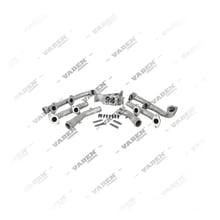
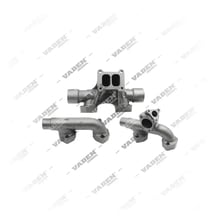
- Multi-segment manifolds: Standard on six-cylinder engines; the sliding-joint housing tolerates expansion.
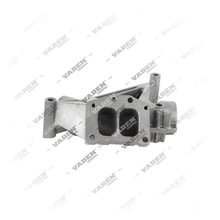
- Turbo-flanged manifolds: Have the outlet the turbine housing bolts to; bolt spacing matches the turbo model.
- EGR-ported manifolds: Carry a gas take-off port; a housing without it cannot be fitted to these engines.
- Gasket and stud kit packages: Include gaskets, studs and nuts alongside the housing.
How to Choose the Right Exhaust Manifold
The first step is reading the OE part number cast into the removed housing. Manifold design can change within the same engine family when the emission level or turbo model changes, so ordering on make and model alone is risky. If the number can't be read, check the engine type code, chassis number and turbo label together.
The second decision is between a complete unit and a repair kit: a gasket and stud kit is enough if the housing is sound and the problem is sealing, while a crack or flange distortion calls for complete replacement.
- Complete unit required: Progressive cracking, uncorrectable flange distortion, persistent segment leakage, a broken turbo flange.
- Repair kit sufficient: Gasket fatigue, loosened or stretched studs, a degraded sealing ring.
- Partial segment replacement: Only the damaged segment gets replaced; the others carry the same thermal age.
Exhaust Manifold Selection and Fitment Criteria| Criterion | How to verify |
|---|
| OE part number | Match against the casting number on the removed housing |
| Emission level | Port layout and EGR connection may vary by variant |
| Segment count | Single, two- or three-piece housing; must match the removed unit |
| Flange bolt pattern | Bolt count, diameter and spacing must align |
| Turbo flange type | Connection style and bolt spacing must match the turbocharger |
| Brand compatibility | Mercedes-Benz, MAN, Scania, Volvo, DAF, Iveco, Renault Trucks, BMC, Ford |
| Installation torque | Requires staged tightening; for exact values, the vehicle manufacturer's service manual is authoritative |
Exhaust Manifold Maintenance and Points to Watch
A manifold may look like a part that needs no maintenance, but installation quality determines its service life. An incorrect tightening sequence, fatigued studs or an uncleaned gasket surface can make even a brand-new unit leak within days.
- Clean the gasket surfaces: Remove old residue and carbon buildup, and check flange flatness.
- Renew the studs: Studs stretched by thermal cycling won't hold torque; renew the nuts too.
- Follow the tightening sequence: Tighten in stages from the center outward; jumping straight to final torque causes distortion.
- Don't force the sliding joints: On multi-segment housings, the joints are fitted to allow thermal expansion.
- Fit the heat shields: Missing insulation causes thermal damage to nearby hoses and wiring.
Common Faults and Fixes
- Hissing noise when cold: Caused by gasket fatigue or a loosened stud; inspect the flange, renew the gasket and stud.
- Soot marks in the engine bay: A sign of a persistent leak; a mark at the flange usually means a gasket set, on the housing a crack.
- Drop in turbo boost: A leak upstream of the turbine inlet lowers boost; check the housing and turbo flange.
- Visible crack: A crack starting between ports results from thermal fatigue; welded repair isn't lasting.
- Snapped stud: Caused by over-tightening and corrosion; a distorted flange means the manifold needs renewing.
Why VADEN ORIGINAL?
- Manufactured to OE dimensions: Flange bolt pattern, port cross-sections and turbo connection dimensions match the original.
- High-temperature resistance: Housings are cast in grades suited to heavy-duty operating temperatures.
- Extensive OEM cross-referencing: Broad coverage of major engine families helps you find the right part fast.
- Complete unit and kit options: Single housings, multi-segment sets and gasket-and-stud packages all sit in the same range.
- Exported to 100+ countries: Field feedback from different climates and road conditions feeds into the range.
Conclusion
The Exhaust Manifold carries the heaviest thermal load among components feeding the turbocharger in heavy-duty diesel engines. Unlike individual parts, this category covers ready-to-install complete housings and sets; the key decision is between complete replacement and a repair kit. A cracked housing or a persistent leak calls for a complete unit, chosen by comparing the OE part number, segment count and flange layout.
Frequently Asked Questions (FAQ)
Should the exhaust manifold be replaced completely, or is a repair kit enough?
If the problem is only gasket fatigue, a loosened stud or a degraded sealing ring, a repair kit is usually sufficient. If the housing has a progressing crack, flange distortion that can't be corrected, or a snapped stud thread, complete unit replacement is required. This category is built specifically for complete housing and set needs.
How do I match the correct exhaust manifold?
The most reliable method is matching the OE casting number on the removed housing. If the number can't be read, the engine type code, chassis number, segment count, flange bolt pattern and turbo flange type should all be checked together. Different manifolds may be used within the same model series depending on the emission variant.
Can an exhaust manifold crack be repaired by welding?
In heavy-duty applications, welded repair generally doesn't offer a lasting fix. Because the cast housing operates under continuous thermal cycling, the welded area can crack again in a short time. When a crack progressing between ports is detected, complete replacement is recommended.
Is it correct to replace just one segment on a multi-segment manifold?
It's technically possible and lowers the initial cost. However, since the other segments carry the same thermal age, they may show similar damage soon after. If the vehicle has high mileage, replacing the complete set is usually more economical overall.
I installed a new manifold but it's still leaking. What could be the cause?
The most common causes are an uncleaned gasket surface, reused fatigued studs and an incorrect tightening sequence. Check flange flatness, renew the studs and gasket, and tighten in stages from the center outward. For torque values, the vehicle manufacturer's current service manual is authoritative.
Related technical guide: Exhaust Manifold: Cracks, Leaks, Replacement & Torque Guide