What Is an EGR Throttle (Throttle Body)?
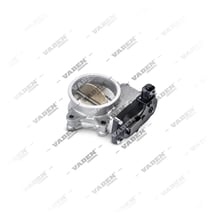
The EGR throttle is an electronically controlled throttle body that regulates the amount of exhaust gas routed back into the intake manifold within the exhaust gas recirculation (EGR) system. Its moving throttle plate opens and closes in response to signals from the engine control unit (ECU), setting the ratio between the fresh air and the recirculated exhaust gas entering the combustion chamber. In heavy-duty diesel engines, this control is one of the most important ways to lower combustion temperature and reduce NOx emissions.
What Does an EGR Throttle Do?
- Regulates exhaust gas flow: Precisely opens and closes the amount of exhaust gas returned to the intake manifold according to ECU commands.
- Reduces NOx emissions: Limits combustion temperature to curb nitrogen oxide (NOx) formation and supports compliance with emission standards (Euro 5/Euro 6).
- Optimizes combustion efficiency: Maintains the correct air-to-exhaust-gas ratio for clean combustion and steady engine operation.
- Supports idle and torque control: Balances flow through load and speed changes for a smooth, vibration-free idle and better driving comfort.
- Protects fuel economy: Correctly metered EGR flow prevents unnecessary fuel enrichment and supports economical running.
EGR Throttle Technical Summary Table
| Feature | Description |
|---|
| Material | Corrosion- and heat-resistant aluminum-alloy body with a heat-resistant plate and shaft |
| Vehicle type | Heavy-duty diesel engines in trucks, buses, tractor units and commercial vehicles |
| System | Exhaust gas recirculation (EGR) and emission control system |
| Compatibility | Types compatible with the EGR systems of brands such as Mercedes-Benz, MAN, Scania, Volvo, DAF, Iveco, Renault, BMC and Ford |
| OE-equivalent approach | Manufactured as an exact equivalent to the original equipment (OE) form, mounting and electronic interface |
| Installation | Bolt-on connection to the manifold/EGR cooler flange, integrated with the ECU via an electrical connector |
| Maintenance | Periodic soot/carbon inspection, connector and plate-movement checks; cleaning or replacement as needed |
What Are the Main Components of an EGR Throttle?
- Throttle body: The heat- and corrosion-resistant main metal housing that directs exhaust gas flow.
- Throttle plate (valve): The moving disc that opens and closes the flow area; sensitive to carbon build-up and sticking.
- Electric actuator / motor: The drive unit that converts the ECU signal into mechanical motion and positions the plate angle.
- Position sensor: The sensor that feeds the plate's actual position back to the ECU and enables closed-loop control.
- Seal and flange: The gasket and mating surface that prevent gas leakage at the manifold or EGR cooler connection.
What to Watch for When Maintaining an EGR Throttle
- Regular carbon checks: Diesel exhaust soot builds up on the plate and restricts its movement; inspect periodically and clean when required.
- Connector and wiring inspection: Check that the electrical connector is free of corrosion, intact and seated correctly.
- Quality fuel and oil: Low-quality fuel increases soot formation and causes the throttle to foul more quickly.
- Reading fault codes: When the check-engine light comes on, read any EGR-related fault codes with a diagnostic tool.
- Choosing OE-grade parts: For correct electronic compatibility, choose parts built to OE standards such as VADEN ORIGINAL.
- Professional installation: Fitting to the correct gasket, flange and torque values should be carried out by a specialist workshop.
Common EGR Throttle Problems and Their Solutions
- Check-engine light on: Usually caused by a faulty position sensor or actuator; read the fault code to identify the failed part and replace the throttle if needed.
- Sticking / seized plate: Excessive carbon build-up blocks the plate; light fouling can be cleaned, while advanced wear calls for full replacement.
- Rough idle and vibration: Incorrect EGR flow disrupts combustion; the throttle needs recalibration, cleaning or replacement with a new unit.
- Power loss and black smoke: A throttle stuck open lets too much exhaust gas in; check the actuator and plate movement and renew the faulty unit.
- Failing the emission test: Faulty EGR control raises NOx/smoke values; repair the system and throttle with an OE-compatible part.
- Corroded connector / poor contact: Moisture and vibration cause electrical faults; clean the connector and repair the wiring/socket if damaged.
Why Choose a VADEN ORIGINAL EGR Throttle?
- OE-standard compliance: Manufactured to the original equipment dimensions, flange and electronic interface for an exact fit.
- Durable materials: Built with heat- and corrosion-resistant components for a long service life.
- Precise electronic control: A quality actuator and position sensor deliver stable, accurate flow control.
- Wide vehicle coverage: Suitable equivalents are available for a range of heavy-duty makes and models.
- Technical support: Professional support for correct part selection and installation.
Frequently Asked Questions (FAQ)
What does an EGR throttle do?
The EGR throttle regulates the amount of exhaust gas returned to the engine under ECU control. This lowers combustion temperature, reducing NOx emissions and helping the engine meet emission standards.
What are the symptoms of a faulty EGR throttle?
The most common signs are a check-engine light, rough idle, power loss, black smoke, increased fuel consumption and failing the emission test.
Can an EGR throttle be cleaned, or does it need replacing?
With light carbon build-up, the throttle can be cleaned to restore its operation. However, if the plate is seized or the actuator or position sensor is faulty, full replacement is required.
Why does an EGR throttle get clogged with carbon?
Soot and carbon in diesel exhaust gas gradually build up on the plate and body. Low-quality fuel, short-distance driving and frequent idling accelerate this build-up.
Which heavy-duty vehicles use an EGR throttle?
It is used together with the EGR system in Euro 5/Euro 6 diesel trucks, buses and tractor units from brands such as Mercedes-Benz, MAN, Scania, Volvo, DAF, Iveco, Renault, BMC and Ford.
Is it harmful to drive with a faulty EGR throttle?
Yes. A faulty throttle increases emissions, reduces engine performance and can damage other emission components over time. Have it checked and replaced as soon as possible.
Conclusion
The EGR throttle is an indispensable component for emission control, fuel efficiency and stable operation in heavy-duty engines. With regular maintenance and the right part, you both stay compliant with environmental standards and protect your engine's service life. For reliable emission performance, choose VADEN ORIGINAL EGR throttles.
Related technical guide: EGR Valve & EGR Flap: Faults, Replacement and Maintenance