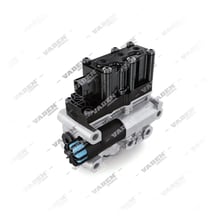
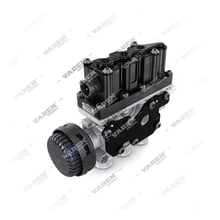
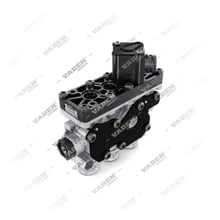
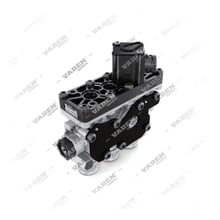
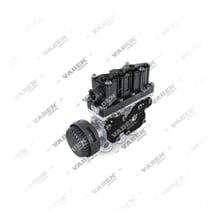
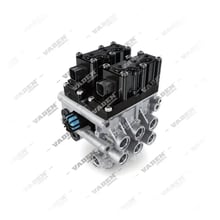
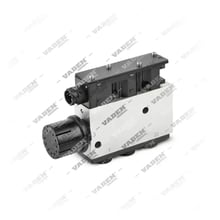
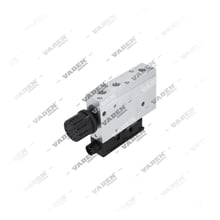
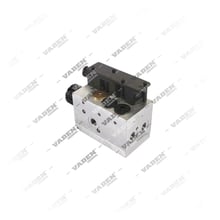
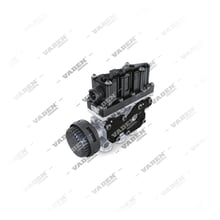
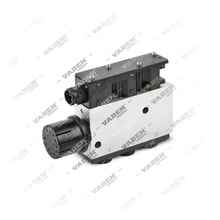
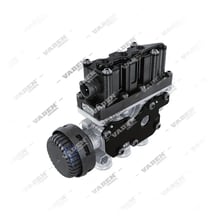
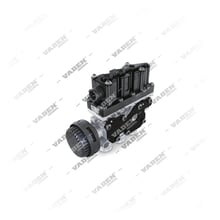
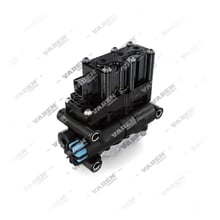
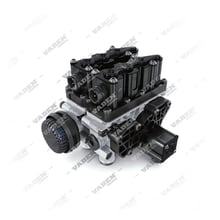
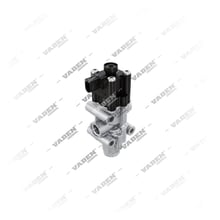
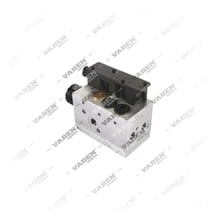
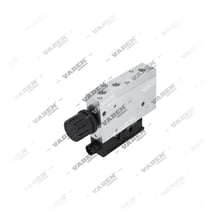
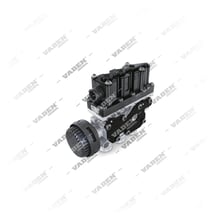
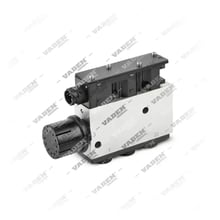
What Is an ECAS Solenoid Valve?
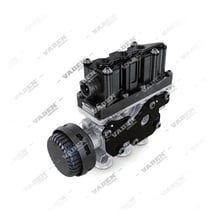
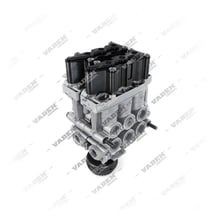
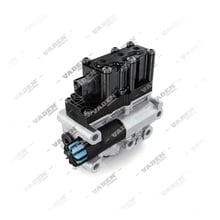
The ECAS solenoid valve is the electro-pneumatic valve unit that opens and closes the fill and exhaust passages to the air springs in an electronically controlled air suspension system, switching them on electronic command. This category, under the Suspension group, is the complete-unit bin for the ECAS solenoid valve family: it lists full valve blocks shipped as a single assembly, with housing, solenoid coils, internal valve group and connector all together. In the field the same product is also called an ECAS valve block or electronic level control valve. It is found on tractor units, trucks, buses and air-suspended trailer axles, in Mercedes-Benz, MAN, Scania, Volvo, DAF and Iveco applications.
How Does an ECAS Solenoid Valve Work?
Height sensors measure the distance between axle and chassis and pass the data to the control unit. When it detects a deviation from the target ride height it energizes the relevant coil; the valve pin shifts, air from the supply port is routed to the spring port, and the chassis rises. On a lowering request the exhaust solenoid is actuated and air in the spring is released through the silencer. Once demand is satisfied the coils de-energize and the valve returns to neutral, locking the spring under pressure. Since the right, left and auxiliary-axle circuits are driven independently within the same block, lift-axle control and leveling are both managed from one unit.
ECAS Solenoid Valve Types and Subgroups
Complete ECAS solenoid valves differ by the number of circuits they control and the vehicle type they fit. Two blocks that look alike from the outside are not interchangeable if their internal channel layout and coil count differ. So the suspension architecture should be identified first, then the port and connector layout on the block.
- Single-circuit valves: a simple block type that controls one spring group or lift axle; used for auxiliary functions and simple trailer layouts.
- Multi-circuit valve blocks: combine right, left and rear-axle circuits in a single housing; feed several springs independently from one supply line.
- Tractor and truck-type valves: handle ride height, roll compensation and lift-axle control together; mounted under the chassis close to the air tank.
- Trailer-type valves: carry extra ports for trailer leveling and remote control box connection; built with a housing protected against dirt and impact.
- Bus applications: sized for high switching frequency to support the kneeling function that lowers the door side, plus frequent level correction.
How to Choose the Right ECAS Solenoid Valve
The most reliable way to select the complete unit is to use the OE number stamped on the removed valve's housing and confirm it against the vehicle make and chassis record. If the number is unreadable, matching is done by circuit count, port threads, connector type and coil voltage. The table below summarizes the points to check; the information is directional — for binding values the vehicle manufacturer's current service manual is authoritative.
ECAS solenoid valve complete-unit selection and compatibility criteria| Criterion | Point to check | Note |
|---|
| OE reference | Number on the valve housing and chassis record | An exact match is required |
| Circuit count | Number of independently controlled springs or axles | From single-circuit to multi-circuit blocks |
| Supply voltage | Coil label and vehicle electrical system | Usually 24 V in heavy-duty vehicles |
| Connector type | Pin count and wiring harness end | Do not force an adapter connection |
| Port dimensions | Supply, spring and exhaust thread sizes | Must match the original fittings |
| Calibration | Height relearn after replacement | Requires a diagnostic tool |
Complete Unit Replacement or Repair Kit?
Because this category covers complete units, the decision is clear: is the fault inside the valve's internal structure, or in a component that can be renewed from outside? For issues traced to a seal, silencer or a single coil, a repair kit is the economical choice. For a cracked housing, worn internal channels, or leaks affecting more than one circuit, a complete replacement is both faster and safer.
- Calls for complete replacement: a cracked housing, internal channel corrosion, winding failure on more than one coil, a pin seized in its bore, and an unstable level that cannot be calibrated.
- Repair kit is sufficient: external leakage around a port, a clogged silencer, a single coil failure, and moisture ingress through the connector seal.
- Fleet and mileage view: on vehicles with high operating hours and mileage, renewing only one component tends to invite a second failure soon after; a complete unit lowers total cost.
Installation, Maintenance and Points to Watch
- Release system pressure: before removing the valve, safely bleed the air suspension circuit and support the vehicle on suitable stands.
- Label the lines: mark the spring, supply and exhaust lines; a misconnected line makes the level commands act in reverse.
- Tighten fittings to spec: pneumatic fittings are sensitive to over-tightening; if the torque value is unknown, the vehicle manufacturer's current service manual is authoritative.
- Check air quality: if the dryer is not doing its job, moisture and oil get carried into the valve; check the cartridge and tank drain regularly.
- Do not skip calibration: relearn the normal ride height and verify the lift-axle and kneeling function before the test drive.
Common Faults and Their Solutions
- One side sags while parked: the sealing element inside the valve has become permeable; if there is no leak at the spring or lines, a complete unit replacement is needed.
- Chassis does not reach the target height: supply pressure is low, a port is blocked, or the coil is not pulling in; check tank pressure, coil resistance and the supply line.
- Continuous air-release sound: the exhaust solenoid is not closing or the silencer is clogged; renew the silencer, and if the problem persists replace the valve block.
- Level keeps self-correcting: the height sensor signal may be unstable; check the sensor and its linkage, and if the signal is correct evaluate the valve for an internal leak.
- Lift axle will not go down or up: the coil or control line of the relevant circuit is faulty; measure the connector supply and verify the circuit output pneumatically.
Why VADEN ORIGINAL?
- Manufactured to OE dimensions: housing, port threads, connector layout and mounting holes are machined to original-unit dimensions, requiring no bracket or line modification.
- Broad OEM matching: products are cross-matched with OE reference numbers, offering wide coverage across truck, tractor, bus and trailer applications.
- Heavy-duty sealing: since this is a component exposed to temperature swings, moisture and road salt, sealing elements are selected accordingly.
- Exported to over a hundred countries: VADEN ORIGINAL products are used in more than 100 countries, with continuous spare parts supply and technical support.
Conclusion
The ECAS solenoid valve is a control component that directly determines a vehicle's road holding, loading height and axle load distribution on air suspension. The complete units in this category offer the fastest, safest solution for valves with internal damage. Choosing the right product means weighing the OE number, circuit count, connector type and port dimensions together, and calibration must always follow replacement.
Frequently Asked Questions (FAQ)
What does an ECAS solenoid valve do?
The ECAS solenoid valve opens and closes the fill and exhaust passages to the air springs in an electronically controlled air suspension system on the control unit's command. This lets chassis height be adjusted to load and road conditions, and manages the lift-axle and leveling functions.
What are the symptoms of a faulty ECAS solenoid valve?
The most common symptoms are the vehicle sagging on one side while parked, the chassis failing to reach the target height, a continuous air-release sound, and the level constantly self-correcting. A valve-circuit fault logged by the control unit also points directly to the valve.
Should I replace the complete valve or is a repair kit enough?
If the problem is limited to a seal, silencer or a single coil, a repair kit is an economical solution. If there is a cracked housing, worn internal channels, a seized valve pin, or an internal leak affecting more than one circuit, a complete unit replacement is safer and more lasting.
How do I match the correct ECAS solenoid valve?
The most reliable method is to confirm the OE number on the removed valve's housing together with the vehicle make and chassis information. If the number cannot be read, compare circuit count, coil voltage, connector pin layout, port thread sizes and mounting hole spacing.
Is calibration required after replacing the valve?
Yes. After the new valve is fitted, the normal ride height must be relearned by the control unit using a diagnostic tool. Without calibration the vehicle will run at the wrong level; the lift-axle and kneeling functions should also be verified before the test drive.
Related technical guide: ECAS Solenoid Valve: Faults, Replacement & Maintenance Guide